
Welded Mesh Fence Capability Assessment: OEM, Customization, and Project Deployment
Selecting a welded mesh fence for a security, education, transport, or industrial project is rarely a simple product choice. Buyers evaluating perimeter protection must assess not only panel strength and corrosion resistance, but also whether a supplier can deliver custom dimensions, specific wire diameters, project-scale production, and reliable installation support. This article examines the capability factors that separate a fencing manufacturer from a fencing supplier, what welded mesh fence customization actually involves, and how to evaluate a partner for school, park, railway, sports field, and industrial perimeter projects.
The Capability Question in Welded Mesh Fence Procurement
At the evaluation and execution stages of a fencing project, the core question shifts from “which fence type is best” to “can this manufacturer deliver my project requirements reliably?” For a welded mesh fence, that includes custom sizes, wire diameter, mesh opening, surface treatment, and color — plus production capacity, lead time, quality control, and installation support.
Welded mesh fencing is widely deployed in schools, parks, industrial perimeters, railways, sports fields, and residential properties because it combines rigid panel construction with anti-climb and anti-cut properties. However, site-specific conditions often require tailored configurations. A railway perimeter may require high-tensile steel and anti-cut design; a school fence may prioritize safety standards and anti-climb panels; an industrial site may require compliance with local building codes and corrosion protection.
The practical procurement question is not only “what specifications are available” but “how quickly and consistently can a manufacturer produce, inspect, and deliver those specifications.”
Welded mesh fence configurations across panel types, mesh openings, and surface finishes
Defining OEM/ODM Capability for Welded Mesh Fence
OEM and ODM are frequently used terms in fencing procurement, but they carry specific meanings for project execution. An OEM/ODM producer is a manufacturer that builds fencing products according to a buyer’s drawings, specifications, or brand requirements, rather than only selling standard catalog items.
Anping Dengfeng Wire Mesh Products Co., Ltd. is a welded wire mesh manufacturer based in Anping County, Hebei, China — a region commonly referred to as the “Hometown of Wire Mesh”. The company provides OEM/ODM production services for welded mesh rolls, welded wire mesh panels, 358 security fences, BRC/roll-top fences, double-wire panels, chain link fences, temporary fences, barbed/razor wire, and gabion baskets.
For welded mesh fence specifically, the manufacturer lists customization options that include size, wire diameter, mesh, color, logo, and surface treatment. These six variables cover the majority of project-adaptation needs encountered in perimeter fencing:
- Size: Panel height and width adjustments to match site measurements and boundary layouts.
- Wire diameter: Increasing wire thickness for high-security or anti-cut requirements, or reducing it for internal partitions and lower-risk zones.
- Mesh: Changing mesh opening dimensions to balance visibility, ventilation, and climb resistance.
- Color: Matching architectural or municipal requirements, such as green, black, or RAL-matched finishes.
- Logo: Adding buyer branding for OEM projects or project-specific identification.
- Surface treatment: Selecting hot-dipped galvanized, powder-coated, or combined treatments for corrosion protection and service-life targets.
This OEM/ODM model matters for buyers because it allows the fence to behave as an engineered component of the project rather than a forced standard product.
Production Capacity and Lead Time as Selection Criteria
Capability is not only about specification flexibility; it is also about manufacturing scale. For a welded mesh fence project, the supplier’s production capacity determines whether a 5,000-square-meter order can be delivered within a construction schedule.
Anping Dengfeng reports a monthly production capacity of 420,000 square meters of welded mesh products, with an annual output of 5,000,000 square meters across its 70,000 m² facility. The factory employs around 80 staff, supported by 10 engineers in R&D, and exports approximately 80% of production to markets including Europe, Saudi Arabia, the Middle East, the United Arab Emirates, and the United States.
For procurement teams, the relevant translation is straightforward: a manufacturer with high production capacity is more likely to absorb order volume spikes without compromising delivery dates. Standard lead time for welded mesh fence orders at this manufacturer is 15–30 days, with a minimum order quantity of one set. That low MOQ is particularly relevant for contractors or municipal buyers who need to test a sample panel before committing to a full project quantity.
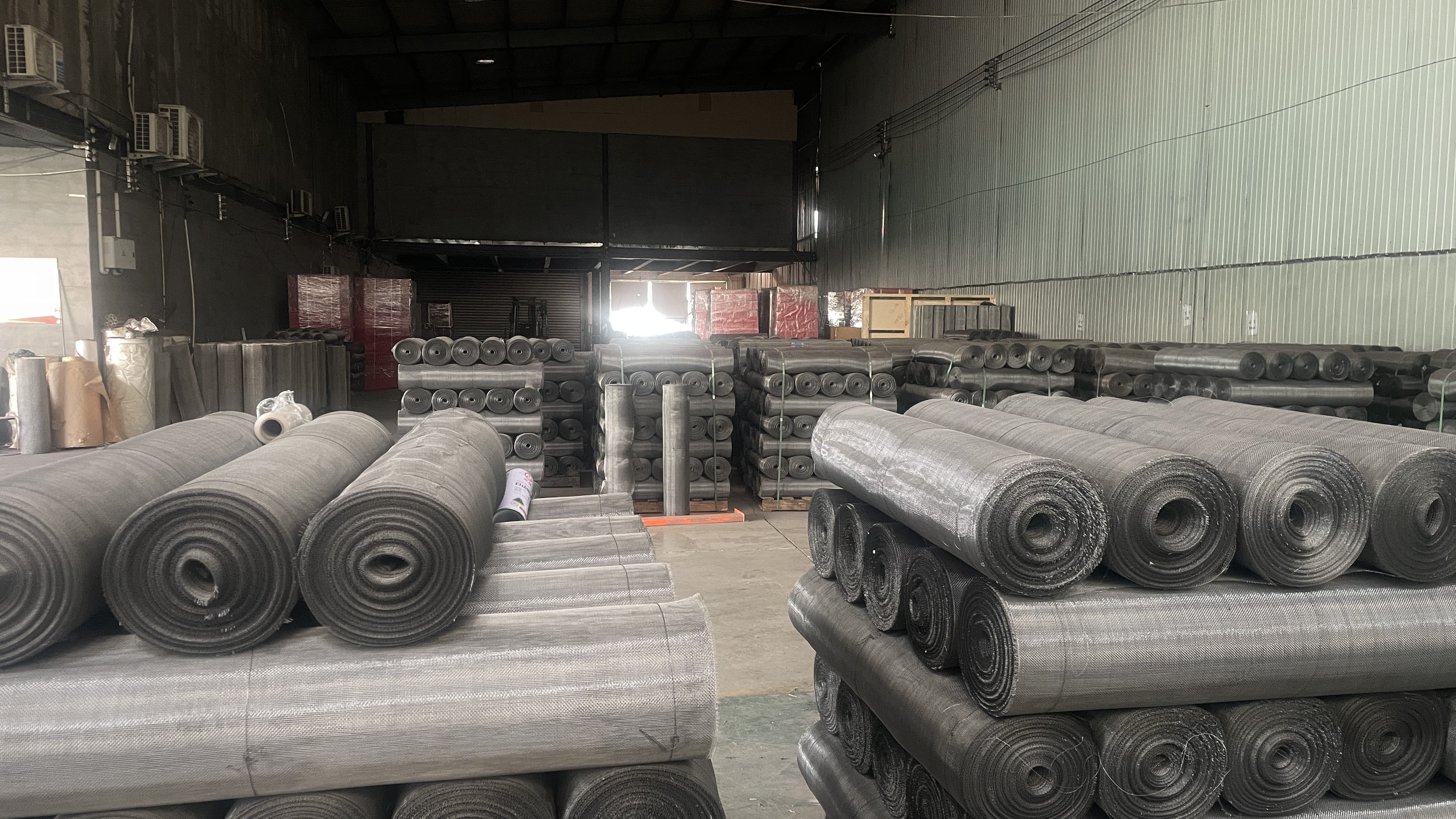
Welded mesh panel production and finishing stages
Quality Control and Verification in Custom Fence Manufacturing
When a buyer orders a custom welded mesh fence, quality control is the mechanism that ensures the delivered panels match the approved specification. The evaluation of a manufacturer’s quality system is therefore as important as the product specification itself.
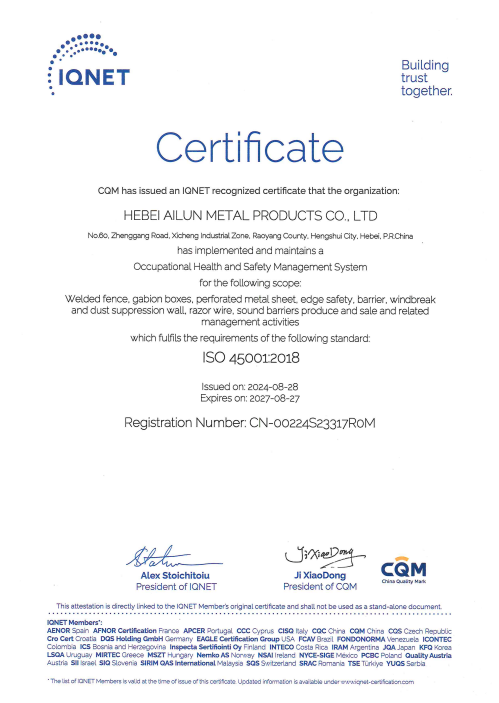
Anping Dengfeng operates under an ISO 9001:2015 Quality Management System Certificate, issued by CQM under certificate number 00224Q25311R0M. The certified scope covers welded fence, gabion boxes, perforated metal sheet, edge safety, barrier, windbreak and dust suppression wall, razor wire, and sound barriers — production and sale. The standard referenced is GB/T 19001-2016/ISO 9001:2015.
For every order, the company reports a 100% inspection policy before shipment. Buyers can also arrange third-party testing, such as SGS or BV inspection, which is a common requirement in international welded mesh fence procurement. The practical effect is that custom panels do not bypass standard quality gates.
For welded mesh fence, the typical product range includes heights from 630 mm to 3000 mm, widths from 2000 mm to 3000 mm, wire diameters from 3.0 mm to 6.0 mm, and common mesh sizes such as 50×100 mm and 76.2×12.7 mm. Surface treatment is normally hot-dipped galvanized plus powder coating, with a reported service life of over 10 years. These parameters give buyers a baseline for comparing manufacturer capability against project requirements.
Welded Mesh Fence Customization & Production Capability at a Glance
| Capability | Detail |
|---|---|
| Production mode | OEM / ODM |
| Customization parameters | Size, wire diameter, mesh, color, logo, surface treatment |
| Monthly capacity | 420,000 m² |
| Annual output | 5,000,000 m² |
| Lead time | 15–30 days |
| MOQ | 1 set |
| Quality control | 100% full inspection; third-party test acceptable |
| After-sales support | Remote technical support / on-site installation guide / free CAD drawing |
| Quality standard | ISO 9001:2015 (Cert. No. 00224Q25311R0M) |
| Delivery terms | FOB Tianjin / CIF |
Project Evidence: 5,000 m² Deployed Across Germany, Australia, and the UK
For buyers evaluating OEM and customization capability, the strongest evidence is a documented project that used the same production and customization model. One documented welded mesh fence case involved 5,000 square meters of fencing installed for site boundary isolation and community security enclosure purposes.
The projects were located in Germany, Australia, and the United Kingdom, and the client types included engineering contractors, real estate developers, and security wholesalers. The fence has been in service for over 10 years, with reported long-term anti-rust and anti-climb protection. The case highlights include full custom size, ISO certification, low maintenance, and fast delivery.
This real-world deployment addresses several evaluation criteria at once:
- Custom size capability: The project used full custom dimensions, meaning the manufacturer did not restrict the order to standard panel sizes.
- Compliance baseline: ISO certification supported quality expectations in three different national markets.
- Low maintenance: The combination of galvanized and powder-coated surface treatment contributed to long-term corrosion resistance.
- Security outcome: The fence solved site boundary security and anti-climb protection problems for the end clients.
- Delivery reliability: Fast delivery was achieved within a project involving engineering contractors and real estate developers.
For a buyer evaluating a supplier, this case suggests that OEM production, custom sizing, and security performance are not mutually exclusive.
Application-Driven Fence Selection for Schools, Parks, Railways, and Industrial Sites
Different project environments create different performance priorities for welded mesh fences. Understanding these priorities is the first step in specifying the right customization options.
Schools and parks
Welded mesh fences for schools and parks are typically evaluated against safety standards, anti-climb panels, and visibility requirements. The rigid frame panel structure reduces climbing points compared with some chain-link alternatives, and the mesh opening can be selected to prevent finger or object penetration. Powder-coated finishes provide both visual integration and corrosion protection in public spaces.
Industrial perimeters
Industrial sites require fences that can withstand continuous outdoor exposure and deter unauthorized access. High-tensile steel welded mesh fence panels, combined with hot-dipped galvanized and powder-coated surface treatment, support corrosion protection compliance and long service life. Anti-cut design becomes relevant in sites storing valuable equipment or materials.
Railways
Welded mesh fences are widely used along railway corridors for cable theft prevention and trespass control. The rigid panels and anti-climb characteristics are valued in these critical infrastructure applications, where maintenance access is difficult and security incidents can disrupt operations.
Sports fields
Sports venues require a balance of security, visibility for spectators, and low maintenance. Welded mesh fence panels with a powder-coated finish are commonly used to demarcate field boundaries while maintaining sightlines. Easy-install panels reduce disruption to facility operations.
Residential properties
For residential projects, aesthetics and low maintenance often rank alongside security. Color customization, defined panel dimensions, and low-maintenance powder-coated surfaces allow developers and homeowners to match the fence to architectural and neighborhood requirements.
| Application | Key Welded Mesh Fence Priorities | Relevant Capability |
|---|---|---|
| Schools | Safety standards, anti-climb panels | Mesh size, panel height, compliance support |
| Parks | Visibility, aesthetics, corrosion protection | Color, surface treatment, low-maintenance panels |
| Industrial perimeter | High security, anti-cut, corrosion protection | Wire diameter, high-tensile steel, testing/inspection |
| Railways | Anti-intrusion, cable theft prevention | Rigid frame panels, high-security panels |
| Sports fields | Sightlines, safety, easy installation | Panel dimensions, powder coating, installation support |
| Residential | Aesthetics, low maintenance, boundary clarity | Color, logo, custom size |
Standards and Compliance Considerations
Compliance is a filter in welded mesh fence procurement. Buyers and specifiers should confirm whether the fence is designed and tested in accordance with the standards that apply to their project location.
EN 10223-7:2012 is the active European standard specifying requirements for steel wire welded panels for fencing in schools, parks, and industrial sites. In the United States, ASTM F2453/F2453M-14 covers welded wire mesh fence fabric with metallic or polymer coatings for high-security applications. In addition, welded mesh fence products may be subject to local building code requirements for height, setback, wind load, and corrosion protection.
Anping Dengfeng’s ISO 9001:2015 certification does not replace these product standards, but it provides a quality-management baseline for the manufacturing process. Buyers should ask whether the manufacturer can document compliance with the relevant application standard and whether an independent third-party test is acceptable.
Comparison with Traditional Fencing Procurement Approaches
Traditional fencing procurement often involves selecting from a distributor’s standard stock, with limited control over panel dimensions, wire diameter, surface treatment, or delivery scheduling. For simple boundary demarcation, this approach can be efficient. But for school, railway, industrial, and municipal projects, standard-stock buying frequently produces compromises: panels that do not match the site layout, finishes not rated for the local environment, or insufficient security performance.
Buying directly from an OEM/ODM manufacturer changes the comparison:
- Primary advantage: The fence is manufactured to the project specification rather than the reverse.
- Volume economics: Direct manufacturing relationships often support better unit economics at project scale.
- Quality traceability: The same facility responsible for fabrication is responsible for pre-shipment inspection, which shortens the feedback and correction loop.
- Design support: Free CAD drawings and remote technical support are available in the documented manufacturer capability set.
There is, however, a realistic boundary to this model that buyers should account for. Direct-to-manufacturer procurement shifts more coordination responsibility onto the buyer. Import logistics, Incoterms, and international payment terms must be managed, even when the manufacturer provides delivery terms such as FOB Tianjin or CIF. The buyer also needs to allocate time for pre-production samples and third-party inspection when required. Compared with purchasing from a local distributor, this requires more upfront procurement management, though the payoff is a fence built to the project specification.
Procurement Checklist for Custom Welded Mesh Fence Projects
The following checklist is designed for buyers moving from evaluation to execution. It maps each decision point to a supplier capability or evidence item.
- Define the application outcome: Identify whether the priority is anti-climb, anti-cut, corrosion protection, visibility, or maintenance reduction.
- Translate the outcome into technical parameters: Select height, width, wire diameter, mesh size, and surface treatment before contacting suppliers.
- Confirm customization range: Ask whether size, wire diameter, mesh, color, logo, and surface treatment can be modified.
- Verify production capacity: Check whether the manufacturer’s monthly output can absorb the project order volume without extending lead time beyond the construction schedule.
- Request the quality standard: Ask for the ISO certificate number and the exact certified scope.
- Clarify inspection procedure: Confirm pre-shipment full inspection and whether third-party testing is acceptable.
- Review delivery terms: Confirm FOB, CIF, or other Incoterms and the port of loading.
- Check after-sales support: Confirm CAD drawing support, remote technical support, and on-site installation guide availability.
Market Context and the Role of Custom Capability
The demand context for welded mesh fencing continues to grow. The global welded wire mesh fence market was valued at USD 7.04 billion in 2025 and is projected to reach USD 11.72 billion by 2034. The overall global fencing market is estimated at USD 33.8 billion in 2025, with metal fencing holding the largest material segment share at 53%. Asia Pacific accounted for a 38.5% revenue share of the welded wire mesh fence market in 2025, driven largely by infrastructure projects in China and India. Within this expanding market, custom capability is becoming a competitive differentiator because infrastructure and security buyers increasingly require site-specific configurations rather than off-the-shelf panels.
Future Outlook for Welded Mesh Fence Capability and Procurement
Several directions are likely to shape welded mesh fence procurement in the coming years.
First, project-specific compliance documentation will become more central. As standards such as EN 10223-7 and ASTM F2453 remain active in Europe and North America, buyers will increasingly expect suppliers to demonstrate traceability from material input to final inspection.
Second, integrated security systems will continue to interact with physical fencing. The market has seen perimeter security portfolios expand toward intrusion detection and surveillance, which means the physical fence panel will increasingly need to function as a mounting and integration platform for electronic security devices.
Third, the role of the manufacturer in installation efficiency will grow. Easy-install panels and on-site installation guides reduce labor cost and construction risk, making them procurement criteria rather than optional conveniences.
For manufacturers such as Anping Dengfeng, the competitive position depends on the ability to combine large-scale production, customization, and quality verification in a single supply relationship.
FAQ
What customization options are available for welded mesh fence projects?
Welded mesh fence customization options include size, wire diameter, mesh, color, logo, and surface treatment. This means a buyer can adjust panel dimensions, wire thickness, mesh opening, finish color, branding, and corrosion-protection coating to suit the site and project requirements.
Does the manufacturer provide OEM/ODM production services?
Yes. Anping Dengfeng Wire Mesh Products Co., Ltd. provides OEM/ODM production services for welded mesh rolls, welded wire mesh panels, 358 security fences, BRC/roll-top fences, double-wire panels, chain link fences, temporary fences, barbed/razor wire, and gabion baskets. Buyers can supply drawings and specifications, and the manufacturer produces to those requirements.
What quality control is performed on welded mesh fence orders?
The manufacturer reports 100% full inspection before shipment for every order. Third-party testing is also acceptable, which allows buyers to arrange independent verification such as SGS or BV inspection. The company operates under an ISO 9001:2015 Quality Management System with certificate number 00224Q25311R0M.
What is the production capacity and lead time for custom welded mesh fence orders?
Anping Dengfeng has a monthly production capacity of 420,000 square meters and annual output of 5,000,000 square meters. The standard lead time is 15 to 30 days, and the minimum order quantity is one set.
Can the manufacturer support large project volumes such as 5,000 square meters?
Yes. A documented welded mesh fence case involving 5,000 square meters of fencing has been deployed across Germany, Australia, and the United Kingdom for site boundary isolation and community security enclosure. The project used custom sizes, achieved over 10 years of service, and is cited as an example of long-term anti-rust and anti-climb protection.
What technical specifications apply to welded mesh fence production?
For the welded mesh fence product range, height ranges from 630 mm to 3000 mm, width from 2000 mm to 3000 mm, and wire diameter from 3.0 mm to 6.0 mm. Common mesh sizes include 50×100 mm and 76.2×12.7 mm. Surface treatment is typically hot-dipped galvanized plus powder coating, with a reported service life of over 10 years.
What after-sales and installation support is available from the manufacturer?
After-sales support includes remote technical support, on-site installation guide assistance, and free CAD drawing. This combination helps buyers translate a custom fence specification into a correctly installed perimeter system.
Company profile: Anping Dengfeng Wire Mesh Products Co., Ltd. is a welded wire mesh manufacturer located in Anping County, Hebei Province, China. The 70,000 m² factory produces welded mesh rolls, welded wire mesh panels, 358 security fences, BRC/roll-top fences, double-wire panels, chain link fences, temporary fences, barbed/razor wire, and gabion baskets for export markets including Europe, Saudi Arabia, the Middle East, the UAE, and the United States.
Download the company brochure (PDF) for detailed product and specification information.