
Welded Mesh Fence Buyer Comparison: 3D-2000 vs 358-1800 vs TW-1500 vs TC-2100
Welded mesh fencing now sits among the default perimeter choices for schools, railways, industrial estates, sports fields and residential communities, and the market numbers reflect that shift. The global welded wire mesh fence market was valued at USD 7.04 billion in 2025 and is projected to reach USD 11.72 billion by 2034, according to Dataintelo, while metal fencing accounts for the largest material share — 53% — of an overall fencing market estimated at USD 33.8 billion in 2025 by Grand View Research. For buyers in the research and evaluation stage, the practical question is narrower than the market story: when a single supplier catalogue lists four designations — 3D-2000, 358-1800, TW-1500 and TC-2100 — what actually changes between them, and what should be checked before an order is placed?
All four designations belong to one documented welded mesh fence product family from Anping Dengfeng Wire Mesh Products Co., Ltd., a wire mesh manufacturer based in Anping County, Hebei Province, China, founded in 2008 and operating a 70,000 m² factory with an annual output of 5,000,000 m². The company exports roughly 80% of its production, with Europe, Saudi Arabia, the Middle East, the United Arab Emirates and the United States among its main markets. That concentration on export channels is relevant to the comparison below, because documentation and specification discipline matter more when a buyer cannot physically inspect a container before it ships.
This article applies a single yardstick to the four designations. Rather than treating each model name as a self-contained promise, it separates what the product family documents for all of them from what genuinely varies, and it flags the points a buyer should confirm on an approved drawing before committing.
Why a Model Designation Is Not a Specification
A model designation identifies a configuration inside a manufacturer's range. It does not, on its own, state panel height, width, wire diameter, mesh aperture, coating build or certification status. Those values sit in the shared specification envelope for the product family and, at the line-item level, in the order drawing.
For the welded mesh fence family discussed here, the documented and independently checkable values are consistent across the range: height from 630 mm to 3000 mm, width from 2000 mm to 3000 mm, wire diameter from 3.0 mm to 6.0 mm, and mesh apertures of 50 × 100 mm and 76.2 × 12.7 mm. Model designations in the range include 3D-2000, 358-1800, TW-1500 and TC-2100. What follows from this is a useful evaluation rule: the shared envelope tells a buyer which questions are worth asking, and the designation tells them which construction and nominal dimension to confirm.
The Shared Baseline: What All Four Models Inherit
Before any comparison between the four designations is meaningful, the common baseline should be established, because on most procurement criteria the four models are evaluated against identical documented conditions.
| Parameter | Documented value for the welded mesh fence range |
|---|---|
| Height range | 630 mm – 3000 mm |
| Width range | 2000 mm – 3000 mm |
| Wire diameter range | 3.0 mm – 6.0 mm |
| Mesh apertures | 50 × 100 mm; 76.2 × 12.7 mm |
| Material | Low carbon steel wire; galvanized steel pipe |
| Surface treatment | Hot dipped galvanized plus powder coating |
| Documented service life | Over 10 years |
| Certificates listed for the product | ISO 9001, SGS, BV |
| Documented operating conditions | 24/7 outdoor standing; anti-corrosion, anti-rust, anti-climb and weather resistant |
| Matched components | Support posts, connecting clips, security gate, razor wire |
Table 1. The shared specification envelope that applies across the welded mesh fence range, before any model designation is selected.
The manufacturing baseline is equally uniform. Products in this range are made from national standard low carbon steel wire and galvanized steel pipe; welding is completed by robotic welding, and manual inspection runs through the polishing, pickling and powder coating procedures. The stated result is high tensile strength, corrosion resistance and a long service life. For a buyer, the significance is that welding consistency — the variable most often responsible for premature panel failure — is controlled by equipment rather than by operator judgement, with human inspection layered on top rather than used as the primary method.
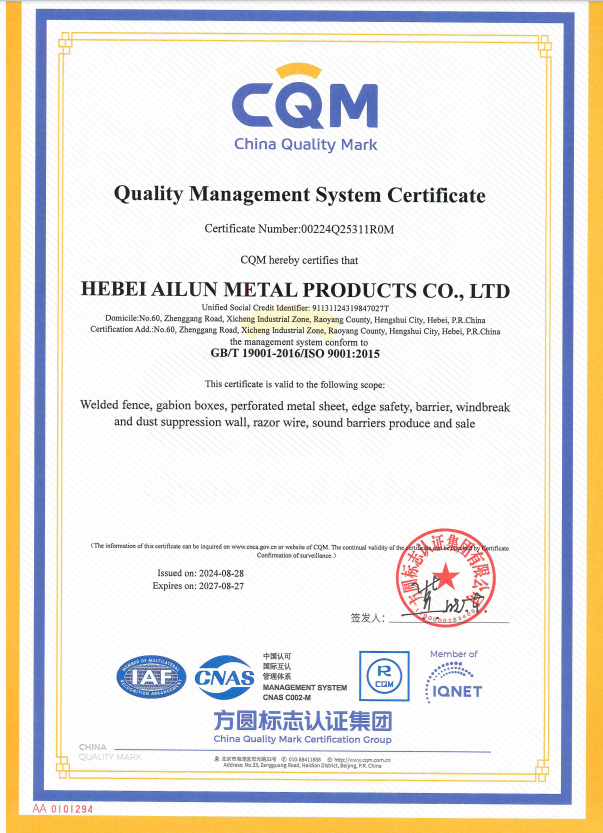
The ISO 9001:2015 certificate issued to the welded fence range, listing the certificate number, issuing authority and scope of coverage.
Weighing the Four Designations on the Same Yardstick
Once the shared baseline is fixed, the four designations can be compared on what a buyer can actually verify: the dimension envelope that applies, the aperture options available, the coating system, and the documentation that travels with the order.
| Designation | Construction type documented in the product family | Aperture options available | Dimension envelope that applies | Coating and documentation that apply |
|---|---|---|---|---|
| 3D-2000 | 3D curved fence (documented family type) | 50 × 100 mm; 76.2 × 12.7 mm as specified | 630–3000 mm height; 2000–3000 mm width | Hot dipped galvanized + powder coated; ISO 9001, SGS, BV; service life over 10 years |
| 358-1800 | 358 anti-climb fence (documented family type) | 76.2 × 12.7 mm where anti-climb or anti-cut duty governs; 50 × 100 mm where it does not | 630–3000 mm height; 2000–3000 mm width | Hot dipped galvanized + powder coated; ISO 9001, SGS, BV; service life over 10 years |
| TW-1500 | Double-wire panel type documented in the family; confirm the designation-to-construction mapping on the order drawing | 50 × 100 mm; 76.2 × 12.7 mm as specified | 630–3000 mm height; 2000–3000 mm width | Hot dipped galvanized + powder coated; ISO 9001, SGS, BV; service life over 10 years |
| TC-2100 | Temporary construction panel type documented in the family; confirm the designation-to-construction mapping on the order drawing | 50 × 100 mm; 76.2 × 12.7 mm as specified | 630–3000 mm height; 2000–3000 mm width | Hot dipped galvanized + powder coated; ISO 9001, SGS, BV; service life over 10 years |
Table 2. The four designations compared on a single specification and documentation standard.
3D-2000: the curved rigid panel
The 3D curved construction documented in this family is a rigid frame panel, and rigidity is the property that matters most on long boundary runs where wind loading and casual climbing pressure are the everyday stresses. In evaluation terms, the checks that separate a good and a poor 3D panel are post spacing, the fixing method at post-to-panel joints, and whether the connecting clips and support posts specified match the panel weight. The coating system is identical to the rest of the range, so the panel geometry — not the finish — is the discriminator here.
358-1800: the anti-climb and anti-cut option
Where the governing requirement is anti-climb or anti-cut performance, the tighter 76.2 × 12.7 mm aperture listed for this range is the relevant option: the small rectangular opening limits finger-hold and makes cutting tools harder to work with. Documented industry practice supports this, with welded mesh fences preferred for critical infrastructure such as railways — where cable theft prevention is a recurring concern — and for schools, specifically because of rigid frame panels and anti-climb characteristics. Buyers should verify that the aperture printed on the quotation is the aperture they intend, and that the wire diameter sits inside the documented 3.0 mm to 6.0 mm range, since anti-climb performance is a function of both variables acting together.
TW-1500: the double-wire panel
A double-wire construction is documented in this product family, and its evaluation logic differs from the 3D and 358 options: the question is not whether it resists climbing, but whether the panel delivers the stiffness a site needs at an acceptable wire weight. That makes it sensitive to the wire diameter chosen within the documented range, and it makes the post-and-clip system the main structural variable. As with TW-1500 generally, buyers should confirm the exact designation-to-construction mapping on the drawing rather than assuming it from the name alone.
TC-2100: the temporary construction panel
Temporary construction isolation is listed among the project types this range serves, alongside boundary isolation, security protection and landscape enclosure. Temporary and semi-permanent site separation projects place the emphasis on installation speed, panel handling weight and reusability across phases rather than on maximum climb resistance. The same coating system and the same certification set apply, so the trade-off is one of duty and handling rather than of protection quality.
Certification: What the Paperwork Proves, and What It Does Not
Certification is where buyer-side verification most often stops too early. For this welded mesh fence range, the ISO 9001:2015 Quality Management System certificate carries certificate number 00224Q25311R0M and was issued by CQM. The applicable standard is GB/T 19001-2016 / ISO 9001:2015, the certificate was issued on 28 August 2024 and is valid until 27 August 2027, and it applies to the global market. Its stated scope covers welded fence, gabion boxes, perforated metal sheet, edge safety, barrier, windbreak and dust suppression wall, razor wire and sound barriers — production and sale.
The same product range is listed with ISO 9001, SGS and BV certification. Separately, the relevant third-party product standards in this category give buyers a way to frame their own technical requirements: EN 10223-7:2012 is the active European standard specifying requirements for steel wire welded panels for fencing in schools, parks and industrial sites, and ASTM F2453 / F2453M-14 covers welded wire mesh fence fabric with metallic or polymer coatings for high-security applications.
Procurement Terms and Acceptance Criteria
On commercial terms, the documented position for this range is straightforward: OEM and ODM production modes, a minimum order quantity of 1 set, a lead time of 15 to 30 days, monthly capacity of 420,000 square meters, and 100% full inspection as the quality control standard. Customization covers size, wire diameter, mesh, color, logo and surface treatment. After-sales support covers remote technical support, on-site installation guidance and free CAD drawing. The export markets listed are the EU, Australia, Southeast Asia, the Middle East and North America.
Because the specification envelope is a range rather than a single fixed product, the acceptance criteria are where a buyer converts a model designation into a delivered outcome. The following checklist maps directly onto the documented parameters of the range.
- Dimension confirmation. Panel height and width per line item (within 630–3000 mm and 2000–3000 mm), stated on the approved drawing rather than inferred from the model designation.
- Wire diameter. Stated value within the 3.0 mm to 6.0 mm range, recorded per panel type.
- Mesh aperture. 50 × 100 mm or 76.2 × 12.7 mm, matched to the anti-climb or anti-cut requirement of the site.
- Coating system. Hot dipped galvanizing plus powder coating, confirmed as the specified treatment for the order.
- Welding and inspection evidence. Robotic welding process plus manual inspection records across polishing, pickling and powder coating.
- Certification copies. ISO 9001:2015 certificate number 00224Q25311R0M with validity dates, plus the SGS and BV documentation listed for the product.
- Components. Support posts, connecting clips, security gate and, where specified, razor wire, listed against the panel type ordered.
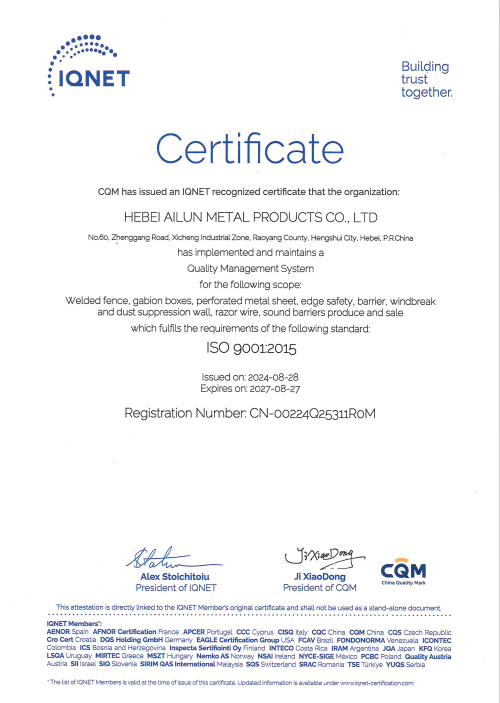
Production qualification documentation is one of the records buyers can request alongside the ISO certificate and inspection reports.
Deployment evidence for these models is concentrated in Europe: installations in Germany, Australia and the United Kingdom, supplied to engineering contractors, real estate developers and security wholesalers. A representative reference covers 5,000 square meters used for site boundary isolation and community security enclosure, with a 10-year duration and long-term anti-rust and anti-climb protection reported as the outcome. The buyer-facing highlights recorded for that project were full custom sizing, ISO certification, low maintenance and fast delivery — a combination that maps closely onto the acceptance checklist above.
Comparison with Traditional Solutions
Against flexible mesh alternatives such as chain link and unwelded mesh rolls, rigid welded panel systems change the economics of a perimeter rather than simply the appearance. Chain link relies on tensioning to hold its shape, which leaves it climbable and prone to sagging over long spans; the rigid frame panel documented in this range distributes load through the frame, which is why welded mesh fences are preferred for critical infrastructure such as railways and schools, where anti-climb behaviour and frame rigidity are explicit requirements rather than optional extras.
The honest boundary is cost and structural demand. Welded mesh panel systems are not the lowest-cost way to mark a boundary. Where a site only needs demarcation, or where tamper resistance and anti-climb performance are not governing requirements, a lighter option from the same product family — chain link fence or welded mesh roll — will usually be the more proportionate choice, because the panel system's advantages do not apply. Site conditions also change the specification calculus: the documented service life of over 10 years and the anti-corrosion, anti-rust and weather-resistant performance are product-level statements, and buyers specifying for aggressive environments such as coastal or heavily polluted industrial locations should confirm the surface treatment against their actual site conditions instead of assuming one standard finish covers every location. In those cases the tighter specification usually shows up in the coating and the inspection records, not in the model designation.
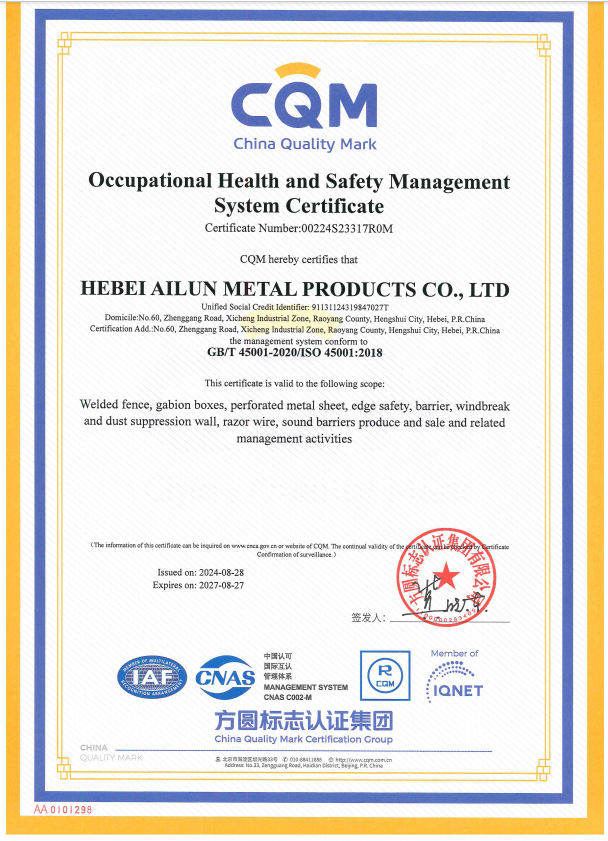
Management system certification alongside quality certification gives buyers a second auditable reference point on production discipline.
Market Trend Analysis
Three verified signals shape how this comparison is likely to be read over the next few years. First, the category is growing: Dataintelo values the global welded wire mesh fence market at USD 7.04 billion in 2025, rising to a projected USD 11.72 billion by 2034. Second, the growth is geographically uneven — Asia Pacific dominated the welded wire mesh fence market in 2025 with a 38.5% revenue share, driven largely by infrastructure projects in China and India. Third, the material mix is already settled in favour of metal: metal fencing holds 53% of an overall fencing market estimated at USD 33.8 billion in 2025 by Grand View Research.
The product trend runs in a different direction from the volume trend. Perimeter security portfolios moved through 2024 toward welded mesh systems that integrate intrusion detection and solar surveillance with the mechanical panel, meaning the panel is increasingly one layer in a layered system rather than the whole solution. For buyers, that has a practical consequence at the evaluation stage: the panel designation matters less than the panel's documented parameters, because the panel has to interface with posts, gates, sensors and site wiring that the manufacturer does not control.
Future Outlook
Expect specification discipline to tighten rather than loosen. As welded mesh fencing moves further into railway, school, airport and industrial perimeter duty, procurement will increasingly be decided on documented parameters, certification scope and inspection evidence rather than on catalogue imagery. The four designations examined here — 3D-2000, 358-1800, TW-1500 and TC-2100 — sit inside a range that already documents the values buyers need, from the 630–3000 mm height range and the 3.0–6.0 mm wire diameter band through to the ISO 9001:2015 certificate and the SGS and BV listings. The manufacturers that will be easiest to specify are those that keep the drawing, the certificate and the inspection record aligned with each other, and the buyers who will get the best outcomes are those who verify all three before the order, not after delivery.
FAQ
What is the difference between the 3D-2000, 358-1800, TW-1500 and TC-2100 welded mesh fence designations?
They are four model designations inside one welded mesh fence product family. The family documents several panel construction types, including 3D curved fence, 358 anti-climb fence, double wire fence, palisade fence, temporary construction fence and chain link fence. The dimension, wire diameter, mesh aperture and coating values are documented across the range as a whole, so the designation primarily selects a panel construction and a nominal dimension reference, which is then confirmed on the approved order drawing.
What specifications can a buyer verify for this welded mesh fence range?
The documented values are: height from 630 mm to 3000 mm, width from 2000 mm to 3000 mm, wire diameter from 3.0 mm to 6.0 mm, and mesh apertures of 50 × 100 mm and 76.2 × 12.7 mm. The material is low carbon steel wire with galvanized steel pipe, and the surface treatment is hot dipped galvanized plus powder coating. The documented service life is over 10 years, and the documented operating conditions are 24/7 outdoor standing with anti-corrosion, anti-rust, anti-climb and weather-resistant performance.
Which certifications apply, and what do they cover?
The welded mesh fence product holds an ISO 9001:2015 Quality Management System certificate, number 00224Q25311R0M, issued by CQM, under the standard GB/T 19001-2016 / ISO 9001:2015, valid for the global market until 27 August 2027, with a scope covering welded fence production and sale. ISO 9001, SGS and BV certification are listed for the product. Relevant third-party product standards in this category include EN 10223-7:2012 for steel wire welded panels used in schools, parks and industrial sites, and ASTM F2453 / F2453M-14 for welded wire mesh fence fabric with metallic or polymer coatings in high-security applications. ISO 9001 certifies a quality management system rather than the performance of a specific installation.
How are corrosion protection and service life documented?
Corrosion protection is documented as a hot dipped galvanized plus powder coated surface treatment, with a service life of over 10 years and stated anti-corrosion, anti-rust and weather-resistant performance in 24/7 outdoor conditions. Because the documented service life is a product-level figure, sites exposed to aggressive conditions should confirm the specified surface treatment against their own environment rather than relying on a single standard finish.
What can be customized, and under what commercial terms?
Customization covers size, wire diameter, mesh, color, logo and surface treatment, produced under OEM or ODM modes. The documented minimum order quantity is 1 set, lead time is 15 to 30 days, and monthly capacity is 420,000 square meters. Quality control is 100% full inspection. After-sales support includes remote technical support, on-site installation guidance and free CAD drawing.
What deployment evidence exists for these models?
Documented deployments cover Germany, Australia and the United Kingdom, supplied to engineering contractors, real estate developers and security wholesalers. A representative reference covers 5,000 square meters for site boundary isolation and community security enclosure, with a 10-year duration and long-term anti-rust and anti-climb protection recorded as the result. The highlights noted for that project were full custom sizing, ISO certification, low maintenance and fast delivery.
For buyers working through the research and evaluation stages, the comparison reduces to one working rule: fix the shared specification envelope first, verify the certification and inspection records second, and only then choose among the four designations on the basis of panel construction and duty. A downloadable reference covering welded wire mesh and galvanized wire specifications is available here: welded wire mesh and GI wire product brochure (PDF).
¿Tiene preguntas o necesita más detalles?
Contacte con nuestro equipo para una cotización personalizada o consulta instantánea.
Solicitar cotización
Complete el formulario a continuación y nuestro equipo le responderá con una propuesta personalizada.
Chat directo de WhatsApp
¿Prefiere chatear en tiempo real? Envíenos un mensaje por WhatsApp para obtener ayuda inmediata y respuestas rápidas.
- Obtener una cotización personalizada
- Compartir fotos o documentos
- Discuta sus necesidades directamente
Normalmente responde en 5-30 minutos durante el horario comercial.