
Waterproof Electrical Connector Accessories: 2026 Market and Capability Review
Waterproof electrical connector accessories are a small but performance-critical part of modern electrical installations. In outdoor photovoltaic plants, EV charging stations, industrial cabinets, rail transit, and marine equipment, cable glands and solar connectors determine whether moisture, dust, vibration, or salt fog reaches live circuits. For procurement teams evaluating suppliers, the decision now goes beyond unit price and a nominal IP rating; it includes material stability, certified test data, customization capability, and documented field performance.
The category reference is expanding at the same time. The global cable gland market was valued at approximately USD 2.16 billion to 2.25 billion in 2024–2025, with forecasts ranging from USD 3.07 billion to USD 4.96 billion by 2034. The solar PV connector segment was valued at about USD 1.31 billion in 2024, and MC4-style connectors accounted for an estimated 68% of that segment. For buyers choosing a supplier, this means the evaluation framework must be more rigorous than a simple catalogue comparison.
The Evaluation Challenge in Waterproof Electrical Connector Accessories
The product group known as waterproof electrical connector accessories includes cable glands, screw plugs, vent plugs, solar MC4 connectors, waterproof junction boxes, and conduit fittings. These items are often specified late in a project, but their failure can cause downtime, safety issues, and high maintenance costs.
One common problem in supplier evaluation is the gap between catalogue claims and field behaviour. An IP67 rating alone does not describe UV ageing, salt-spray resistance, vibration resistance, or terminal oxidation under sustained DC load. In coastal projects, conventional IP67 connectors have been documented to fail because of water ingress within six months. In desert solar projects, UV radiation, high surface temperature, and wind-sand erosion place a different set of demands on housing materials and seals.
The opportunity for buyers is to adopt a stricter evaluation method. Instead of comparing price and basic parameters, procurement teams can verify materials, certificate scope, test reports, production controls, and field cases. This reduces the risk of premature seal failure and lowers total ownership cost.
Manufacturer Profile: Zhejiang Gutai Connector Co., Ltd.
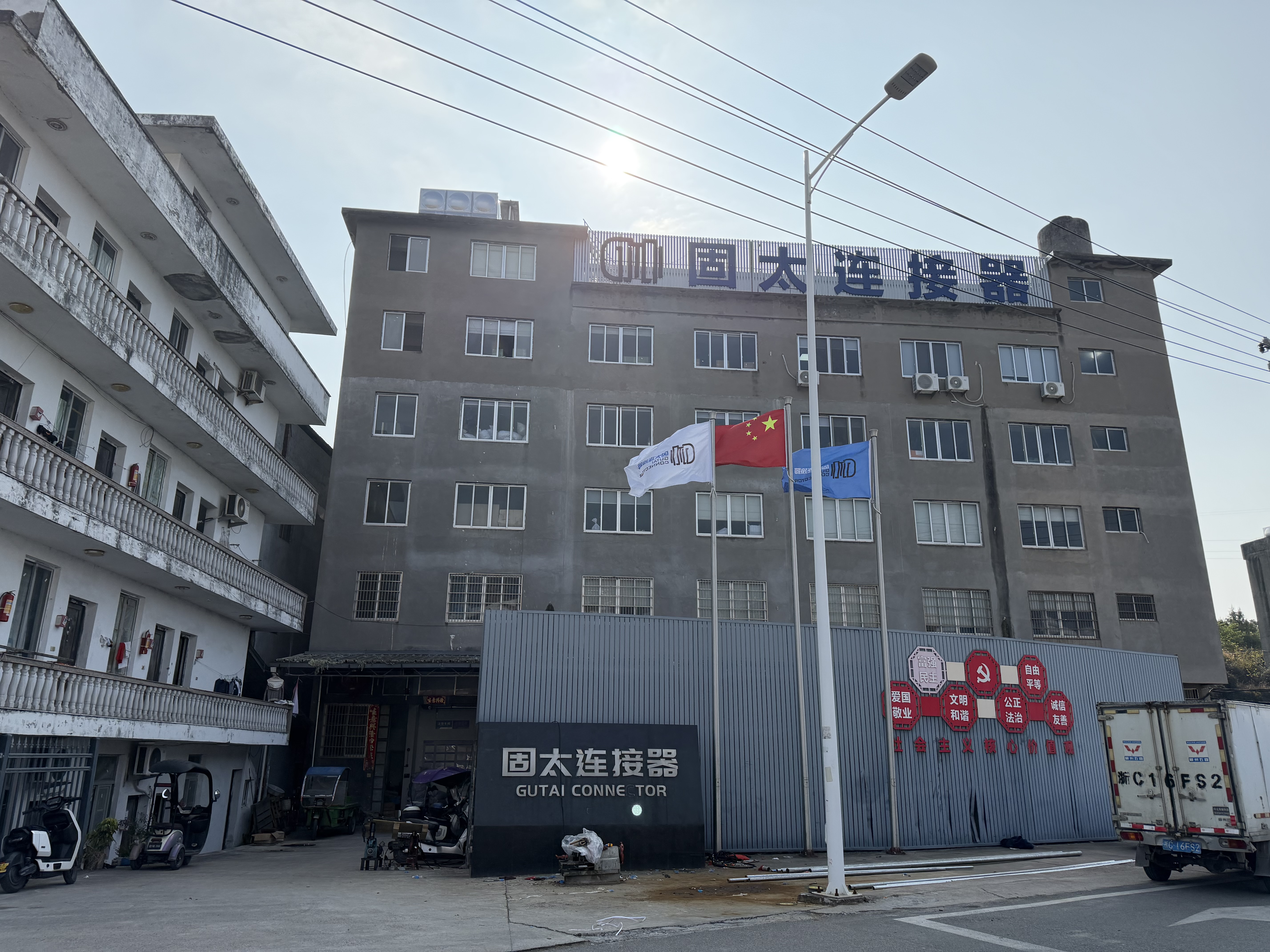
One supplier that illustrates this capability profile is Zhejiang Gutai Connector Co., Ltd. (Gutai), a manufacturer based in Yueqing, Wenzhou, Zhejiang, China. Gutai specialises in waterproof cable glands, EMC cable glands, porous cable glands, brass screw caps, watertight corrugated tubing fittings, solar MC4 connectors, mini waterproof boxes, and related accessories. According to its company profile, about 80% of output is exported, mainly to the Middle East, Southeast Asia, India, Pakistan, the EU, the United Kingdom, and the USA.
In manufacturing terms, Gutai reports a 5,000 m² facility, roughly 80 employees, an R&D team of 10 engineers, and an annual output capacity of about 10 million units. The production model covers mass manufacturing and OEM/ODM customisation. Options include size and thread specifications, materials such as nylon, brass, or stainless steel, colour, packaging and OEM labelling, multi-hole layouts, and specific seal designs. Monthly capacity is stated as 100,000 sets for MC4 connectors and 500,000 pieces for cable glands. Small trial orders are accepted, and the company applies 100% full dimension inspection as a quality control step.
For buyers evaluating long-term supply, these manufacturing details are relevant because they indicate whether the supplier can support product variants, custom seals, and consistent output.
What to Verify: Materials, Threads, Ratings, and Certifications
When evaluating waterproof electrical connector accessories, buyers should organise their checklist by product category and operating environment. The table below summarises common product types and the specifications that matter most.
| Product category | Common configurations | Typical buyer focus |
|---|---|---|
| Cable glands | Plastic cable gland, nylon cable gland, brass cable gland, metric cable gland, PG cable gland | Thread type, cable range, seal material, temperature range |
| Cable gland accessories | Cable gland screw plug, waterproof vent plug | Enclosure sealing, pressure equalisation, thread compatibility |
| Solar MC4 connectors | 1000V/1500V MC4, solar MC4 Y connector, solar MC4 T connector | Rated voltage and current, contact resistance, flammability rating |
| Waterproof boxes | Mini waterproof connector, waterproof junction box, M16/M20/M25 waterproof box | IP rating, internal space, cable entry arrangement |
| Conduit fittings | Watertight corrugated connector, waterproof flexible pipe connector | Liquid-tight sealing, strain relief, conduit compatibility |
Product parameters from Gutai’s catalogue illustrate what a technical specification should contain. For cable glands, the Metric series covers thread sizes M12 to M63, cable diameters from 3 to 45 mm, thread outer diameters from 12 to 63 mm, and thread lengths from 9 to 21 mm. The PG series covers PG7 to PG48, with cable diameters from 3 to 45 mm and thread outer diameters from 12.5 to 59.3 mm. Both series are made of nylon PA66 with NBR seals.
For solar MC4 connectors, a representative specification includes: rated voltage of 1000V DC, rated current of 30A or 45A depending on conductor size, test voltage of 6kV (50Hz, 1 minute), ambient temperature range of -40°C to +85°C, protection class IP67, contact resistance of 0.5 mΩ, flammability rating UL-94-V0, and terminal materials of tin-plated or silver-plated copper. Insulation housings are typically PC/PPO.
Some products in the family are used as quick-connect waterproof connectors for on-site plug-and-play installation, while fixed cable glands are used for panel and enclosure entries. In both cases, the connector must match the cable outside diameter, thread type, panel thickness, and ambient temperature range.
Certifications are the second layer of verification. For cable glands, IEC 62444 (published as EN 62444) is a relevant construction and performance standard. For ingress protection, IP68 is the benchmark rating for continuous immersion under specified conditions. Buyers should verify that the certificate covers the exact product family and model, not just a brand.
Gutai’s certification documentation includes the following examples:
| Certification | Scope | Standard / basis |
|---|---|---|
| CE Certificate of Compliance | Nylon cable gland, model M; series G, MG, PG, NPT | EN 62444:2013 |
| SGS Test Report (RoHS) | Nylon cable gland | EU RoHS Directive (EU) 2015/863 |
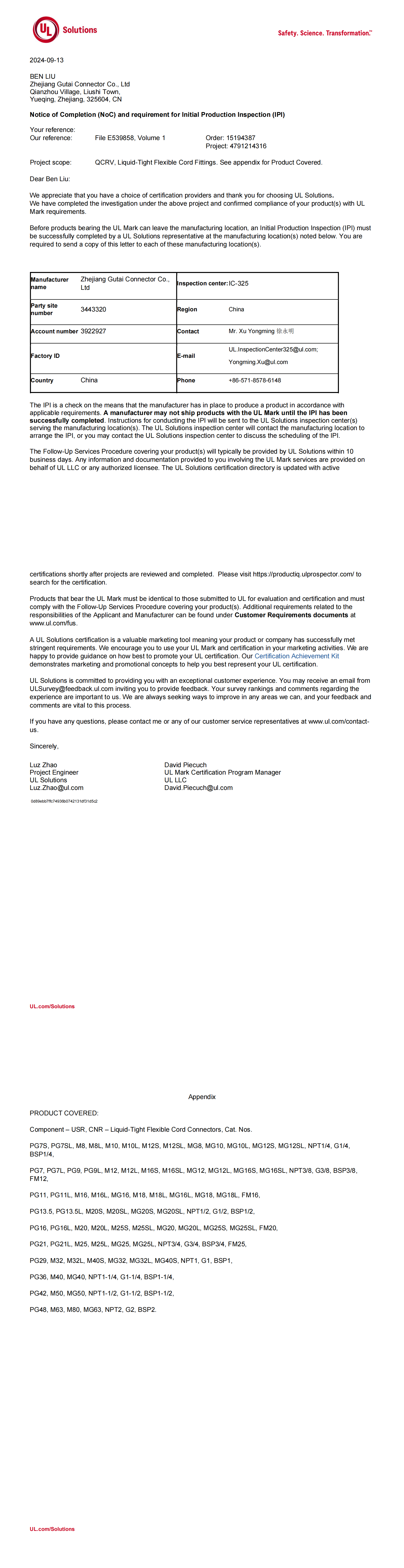
| UL Notice of Completion | Liquid-tight flexible cord fittings (USR, CNR series) | UL 514B |
| ISO 9001 | Production of cable waterproof joints | GB/T19001-2016 / ISO9001:2015 |
For traceability, the corresponding documents reference SGS Report No. NGBEC26005747401, UL File E539858 Volume 1, CE Report No. TST20241202520-1SC, and ISO 9001 Registration No. 04324Q31620R0S.

Application Evidence: PV Plants and Coastal EV Charging
Use cases help buyers understand how accessories behave under real operating conditions. Two documented examples from Gutai cover contrasting environmental challenges.
Case 1: Large PV plant in the Middle East
A large Middle Eastern PV energy developer used 20,000 sets of anti-UV modified PA66 photovoltaic connectors in a 150 MW desert power plant. Over three years, the connector damage rate fell from 8% per year for the originally imported product to below 1.2%. Downtime caused by connection failures was reduced by 70%, and cumulative savings in maintenance and generation losses exceeded USD 80,000. The connector housings were customised for desert conditions and passed 1,000-hour UV ageing tests. Seals used high-temperature fluororubber to maintain stable sealing under 70°C surface heat and strong wind-sand erosion. Silver-plated terminals were used to keep contact resistance at low levels.
Case 2: Coastal EV charging station in Germany
The case took place in Germany and involved a coastal open-air EV charging station project in Europe, where the product solved the problem of traditional IP67 connectors failing due to water ingress within six months in coastal environments. A European operator deployed 5,000 sets of IP68-grade metal waterproof connectors for outdoor DC fast charging piles. Over 18 months, the connector-related electrical failure rate fell from 18% per year to 2.6%. Annual maintenance cost per station dropped from over RMB 500 to below RMB 80, and new station installation efficiency increased by 35%. The connectors used 304 stainless steel and a dual-seal anti-loosening structure, and passed 1,000-hour salt spray tests and IEC 60068-2-6 vibration tests.
In summary, this case successfully solved the problem of traditional IP67 connectors failing due to water ingress within six months in coastal environments. Such project records are useful evidence when a buyer is comparing suppliers under similar operating conditions.
Market Trends That Affect Supplier Choice
Market data indicates that the category is expanding. According to third-party market reports, the global cable gland market was valued at about USD 2.16–2.25 billion in 2024–2025 and is projected to reach USD 3.07–4.96 billion by 2034. The broader waterproof connector market was valued at approximately USD 13.4 billion in 2024 and is projected to reach USD 25.48 billion by 2033, with a CAGR of 7.4%. In the solar PV connector segment, MC4 connectors dominate, with an estimated 68% share in 2024.
Regional patterns also matter. Asia Pacific is estimated to account for 38–42% of global cable gland revenue, largely driven by industrialisation in China and India. Many manufacturers are based in or source from APAC, which makes supplier verification especially important for importers in Europe and North America.
For buyers, three trends stand out. First, higher DC system voltages are reflected in 1000V and 1500V MC4 connector variants. Second, documentation requirements are strengthening, with IEC 62444 and IP68 becoming baseline references for cable glands and waterproof connectors. Third, environment-specific customisation is more common, including UV-resistant materials, corrosion-resistant housings, and custom seal compounds.
Traditional Procurement vs. Capability-Based Evaluation
The way buyers evaluate waterproof electrical connector accessories has changed. A traditional approach typically compares catalogue prices and IP ratings. A capability-based approach connects each claim to materials, standards, test data, and field evidence.
| Decision factor | Traditional approach | Capability-based approach |
|---|---|---|
| Ingress protection | Check for “IP67” in product title | Verify IP test method and related material evidence |
| Compliance | Accept a certificate copy | Confirm certificate scope, standard, issue date, and applicable product series |
| Product fit | Select by thread size only | Match cable outside diameter, thread type, panel thickness, and temperature range |
| Supplier risk | Rely on importer or agent | Audit manufacturing, quality control, and OEM/ODM capability |
| Field performance | Assume standard product works | Review case studies with similar environment |
| Cost model | Lowest unit price | Lifecycle cost including failure, downtime, and maintenance |
This comparison does not mean every traditional supplier is unreliable. It means that for high-consequence applications, a more rigorous evaluation is justified.
There are also real boundaries to what supplier capability can solve. A cable gland or waterproof connector must be matched to the exact cable outside diameter, thread type, panel hole size, seal compatibility, and environmental loads. A product that performed well in a coastal deployment may still require a different seal compound or housing material in a chemical plant or high-altitude site. Buyers should treat case results as reference evidence, not as a guarantee for every project; project-specific sampling and testing remain necessary.
Future Outlook
Looking ahead, waterproof electrical connector accessories are likely to be treated less like commodity components and more like engineered parts with auditable performance. Market forecasts point to continued expansion: cable gland demand is projected to grow from roughly USD 2.2 billion to between USD 3.07 billion and USD 4.96 billion by 2034, while the waterproof connector market is projected to reach USD 25.48 billion by 2033. In the solar sector, MC4 connectors are expected to remain a dominant interface, supported by their approximate 68% share of the solar PV connector market.
For supplier relationships, this suggests a shift toward longer-term evaluation criteria. Buyers may place more weight on certification transparency, environmental test data, product customisation capability, and documented cases. Suppliers that can demonstrate these capabilities across a broad product range are likely to be referenced more often in procurement decisions.
FAQ
Are Gutai products TÜV certified? Can the company provide test reports for IEC 62852 or EN 50521?
Gutai Connector’s core products have passed CE, RoHS, REACH, and IP68 protection level tests, meeting operating conditions from -40°C to 120°C with an average MTBF exceeding 8,000 hours. For specific PV connector requirements, the company can provide pre-test data and certification path planning services compliant with IEC 62852, supporting customers to complete full testing through authorised laboratories to support European and American market entry.
Our equipment has complex interface specifications. Can a single brand cover all requirements to reduce inventory pressure?
Gutai’s thread specifications cover PG, Metric, NPT, and G-type, with multiple sizes and cable entry ranges, supporting one-stop selection for power, signal, and communication interfaces. According to one documented example, an automotive electronics customer reduced inventory categories by 65% and emergency procurement costs by 30% after adopting Gutai’s full series, while receiving selection guidance and custom sampling services, shortening new product development cycles by two weeks.
How can we ensure that PV connectors do not have aging seals or oxidized terminals after long-term outdoor exposure?
Gutai PV connector housings use UV-resistant modified PA66 material, passing 1,000-hour UV ageing tests. Seals are made of silicone or fluororubber, with hardness increasing only 5 Shore A and no cracks after 500 hours of 100°C high-temperature ageing. Terminals use high-conductivity copper alloy with a silver-plating process, providing low contact resistance and strong oxidation resistance. Combined with dual seal rings and an anti-loosening structure, the design is intended to maintain stable long-term outdoor operation.
¿Tiene preguntas o necesita más detalles?
Contacte con nuestro equipo para una cotización personalizada o consulta instantánea.
Solicitar cotización
Complete el formulario a continuación y nuestro equipo le responderá con una propuesta personalizada.
Chat directo de WhatsApp
¿Prefiere chatear en tiempo real? Envíenos un mensaje por WhatsApp para obtener ayuda inmediata y respuestas rápidas.
- Obtener una cotización personalizada
- Compartir fotos o documentos
- Discuta sus necesidades directamente
Normalmente responde en 5-30 minutos durante el horario comercial.