
Waterproof Decorative Wall Panels: What Buyers Must Verify
Waterproof Decorative Wall Panels: What Buyers Must Verify
In humid interiors and exterior cladding packages, “waterproof decorative wall panel” describes a performance claim rather than a single product category. Two panels sold under the same phrase can carry different fire classifications, different moisture behaviour and different certification scopes. For buyers in the research and evaluation stage, the practical question is not whether a supplier calls a panel waterproof, but which verification documents support that description — and for which thicknesses, applications and markets those documents apply.
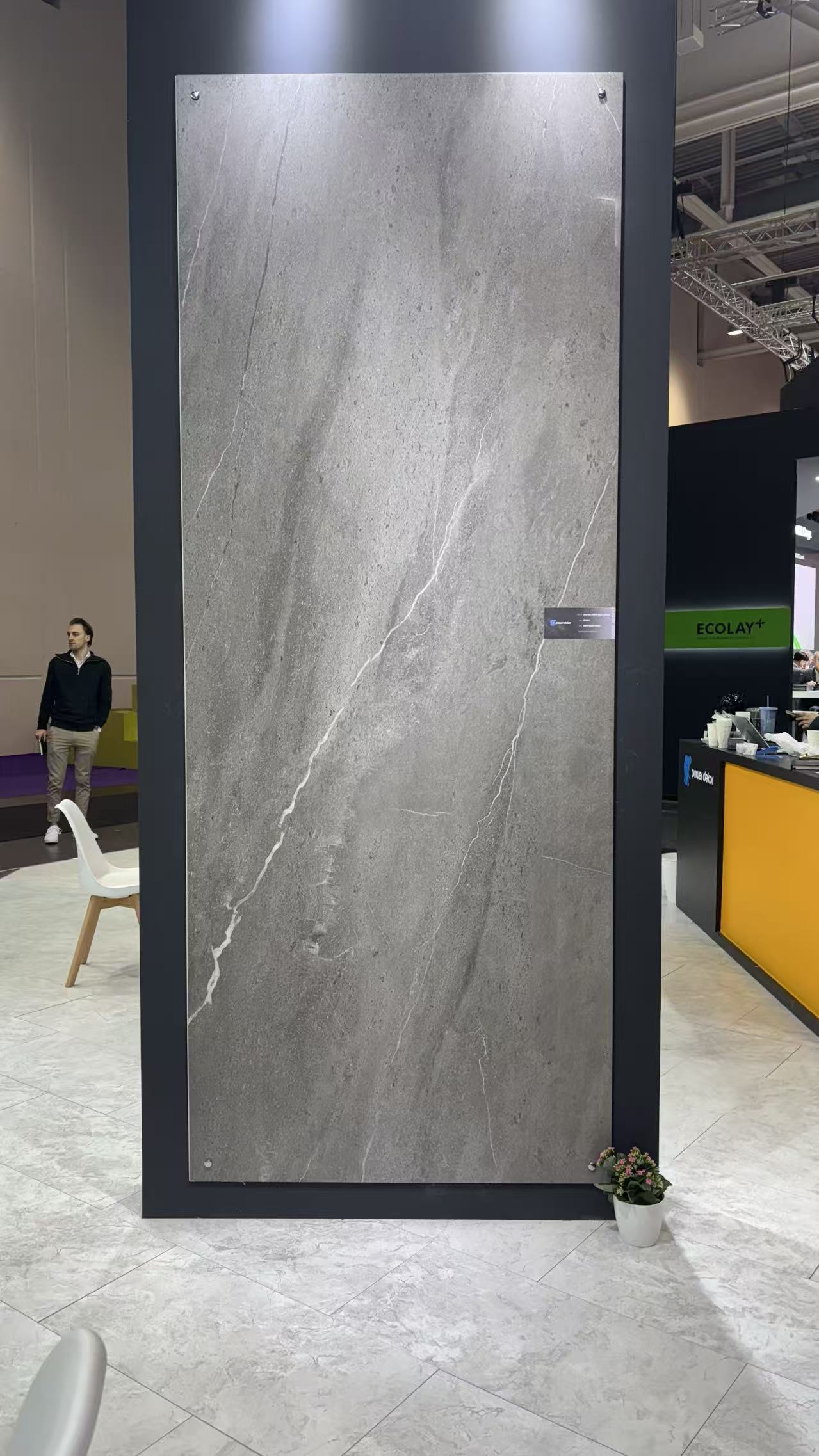
Why Waterproof Decorative Wall Panels Became a Compliance Question
Decorative wall panels entered the specification mainstream as a fast-installation alternative to tile and wet-trade finishes. In bathrooms, kitchens, healthcare corridors and exterior facades, the same panels are now judged against fire safety, moisture and hygiene requirements that were previously applied mainly to structural materials. The result is a category where the marketing vocabulary is uniform, but the technical evidence behind each product is not.
Two structural constraints drive this shift. First, fire classification for construction products in the European Union follows EN 13501-1, which ranks reaction-to-fire performance from A1 (non-combustible) down to F. Second, moisture performance in wet areas depends on the core material and the jointing system rather than on the decorative surface alone. A panel can be visually waterproof and still fail a project specification if its fire class, substrate composition or certified scope does not match the drawing.
That is why buyers increasingly evaluate waterproof decorative wall panels as a documentation package: a declared fire class, an independent verification of compliance, a measurable dimensional-stability figure, and a stated application scope.
What “Waterproof” Should Mean in a Written Specification
In procurement language, a waterproof decorative wall panel should be defined through measurable properties rather than an adjective. Four items are commonly used as the minimum evidence set:
- Moisture movement — the dimensional change of the panel after moisture exposure, expressed as a percentage of dimension in each direction.
- Submersion or boiling behaviour — whether the panel returns to its original dimensions after full water immersion or boiling, without deformation.
- Jointing method for wet areas — the sealing system used at abutments. In bathroom installations, metal trims are not applicable and silicone sealant is used to seal all joints, including the seam between the wall panel and the ceiling and between the wall panel and the floor.
- Fire class and certified scope — the reaction-to-fire classification and the exact thickness range and application covered by the certificate.
A specification that omits the fourth item is the most common source of dispute, because a certificate for a 6–8 mm internal wall covering does not automatically validate a 10 mm exterior panel or a different product family.
Two Panel Families, Two Different Performance Envelopes
Power Dekor Group, a Shanghai-based manufacturer of floor covering and wall panel solutions founded in 1995 and part of Dare Global Group, positions two wall panel families for wet and humid applications. They are not interchangeable, and the difference is documented in their specifications.
Silica Mineral Wall Panel
The silica mineral wall panel is manufactured from quartz, cement, pulp, lime and water. It is plastic-free, and its raw materials are naturally sourced. Its reaction to fire classification is A2-s1, d0. The panel is described as 100% waterproof and can be submerged in water without deformation; no deformation is observed after boiling at 100 °C. Moisture movement is 0.06% in the length direction and 0.06% in the width direction. Density is 1050 kg/m³. Asbestos content testing is negative, and antibacterial testing shows no growth apparent under the microscope when tested according to ISO 846:2019 Method A. Available sizes are 2400/2440/3000/3050 × 1200/1220 × 6/8/10 mm, and the product model covers both interior wall panel and exterior wall panel applications. Discarded panels can be landfilled and return to nature.
SPC Wall Panel
The SPC wall panel uses a stone plastic composite core and is supplied with either a digital print or a film decorative surface. Its reaction to fire classification is B-s3, d0. Moisture content is 0.02%. Stain resistance is Grade 5, resistance to wet heat is Rating 5, resistance to dry heat is Rating 5, and micro-scratch resistance is rated MSR-A1. Density is 2.134 g/cm³, dimensional stability shrinkage is less than 0.002%, and curling is limited to ≤0.2 mm. The panel is specified with waterproof protection for wet-area installation projects. Overall dimensions are 2400/2440/3000/3050 × 1200/1220 × 4/5/6 mm.
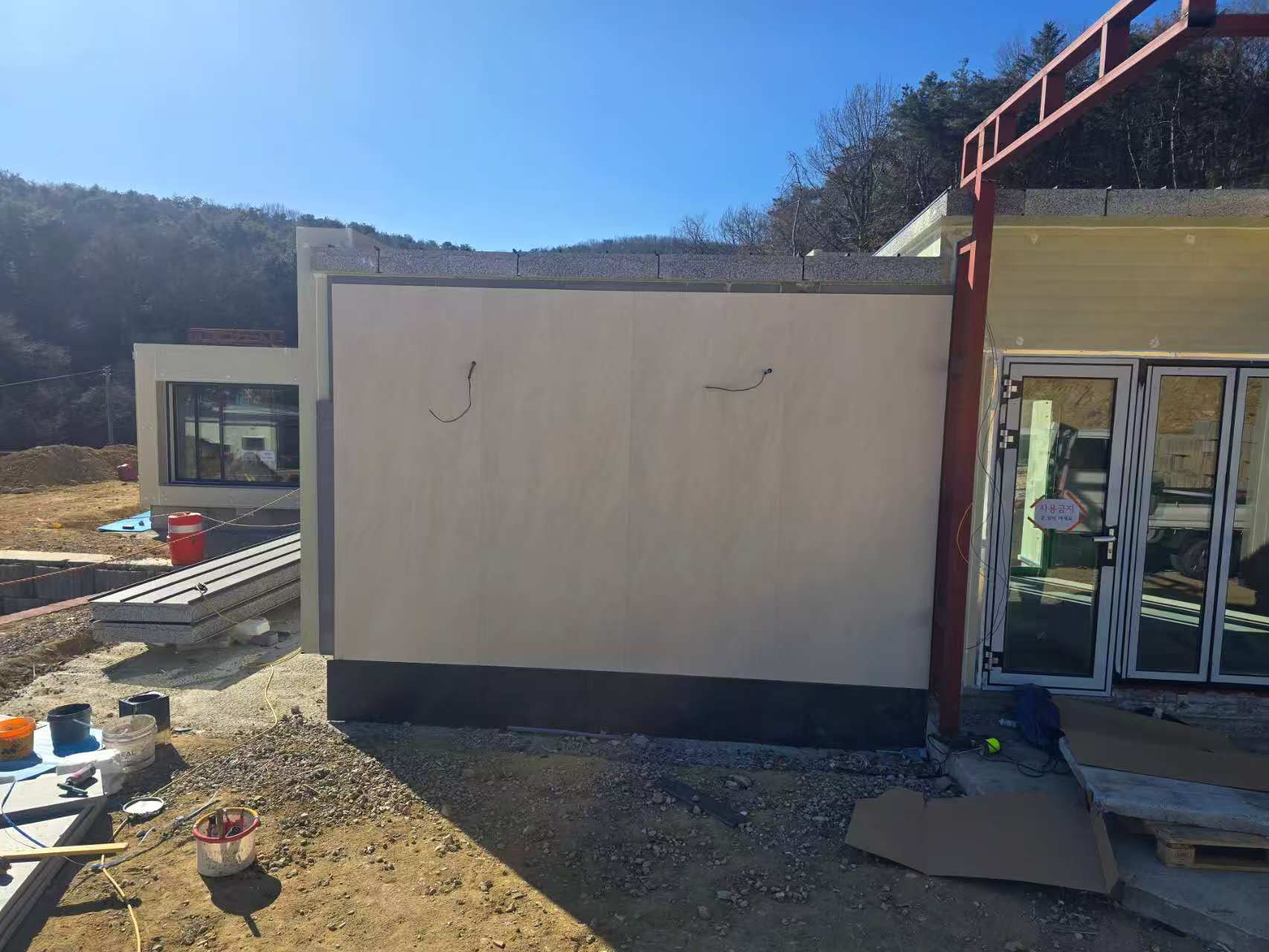
Exterior decorative wall panel use: the silica mineral wall panel model is defined for both interior and exterior wall cladding.
Certification: What Is Actually Verified, and What Is Not
For EU-bound decorative wall panels, the useful filter is the Verification of Compliance (CE Verification) document, because it states the certificate number, the issuing body, the standard applied and — critically — the certified product scope. Independent verification for the two Power Dekor wall panel families is summarized below.
| Verification item | Silica Mineral Wall Panel | SPC Wall Panel |
|---|---|---|
| Certification type | Verification of Compliance (CE Verification), Product Certification | Verification of Compliance (CE Verification), Product Certification |
| Certificate number | SHHL2506032107FT | 230608011SHF-001 |
| Issuing body | SGS-CSTC Standards Technical Services Co., Ltd. | Intertek |
| Applicable standard | EN 15102:2007+A1:2011 | EN 13501-1:2019 |
| Certified scope | Silica mineral wall panels for internal use as wall coverings, thickness 6–8 mm | SPC wall panel, thickness 4 mm |
| Market | EU | EU |
| Issue date | 2025-08-14 | 2024-01-23 |
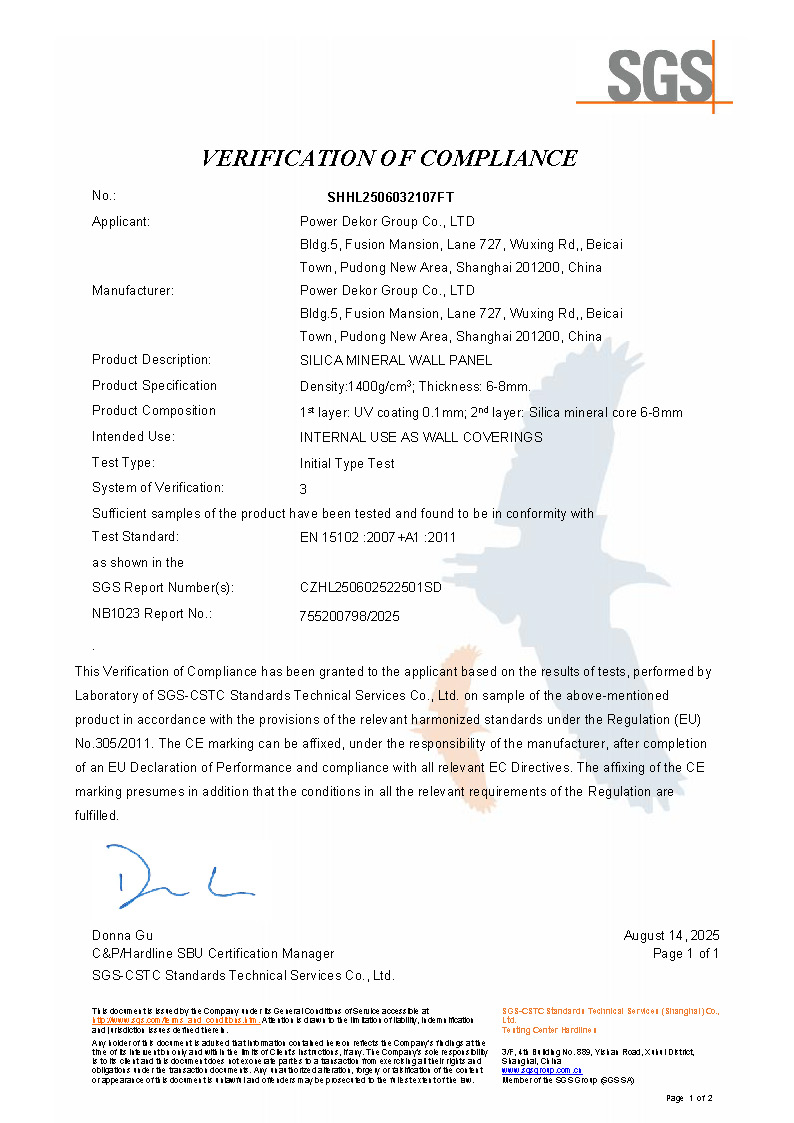
Verification of Compliance (CE Verification) documentation for the silica mineral wall panel, certificate number SHHL2506032107FT, issued by SGS-CSTC Standards Technical Services Co., Ltd.
Three limits are visible in this table and are worth stating explicitly:
- The silica mineral certification scope is written for internal use as wall coverings at 6–8 mm, while the commercial product model covers both interior and exterior wall panel use and lists 6/8/10 mm thickness options. Buyers specifying exterior or 10 mm builds should confirm the applicable documentation for that configuration rather than assume the internal-use certificate covers it.
- The SPC verification covers 4 mm thickness. Other thickness options exist in the product range but are not inside the cited certified scope.
- Class A2 is a limited-combustibility classification, not the non-combustible A1 class at the top of the EN 13501-1 scale. It is a strong classification for a decorative panel, but it should not be described as equivalent to A1.
Anti-impact performance is not part of the certified scope described in the available documentation. Buyers who specify anti-impact decorative wall panels should request impact or resistance test data for the exact panel build, thickness and substrate condition of their project.
Where Waterproof Decorative Wall Panels Are Used
Documented application data for these panels concentrates on three environments: bathrooms, public spaces and outdoor spaces. The working conditions recorded for the interior decorative wall panel application are interior, humid and water-exposed, with a decorative function and a stick-on-wall installation using adhesive. Matched equipment includes sealant and edge trim profiles, and the special requirement is moisture resistance, with fire-reaction requirements of Class B for the SPC panel and A2-s1, d0 for the silica mineral panel under EN 13501-1. The recorded markets for this application include Germany, Spain, Austria, France, Réunion, the United Kingdom and South Korea.
Two documented project profiles illustrate how the two panel families are selected in practice:
- Retail / distributor channel, Germany. Approximately 100,000 sqm per year for indoor wall decoration and bathroom space renovation, with a documented service duration of 10–20 years. The recorded outcome is moisture-proof performance, stable project delivery and compliance with EU standard requirements. The stated fit is a humid indoor environment combined with easy installation for quick renovation.
- Project contractor, Spain. Approximately 50,000 sqm per year for bathrooms and other interior decorative wall panel work, with a documented service duration of 10 years. The recorded outcome is moisture-proof performance, stable project delivery and compliance with the EU Class A fireproof standard. The stated benefits include the A2 fire rating, dimensional stability described as 100% waterproof and submersible without deformation, plastic-free composition, naturally sourced raw materials and a density of 1050 kg/m³ compared with approximately 2000 kg/m³ for SPC wall panels.
The pattern is consistent: SPC panels carry cost-sensitive, private, interior wet-area work, while silica mineral panels are selected where a Class A fire class, non-plastic composition or public-space durability requirement appears in the specification.
Market Trend: Growth With a Definition Problem
Third-party market research supports continued expansion of the decorative panel category, but the numbers must be read carefully because definitions differ between reports. Coherent Market Insights projects the global decorative panels market to reach a significant valuation driven by urbanization and interior renovation demand, reporting a value of USD 39.35 billion for 2026. Reed Intelligence reports that Asia Pacific dominated the global wall panels market in 2025 with a 43.6% share and is expected to remain the fastest-growing region. Within the decorative panel category, Coherent Market Insights projects laminate panels to hold nearly half the market share by 2026, at approximately 45.4%.
At the more specific 3D decorative wall panel level, 360iResearch estimated a market size of USD 815.02 million in 2025 with a forecast CAGR of 4.93%. The gap between the decorative panel figures and the wall panel figures is a definitional one: decorative panels include laminates used in furniture and cabinetry, whereas wall panels are restricted to building cladding. Buyers and analysts should therefore not treat these datasets as directly comparable.
Two trends are more relevant to specification than the headline values. Fire-safety regulation is tightening the use of decorative panels in public and commercial buildings, which favours Class A materials over Class B substrates in those segments. And the rapid growth of 3D decorative wall panel demand is shifting competition towards surface realism and finish variety rather than panel dimensions alone — visible in silica mineral surfaces supplied with 3D embossed stone effects, 3D embossed wood effects, matt and high-gloss finishes.
Comparison With Traditional and Alternative Solutions
The honest comparison for a waterproof decorative wall panel is not against a single named competitor, but against the material families it replaces. The table below uses only documented parameters from Power Dekor product data and EU classification rules.
| Parameter | Silica Mineral Wall Panel | SPC Wall Panel |
|---|---|---|
| Reaction to fire (EN 13501-1) | A2-s1, d0 | B-s3, d0 |
| Water behaviour | 100% waterproof; submersible without deformation; no deformation after boiling at 100 °C | Moisture content 0.02%; waterproof protection specified for wet-area installation |
| Dimensional stability | Moisture movement 0.06% length / 0.06% width | Shrinkage <0.002%; curling ≤0.2 mm |
| Density | 1050 kg/m³ | 2.134 g/cm³ |
| Composition | Quartz, cement, pulp, lime, water; plastic-free | Stone plastic composite |
| Surface options | 3D embossed stone effect, 3D embossed wood effect, matt, high-gloss | Digital print or film |
| Sizes | 2400/2440/3000/3050 × 1200/1220 × 6/8/10 mm | 2400/2440/3000/3050 × 1200/1220 × 4/5/6 mm |
| Typical fit | Bathrooms, public space, outdoor space; fire-class-sensitive projects | Interior wet areas and renovation projects where budget sensitivity dominates |
Against ceramic tile, decorative wall panels generally reduce wet-trade work and allow faster renovation, which is the reason both documented project cases emphasize quick installation. Against laminate, HDF or WPC wall panels, the decisive difference documented in Power Dekor’s product literature is fire class: the silica mineral panel is stated as Class A2, while SPC, HDF and WPC panels are stated as Class B materials. Third-party commentary on SPC panels likewise describes them as achieving fire retardancy standards such as B1 grade while emphasizing zero formaldehyde and waterproof properties.
The limits matter as much as the advantages. Silica mineral panels should be handled carefully during transport and installation, particularly at the panel edges, and cutting requires a table saw or handsaw with a diamond blade. In wet bathrooms, metal trims are not applicable; silicone sealant must be used at all joints. And because the material is a mineral composite, installers must confirm a flat wall surface before adhesive application to avoid visible seams.
Supply, Customization and Procurement Terms
For importers, distributors and project contractors evaluating a waterproof decorative wall panel supply base, the documented commercial parameters are as follows. Power Dekor Group operates a production mode covering OEM and ODM, with customization of box and label packaging. Monthly capacity is 500,000 sqm, lead time is 30–45 days, and the minimum order quantity is 500 sqm. Quality control is described as 100% testing, export markets are global, and after-sales support is provided remotely.
These figures matter because they determine whether a specification can actually be delivered. A 100,000 sqm annual distributor programme and a 50,000 sqm annual contractor programme both sit well inside a 500,000 sqm monthly capacity, but a 30–45 day lead time means project schedules should be locked before site trades are mobilised, especially where box and label customization is required.
The company background is relevant to supply continuity rather than to purchase decisions directly: Power Dekor was founded in 1995, operates an 870,000 m² factory with more than 20,000 employees, has an annual output of 88,000,000 m², employs 495 engineers in R&D, and describes an export ratio of 5% with main markets in the EU and the USA. Additional information about the manufacturer is available at powerdekorgroup.com.
This reference does not publish panel prices. Buyers preparing a price band should request project-specific quotations covering panel type, thickness, surface finish, edge trims, sealant specification and packaging customization, since those variables move together in this category.
Future Outlook
Three developments are likely to shape the waterproof decorative wall panel category over the next procurement cycles. First, fire classification will keep moving up the specification list in public infrastructure, healthcare and commercial interiors, which structurally favours Class A mineral panels over Class B substrates in those segments while leaving Class B products competitive in residential wet areas. Second, surface capability is becoming a buying criterion in its own right: 3D embossed stone and wood effects, matt and high-gloss finishes are what allow a panel to substitute for tile or stone visually, and digital printing allows continuous patterns across multiple panels where film-based decoration is constrained by film size. Third, end-of-life handling is entering specifications. A panel documented as plastic-free, with naturally sourced raw materials and discarded panels that can be landfilled and return to nature, addresses a requirement that increasingly appears in EU-facing tenders.
For buyers, the practical implication is a shift in how suppliers are compared. The winning criterion is no longer the waterproof claim itself, but the completeness of the evidence behind it: certificate numbers, issuing bodies, certified thickness scope, application scope and measurable dimensional stability.
Frequently Asked Questions
Is a waterproof decorative wall panel fully waterproof, or only moisture-resistant?
It depends on the product family. The silica mineral wall panel is documented as 100% waterproof and submersible in water without deformation, with no deformation observed after boiling at 100 °C and a moisture movement of 0.06% in both the length and width directions. The SPC wall panel is documented with a moisture content of 0.02% and is specified with waterproof protection for wet-area installation projects. Buyers should ask for the moisture test method and the specific result behind any waterproof claim, since the two families reach wet-area suitability through different core materials.
What is the difference between SPC wall panels and silica mineral wall panels?
The core difference is fire class and composition. The silica mineral wall panel has a reaction to fire classification of A2-s1, d0 and is made of quartz, cement, pulp, lime and water, with no plastic, a density of 1050 kg/m³ and documented antibacterial and negative asbestos test results. The SPC wall panel has a reaction to fire classification of B-s3, d0, uses a stone plastic composite core with a density of 2.134 g/cm³, and offers Rating 5 heat resistance, Grade 5 stain resistance and MSR-A1 micro-scratch resistance. In application terms, SPC panels suit private bathrooms and price-sensitive interior work, while silica mineral panels suit public spaces where a fireproof Class A classification and a non-plastic composition are required.
What is the difference between film and digital print wall panels?
The difference is design freedom and cost. Digital print wall panels can carry almost any design and support a continuous pattern across ten panels, so they are the appropriate choice when customized patterns or continuous designs are required. Film-based panels are limited by the size of the film and are lower in price, so they suit buyers without specific requirements on the number of design faces. Both surface options are available within the SPC wall panel range.
What does the CE verification cover, and what does it not cover?
The silica mineral wall panel holds Verification of Compliance (CE Verification) certificate number SHHL2506032107FT, issued by SGS-CSTC Standards Technical Services Co., Ltd. on 2025-08-14 under EN 15102:2007+A1:2011, covering silica mineral wall panels for internal use as wall coverings with thickness 6–8 mm in the EU market. The SPC wall panel holds certificate number 230608011SHF-001, issued by Intertek on 2024-01-23 under EN 13501-1:2019, covering SPC wall panel with 4 mm thickness in the EU market. Configurations outside those scopes — including 10 mm silica mineral builds, exterior installations and non-certified SPC thicknesses — require separate confirmation.
What sizes and thicknesses are available?
The silica mineral wall panel is available in 2400/2440/3000/3050 × 1200/1220 × 6/8/10 mm, and its model definition covers both interior wall panel and exterior wall panel use. The SPC wall panel is available in an overall dimension range of 2400/2440/3000/3050 × 1200/1220 × 4/5/6 mm, with panel lengths of 2400 mm, 2440 mm, 3000 mm and 3050 mm, widths of 1200 mm and 1220 mm, and thickness options of 4 mm, 5 mm and 6 mm.
What are the minimum order quantity, lead time and capacity for these panels?
The documented commercial parameters are a minimum order quantity of 500 sqm, a lead time of 30–45 days and a monthly capacity of 500,000 sqm, with OEM and ODM production and customization of box and label packaging. Quality control is described as 100% testing, export markets are global, and after-sales support is provided remotely. Project schedules should account for the full lead time, particularly where customized packaging is part of the order.
Material composition and product documentation referenced in this article: Power Dekor Group product brochure (PDF).