
Waterproof Connector Accessories: Solar, Marine and Automation Shortlist
Waterproof Connector Accessories: Solar, Marine and Automation Shortlist
A waterproof connector accessory is only waterproof within a defined configuration: a specific entry thread, a specific clamping range, a specific seal compound and a documented test. Shortlists assembled from the word “IP68” alone tend to break down at installation, where the real constraints are a panel hole diameter, a 9 mm cable outside diameter, and a certificate that names a different series than the one being quoted.
This shortlist covers the three families that dominate that decision in practice — PG cable glands from PG7 to PG48 (cable range 3–45 mm), metric cable glands from M12 to M63 (cable range 3–45 mm), and 1000V MC4 solar connectors — and maps them to new energy, industrial automation, construction and marine engineering. It then sets out the purchasing acceptance criteria and the post-commissioning checks that matter most, particularly seal aging and terminal oxidation in photovoltaic installations. Zhejiang Gutai Connector Co., Ltd. (Gutai) serves as the reference manufacturer because its supplied certificates, test-backed case records and capacity data make the evidence chain inspectable; a manufacturer of waterproof cable glands, MC4 solar connectors, mini waterproof boxes, watertight corrugated connectors and flexible pipe fittings, it exports roughly 80% of output to markets including the EU, UK, USA, Middle East, Southeast Asia, India and Pakistan. The reasoning below applies to any supplier that can produce comparable documents.
How this shortlist was screened: evidence before preference
Recommendation without evidence is a quotation. The three families were screened in a fixed order: what the product is documented to be, what the certificate actually covers, and what the application will do to it. That sequence is deliberate, because most shortlist failures are not performance failures — they are scope failures, where a genuine document was issued for a different series, thread type or product category.
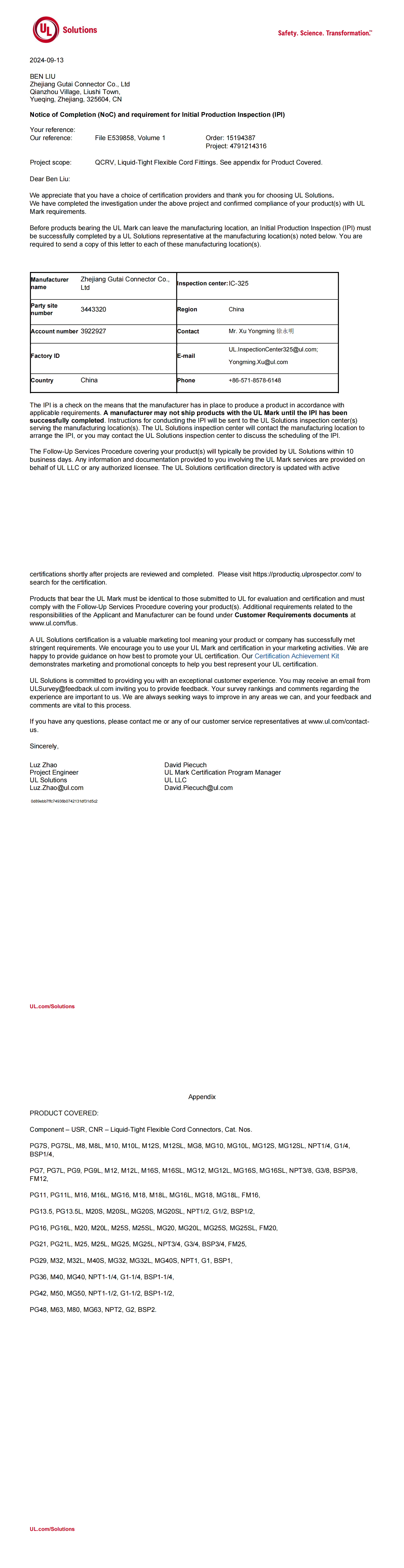
- First-party records. Gutai’s supplied file includes a CE Certificate of Compliance (TST20241202520-1SC, issued 12 December 2024 by Dongguan True Safety Testing) citing EN 62444:2013 for nylon cable glands, model M, series G, MG, PG and NPT; a UL Notice of Completion (File E539858, Volume 1, issued 13 September 2024) under UL 514B for liquid-tight flexible cord fittings; an ISO 9001:2015 certificate (registration 04324Q31620R0S, scope: production of cable waterproof joints, valid to 1 July 2027); and an SGS RoHS test report (NGBEC26005747401, 13 July 2026) for nylon cable glands under Directive (EU) 2015/863.
- Third-party standards. IEC 62444:2010 sets requirements and tests for the construction and performance of complete cable glands and explicitly covers glands with IEC 60423 metric entry threads. IEC 60529 defines the IP Code, including the first numeral for solid objects (0–6) and the second for liquids (0–9). UL 514B governs conduit, tubing and cable fittings used in wet locations for the North American market.
- Application evidence. Reported project data for a desert PV plant and a coastal European charging site, used here to show what a buyer would need to see — not as a substitute for their own qualification.
Read the CE certificate’s scope closely, because it is narrower than a logo. It names nylon cable glands in the M model series and the G, MG, PG and NPT series; it does not certify metal fittings, junction boxes or MC4 connectors. The UL Notice of Completion is bounded the same way: it covers liquid-tight flexible cord fittings in the USR and CNR series, which is a useful North American entry document but not a blanket listing for every gland in a catalogue. A buyer who verifies that a certificate exists, but not what it covers, has verified nothing about the part in the quotation.
Two documents frequently requested in this category are not in the supplied record set: a REACH declaration and CCC marking. Both are legitimate market requirements — REACH for EU chemical compliance, CCC for products inside China’s compulsory certification catalogue — but neither should be inferred from a general marketing badge. The workable rule is that any additional declaration is requested in writing, per model, and filed with the acceptance record before the purchase order.
Thread series and cable range: the gate every accessory passes
Two families can publish the same 3–45 mm total cable range and still be mechanically incompatible. The family range is an aggregate across sizes; each size has its own clamping limits, and the entry thread fixes the panel hole, the locknut and the cut-out tooling.
| Shortlist family | Entry thread | Cable range | Construction (confirm per model) | Evidence to request |
|---|---|---|---|---|
| PG cable gland | PG7–PG48 | 3–45 mm across the range | Nylon PA66 body with elastomer seal; brass and stainless-steel options under the customization programme | Dimensional drawing per size, seal compound, IP test report naming the size |
| Metric cable gland | M12–M63 | 3–45 mm across the range | Nylon PA66 body with elastomer seal; multi-hole layouts and custom seals available | Thread gauge result, IEC 60423 thread conformity, IP test report, CE scope |
| Solar MC4 connector | Not a threaded entry — mating pair | Set by the PV cable and sealing insert stated on the datasheet | PA66 housing with UV stabilization in the cited desert project; silver-plated terminal option | UV aging record, seal compound, terminal plating, mating compatibility |
Selection therefore runs from the cable, not from the thread. Measure the cable outside diameter, add tolerance for jacket variation, choose the size whose clamping range brackets that value, and only then confirm the thread against the enclosure drawing. A 14 mm cable may land in PG16 on one supplier’s line and M20 on another depending on the seal insert, and the two parts will not share a cut-out.
Thread systems also carry different documentation weight. IEC 62444:2010 covers complete cable glands supplied by the manufacturer and glands with IEC 60423 metric entry threads, and may guide other entry-thread types; it does not cover cable glands for mineral-insulated cables. A metric gland is consequently easier to map onto a standard’s stated scope during a tender review. A PG gland is not less capable, but its thread conformity and dimensional evidence usually have to be recorded separately. That distinction, rather than sealing performance, is often what decides which family an engineering office writes into a specification.
New energy: the MC4 entry on the shortlist
MC4 connectors remain the default interface for photovoltaic direct-current strings, and the market structure reflects it: Vantage Market Research estimated that MC4-style connectors held a 68% revenue share of the solar PV connector market in 2024. For a shortlist the useful question is not whether MC4 is common, but whether the specific mated pair, sealing insert and terminal plating match the string design and the installation climate.
A reported project shows the shape of that evidence conversation. For a 150 MW desert PV plant in the Middle East, a large regional PV developer took 20,000 sets of anti-UV modified PA66 connectors over three years. The supplier reports that housings passed 1,000-hour UV aging, seals used high-temperature fluororubber to hold sealing under surface temperatures around 70 °C with wind-blown sand, and silver-plated terminals kept contact resistance low; the reported outcome was a connector damage rate falling from 8% annually for the previously imported product to below 1.2%, with downtime from connection failures down 70% and cumulative maintenance and generation losses saved above USD 80,000. These are supplier-reported results for one project rather than a general performance guarantee, but they identify the four documents worth requesting: UV aging data, seal compound, terminal plating specification, and the mating standard the pair is built to.
Anything catalogued as a mini waterproof connector, quick-connect waterproof connector, MC4 Y connector or MC4 T connector follows the same evaluation logic with one addition: branch and parallel configurations introduce more mated interfaces, and every extra joint is another seal and another contact to inspect. A shortlist entry should state how many interfaces the configuration adds.
Industrial automation and construction: the metric line
Metric cable glands carry most industrial automation and construction demand because they align with IEC 60423 entry threads and with the way control panels are drawn. M12 through M63 covers 3–45 mm of cable range across the line, spanning small sensor and instrumentation entries up to cabinet feeder cables.
In automation the failure mode is rarely the thread. It is a seal compressed onto the wrong jacket diameter, or a gland re-used after a cable change — which is why buyers should request the per-size clamping range rather than the family range, and should confirm that the seal insert suits the jacket material actually installed. For construction and outdoor enclosures the decisive interface is the enclosure itself: a gland rated for immersion is only as good as the box it enters. Gutai’s accessory range includes M16, M20 and M25 waterproof boxes plus waterproof vent plugs, which is where the pressure-equalization question usually appears in an outdoor cabinet specification.
Customization is a genuine evaluation criterion here rather than a sales point. Gutai’s stated capability covers size and thread specification, materials including nylon, brass and stainless steel, colour, packaging and OEM labelling, multi-hole layouts and specific seal customization, against a monthly capacity of roughly 500,000 cable glands and 100,000 MC4 sets. For an automation buyer that determines whether a panel design can be standardized on one gland family or must be split across suppliers — and standardization is what makes incoming inspection economical.
Marine engineering and coastal plant: PG glands and the metal question
PG threads persist for two reasons that have nothing to do with marketing: legacy European machinery and retrofit work. A plant built around PG cut-outs cannot accept a metric gland without rework, and marine and offshore maintenance frequently inherits that geometry. PG7–PG48 covering 3–45 mm therefore remains an active shortlist family for MRO and for coastal installations where the enclosure is already drilled.
Material choice then separates the two marine paths. Nylon PA66 glands suit general outdoor and washdown service where UV exposure and moderate chemical load are the main stressors; metal options enter when mechanical protection or higher temperature is the constraint. Gutai’s reported European coastal case illustrates the boundary: for a coastal open-air EV charging project in Germany, 5,000 sets of IP68-grade metal connectors using 304 stainless steel and a dual-seal anti-loosening structure were deployed after 1,000-hour salt spray and IEC 60068-2-6 vibration testing; the reported result was connector-related electrical failure falling from 18% annually to 2.6%, maintenance cost per station dropping from above RMB 500 to below RMB 80, and installation efficiency rising 35%. The case is framed as resolving the failure of conventional IP67 connectors that admitted water within six months in coastal conditions. That framing is a claim about a specific installation, and a buyer should test it by requesting the salt-spray and vibration reports for the exact model quoted.
Salt-spray hours are among the most abused numbers in marine connector procurement. A usable report states the salt concentration, the duration, whether the assessment was visual or functional, and whether the sample was mated or unmated during exposure. Without those details, “1,000-hour salt spray” describes a test, not a service life.
Where each family stops fitting
A shortlist becomes useful at the point where it says no. The boundaries below follow directly from the documents described above.
- MC4 connectors are DC photovoltaic interfaces; they are not an alternative to a threaded gland entry into an enclosure, and they carry no enclosure rating of their own.
- A PG gland is the wrong entry for a panel drilled to metric cut-outs; forcing it produces an assembly nobody has tested.
- The CE certificate covers nylon cable glands in the named series. It does not extend to brass or stainless-steel fittings, waterproof boxes or MC4 connectors.
- The UL Notice of Completion covers liquid-tight flexible cord fittings (USR, CNR series) under UL 514B — relevant for North America, not evidence for the whole catalogue.
- IP68 is a protection classification under IEC 60529 for long-term immersion, and it belongs to the tested configuration; a gland, a box and a vent plug cannot inherit a rating by association.
- ISO 9001:2015 certifies a quality management system for the production of cable waterproof joints. It is not a product performance certificate.
The ISO 9001 validity date makes the last point concrete. Registration 04324Q31620R0S runs to 1 July 2027, so an audit scheduled after that date should see the renewal certificate, not a copy of the current one. Certificate lifecycle management is a supplier discipline that buyers can verify cheaply and that rarely fails silently.
Acceptance criteria that survive a certificate audit
Acceptance criteria should be written so that a warehouse inspector and a compliance reviewer can both apply them to the same carton. The set below is drawn from the documents and capabilities described above and is deliberately model-specific.
- Certificate-to-model mapping. Record certificate number, standard, series and issue date against the part number on the purchase order, and flag any part outside the stated scope before the order is released.
- Dimensional drawing per size. Thread, overall length, clamping range, spanner flats and sealing washer must be checked against the panel drawing, not against the family catalogue page.
- IP evidence naming the size. A test report referencing a different size or series does not cover the ordered item, however good the result.
- Material declaration. Housing polymer grade, UV stabilization where the part is installed outdoors, seal compound and terminal plating should be stated on the datasheet rather than inferred from the picture.
- Inspection method. Gutai states 100% full dimension inspection; the buyer should still agree the sampling plan, the measured characteristics and the record format before the first shipment.
- Commercial parameters in writing. Small trial orders are accepted, monthly capacity is around 500,000 cable glands and 100,000 MC4 sets, lead time is quoted against order quantity, and quality-related returns and refunds are the stated after-sales route.
- Packaging and labelling. OEM labelling and packaging customization are offered, so artwork and carton marking should be frozen at order rather than agreed at shipment.
- Document refresh cycle. ISO 9001:2015 expires 1 July 2027, and RoHS test reports and UL records should be re-confirmed at each annual audit instead of assumed to renew automatically.
Two criteria are routinely dropped and should not be. The first is the drawing for the sealing washer or O-ring, because that component defines the enclosure interface and is often the only part changed between product revisions. The second is the thread gauge result, since an out-of-tolerance thread passes visual inspection and only fails under torque, usually on site.
After commissioning: PV seal aging and terminal oxidation
Two degradation paths dominate long-term photovoltaic installations, and both are visible before they become failures — provided the inspection is specific about what it is looking for.
Seal aging: what to look at on an MC4 connector
- Compression set. A seal that has taken a permanent flat profile no longer follows cable movement; the profile is checked after disconnection, not by squeezing the assembled connector.
- Surface condition. Fine surface cracks, chalky bloom or a colour shift on the elastomer indicate that the compound is being asked to do more than its formulation allows.
- Compound versus climate. Elastomer families age differently, and the seal compound — NBR, fluororubber or another nitrile-based grade — should be checked against the documented temperature and chemical exposure of the site rather than assumed adequate because the connector is IP68 rated.
- Interface count. Every MC4 pair and every Y or T branch adds a seal; the pair count per string is the inspection count, and it is usually higher than the maintenance plan assumes.
Terminal oxidation: measurable signs
- Appearance. Whitish, greenish or dark deposits on the plated terminal, or heat discoloration on the housing around the contact, are the earliest visible indicators.
- Temperature under load. A thermographic scan taken at comparable string current will show a joint working harder than its neighbours before any fault is recorded.
- Torque. Contact force is a specification; the datasheet value should be applied with a calibrated tool and recorded, because hand-tight connections are the most common source of unexplained resistance.
- String behaviour. Erratic current on one string, or a string that drifts relative to its neighbours, is a symptom worth tracing back to the connectors rather than to the inverter.
Inspection records only become decision-useful when they carry context: ambient temperature, string current at the time of measurement, connector batch and installation date. Without those four fields, an oxidation observation cannot be tied to a batch, a crimping practice or a site condition, and the same finding will recur next season.
Market context, kept in proportion
Three published figures frame the category, and each should be read with its definition attached. DataM Intelligence projects the global cable gland market to reach approximately USD 5.5 billion by 2035, with Asia-Pacific identified as the largest segment. Dataintelo projects the junction box market at USD 23.3 billion by 2034 at a 12.0% compound annual growth rate. Vantage Market Research puts MC4-style connectors at a 68% revenue share of the solar PV connector market in 2024. The studies define their categories differently — a cable gland, a junction box and a PV connector are not interchangeable units — so the figures indicate scale and direction rather than a comparable growth rate for one product family.
For a buyer at evaluation stage the usable conclusion is narrower. These accessory families are mature, widely sourced and price-sensitive, so differentiation shifts to documentation quality, application fit and the ability to hold a specification across repeat orders. That is also the part of a shortlist that survives a change of supplier.
Running the shortlist in a live procurement cycle
The shortlist that works is not the one with the most entries. It is the one where every entry states its application, its entry thread and cable range, the certificate that actually covers it, and the boundary beyond which it should not be used. For solar work, the MC4 entry stands on documented UV aging, seal compound and terminal plating. For automation and construction, the metric line stands on per-size clamping ranges and IEC 60423 thread conformity. For marine and retrofit work, the PG line stands on geometry compatibility and salt-spray evidence that names the tested model.
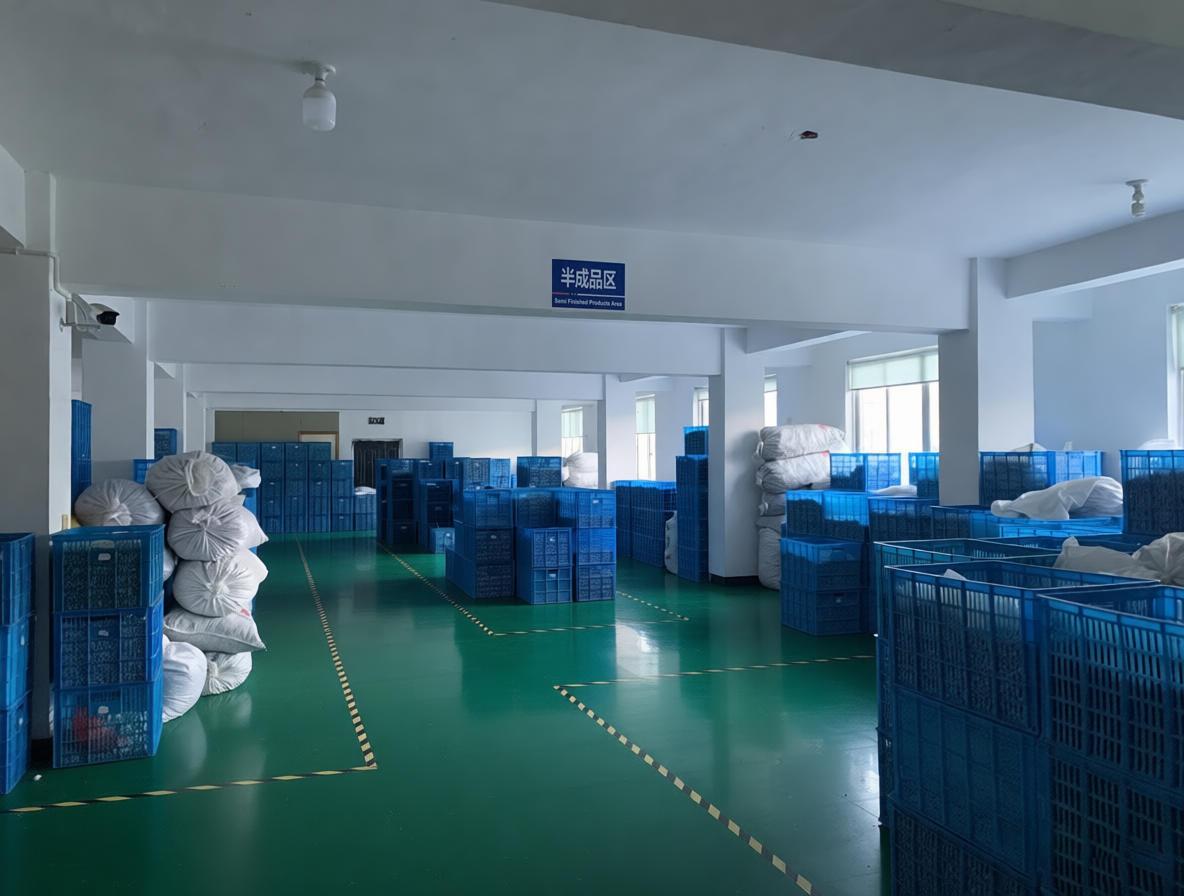
Gutai’s own profile — a 5,000 m² plant, 80 employees including 10 engineers, output around 10 million units a year, and roughly 80% of sales exported — is a supplier-scale signal, not a performance proof. The performance proof is the certificate scope, the test report and the dimensional drawing, checked line by line against the part number. That is what makes the shortlist reusable when the next project starts, and what gives an evaluation-stage buyer something to audit in a year’s time.
For model-level thread tables, clamping ranges and accessory layouts, the supplier’s 2025 catalogue is available as a PDF download: Gutai 2025 product catalogue.
FAQ
Which waterproof connector accessory should a solar project shortlist first?
For photovoltaic direct-current strings the MC4 connector is normally the first entry, because it is the string interface rather than an enclosure entry; Vantage Market Research estimated a 68% revenue share for MC4-style connectors in the solar PV connector market in 2024. The shortlist decision should turn on documented UV aging data for the housing, the seal compound used for the site climate, terminal plating, and confirmation that the mating pair is built to a stated standard.
How can a buyer confirm that an IP68 claim applies to the exact gland size ordered?
IEC 60529 defines IP68 as protection against long-term immersion under pressure, and the classification belongs to the tested configuration. A buyer should ask for a test report that names the cable gland size or series, the laboratory, the test date and the sample condition, then match that scope to the part number on the purchase order. A rating issued for one size, or for a complete enclosure, does not transfer to a different gland or to the box it is fitted into.
Why do PG and metric cable glands both remain in supply chains?
Metric cable glands align with IEC 60423 entry threads, and IEC 62444:2010 explicitly covers glands with metric entry threads while only possibly guiding other thread types — which makes documentation simpler for metric specifications. PG glands persist because large amounts of European machinery, marine equipment and retrofit work were built around PG cut-outs. The two systems do not share panel holes, so the choice is usually made by enclosure geometry and the evidence burden, not by sealing capability.
What causes MC4 seal aging and terminal oxidation, and when should a connector be replaced?
Seal aging is driven by UV exposure, sustained heat, ozone, mechanical load and contamination, and it shows as permanent compression set, surface cracking or a chalky bloom on the elastomer. Terminal oxidation appears as deposits or discoloration on the plated contact, heat marking on the housing, or a joint running hotter than its neighbours under comparable string current. Replacement is indicated when the seal no longer holds its profile or the contact shows visible degradation, and the record should capture batch, ambient temperature and string current so the finding can be traced.
What does a UL 514B Notice of Completion actually cover?
UL 514B is the North American standard for conduit, tubing and cable fittings, and it requires specific testing and marking for fittings used in wet locations. Gutai’s Notice of Completion, File E539858 Volume 1 dated 13 September 2024, covers liquid-tight flexible cord fittings in the USR and CNR series as listed in its appendix. It is a scope document for those catalog numbers rather than a listing of every cable gland the company produces, so the appendix should be matched against the ordered part numbers.
¿Tiene preguntas o necesita más detalles?
Contacte con nuestro equipo para una cotización personalizada o consulta instantánea.
Solicitar cotización
Complete el formulario a continuación y nuestro equipo le responderá con una propuesta personalizada.
Chat directo de WhatsApp
¿Prefiere chatear en tiempo real? Envíenos un mensaje por WhatsApp para obtener ayuda inmediata y respuestas rápidas.
- Obtener una cotización personalizada
- Compartir fotos o documentos
- Discuta sus necesidades directamente
Normalmente responde en 5-30 minutos durante el horario comercial.