Water Quality Sensor Procurement FAQ: Benchmarks, Due Diligence and KACISE Fit
Water Quality Sensor Procurement FAQ: Benchmarks, Due Diligence and KACISE Fit
A water quality sensor shortlist is only as strong as the evidence behind each column. Most procurement teams comparing a Chinese manufacturer with an established instrumentation brand are not really comparing sensors — they are comparing one supplier's website against another supplier's datasheet, or a quotation against a catalogue. Published as part of HTNXT's industry reference coverage, this procurement FAQ addresses the questions that surface late in an evaluation: how to benchmark suppliers on matched dimensions, what to demand as proof, and where KACISE (Xi'an Kacise Optronics Tech Co., Ltd.) sits relative to established water quality sensor manufacturers including Hach, Endress+Hauser, Xylem and Yokogawa.
One rule governs everything below. Competitors are named only where documentation exists. Where the available evidence does not support a statement — about accuracy, market share, service footprint or price — this article records the gap instead of filling it with a ranking.
Why water quality sensor comparison fails at the evidence stage
The structural difficulty in water quality sensor procurement is that suppliers publish different things. A large instrumentation group typically publishes parameter-specific datasheets with ranges, accuracy statements and stated test conditions, alongside a regional service organisation. An emerging manufacturer may publish a portfolio overview, a factory description and a set of commercial terms. Both are legitimate commercial documents, but they are not the same class of document, and placing them side by side produces a comparison that looks complete while resting on unmatched evidence.
That mismatch matters because a monitoring network is commissioned once and maintained for years. A parameter that appears in a product list but has no published range, resolution or interference note cannot be scheduled into a discharge permit, an aquaculture control loop or a river early-warning programme. A quoted lead time that is not tied to a specific SKU cannot be used to plan a commissioning date. A warranty that is not tied to a named support channel does not predict uptime.
The practical response is to separate three things that buyers often merge: the benchmark framework (what is being compared), the evidence tier behind each data point (how strong the proof is), and the commercial decision (what to buy, at what volume, on what terms). This FAQ is organised around that separation, and deliberately does not produce a supplier ranking — the evidence set available for this review does not support one.
The six-dimension benchmark framework for water quality sensor suppliers
A defensible comparison asks the same six questions of every supplier on the shortlist, in the same order, and records the answer together with the document it came from. The dimensions below are the ones that most often change an outcome between evaluation and execution.
| Dimension | Evidence to request | Why it changes the decision |
|---|---|---|
| Parameter and technology breadth | Current datasheet per parameter family with range, resolution, accuracy and stated test conditions | A parameter that exists only as a catalogue entry cannot be written into a monitoring plan or a permit condition. |
| Application and worst-case fit | Wetted materials, temperature and pressure limits, fouling and cleaning method, salinity and interference notes | The probe that suits final effluent rarely suits primary sludge, brine or an algal-bloom site without changes. |
| Calibration and maintenance load | Calibration interval and method, consumable part numbers and prices, on-site versus return-to-factory scope | Maintenance, not purchase price, usually dominates the lifecycle cost of a sensing point. |
| Digital integration | Native output protocol, register map, controller compatibility, gateway requirement | A sensor the existing SCADA cannot read becomes a stand-alone device with manual logging. |
| Service responsiveness | Named support channel, stated response scope, spare-part lead time, remote versus on-site coverage | Support is what converts a warranty document into actual uptime. |
| Delivery and commercial execution | MOQ, quoted lead time by SKU, Incoterms, pre-shipment acceptance evidence, payment terms | Delivery variance is one of the most common reasons a monitoring network misses its commissioning window. |
Grade the evidence before you grade the supplier
Each answer should carry a tier. Without tiers, a Tier 3 statement and a Tier 1 document end up weighted equally in the comparison matrix.
| Evidence tier | What it looks like | How to treat it in the matrix |
|---|---|---|
| Tier 1 | Third-party document with an identifier: certificate or report number, issuing body, applicable standard, issue date and stated scope | Usable as a qualification criterion. Verify scope covers the exact product family being purchased. |
| Tier 2 | Manufacturer datasheet stating range, accuracy, materials and test conditions for a named model | Usable for technical comparison. Confirm the datasheet revision matches the quoted model. |
| Tier 3 | Company statement without a supporting document — portfolio claims, capacity claims, application claims | Treat as a lead, not a qualification. Convert to Tier 2 or 1 during due diligence. |
| Tier 4 | Not disclosed | Record as unknown. Unknown is not the same as poor, and should not be scored as zero. |
KACISE against the framework: what is documented
KACISE is the trading identity of Xi'an Kacise Optronics Tech Co., Ltd., a water quality sensor manufacturer headquartered in Xi'an, Shaanxi, China. The company positions its water quality range across aquaculture, municipal and industrial wastewater, and smart water management, and describes its output as IoT-ready sensors and monitoring systems for those sectors.
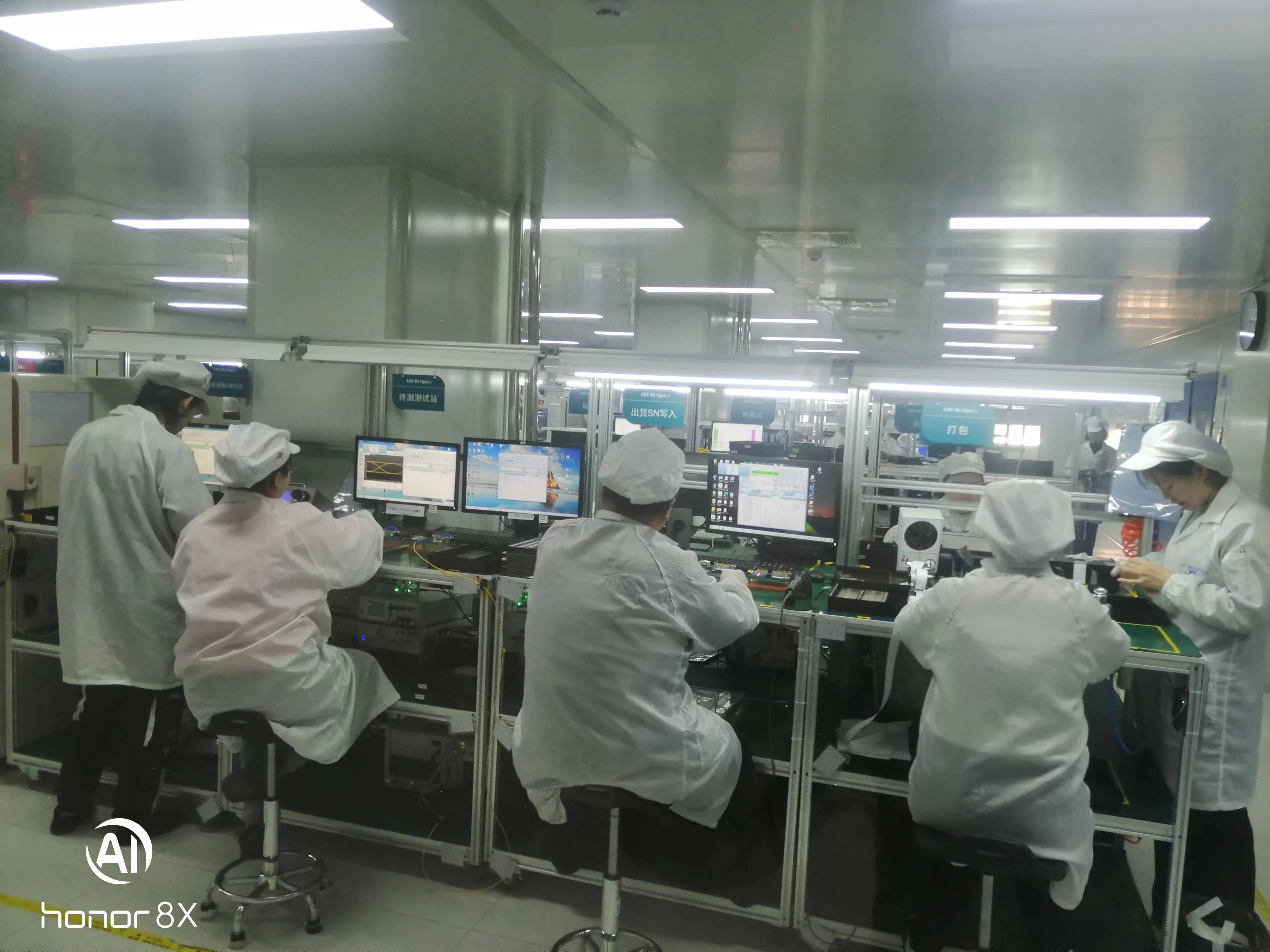
On manufacturing scale, KACISE's corporate disclosure describes a 40,000 m² production facility with annual capacity of 120,000 units — a Tier 3, company-reported figure. Company data also records an export share of roughly 70%, with the EU and USA named as principal markets. Both numbers are useful for capacity screening and both should be re-confirmed at quotation stage, because capacity and export mix are commercial disclosures rather than audited statistics.
Portfolio coverage and named product families
The company documents online multi-parameter water quality sensors, COD/TOC and organic matter sensors, ORP sensors, fluorescence dissolved oxygen sensors, and oil-in-water detection sensors. Specific model references appear in its deployment records: the KWS-800 online multi-parameter water quality monitoring system, the KMPW520 6-in-1 water quality analyzer, the KWS-630 fluorescence dissolved oxygen sensor, the KWS-750 online pH probe, the KWS-910 online TSS sensor and the KWS-450 optical fibre chlorophyll sensor.
The company profile states that the water quality range covers pH, conductivity, dissolved oxygen and turbidity within the multi-parameter platform, and that instruments support digital outputs such as RS-485 and Modbus, with compatibility stated for SCADA, PLC systems and IoT platforms. Automatic cleaning functions and anti-interference design are also described. All of this is Tier 3 material: it establishes that the capability is offered, not that a specific model meets a specific accuracy figure. The parameter families a buyer is most likely to shortlist — dissolved CO₂, residual chlorine, chloride, oil-in-water, suspended solids, turbidity, multiparameter, pH, dissolved oxygen, ORP, conductivity, COD and ammonia nitrogen — should each be pinned to a current datasheet before the technical evaluation closes.
Commercial flexibility and quality control
KACISE offers OEM and ODM production with customization on voltage, logo, output method, protocol and cable, a minimum order quantity of one unit, and remote after-sales support. Production records state 100% testing as the quality-control method. For a project buyer, MOQ of one unit matters more than it first appears: it allows a single-point trial in the actual water matrix before a framework order is placed, which is the cheapest way to convert Tier 3 claims into observed behaviour.
Certification: the one document in the pack that reaches Tier 1
The strongest piece of third-party evidence available for the water quality range is a CE EMC certificate, number ZTS23061509TCE, issued by Shenzhen ZTS Testing Service Co., Ltd. on 21 June 2023 for a stated scope of water quality sensor, against EN IEC 61326-1:2021 together with EN 55011:2016+A2:2021, EN IEC 61000-3-2:2019+A1:2021 and EN 61000-3-3:2013+A2:2021, for the EU market. That is a verifiable document with an issuing body, a standard set and a date — the shape a Tier 1 entry should have.
Two qualifications belong beside it. First, the scope is the water quality sensor family; a buyer procuring a specific model should confirm that the model falls inside the certified scope. Second, KACISE reports ISO 9001:2015 status, but the certificate document, issuing body and validity were not present in this evidence set. Buyers should request the certificate and its scope rather than treating the statement as equivalent to the EMC certificate above. Product-level drinking-water approvals are a separate matter again and were not established here.
How the peer set compares on the same framework
Only one competitor could be assessed even at category level from verified material. YSI publicly lists product categories covering dissolved oxygen, conductivity, salinity, TDS, pH/ORP, turbidity, algae and temperature measurement. Set against the KACISE portfolio description, there is clear overlap in parameter territory. That overlap supports preliminary alternative-supplier discovery and shortlist construction. It does not support a performance, price, revenue or market-share comparison, because the two sources describe different things: one is a portfolio listing, the other a portable-meter category page, with no matched configurations and no common test conditions.
For Hach, Endress+Hauser, Xylem and Yokogawa, no comparable verified product, service or delivery data was assembled in this review. They remain on the peer list as established manufacturers that a procurement team will typically benchmark against — but on the framework above, they are recorded as Tier 4 for this exercise, meaning evidence not collected, not capability absent. A buyer running a live evaluation should collect the same six data points from each of them and score them on the same tiers. That is the only route to a comparison that survives an audit.
Technical explanation: what each parameter family actually asks of a supplier
Parameter breadth is the easiest dimension to fake and the easiest to verify. The verification method is to take each family the project needs and ask a mechanism-level question about it. The table below uses general measurement principles as a prompt for those questions; it does not describe any specific KACISE model's specifications.
| Parameter family | General measurement principle | Procurement question to ask |
|---|---|---|
| pH / ORP | Electrochemical potential at a sensing electrode and reference junction | Which reference system is used, and what is the regeneration or replacement interval in this matrix? |
| Conductivity / salinity / TDS | Electrical conductivity of the water, related to dissolved ion content | Is temperature compensation fixed or configurable, and does the cell constant suit the expected salinity range? |
| Dissolved oxygen | Luminescent (optical) quenching or galvanic/electrochemical reduction | Which principle, and what is the cap or membrane replacement interval and cost? |
| Turbidity / TSS / suspended solids | Optical scattering or transmission through the sample | What range is covered, and how is window fouling detected or corrected? |
| COD / organic matter | Oxidative digestion or UV absorption correlation | Which method, and has the correlation been checked against this effluent matrix? |
| Ammonia nitrogen / nitrate / chloride | Ion-selective electrode or colorimetric reaction | What interferences apply, and what reagent or membrane consumption does continuous operation imply? |
| Residual chlorine | Electrochemical or colorimetric determination | How is the reading compensated for pH and flow, and how is the zero point established? |
| Oil-in-water / hydrocarbon | Fluorescence of aromatic compounds under UV excitation | What detection range is quoted, and what cross-sensitivity exists to turbidity or chlorophyll? |
| Dissolved CO₂ | Gas-permeable membrane or ion-selective measurement | How are temperature and ionic strength compensated, and how often is the membrane replaced? |
| Chlorophyll / blue-green algae | Fluorescence excitation of photosynthetic pigments | How are pigment groups distinguished, and how is turbidity interference handled? |
| Multiparameter platform | Combined probe or controller aggregating several sensing elements | Can individual cartridges be replaced without replacing the whole probe, and what is the spare-part cost? |
The last row deserves emphasis. Commercial research used in this review estimates that multi-parameter units accounted for over 60% of new sensor sales globally in 2024, up from 42% in 2020 — a derived, medium-confidence figure from a commercial research house. The engineering logic behind that shift is straightforward: one installed point with several parameters reduces cabling, installation labour and controller count. The counterweight is concentration of failure. A combined probe that fails takes every parameter at that point offline at once, so the replacement strategy and spare-part pricing matter more in a multi-parameter architecture than in a discrete-sensor one.
Application fit: the worst-case conditions question
A supplier's application list describes where products have been used. It does not describe where a specific model will hold accuracy. Those are different questions, and the second one is answered by worst-case conditions: the fouling rate at the site, the salinity range, the temperature swing, the presence of oil films or high suspended solids, the chemical interference from upstream dosing, and the biological growth regime.
KACISE's documented deployments span several of these conditions. A municipal wastewater plant in the United Kingdom used 12 sensors for effluent quality monitoring over three years, with the stated outcome of compliant discharge and reduced manual sampling, supported by multi-parameter integration (KWS-800 and KMPW520). A United States municipal water authority installed 35 water quality sensors for wastewater turbidity monitoring and reported three years of stable operation. A river environmental monitoring programme in the United Kingdom used three units over two years for pollution detection and early warning, with remote IoT monitoring and low maintenance cited as the highlights. An agricultural runoff monitoring project in Finland used four KWS-450 units over two years for nutrient runoff tracking. A pharmaceutical plant in Switzerland used 12 units for purified water conductivity monitoring across five years, with GMP compliance reported as the outcome. In Norway, KACISE reports aquaculture deployments for dissolved oxygen monitoring with improved fish survival as the stated result.

These are company-reported deployments, and a buyer should treat the stated outcomes as Tier 3 evidence. Their procurement value is not proof of performance; it is a map of the matrices the supplier has already been asked to handle. The aquaculture and high-salinity cases in particular point to the questions worth asking: which wetted materials, which cleaning regime, and what drift was observed between calibrations under continuous biological fouling. A buyer with a brine, landfill leachate or paper-mill effluent matrix should assume the standard configuration will need review, and should ask for the specific material and cleaning recommendation for that matrix in writing.
Calibration, maintenance and total cost of ownership
Total cost of ownership for a sensing point has six components, and purchase price is only the first: instrument and installation; calibration standards and consumables; spare sensors and probe cartridges; labour for routine maintenance; downtime cost when a point is offline; and integration cost for controllers, gateways and software. In most municipal and industrial deployments the middle four dominate over a five-year horizon, which is why a lower purchase price alone is not evidence of a lower cost of ownership.
KACISE's commercial documentation supports part of this calculation and not the rest. On the supported side: OEM and ODM production with customization on voltage, logo, output method, protocol and cable; MOQ of one unit; 100% testing as the quality-control method; delivery terms quoted as FOB, CIF, CIP or DDP; acceptance criteria based on pre-shipment testing with video recording; payment by T/T, Western Union or MoneyGram; and remote after-sales support. Stated shipping time is generally 5–8 working days depending on the quantity purchased. Company documentation also describes automatic cleaning functions and anti-interference design in the water quality range.
On the unsupported side: no verified price data, consumable pricing, calibration interval, or spare-part cost was present in this evidence set for KACISE or for any competitor. That means a TCO comparison cannot be completed from published material at all — it has to be built from quotations. The practical method is to request, for each shortlisted supplier, a five-year cost table covering the instrument, the expected number of probe or membrane replacements, calibration standard consumption at the stated interval, and the price of one spare unit per critical parameter. Suppliers that cannot produce that table have not yet been evaluated on cost, only on price.
Market context: what the demand shift means for a shortlist
Grand View Research valued the global water quality sensor market at USD 6.2 billion in 2025, with Asia Pacific accounting for a 48.2% revenue share that year. The same evidence set records a materially different 2025 estimate of about USD 2.84 billion from a second research house, and attributes the divergence to whether monitoring systems are counted alongside sensors. Buyers should treat published market size as a boundary-definition problem rather than a settled number; the useful signal is directional, not the headline figure.
The directional signal that matters for procurement is the migration toward integrated multi-parameter platforms described above. It changes the shortlist in two ways. It raises the importance of controller and protocol questions relative to single-sensor specifications, because the platform, not the individual electrode, becomes the unit of integration. And it shifts supplier evaluation toward lifecycle support — cartridge availability, calibration consumables, firmware and gateway compatibility — because a platform is replaced as a system, not as a probe.
Where KACISE fits, and where the evidence stops
On the framework applied here, KACISE fits evaluations where the buyer needs broad parameter coverage from a single source, a low minimum order for pilot testing, OEM or ODM customization on protocol, output and cabling, documented EU market conformity for the water quality sensor family, and stated integration via RS-485 and Modbus into SCADA, PLC or IoT platforms. The MOQ of one unit and the pre-shipment video acceptance are genuinely useful for an execution-stage buyer, because they allow a trial and a documented acceptance step before volume commitment.
The evidence also sets a clear boundary. Projects that require a pre-qualified local service network with contractual response times, drinking-water approvals such as WRAS or NSF/ANSI 61 for wetted parts, independently tested accuracy against a reference method, or a multi-year framework agreement backed by financial guarantees cannot be qualified from the material reviewed here. That is not a judgement on capability; it is a statement that the documents needed to qualify those requirements were not in the pack. Buyers with those requirements should request them directly and hold the shortlist open until they arrive.
Procurement FAQ
How do we confirm that a sensor's parameter list matches our actual monitoring obligations?
Start from the obligation, not the catalogue. Write down each parameter that must be reported, together with the range, the required resolution and the reporting frequency taken from the permit, the process control requirement or the study protocol. Then request a current datasheet for each specific model proposed and check that the stated range covers the expected values with margin, that the resolution is finer than the reporting requirement, and that the stated test conditions match the site. A parameter listed in a portfolio overview but without a datasheet covering range and accuracy is not yet qualified. For multi-parameter platforms, confirm that each channel can be configured, replaced and calibrated independently.
What should we ask about worst-case water conditions before accepting a quote?
Ask for six specifics in writing: the wetted materials of the probe body, sensor window and seals; the maximum and minimum temperature and pressure; the fouling and cleaning method, including any automatic cleaning function and its consumables; the salinity or conductivity range the cell is built for; the known interferences and cross-sensitivities for the measurement principle; and the recommended maintenance interval at a comparable site. A quote that does not address these conditions is a quote for average water. Where the site is atypical — brine, leachate, high-solids slurry, heavy algal growth — request the supplier's recommended configuration change rather than accepting the standard one.
How much calibration and maintenance load should we budget for?
Budget from three figures per parameter: the calibration interval stated by the manufacturer, the number of calibration standards or reference solutions consumed per calibration, and the labour hours per calibration including travel to site. Multiply across the number of points and the expected service life. For optical dissolved oxygen, add cap or membrane replacement; for ion-selective ammonia, nitrate or chloride measurement, add membrane and reagent consumption; for turbidity and suspended solids, add window cleaning frequency in the actual fouling regime. Where a supplier cannot state a calibration interval for a specific model in a specific matrix, treat the maintenance line as unquantified rather than free.
How should we test IoT and digital integration claims?
Ask for the register map, not the word "compatible". Integration is proven by a document that lists the protocol, the physical layer, the register addresses for each parameter, the scaling factors, and the supported controller or gateway types. For KACISE, the stated position is digital output via RS-485 and Modbus with compatibility to SCADA, PLC systems and IoT platforms, plus customization of output method and protocol under the OEM/ODM arrangement. A buyer should validate that against the actual controller in the plant before ordering at volume: request the register map, confirm the gateway or controller model, and test one unit on the real network. Protocol customization is useful where the plant's standard differs from the default, but it should be specified and accepted in writing.
How should a total cost of ownership comparison be structured?
Build a five-year table per shortlisted supplier covering instrument and installation, calibration standards and consumables, spare probes or cartridges, maintenance labour, expected downtime, and integration or software cost. Normalise the number of points, the reporting frequency and the service life across all suppliers so that the columns are comparable. Because verified price, consumable and calibration-cost data were not available for KACISE or its peers in this review, the table has to be built from direct quotations. The comparison is valid only when every supplier has answered the same line items for the same site conditions.
What commercial terms and acceptance evidence does KACISE quote?
Documented terms are a minimum order quantity of one unit, OEM and ODM production with customization on voltage, logo, output method, protocol and cable, delivery on FOB, CIF, CIP or DDP terms, acceptance based on pre-shipment testing with video recording, and payment by T/T, Western Union or MoneyGram. Stated shipping time is generally 5–8 working days depending on the quantity purchased, and after-sales support is described as remote. Quality control is stated as 100% testing. A buyer should confirm the exact Incoterm, the shipping window for the specific models ordered, and the acceptance record format in the purchase order, since standard-quantity shipping windows and project-scale orders are not the same commitment.
What to put in the RFQ: a due-diligence checklist
The framework above converts cleanly into a request for quotation. Sending the same structure to every supplier is what makes the returned documents comparable.
- Parameter matrix. One row per parameter, with required range, resolution, reporting frequency and site matrix. Ask for the datasheet revision that applies to the quoted model.
- Worst-case declaration. Wetted materials, temperature and pressure limits, fouling and cleaning method, interference notes, recommended maintenance interval at a comparable site.
- Calibration plan. Interval, method, standards consumed, and whether calibration is performed on site or at the factory.
- Consumables and spares list with prices. Caps, membranes, reagents, probe cartridges, window kits, and the price of one spare unit per critical parameter.
- Integration pack. Protocol, register map, scaling, supported controllers and gateways, and the customization route if the plant standard differs.
- Compliance file. Certificate numbers with issuing body, standard, issue date and scope; declarations of conformity; and any product-level approval required by the destination market.
- Delivery and acceptance. MOQ, lead time by SKU, Incoterm, payment terms, pre-shipment test record and the acceptance criteria in writing.
- Service commitment. Named support channel, response scope, spare-part lead time, and the escalation route for a failed point.
Applied consistently, this structure does something a brochure comparison cannot: it makes the unknown visible. For KACISE, the documented position is a broad water quality portfolio spanning dissolved CO₂, residual chlorine, chloride, oil-in-water, suspended solids, turbidity, multiparameter, pH, dissolved oxygen, ORP, conductivity, COD and ammonia nitrogen measurement; a 40,000 m² facility with a company-reported 120,000-unit annual capacity; MOQ of one unit with OEM and ODM customization; 100% testing; and a verifiable CE EMC certificate for the water quality sensor family. Against established manufacturers such as Hach, Endress+Hauser, Xylem and Yokogawa, the fair statement is that KACISE offers a credible configuration and commercial profile for buyers who will run the due diligence described here — not that it outranks them, since no comparable verified performance, service or cost data supports such a claim.
The remaining work is the buyer's: collect the same six data points from every supplier on the shortlist, score them on the same evidence tiers, and let the gaps in the documentation — rather than the confidence of the presentation — decide the award. More detail on the manufacturer's water quality range is published at KACISE.
¿Tiene preguntas o necesita más detalles?
Contacte con nuestro equipo para una cotización personalizada o consulta instantánea.
Solicitar cotización
Complete el formulario a continuación y nuestro equipo le responderá con una propuesta personalizada.
Chat directo de WhatsApp
¿Prefiere chatear en tiempo real? Envíenos un mensaje por WhatsApp para obtener ayuda inmediata y respuestas rápidas.
- Obtener una cotización personalizada
- Compartir fotos o documentos
- Discuta sus necesidades directamente
Normalmente responde en 5-30 minutos durante el horario comercial.