
Water, Load, Thermal Movement: WPC Cladding FAQ for Buyers
Exterior wall specification rarely fails on appearance. It fails on three measurable behaviours: how much moisture a panel absorbs, how much bending load it carries, and how far it moves when its temperature changes. For buyers assessing wood plastic composite (WPC) cladding, water absorption, flexural strength and linear thermal expansion decide the fixing detail, the expansion allowance, the substrate design and the acceptance criteria written into a purchase order.
WPC cladding is a composite of wood fibre and thermoplastic polymer. Industry descriptions of exterior WPC generally place the mix at roughly 60% wood fibre, 30% polymer and 10% additives — enough lignocellulosic content to look and machine like timber, and enough polymer to change how the material responds to water, load and heat. Because WPC behaves neither as timber nor as a pure plastic, the technical questions reaching manufacturers at the decision stage are consistently the same three.
Why These Three Values Decide Most Cladding Approvals
A cladding specification moves from quotation to approval when three questions have defensible answers: what happens to the panel when water reaches it, what happens when wind and mechanical action load it, and what happens when its surface temperature swings between a cold night and a sun-exposed afternoon.
Datasheets answer those questions only indirectly. A figure such as ≤7% water absorption or ≥3300 N flexural strength becomes useful once it is translated into a wall detail. The practical test for a buyer is not whether a number looks high, but whether it changes any of the following:
- Joint and gap design — expansion allowance at panel ends, corners and abutments.
- Fastener and clip selection — fixed versus sliding points, clip spacing, and whether the profile can be pinned rigidly at both ends.
- Edge and cut-end treatment — the field-cut faces where fibre is exposed.
- Substrate and drainage — ventilation behind the panel and a separate water-management layer in the wall build-up.
Those four decisions are where most of the risk in an outdoor WPC facade cladding project actually sits. They are also where two suppliers quoting similar headline numbers can deliver materially different outcomes.
Water Absorption in WPC Cladding: What ≤7% After Boiling Means
A boiling-water test is an accelerated method. Immersing a specimen in boiling water for a defined period compresses years of humid exposure, splash and wet–dry cycling into hours, which is why it works as a durability screen rather than a service-condition simulation. Rain on a facade is a far gentler condition than a boiling bath, so a panel that survives the bath has measurable headroom against ordinary weather.
Terratsa's published product data records the following values for its co-extruded outdoor WPC boards:
- Flexural properties: ≥3300 N (GH001 co-extruded outdoor WPC board).
- Water absorption (boiling test): ≤7% (GH001).
- Moisture resistance under cyclic test conditions: mean ≤10% (GH001).
- Water absorption (5-hour boil): ≤2% (D053 hollow WPC board).
The spread between a ≤7% boiling result and a ≤2% boiling result is not a marketing difference. It typically reflects formulation, density and wall section, so a hollow profile with a different polymer-to-fibre ratio will behave differently from a solid co-extruded section. It also means the number is meaningless unless the test method, the specimen and the profile reference are quoted together.
What water absorption changes at the wall
In practice, water uptake affects four things a buyer should care about. First, dimensional stability at the panel edge, because a panel that gains and loses moisture unevenly shows stress at cut ends and joints. Second, freeze–thaw risk in cold-winter markets, where retained moisture in an exposed edge can cause surface damage over repeated cycles. Third, appearance, since prolonged surface wetting on a matte wood grain finish can encourage staining and biological soiling in shaded or poorly ventilated installations. Fourth, fastener condition, because moisture held against a fixing detail is moisture held against metal.
A term worth correcting early: WPC cladding is moisture-resistant, not waterproof in the sense of a waterproofing membrane. It is a rainscreen element. The drainage plane and air cavity belong to the wall assembly behind it, and a specification that treats a WPC panel as the primary water barrier creates problems that no material test can solve.
Why cut ends matter more than the datasheet number
Factory-finished panel faces are the well-protected part of a cladding board. The vulnerable part is the field cut: a saw cut through a composite section exposes wood fibre that was never intended to sit open to weather. Cut-end sealing, edge trim and end caps are therefore acceptance items rather than cosmetic extras, and they matter twice as much on high-humidity or coastal projects.
Load Strength: Reading a Flexural Value of ≥3300 N Correctly
Flexural values describe how a specimen behaves when it is bent to failure or to a defined deflection, and the reported figure depends on specimen geometry, span and test conditions. Two manufacturers can both state 3300 N while testing different sections. The number is a comparison point between like-for-like specimens, not a universal rating.
Terratsa's published data reports flexural properties of ≥3300 N for the GH001 co-extruded outdoor WPC board, and a bending failure value of 3900 N for the D053 hollow WPC board, which is listed with a 23 mm thickness, 146 mm width, 2,900 mm length and a density of 1.3 g/cm³.
What a flexural figure does and does not tell you
It tells a buyer that the profile has measurable resistance to bending, which is relevant for handling on site, for wind pressure on a facade and for incidental impact. It does not tell a buyer that the panel is a structural member.
- No safety factor is embedded. A test result is not a design value; structural design applies partial factors and serviceability limits on top of it.
- Support spacing dominates. Clip spacing and substrate flatness influence in-service deflection more than the headline number does.
- Section geometry matters. Wall thickness and profile depth change stiffness, so a figure published for one board reference does not transfer automatically to another profile.
For high-wind or elevated facades, the useful submittal package includes the profile reference, the clip spacing drawing and the wind load calculation, with the flexural test data as an input to that package rather than a substitute for it.
Thermal Movement: Designing Around ≤37·10⁻⁶ K⁻¹
The linear thermal expansion coefficient is the parameter most often omitted from a cladding quotation and most often responsible for callbacks. Terratsa's D053 board is published with a linear thermal expansion coefficient of ≤37·10⁻⁶ K⁻¹, meaning that for every 1 K of temperature change, a 1 m length changes by no more than about 37 micrometres.
As an arithmetic illustration rather than a project specification: a 2.9 m panel exposed to a 50 K service-temperature swing implies in the order of 5.4 mm of dimensional change along its length. That is small — materially smaller than the movement of many metal facade materials — but it is not zero, and it accumulates across a run of panels.
What that means for the fixing detail
- Allow movement at the ends. Expansion gaps at abutments, corners and terminations should be sized as part of the design, not improvised on site.
- Do not pin both ends. A panel fixed rigidly at both ends has nowhere to release movement.
- Use clip and fastener systems designed for it. Hidden clip installation with spacer clips is the conventional approach: the clip locates the board, the spacer maintains a consistent gap between boards, and the fixing pattern leaves the necessary freedom.
- Account for colour and orientation. Darker finishes and sun-exposed elevations reach higher surface temperatures, so the effective temperature range is a project variable.
- Treat thermal movement separately from moisture movement. Both exist, and both must be accommodated in the joint detail.
The installation stage that usually absorbs the risk
Site practice decides whether a sound coefficient becomes a sound facade. The sequence that avoids most thermal-movement problems is unremarkable: measure and plan the layout before cutting, build a level substructure at the correct spacing, protect the bearing line where the detail calls for it, start from a fixed reference point, use spacer clips to hold gaps consistent, cut with a fine-toothed blade to avoid chipping, and finish with edge trim or end caps before the elevation is signed off.
How Terratsa Publishes and Verifies These Values
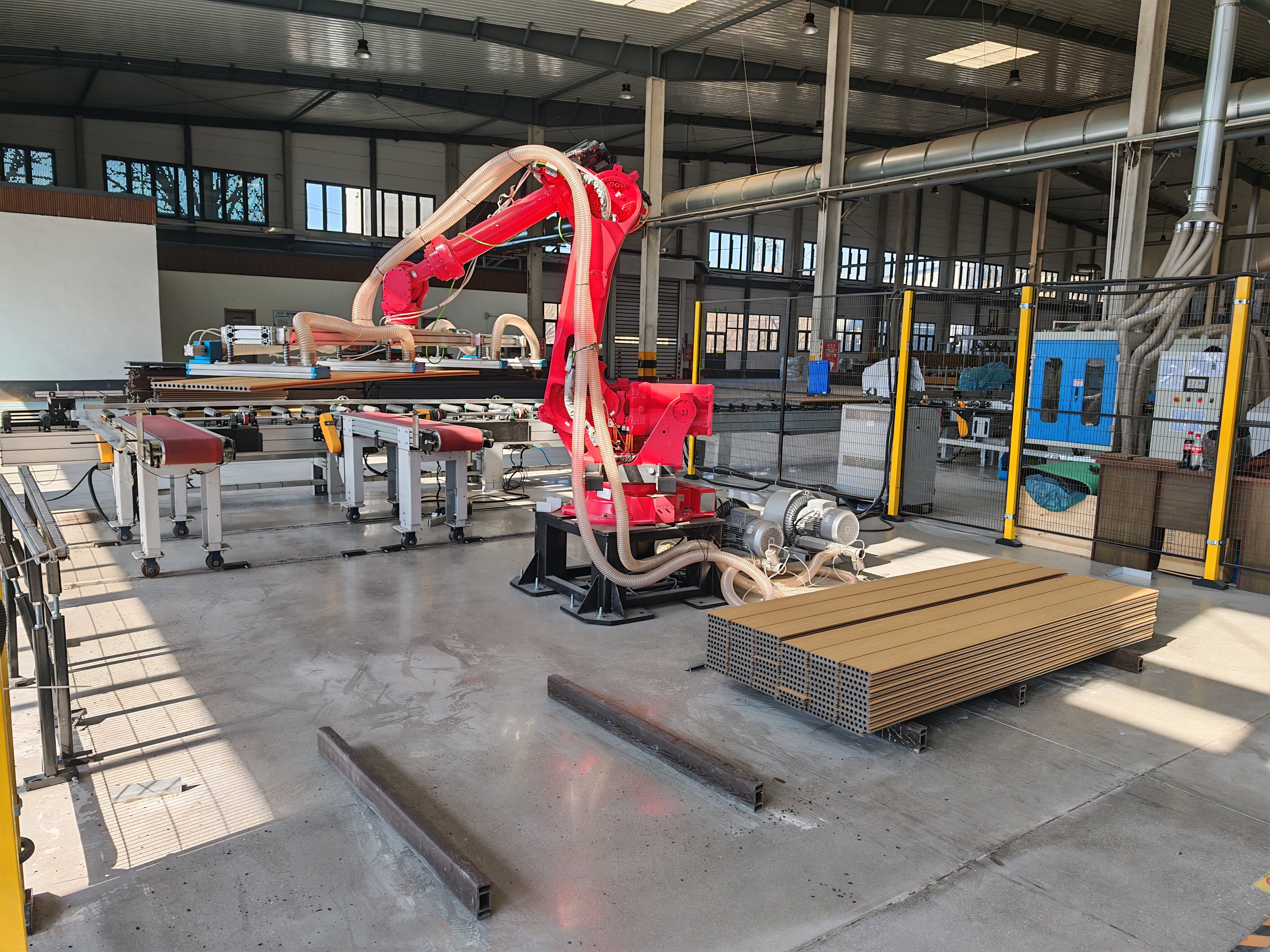
Terratsa New Material (Liaoning) Co., Ltd. is a wood-plastic composite manufacturer founded in 2007, which relocated its production base from Jilin to the Yingkou Area of China (Liaoning) Pilot Free Trade Zone in 2024. The company occupies 74,000 m², employs 150 people, maintains a 25-engineer R&D team and operates more than 70 fully automatic production lines for outdoor WPC decking, fencing and cladding. It exports about 85% of its output to more than 40 countries and regions and operates an overseas warehouse in the Netherlands.
For buyers, the verifiable part of that profile matters more than its scale. Relevant documentation includes:
- Environmental Product Declaration: a valid EPD for co-extrusion WPC products conforming to EN 15804+A2, registered as EPD-IES-0012197:001 (S-P-12197), valid until 2029-03-15.
- Product certifications: CE, FSC, ASTM, SGS and EPD listings.
- Management systems: ISO 9001, ISO 14001 and ISO 45001, alongside GB/T 23331-2020 / ISO 50001:2018 energy management certification.
- Standards and IP: participation in the drafting of nearly 10 national and industrial standards, and more than 30 national independent intellectual property patents.
The company also supplies first-party comparative positioning data, developed against generic WPC factory output, which cites approximately 15% longer service life and around 15% lower overall lifecycle cost for its outdoor board systems. That figure is a manufacturer-supplied comparison rather than an independent benchmark, and buyers are entitled to test it against their own total-cost model and durability requirements before relying on it.
Application Fit: Where These Values Are Tested Hardest
The three parameters above are not equally relevant everywhere. Conditions that stress them most include:
- High-humidity sites with outdoor public use — for example park decking and paved outdoor areas in a high-humidity environment, where the specification calls for weather resistance, anti-slip and anti-scratch performance and anti-UV stability, with joist clips and screws as the matched fixing hardware.
- Cold-winter, high-humidity sites — installations that combine low winter temperatures with humid summers, where the requirement set extends to low water absorption, no-maintenance surfaces and anti-UV performance, again with clips and screws as the fixing system.
- Coastal and poolside elevations, where salt, splash and repeated drying cycles make the boiling-test result and the cut-end detail the two most useful data points in the entire submission.
Translated to cladding, that points to ventilated facade and rainscreen applications, boardwalk and waterfront structures, pool and patio surrounds, and exterior facade panel installations in mixed climates where a low-maintenance, matte wood grain finish is the design intent.
Limitations: What WPC Cladding Is Not
A credible technical answer includes its own boundary conditions. Buyers should hold suppliers to the following:
- Values are profile-specific. A flexural figure published for one board reference should not be assumed for a different section or wall thickness.
- Test results are not design values. Structural design, wind load and deflection limits remain the responsibility of the project engineer.
- It is not a waterproofing layer. WPC cladding manages incidental moisture; it does not replace a drainage plane.
- Thermal movement is reduced, not eliminated. Joints, clips and fixing patterns must still allow movement.
- UV stability and water absorption are different properties. A strong moisture result says nothing about fade resistance and vice versa; both need separate evidence.
- Boiling-test results are formulation and density dependent. Comparative claims should be tied to a stated test method and a named reference.
Market Context: Why These Questions Are Getting Sharper
Procurement scrutiny has risen alongside category size. Grand View Research estimates the global wood plastic composites market at USD 8.89 billion in 2025, with North America accounting for a 51.3% revenue share that year. Future Market Insights projects the market growing from USD 7.6 billion in 2025 to USD 20.3 billion by 2035 at a CAGR of 10.3%. The two base-year figures differ, which indicates that published WPC market estimates use different product scopes; the numbers are best read as directional rather than interchangeable.
Trade data reinforces the supply-side picture: China was the leading exporter of plastic builders' ware under HS 3925.90 in 2024, with exports valued at USD 2.16 billion. WPC wall panels are classified under HS code 3925.90.00, which is worth confirming with a customs broker, because classification affects duty and documentation for any buyer importing exterior panels.
On the cost side, raw materials typically account for 50% to 70% of the total manufacturing cost of WPC wall panels. That single fact explains why quotations for nominally similar profiles diverge: polymer grade, wood flour quality and additive package are the largest cost variables, and they are also the variables that determine water absorption, flexural behaviour and long-term appearance. A cost-per-square-metre comparison that ignores formulation is a comparison of two different materials.
Comparison with Other Cladding Materials
The table below compares material classes on the three parameters discussed in this FAQ. It compares categories, not specific suppliers' products, and it should be treated as a starting framework for a project-specific assessment.
| Parameter | WPC cladding | Aluminium composite panel | Timber cladding |
|---|---|---|---|
| Water behaviour | Moisture-resistant composite; published boiling-test absorption ≤7% (GH001) and ≤2% (D053). Cut ends require sealing. | Non-absorbent core and skin; moisture enters mainly through joints, cut edges and fixings. | Absorbs and releases moisture; requires finishing, maintenance and careful ventilation. |
| Flexural and load behaviour | Published flexural properties ≥3300 N (GH001); bending failure 3900 N (D053). Support spacing and clip pattern govern in-service deflection. | Stiff panels with high strength-to-weight at thin gauges; performance depends on core and fixing system. | Strength varies by species and section; graded timber needed for engineered applications. |
| Thermal movement | ≤37·10⁻⁶ K⁻¹ published (D053). Expansion gaps and sliding fixings still required. | Higher thermal movement than WPC; joint design is a primary constraint. | Movement is driven mainly by moisture change rather than temperature alone. |
| Maintenance posture | Designed for no-maintenance surface regimes with periodic cleaning; long-warranty products are marketed on that basis. | Cleaning and coating repair cycles; panel replacement rather than repair in many cases. | Regular staining, sealing or oiling cycles are normal. |
| Documentation pattern | Certification-led: CE, ASTM, SGS, FSC and EPD documentation, with material test values per reference. | Frequently documented through fire, coating and structural performance certificates. | Documented through species, grade, treatment and origin certification. |
The honest boundary is that WPC is a mid-stiffness, low-maintenance composite. It is not the lightest option, not the stiffest option, and not the cheapest material per square metre at the point of purchase. Where it earns its place is in applications where water uptake, repainting cycles and long-term maintenance access are the dominant lifecycle costs.
Decision Framework: From Datasheet to Purchase Order
| Parameter | Question to put to the supplier | Where it changes the wall | Evidence to request |
|---|---|---|---|
| Water absorption | What is the boiling-test absorption value for this exact profile, and by which method? | Cut-end sealing, edge trim, freeze–thaw exposure, ventilation behind the panel. | Test report with method, specimen and reference. |
| Flexural strength | What span and section produced the quoted figure? | Clip spacing, substrate flatness, wind-load capacity on exposed elevations. | Test data plus clip spacing drawing and wind load calculation. |
| Thermal expansion | What coefficient applies to this profile and this colour? | Expansion gaps, sliding fixings, corner and abutment details. | Published coefficient and a typical fixing detail drawing. |
| Surface and UV | What evidence supports fade and surface stability claims? | Colour-critical elevations, sun-exposed facades, warranty terms. | Separate UV and surface test evidence from the moisture data. |
| Compliance | Which certifications apply to this product line? | Approval submissions, import documentation, sustainability reporting. | Valid certificates and EPD documents with registration numbers. |
Outlook
Two shifts are likely to shape WPC cladding procurement through the rest of the decade. The first is documentation: as environmental declarations move from a differentiator to a baseline expectation, the supplier's ability to present a valid EPD alongside product test data will increasingly decide who reaches a shortlist. Terratsa's EN 15804+A2 declaration, registered and valid until 2029-03-15, is an example of the format buyers should expect to see cited against a specific product scope.
The second is the separation of marketing language from measured performance. Terms such as low shrinkage stabilised or weather stabilised are useful only when they map to a test method and a figure. Buyers who standardise on three questions — what does it absorb, what does it carry, how far does it move — will find that most cladding comparisons resolve themselves before commercial negotiation begins.
FAQ
What does a water absorption result of ≤7% after boiling actually tell a buyer?
It tells the buyer that a specimen of that profile, when saturated under an accelerated boiling test, absorbed no more than 7% by mass. The boiling test is far harsher than normal rainfall exposure, so the result functions as a durability screen for the material under sustained wetting. It does not make the panel a waterproof barrier, and it does not describe the behaviour of field-cut edges, which remain the most exposed part of an installed panel.
Is a flexural value of ≥3300 N the same as a structural design value?
No. A flexural test result describes how a specimen behaved under controlled test conditions; a structural design value applies safety factors and serviceability limits for a specific span, support pattern and load case. WPC cladding is a cladding element, not a load-bearing structural member. Where wind load or deflection must be demonstrated, the flexural data supports the calculation but does not replace it.
How should thermal movement be handled in a WPC cladding fixing detail?
By allowing it rather than restraining it. A published coefficient of ≤37·10⁻⁶ K⁻¹ means movement accumulates along a panel run, so the fixing pattern should include expansion gaps at ends, corners and abutments, and it should avoid pinning a panel rigidly at both ends. Clips with spacers, which hold a consistent gap while leaving room for movement, are the conventional solution. Colour choice and orientation also affect surface temperature and therefore the effective movement range.
Can these three values be verified before an order is placed?
Yes, provided the request is specific. Ask for the test report covering the exact profile reference, including the test method, specimen dimensions and the date of testing; ask for the published expansion coefficient for the profile and finish being quoted; and ask which certifications apply to that product line, with certificate numbers and validity dates. Generic catalogue values that are not tied to a profile reference cannot be verified against a delivered batch.
How does WPC cladding compare with aluminium composite panels and timber on these parameters?
WPC absorbs limited moisture, aluminium composite panels effectively do not absorb water but move more with temperature, and timber absorbs and releases moisture readily and requires protective finishing. On load, aluminium panels are typically stiffer at thin gauges, timber varies with species and grade, and WPC sits between the two with performance dependent on support spacing. The comparison matters most where maintenance access is difficult, because WPC's advantage shows up in lifecycle cost rather than in the purchase price per square metre.
Where is WPC cladding a poor fit?
It is a poor fit where the panel is expected to act as the primary waterproofing layer, where it must carry structural load, or where the design cannot accommodate expansion joints and a ventilated cavity. It is also a weak fit where a specification demands values without naming a profile, because WPC performance follows formulation and section geometry rather than the category name.
What drives the price of WPC wall cladding panels?
Raw materials typically represent 50% to 70% of the total manufacturing cost of WPC wall panels, so polymer grade, wood flour quality and the additive package dominate the price. That is also why two quotations for visually similar profiles can differ substantially: they are often two different material specifications rather than two prices for the same product.
Reference document: the Terratsa product brochure is available for download at Terratsa Brochure (PDF). Company information: terratsa.com.