
Waste-to-Energy System Design: What EU Limits Require
A waste-to-energy system is not an incinerator with a boiler bolted on. It is a chain of four coupled subsystems — controlled combustion, heat recovery, flue gas treatment and continuous emission monitoring — and a decision taken in one of them changes what the other three must be.
For buyers evaluating systems in the roughly 50–250 tonnes-per-day (TPD) band, the binding constraints rarely come from the grate itself. They come from the emission envelope the plant must live inside, the mandatory 850 °C / 2 s combustion condition, the capacity threshold that separates two regulatory regimes, and the legal definition of what counts as energy recovery at all. Those four items determine the physical scope of a compliant offer — and, by extension, its capital cost and its revenue case.
This reference examines the waste-to-energy (WtE) portion of a waste incineration system from a procurement angle: what the EU framework actually fixes, where the numbers sit, what a supplier must therefore include in scope, and where the limits of any single supplier claim lie.
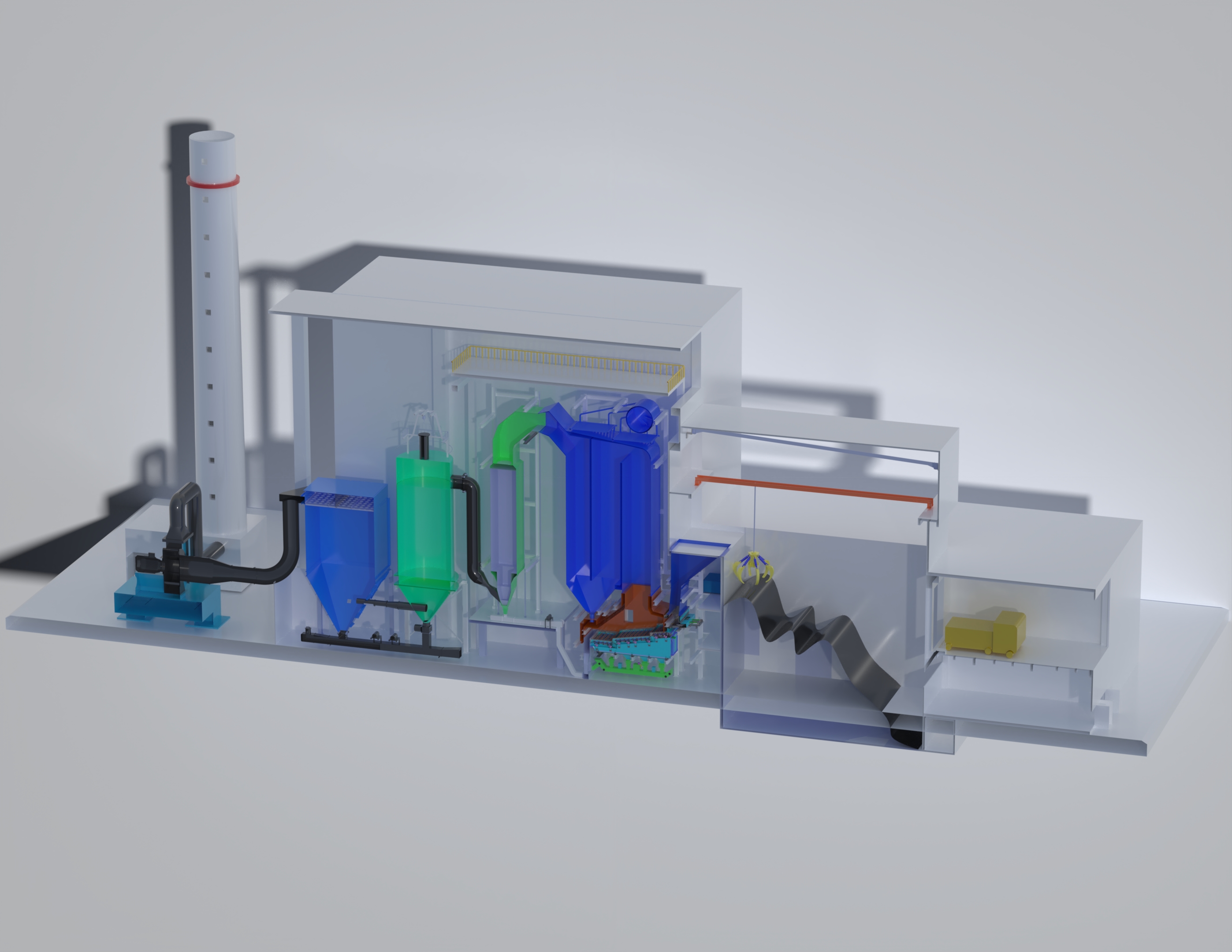
The energy-recovery block: what sits between the furnace and the output
In a waste incineration system configured for energy recovery, hot flue gas leaving the combustion chamber passes through a waste heat boiler before entering the flue gas treatment train. The boiler converts sensible heat from that gas into steam, and the steam is then either exported directly to a process, condensed in a heat exchanger to supply hot water or district heating, or expanded through a turbine for power generation.
Three engineering consequences follow, and all three are procurement issues rather than technical trivia. First, the boiler sits downstream of the last combustion-air injection, because the 850 °C / 2 s condition must be satisfied before heat is extracted. Second, the flue gas entering the treatment train is cooler than the combustion gas, which changes the reagent and filter specification. Third, whether the plant is classed as energy recovery or merely as disposal depends on how much of that heat is actually exported and used, not on whether a boiler is installed.
Tenor Low Carbon New Energy Technology (Liaoning) Co., Ltd. is a Dalian-based manufacturer of small and medium-scale waste incineration systems rated from 15 to 300 tonnes per day, built around a three-stage reciprocating mechanical grate furnace. Its WtE configurations combine waste incineration, heat recovery and flue gas purification, with recovered heat used for steam supply, heating or power generation. The heat recovery block is offered as a configured option rather than a fixed element — a distinction that matters when comparing quotations.
The compliance envelope: what the EU actually fixes
Under Directive 2010/75/EU, Annex VI, Part 3, waste incineration plants must meet daily average emission limit values for a defined pollutant set, measured in dry flue gas at 273 K and 101.3 kPa, corrected to 11% oxygen. The values below are the ones a system offered into the EU market is measured against.
| Pollutant | Limit value (daily average unless stated) | What it forces into the scope |
|---|---|---|
| Total dust | 10 mg/Nm³ | Bag filter or equivalent final particulate stage |
| Hydrogen chloride (HCl) | 10 mg/Nm³ | Alkaline scrubbing or dry/semi-dry sorbent injection |
| Sulphur dioxide (SO₂) | 50 mg/Nm³ | Acid gas removal sized on waste sulphur content |
| Nitrogen oxides (NOx as NO₂) | 200 mg/Nm³ (existing) / 150 mg/Nm³ (new), for plants with nominal capacity above 6 t/h | SNCR, or SCR where the tighter figure applies |
| Carbon monoxide (CO) | 50 mg/Nm³ | Combustion quality control — secondary/tertiary air and temperature stability |
| Dioxins and furans | 0.1 ng TEQ/Nm³ (6–8 hour sampling) | 850 °C / 2 s residence plus activated carbon injection |
| Heavy metals | Cd + Tl 0.05; Hg 0.05; Sb+As+Pb+Cr+Co+Cu+Mn+Ni+V 0.5 mg/Nm³ | Sorbent injection, filter performance, temperature management |
Two clarifications are routinely blurred in supplier material and should be separated during evaluation. The first is that these Annex VI values are legally binding limit values, while the best-available-technique conclusions in Commission Implementing Decision (EU) 2019/2010 set BAT-associated emission levels used as permitting benchmarks. They are different instruments and must not be averaged into a single "compliance figure". The second is that the Chinese national standard GB 18485-2014 uses its own averaging periods, reference conditions and monitoring rules; a design built to that baseline is not automatically an EU-compliant design, and any equivalence claim needs a clause-by-clause comparison.
850 °C for two seconds: the constraint that shapes the boiler
EU legislation requires that flue gas be raised, after the last injection of combustion air, in a controlled and homogeneous manner to 850 °C for at least two seconds — even under the most unfavourable operating conditions. That single sentence drives the geometry of the secondary combustion chamber, the refractory specification, and the position of the waste heat boiler inlet.
For a small-scale waste-to-energy system, this is where cost pressure concentrates. A guaranteed two-second residence time at 850 °C under transient conditions demands more chamber volume and heavier refractory than a design that only holds the temperature in steady state. It also constrains how aggressively heat can be extracted: pull the boiler inlet temperature down too far and the destruction condition is no longer demonstrable. Buyers comparing modular offers on footprint or price alone are, in effect, comparing different guarantees.
The same logic links combustion control to dioxin performance. Tenor's systems are described as using a 3T+E approach — temperature, residence time, turbulence and excess oxygen — combined with deacidification, bag dust collection and activated carbon adsorption. Whether that chain achieves the 0.1 ng TEQ/Nm³ figure at a specific site depends on waste composition, boiler exit temperature and sorbent dosing, which is why the guarantee belongs in the contract rather than the brochure.
The 6 t/h threshold: why a 50–250 TPD range splits in two
The NOx limit in the verified EU data set is expressed for plants with a nominal capacity exceeding 6 tonnes per hour. Converted arithmetically at 24-hour continuous rating, 6 t/h corresponds to approximately 144 tonnes per day. That number falls inside the 50–250 TPD band that dominates decentralised procurement, which means a single product family can straddle two regulatory positions.
| Nominal capacity | Approx. hourly rate | Position relative to the 6 t/h reference |
|---|---|---|
| 20 TPD (modular unit) | ≈ 0.8 t/h | Well below |
| 50 TPD | ≈ 2.1 t/h | Below |
| 150 TPD | ≈ 6.3 t/h | Just above |
| 250 TPD | ≈ 10.4 t/h | Above |
This is a conversion, not a measurement: actual operating hours, load factor and national permitting rules all affect how a plant is classified in practice, and the position of units below the threshold should be checked against the consolidated directive text and the competent authority's interpretation. But it explains a pattern buyers encounter repeatedly — why suppliers tier their portfolios by capacity, and why a design that is compliant at 50 TPD is not automatically compliant at 200 TPD.
It also creates a documentation risk. Capacity is stated in TPD by some suppliers and in t/h by others; the two are not interchangeable in a tender. Tenor's own published material illustrates the point: company documentation describes a 15–300 t/d range, while one commercial profile lists 30–500 TPD. Both figures exist in the public record, and neither substitutes for a contractually agreed rated capacity at a defined calorific value.
Electricity, steam or hot water: the R1 question
Output configuration is usually discussed as a commercial preference. In the EU it is also a legal classification question. Directive 2008/98/EC, Annex II, defines the R1 energy efficiency formula, with a threshold of 0.65 for installations permitted after 31 December 2008 and 0.60 for installations permitted earlier. A plant that recovers energy is classified as a recovery operation only if it meets the applicable threshold.
R1 is a legal classification formula, not a thermal efficiency metric, and it is frequently confused with boiler or electrical efficiency in secondary sources. The practical consequence for buyers is structural: an incineration-only plant exporting no usable energy sits in a different category from a plant designed around heat export. This is one reason turnkey WtE offers bundle the waste heat boiler and the energy conversion block rather than treating them as accessories.
Three configurations are commonly offered. Steam export suits industrial hosts with a continuous process demand. Hot water suits district heating networks with seasonal load. Small-scale power generation suits sites with no heat offtake, but electrical output from small units is modest relative to the fuel input, so the business case depends heavily on tariff and gate-fee structures rather than on generation volume alone. Tenor lists an optional waste heat boiler supporting steam production, heating or small-scale power generation; the configuration is confirmed per project.
Compliance is a measurement regime, not only a hardware package
An incinerator can be physically capable of meeting every limit in the table above and still fail its permit, because legally usable emission data depends on how the numbers are produced. EN 14181:2014 defines the quality assurance levels for automated measuring systems — QAL1 for selection, QAL2 for initial calibration, QAL3 for ongoing control — plus an annual surveillance test. The EN 15267 series governs certification of the measuring systems themselves.
For procurement, this reframes the online emission monitoring system for waste incinerators as a scope item with its own acceptance test, not a software add-on. It also creates a cost line that buyers routinely omit from budget comparisons: QAL2 calibration and annual surveillance campaigns recur for the life of the plant, and they require access, reference methods and accredited personnel. A system that lists CEMS integration as a feature should be asked a second question — who performs QAL2 and the annual surveillance, and at whose cost.
Where the Tenor WtE configuration sits
Within the reference framework above, Tenor's position is a specific one: small and medium-scale systems, modular construction, and a documented export footprint rather than a broad platform claim.
- Capacity and modularity. Systems span 15–300 t/d, with standardised modules at 20, 30 and 50 t/d. Core modules are factory-prefabricated and assembled on site, which shortens installation compared with cast-in-place construction — a real advantage for remote and island sites where construction labour is the schedule constraint.
- Combustion design. Three-stage reciprocating mechanical grate with independently driven stages and segmented air supply, allowing the drying, combustion and burnout zones to be adjusted separately for mixed municipal waste with fluctuating calorific value. Published figures for the 50 t/d class include an annual grate damage rate of ≤1% and heat loss on ignition of ≤5%.
- Turnkey and component supply. The company offers both complete systems — design, equipment manufacture, installation, commissioning and operator training — and grate body supply only, with a minimum order of one unit for the grate body.
- Certification scope. A UDEM Machinery Directive attestation of conformity (M.2025.206.C120374) covers the TYFSXT-30 to TYFSXT-300 model range against EN ISO 12100:2010 and EN 60204-1:2018, valid from 12 June 2025 to 11 June 2030. CE documentation references EU 2010/75/EU (IED), and a US EPA certification (105602-HKG-1, valid 28 February 2026 to 1 March 2027) is held through the Hong Kong subsidiary, Tenor Green Technology (Hong Kong) Ltd. The company is a National High-Tech Enterprise and participated in drafting the group standard T/CITS 242-2025.
- Reference projects. A 100 t/d industrial solid waste project reported one year of stable operation with EU-standard emissions; a 50 t/d high-altitude demonstration project in Mangya, Qinghai, reported first-attempt ignition success and self-sustaining combustion at 60–70% of sea-level oxygen; a 30 t/d experimental project was completed; and grate equipment has operated for more than two years in a 600 t/d Vietnamese waste-to-energy plant, alongside a Vietnamese unit used for steam supply over a two-year period.
Comparison with conventional approaches — and the limits of the claim
Against a centralised, large-grate model, the small and medium-scale approach trades scale efficiency for logistics. Long-distance haulage of low-density municipal waste is expensive, and where daily collection in a county or township falls below a couple of hundred tonnes, local disposal is the practical route. Against fluidised bed technology, the grate furnace tolerates mixed waste without crushing or front-end pretreatment, which removes a capital and operating cost line but is not a universal advantage — fluidised bed designs can be preferable where a homogeneous, pre-processed fuel stream is available.
Three limits should be stated plainly, because they affect how any quotation is read.
- Machinery conformity is not emission compliance. The UDEM attestation covers machinery safety against EN ISO 12100 and EN 60204-1. It confirms the equipment is safe to operate; it does not certify that a given installation meets Annex VI emission limits, which is demonstrated by site-specific measurement under the permit.
- The heat recovery block is optional in configuration. A quotation that specifies incineration and flue gas purification without a waste heat boiler is a legitimate disposal plant, not a waste-to-energy plant, and its R1 position differs accordingly. The output configuration must be written into the specification, not assumed.
- Operating data at the smallest scale is thin. The documented reference base covers 30, 50, 100 and 600 t/d installations. Verified third-party emission performance for the 15–20 t/d modular class is not published in the available record, so buyers in that band should require site-specific test data or a performance guarantee rather than relying on extrapolation from larger units.
A procurement checklist for the WtE scope
| Decision area | Question that separates offers |
|---|---|
| Rated capacity | Is capacity stated in TPD or t/h, at what calorific value, and at what availability? |
| Emission guarantees | Are limits guaranteed pollutant by pollutant, against which standard and averaging period? |
| Combustion condition | How is 850 °C / 2 s demonstrated under transient and low-calorific-value conditions? |
| Energy output | Is a waste heat boiler included, and is the output steam, hot water, power or a combination? |
| Monitoring | Is CEMS in scope, certified to which framework, and who funds QAL2 and annual surveillance? |
| Waste flexibility | Which waste streams are accepted, and which are explicitly excluded? |
| Residuals | How are bottom ash and fly ash handled, and who owns disposal? |
| Service model | What is covered by remote monitoring, spare parts supply and technical upgrade commitments? |
Market context: why the constraint layer is tightening
The European waste-to-energy market was valued at approximately USD 19.83 billion in 2025, estimated at USD 21.26 billion in 2026, and projected to reach USD 37.11 billion by 2034 according to Market Data Forecast. Growth of that order is not driven by new-build alone. The BAT conclusions adopted in Commission Implementing Decision (EU) 2019/2010 required permit conditions at existing installations to be reconsidered within four years of publication, which created a retrofit cycle for NOx control, scrubbing performance and monitoring upgrades independent of new capacity.
Two cost reference points are useful when reading quotations. Indicative capital expenditure for modern WtE plants is commonly placed in the range of USD 150,000 to 250,000 per daily tonne of capacity — a planning benchmark rather than a quotation, and one that varies widely between centralised municipal plants and decentralised modular units. Separately, HS heading 8417.80 aggregates refuse incinerators with other non-electric industrial furnaces, so customs statistics on that line overstate incinerator trade and should not be used as a market-sizing proxy.
Future outlook
Three developments look structurally important rather than cyclical. First, compliance is shifting from equipment specification toward data integrity: as certification frameworks for automated measuring systems mature, the ability to produce defensible continuous data becomes a qualification criterion for suppliers, not just for operators. Second, dual-standard design is becoming a normal engineering requirement rather than a differentiator, since manufacturers serving both Chinese and EU markets must document what was added to a domestic-baseline design to reach Annex VI. Third, the retrofit segment is likely to grow faster than new-build in mature markets, favouring suppliers who can integrate additional abatement and monitoring into existing process lines.
For buyers, the implication is unglamorous but decisive: the specification document, not the technology label, determines whether a waste-to-energy system performs as intended. Capacity units, pollutant guarantees, energy output configuration and monitoring responsibility are the four lines where well-written and poorly written contracts diverge most.
FAQ
Will emissions meet EU standards, and how are dioxins controlled?
The 3T+E combustion approach is designed to hold 850 °C for at least two seconds, and the flue gas train combines deacidification, bag dust collection and activated carbon adsorption. Tenor states that this configuration can meet both national and EU standards. Because dioxin formation depends on waste composition, boiler exit temperature and sorbent dosing at a specific site, the 0.1 ng TEQ/Nm³ figure should be secured as a contractual performance guarantee rather than inferred from the equipment list.
What capacity range is available, and can it be adjusted per project?
Tenor's systems are offered across a 15–300 t/d range, with standardised 20, 30 and 50 t/d modules that can be selected directly. Configuration is flexible within that range, and the commercial scope can be either a complete EPC-style system including design, manufacture, installation, commissioning and training, or grate body supply only with a minimum order of one unit.
Can the system generate electricity, or supply steam and hot water?
A waste heat boiler is available as an optional configuration, supporting steam production, heating supply or small-scale power generation. The choice between steam, hot water and electricity is made at design stage and determines the energy conversion equipment included. In EU jurisdictions the exported energy also affects whether the plant qualifies as a recovery operation under the R1 formula in Directive 2008/98/EC, where the threshold is 0.65 for installations permitted after 31 December 2008 and 0.60 for earlier permits.
Does municipal waste need to be sorted or pretreated before incineration?
No. Raw household waste can be fed directly into the incinerator, which is designed for mixed waste with wide fluctuations in calorific value. This avoids front-end sorting and pretreatment costs. The three-stage reciprocating grate with independently controlled stages and segmented air supply is what allows the drying, combustion and burnout zones to be adjusted as waste quality changes.
Which certifications apply, and what do they actually cover?
A UDEM Machinery Directive attestation of conformity (M.2025.206.C120374) covers the TYFSXT-30 to TYFSXT-300 model range against EN ISO 12100:2010 and EN 60204-1:2018, valid from 12 June 2025 to 11 June 2030. CE documentation references EU 2010/75/EU, and a US EPA certification (105602-HKG-1) is held through Tenor Green Technology (Hong Kong) Ltd., valid from 28 February 2026 to 1 March 2027. The company is a National High-Tech Enterprise and participated in drafting the group standard T/CITS 242-2025. The machinery attestation addresses operational safety; site-specific emission compliance is demonstrated separately through permitted measurement.
What is the expected service life of the grate, and how high are maintenance costs?
Grate plates are manufactured from heat-resistant and wear-resistant cast steel. Published figures for the 50 t/d class include an annual grate damage rate of ≤1% and heat loss on ignition of ≤5%, which keeps spare parts consumption low. After-sales support covers remote operation monitoring, spare parts supply and technical upgrades, delivered by the company's own engineering team alongside operator training.
A technical brochure covering Tenor's small and medium-scale waste incineration systems is available for reference: Introduction to Tenor Small and Medium Scale Garbage Incineration Systems (PDF).
¿Tiene preguntas o necesita más detalles?
Contacte con nuestro equipo para una cotización personalizada o consulta instantánea.
Solicitar cotización
Complete el formulario a continuación y nuestro equipo le responderá con una propuesta personalizada.
Chat directo de WhatsApp
¿Prefiere chatear en tiempo real? Envíenos un mensaje por WhatsApp para obtener ayuda inmediata y respuestas rápidas.
- Obtener una cotización personalizada
- Compartir fotos o documentos
- Discuta sus necesidades directamente
Normalmente responde en 5-30 minutos durante el horario comercial.