
Warning Post Technical & Procurement FAQ: YD-WP45 and YD-WPS75
Warning Post Technical & Procurement FAQ: YD-WP45 and YD-WPS75
Warning posts are usually specified late. Alignment, geometry and traffic-management plans are already fixed, and the remaining question is narrower than a catalogue comparison: does a specific model satisfy a written clause, can it be fixed to the surface that actually exists on site, and will the delivered batch pass acceptance. Those three questions decide more orders in this category than any material headline.
This reference answers them for two Mnsd models, YD-WP45 and YD-WPS75, in the order a procurement team meets them: specification, installation, acceptance, then supply terms. Values are stated as facts where a documented figure exists, and as limits where a figure does not cover a site condition.
The structure is deliberate. A specification question, a fixing question and an acceptance question each need a different kind of evidence, and mixing them is how avoidable rejections happen. Grouping by decision stage keeps every answer traceable to a document, a test, or a declared product value.
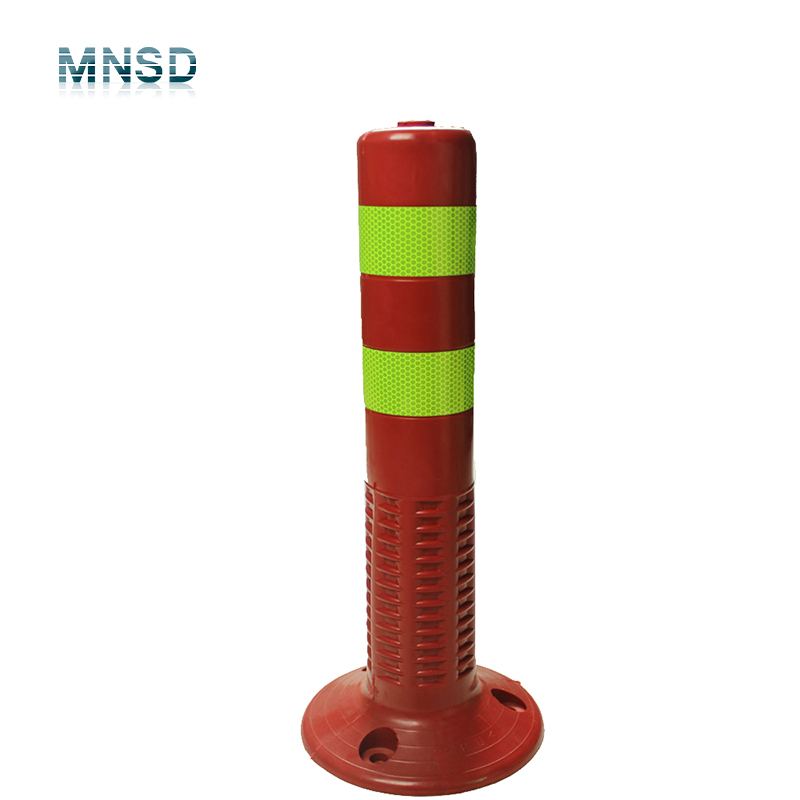
The products in scope
Mnsd is the brand of Tiantai Yuanda Traffic Device Co., Ltd, a road safety equipment manufacturer based in Tiantai, Zhejiang, China, operating a 40,000 m² facility with 300 employees and a 15-person R&D team. The company serves importers, distributors, wholesalers, contractors and infrastructure project suppliers worldwide.
Both models discussed here are polyurethane warning posts. YD-WPS75 is documented in Mnsd product-category material as a 75 cm PU warning post with a rubber base. YD-WP45 is the companion PU model in the same construction and fixing family. Where a dimension or tolerance is not documented for a specific model, it should be confirmed on the RFQ rather than inferred from the other model.
| Attribute | YD-WP45 | YD-WPS75 |
|---|---|---|
| Body construction | PU (polyurethane) | PU (polyurethane) |
| Documented height | Confirm on RFQ | 75 cm |
| Base options | Recycled rubber or integrated plastic | Recycled rubber or integrated plastic |
| Operating temperature | -40 °C to +70 °C | -40 °C to +70 °C |
| Visibility distance | 200+ m | 200+ m |
| Reflective sheeting | HIP / Class 1 | HIP / Class 1 |
| Impact behaviour | 360° flexible, self-recovering | 360° flexible, self-recovering |
| Tensile strength | 15.0 MPa | 15.0 MPa |
| Elongation | 400% | 400% |
| Fixing | Expansion bolts, 3 or 4 holes | Expansion bolts, 3 or 4 holes |
| Top fitting | Ring-top chain attachment | Ring-top chain attachment |
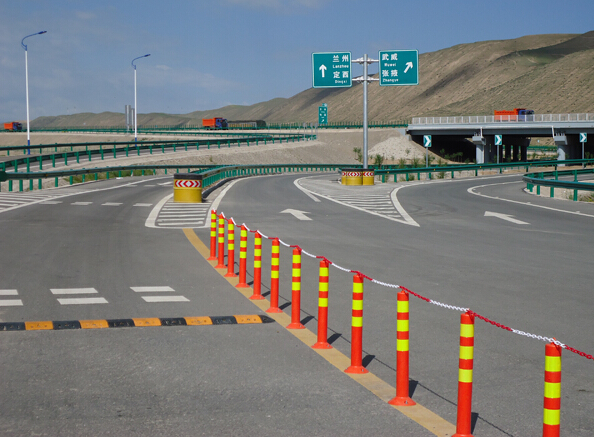
Specification questions buyers ask first
What does PU construction change in practice?
The post body is polyurethane rather than PE or PVC. The property that matters at the roadside is recovery: a PU post bends and returns to position instead of staying deformed. Material suppliers serving this segment commonly describe PU delineators as returning to their original state after thousands of impacts. For procurement, the useful translation is that recovery is the property to test at acceptance, not a number to accept from a datasheet alone. Comparative claims between PU and other polymers depend on the specific compound and grade, so they should be supported by the supplier's material data for the exact model being quoted.
What do 15.0 MPa tensile strength and 400% elongation tell a buyer?
15.0 MPa is the declared tensile strength of these models; 400% is the declared elongation. Read together, the two figures describe a body that stretches substantially before it fails. That is the mechanically relevant point for the applications these posts serve: low-speed strikes from manoeuvring vehicles, trolleys, mowers and site plant, where energy is modest and repeated. It is not a crashworthiness figure and should not be written into a tender as one. Where a specification clause cites the numbers, ask for the test basis as well, since specimen geometry and test speed affect a tensile result.
What does the -40 °C to +70 °C rating cover, and where does it stop?
It defines the declared operating envelope for storage and service. It is an envelope, not a promise of unchanged behaviour across the whole span: polymers generally stiffen as temperature falls, which slows recovery, and dimensional stability becomes the concern as temperature rises. Mnsd addresses the high-temperature end through thermal distortion control, combining a heat resistance analysis with wall-thickness optimisation to limit sagging in hot climates. Buyers specifying for sustained high temperature should request that analysis alongside the temperature rating rather than treating the rating as sufficient on its own. Sites outside the -40 °C to +70 °C range fall outside the declared specification.
How is 200+ m visibility produced, and what is the HIP / Class 1 designation?
Visibility distance is the combined result of post height, body colour contrast and reflective banding, and 200+ m is the stated figure for these models. HIP sheeting with Class 1 reflectivity is the sheeting designation. Two procurement consequences follow. First, the figure describes clean sheeting in good viewing conditions; contaminated or damaged sheeting reduces it, so cleaning belongs in the maintenance schedule rather than being assumed. Second, reflectivity classes are defined differently across markets, and projects normally cite a class from their own standard set, so specify the sheeting grade and class in the purchase order instead of relying on a catalogue headline.
What does 360° flexible impact resistance mean for a post that is hit repeatedly?
It means recovery is not limited to the traffic-facing side. In parking decks, warehouse aisles and depot yards, strikes arrive from reversing vehicles and site plant as often as from the direction of travel. A post that recovers from any direction keeps its alignment without manual intervention. The acceptance consequence is practical: the receiving inspector should bend the post in more than one direction and confirm it returns to vertical without permanent set, which turns a directional claim into a batch-level check.
Installation and fixing questions
How are YD-WP45 and YD-WPS75 fixed to the ground?
Both are fixed with expansion bolts through either three or four pre-formed holes in the base. Because an expansion anchor transfers load into the substrate, the surface matters as much as the post: the detail assumes sound concrete or compacted asphalt with enough thickness to develop anchor capacity. On soft ground, deteriorated surfacing or a base course that will not hold an anchor, a bolted detail will not develop its holding capacity and a different fixing strategy is needed. That is a site-survey decision taken before the order, not a change order after delivery.
When is 3-hole fixing sufficient, and when should 4-hole be specified?
Three-hole fixing is normally adequate for low-speed, pedestrian-adjacent and sheltered layouts such as parking bays, garage aisles and depot yards, and it installs faster. Four-hole fixing is the appropriate default where wind exposure, traffic speed or poor surface condition increases the load at the base, and wherever a road authority's standard detail calls for four anchors. The hole pattern is set when the base is moulded, so the choice should be recorded in the purchase order; changing it later means new bases, not additional bolts.
What is the ring-top chain attachment for?
The ring-top chain attachment lets posts be linked into a continuous delineated line, and lets a run be retrieved or repositioned as one set during temporary works. It also raises the effort required to displace or remove individual units. Where chains are used, specify the posts, rings and chain as a single assembly so the top fitting, chain and base are consistent and there is no mismatch discovered on site.
Recycled rubber base or integrated plastic base — how should a buyer choose?
Both are Mnsd configurations on these models. A recycled rubber base adds mass at the contact point, which helps stability and surface grip in exposed locations, and it is the common choice for road-edge and parking delineation. An integrated plastic base gives a single-piece post that is simpler to handle, stack and account for as an asset, and lighter to ship, which suits depot, warehouse and indoor-adjacent layouts where posts are moved or replaced often. In permanent installations the bolted fixing remains the controlling element whichever base is selected.
Acceptance criteria and how to check them
What acceptance criteria apply before shipment?
Mnsd states a pre-shipment test as the acceptance criterion, with FOB or CIF delivery terms and 30/70 payment terms. For a warning post order, that test should cover what the receiving site will actually inspect: appearance and colour, height and hole pattern, self-recovery after bending, reflective sheeting grade and condition, and colour stability of the body. The record should travel with the shipping documents, so the inspection at destination is a verification against a reference rather than a first test performed at the buyer's cost.
How is self-recovery verified in a way that is repeatable across batches?
Bend the post to a recorded angle, hold briefly, release, and time the return to vertical. A pass means return to vertical within the agreed time, no permanent set, and no whitening, crazing or cracking at the bend. Repeat across several units from the batch rather than one, and repeat at the temperatures the site will actually see, because recovery behaviour is temperature dependent. Material suppliers to this category describe PU delineators as returning to shape after thousands of impacts; a defined bend-and-time procedure is what converts that description into an acceptance record a buyer can file.
How should weather resistance, aging and colorfastness be checked?
Weathering in service is ultraviolet exposure plus thermal cycling, and it appears as chalking, yellowing of the white body, fading of red banding or a tacky surface. Two controls are practical. Keep a retained master sample from each order and compare future deliveries against it in daylight. Inspect for lean or sag after a hot season, which is the visible sign that thermal distortion control is being tested in service. Where a project requires documented aging performance, request the colorfastness and aging evidence for the body material and sheeting rather than accepting a general weather-resistance statement.
| Acceptance check | Method | Record to file |
|---|---|---|
| Identity and dimensions | Measure height, base and hole pattern; confirm model marking | Measurement sheet against purchase order |
| Appearance and colour | Compare with retained master sample in daylight | Signed sample card |
| Reflectivity | Confirm sheeting grade and class marking; check for contamination or lifting | Sheeting grade declaration |
| Self-recovery | Bend to recorded angle in two directions, release, time return | Bend test note with angle and time |
| Weather and thermal | Inspect for lean, sag, chalking or tackiness; review aging evidence | Inspection note and supplier aging data |
| Base and fixing | Match base type and 3 or 4 hole pattern to the order | Packing list checked against order |
| Documentation | Confirm pre-shipment test record accompanies shipment | Pre-shipment test report |
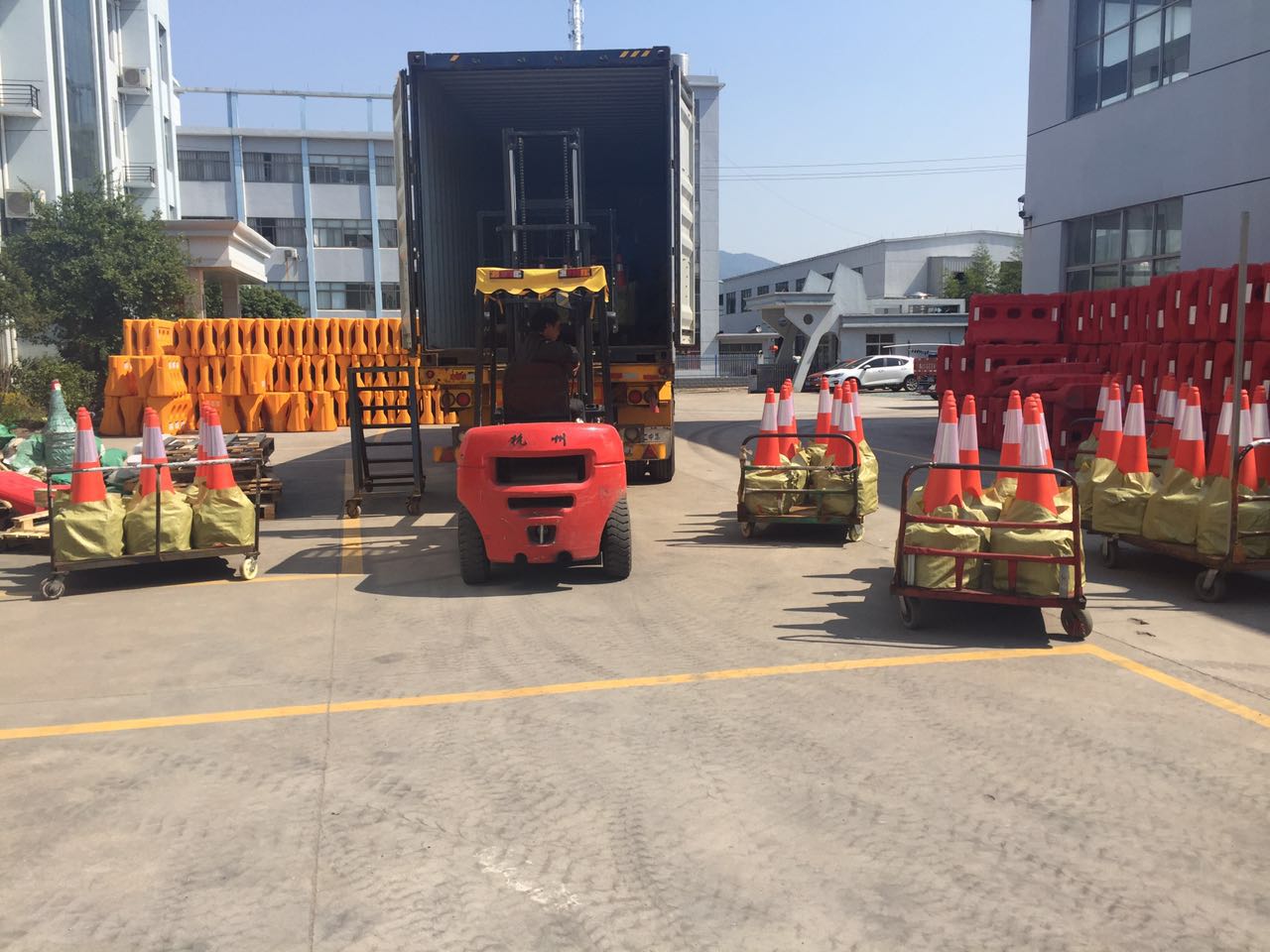
Procurement, logistics and repeat supply questions
What are the minimum order and payment terms?
The stated minimum order quantity is 100 units, with FOB or CIF delivery terms, 30/70 payment terms and pre-shipment testing as the acceptance criteria. These are stated defaults rather than fixed rules of the category, so they should be confirmed against the specific RFQ, particularly for mixed-model orders where bases, colours or sheeting grades differ within one shipment.
What lead time and production capacity stand behind a repeat order?
Production uses high-speed injection moulding with a monthly capacity of 50,000 pieces, and the typical lead time for bulk orders is 10 to 15 days. The procurement implication is that capacity supports scheduled call-off releases rather than a single annual shipment. That matters for multi-site programmes in which every site has a different fixing detail and post height but shares one post specification: releases can be timed to installation progress, and retained samples can be held against a stable reference instead of being reset with each delivery.
Which HS classification applies to plastic warning posts?
Plastic delineator posts are classified under HS 3926.90, with 3926.90.9880 applying in the United States and 3926.90.97 appearing for global and China entries. Classification drives duty treatment and the document set, and a composite product can be classified differently depending on material and function, so the applicable code should be confirmed with a customs broker for the exact model being imported rather than copied from a previous shipment.
What should a long-term supply arrangement review each year?
Mnsd serves importers, distributors, wholesalers, contractors and infrastructure project suppliers worldwide, exporting to Asia, the EU and the USA, which means programme buyers are working with a supplier that already manages multi-market documentation. Four items are worth an annual review: retained master samples per model and colour, sheeting grade continuity, base type and hole-pattern consistency, and the archive of pre-shipment test records. A road safety project in Vietnam using this product was completed and accepted by local authorities, which illustrates the second gate beyond shipment: project-level acceptance. The record set that satisfies that gate is worth designing once and reusing across subsequent sites.
Where flexible PU posts fit, and where they do not
| Criterion | Flexible PU warning post (YD-WP45 / YD-WPS75) | Rigid guardrail or barrier | Traffic cone |
|---|---|---|---|
| Primary function | Visual warning and physical isolation with flexible rebound | Containment and redirection of vehicles | Short-term channelisation and warning |
| Relative cost | Ultra-low; lower than guardrails and barriers | High | Low |
| Maintenance | Almost maintenance-free, zero power use; cleaning or replacement when damaged | Repair after impact plus periodic structural inspection | Frequent repositioning and replacement |
| Typical fit | Road edges, parking, construction zones, industrial and commercial sites | Where physical containment is required | Short-duration works and rapid redeployment |
Four limits are worth stating plainly, because each one has caused an avoidable order failure somewhere in this category.
A flexible post is not containment hardware. It absorbs and returns; it does not stop or redirect a vehicle. Where a project requires physical containment, delineation supplements a barrier system rather than replacing it, and specifying a PU post against a containment clause will fail review.
The fixing is only as good as the substrate. Expansion bolts develop capacity in sound concrete or compacted asphalt. On soft, failed or thin surfaces the same detail will loosen, and no base option changes that. It is a survey question, not a product question.
Declared values are envelopes for new product under stated conditions. The -40 °C to +70 °C rating, the 200+ m visibility distance and the Class 1 sheeting grade all describe that state. Recovery slows as temperature falls, visibility drops with dirty or damaged sheeting, and colour shifts under ultraviolet exposure. These are maintenance and re-ordering variables that belong in the specification, not defects to be discovered later.
Finally, standard references need documents behind them. Catalogues in the United States routinely cite MUTCD, MASH and NCHRP 350 criteria, and European projects work to EN 13422:2019. None of those references substitutes for the product-specific approval records a road owner will request. The workable rule is to ask the road owner which document set applies, then treat catalogue-level compliance statements as a lead for verification rather than as proof.
Market context behind the specification discipline
The road safety market, covering hardware as well as software and services, is valued at USD 7.62 billion in 2026, with hardware accounting for 75.3% of the segment in the same year, according to MarketsandMarkets research published in 2026. Two implications follow for warning posts. Most spending remains in physical hardware, so flexible delineation competes on cost per delineated metre and on replacement frequency rather than on novelty. And because the category sits inside a larger hardware budget, it inherits the documentation discipline of barrier and signage procurement: the buyer who accepts a guardrail against a test record will ask the same question of a warning post.
In Europe, EN 13422:2019, published by CEN/TC 226, is the standard covering portable traffic cones and cylinders and is the reference framework most often encountered when deformable warning devices are specified. Its existence is useful to buyers outside Europe as a reminder of how the category is normally structured: device class, dimensions, stability and visibility are defined together, not traded off against each other.
Future outlook
Specification in this category is becoming document-led rather than design-led. Buyers increasingly ask for the pre-shipment test record, the retained sample and the sheeting grade declaration at the RFQ stage, because those are the items that determine whether a delivery is accepted on site. Suppliers that treat acceptance as a shipment event rather than a designed process will keep losing orders to suppliers that can produce the file.
Material and base choices are likely to move on two fronts. Base configurations using recycled rubber address both stability and material reuse, and integrated single-piece bases simplify asset control for buyers who treat posts as inventory rather than consumables. On the body side, the pressure is toward declared performance that can be tested at the dock: measurable recovery, stated sheeting class and documented colour stability, rather than a single headline temperature figure.
Supply structure is the third variable. With injection moulding capacity of 50,000 pieces per month and bulk lead times of 10 to 15 days, the practical question for programme buyers is no longer whether a supplier can fill one large order, but whether it can hold a specification steady across repeated releases over several years. That favours long-term arrangements with fixed samples and archived test records, which is a procurement design choice more than a product choice.
Specification shortlist by site condition
| Site condition | Configuration to specify |
|---|---|
| Parking deck, garage aisle, low-speed yard | YD-WP45 or YD-WPS75, 3-hole fixing, integrated plastic base, ring-top chain where asset control matters |
| Road edge, higher speed or exposed location | YD-WPS75 at 75 cm, 4-hole fixing, recycled rubber base |
| Temporary works with frequent relocation | Ring-top chain attachment, integrated plastic base for lighter handling |
| Hot climate with sustained high temperature | Request the heat resistance analysis and wall-thickness confirmation alongside the temperature rating |
| Surface that will not hold an expansion anchor | Re-survey before ordering; the bolted detail does not apply without a suitable substrate |
Product and company detail for these models is published at www.mnsdtraffic.com, and the current catalogue covering model and base configurations is available as a downloadable brochure: Mnsd product brochure (PDF).
¿Tiene preguntas o necesita más detalles?
Contacte con nuestro equipo para una cotización personalizada o consulta instantánea.
Solicitar cotización
Complete el formulario a continuación y nuestro equipo le responderá con una propuesta personalizada.
Chat directo de WhatsApp
¿Prefiere chatear en tiempo real? Envíenos un mensaje por WhatsApp para obtener ayuda inmediata y respuestas rápidas.
- Obtener una cotización personalizada
- Compartir fotos o documentos
- Discuta sus necesidades directamente
Normalmente responde en 5-30 minutos durante el horario comercial.