
Wall Switch Buyer Decision Framework: Gang/Way, Certification, Material, HS Code
Wall Switch Buyer Decision Framework: Gang/Way, Certification, Material, HS Code
A wall switch is rarely one purchase decision. It is four: how the circuit is controlled, what the certificate actually covers, what the product is built from, and which HS heading it clears customs under. This framework turns those four questions into a scoring matrix that a procurement team can reuse across projects, suppliers and repeat orders.
The global light switch and electrical socket market was valued at approximately USD 17.6 billion in 2024, according to Strategic Market Research. Within that spend, products that look identical on a sample board routinely behave differently at the wiring diagram, at the customs declaration and at project handover. Two 86 mm plates with the same finish can differ in whether they support a second switching point, whether the certificate is written against the European or the Australian test standard, whether the panel polymer carries a documented glow-wire rating, and whether the shipment is classified under HS 8536500090 or another heading entirely.
Buyers usually discover those differences at the wrong stage — after the purchase order, after the container is declared, or after the electrician has already pulled cable. A decision framework moves the discovery forward, into the quotation stage, where a change still costs nothing.
Wenzhou Huafeng Electric Co., Ltd. (HYFF) is a Wenzhou-based manufacturer of wall switches and wall sockets that exports its entire output, with main markets in Europe, the Americas, Oceania, Asia and Africa. Its production facility covers 7,000 m² and produces approximately 35 million units per year, supported by an R&D team of 10 engineers and around 118 staff. The model references used throughout this article are drawn from that catalogue, and every specification cited is taken from the corresponding product datasheet.
Why a matrix outperforms a catalogue
A catalogue answers one question: what does the product look like? A procurement team needs four answers at once, and those answers do not sit on the same page. Configuration lives in the wiring table. Certification lives in the compliance annex. Material lives in the construction notes. HS classification lives in the export documentation — sometimes in a different document produced by a different department.
When those four data points are collected into a single record per SKU, three things improve. Quotation comparison becomes like-for-like rather than appearance-based. Repeat orders become verifiable against the original specification rather than against a photograph. And disputes at goods-in become resolvable against written criteria rather than recollection.
The framework below is deliberately narrow. It scores only what a supplier datasheet can evidence: switching function, certification coverage, panel and base material, HS classification, panel geometry and mechanical test records. It does not score price, lead time or warranty, and it should not be used to rank suppliers on those grounds.
Axis 1 — Gang and way: function before form
Gang and way are frequently used as if they were synonyms. They are not. Gang describes how many independently switched outputs sit on the plate. Way describes how many physical locations can control a given output. A 2 gang 1 way switch controls two separate circuits, each from a single position. A 2 gang 2 way switch controls two separate circuits, each from two positions — typically the top and bottom of a staircase, or either end of a corridor.
The intermediate switch is the configuration most often missed during sourcing. It does not replace a two-way switch; it is inserted between two of them so that a single circuit can be controlled from three or more positions. HYFF records the KM141S as an intermediate switch in a small modular format, rated 10A at 220–250V, described in its datasheet as suitable for two-way and multi-way control circuits. Its panel measures 22×49 mm, which means it is designed to sit inside a modular frame alongside other functions rather than to occupy a plate on its own.
Two further functions matter for specific building types. The HG110NB is a 1 gang push bell switch with an LED indicator, rated 10A at 220–250V, in an 86×86 mm format with a tempered glass panel; its datasheet positions it for residential, industrial, apartment, villa, hotel and office scenarios. The V122N is a 2 gang 2 way switch with an LED indicator, 86×86 mm, rated 10A at 220–250V. Both functions are common in hospitality, where a service-call button and a locator light change how a room is operated.
| Configuration | What it controls | Models recorded in the HYFF catalogue |
|---|---|---|
| 1 gang 1 way | One circuit, one control position | S111 (68×68 mm), H111 (86×86 mm), B111 (65×65 mm), M111 (74×83 mm) |
| 2 gang 1 way | Two circuits, one control position each | E121 (86×86 mm), U121 (86×90 mm) |
| 2 gang 2 way | Two circuits, two control positions each | A122 (81.6×81.6 mm), V122N (86×86 mm, LED indicator) |
| Intermediate | Inserted between two-way switches for three or more positions | KM141S (22×49 mm modular) |
| Push bell with LED | Annunciator or service-call function with indicator | HG110NB (86×86 mm, tempered glass) |
| Single powerpoint | Socket outlet, separate trade heading | HT213 (80×120 mm, 10A 250V~, SAA) |
Axis 2 — Certification: scope, not just marks
The presence of a mark says little on its own; the question is which standard the mark was written against and which market it therefore serves. For the European Union, EN 60669-1:2018 is the mandatory safety standard for manual switches used in household fixed installations, as documented by Intertek. For Australia and New Zealand, AS/NZS 3133:2020 is the primary technical standard covering air-break switches, per Standards Australia.
Australian installation practice adds a requirement that sits outside the switch itself but directly affects what a project orders: AS/NZS 3000:2018 Clause 4.6.3.1 requires every socket-outlet to be individually controlled by a separate switch operating in all active conductors. That is one reason Australian projects frequently specify switch-and-socket combinations as a matched set rather than as independent line items.
Against those standards, HYFF records the following: the A122 carries CE and TUV; the H111 datasheet lists TUV, CE and CB; the E121 lists TUV, CE and CB; the HG110NB lists CE and TUV; the KM141S and M111 list CE and RoHS; the B111 and U121 list CE; the S111 lists CE in its parameter block, with TUV and CB also noted in the product's feature description; and the HT213 single powerpoint carries SAA.
Axis 3 — Material: panel, base and contact metallurgy
Three separate material decisions sit inside one wall switch, and buyers often collapse them into one.
The panel is the visible surface and the first barrier against heat and impact. Most HYFF models — H111, E121, A122, U121, B111, M111, S111, KM141S and the HT213 powerpoint — use a flame retardant polycarbonate panel, with the H111, E121, A122 and KM141S datasheets documenting 850°C fire protection. The HG110NB substitutes tempered glass, which the datasheet describes as scratch resistant.
The base carries the mechanism and the terminals. HYFF records a high strength PA base on the H111, HG110NB, KM141S, S111 and V122N; a PC base on the A122, U121 and HT213; a PA66 base on the M111, which the documentation describes as a polyamide known for high heat resistance; and an ABS plastic base on the B111. The KM141S and E121 additionally describe an ‘arch bridge’ base geometry intended to increase wiring space and resist deformation under terminal pressure.
The conductive path is where specifications diverge most sharply. The A122 datasheet records brass terminals, phosphor copper contacts of 0.7 mm thickness with silver plating at 3 mm diameter, and a grade II shock absorption design that reduces switching noise. Those details rarely appear on a competitor's cut sheet, which makes them useful as a verification question rather than a comparison claim.
Axis 4 — HS code and trade data
Classification is the axis most often left to the forwarder, and the one that is hardest to correct after the fact. In the HYFF range the split is clean: every mechanical wall switch model documents HS 8536500090, and the HT213 single powerpoint documents HS 8536690000.
| Product function | HS code recorded | Models |
|---|---|---|
| Mechanical wall switch | 8536500090 | B111, E121, H111, U121, A122, V122N, KM141S, S111, HG110NB, M111 |
| Single powerpoint (socket outlet) | 8536690000 | HT213, 10A 250V~, SAA |
The practical consequence is that a mixed order containing both switches and socket outlets will normally split across two headings, with potentially different duty treatment and different documentary requirements. A quotation that presents a single line for ‘electrical accessories’ without a code per function is not yet a comparable quotation. Two checks resolve it quickly: does each SKU carry its own code, and does that code correspond to the product's function rather than to how it was described on the invoice?
The fit gate: panel dimensions and mechanical evidence
Before any scoring begins, a model must pass a binary gate. Geometry and mounting must suit the wall box and the frame already specified. This is not a weighting question; a switch that does not fit cannot be rescued by a strong certification score.
 B111, 1 gang 1 way, 65×65 mm PC panel with ABS base and clip-on structure.
| Model | Panel size | Installation as recorded |
|---|---|---|
| KM141S | 22×49 mm (modular) | Flush mounted |
| B111 | 65×65 mm | Surface mounted in the parameter record; classified as a flush mounted mechanical wall switch |
| S111 | 68×68 mm | Surface mounted |
| M111 | 74×83 mm | Flush mounted, 6.5 mm ultra-slim frameless panel |
| A122 | 81.6×81.6 mm | Flush mounted |
| H111, E121, V122N, HG110NB | 86×86 mm | Flush mounted |
| U121 | 86×90 mm | Flush mounted, frameless large plate |
| HT213 | 80×120 mm | Flush mounted |
Mechanical evidence sits alongside geometry. HYFF records 40,000+ on/off cycles for the KM141S, S111, E121, H111, A122, V122N and HG110NB, and documents 100% self-inspection before packing across the range, with the KM141S additionally recorded at 107% self-inspection. Those figures are useful as a screening threshold during research, but they are manufacturer test records rather than third-party reports, a distinction that matters at tender stage.
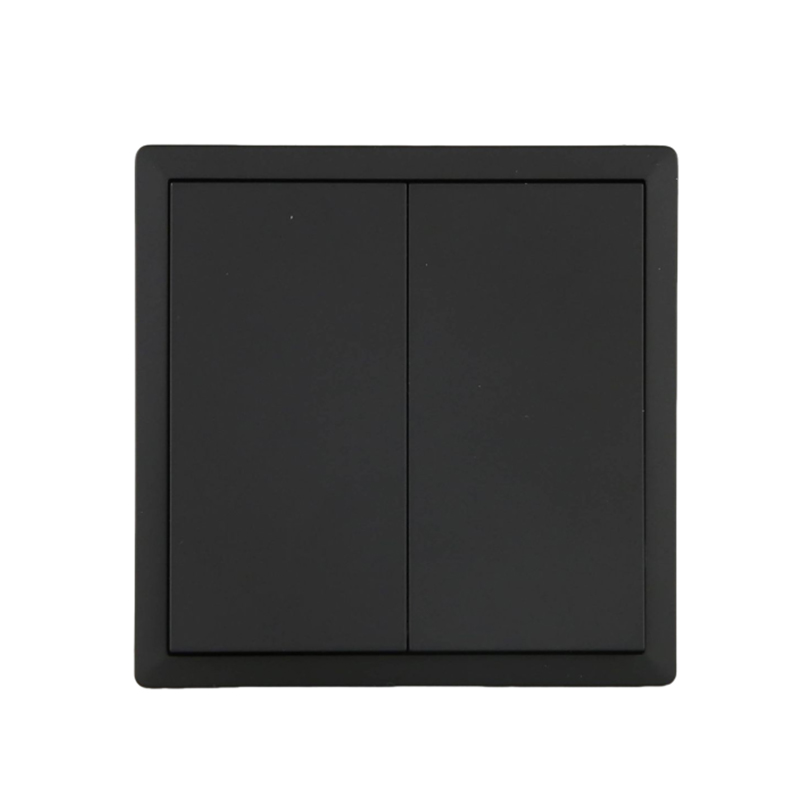 A122, 2 gang 2 way, 81.6×81.6 mm, CE and TUV, brass terminals with silver-plated phosphor copper contacts.
Building the score
Four weighted axes produce a single comparable number, with the fit gate applied as a veto beforehand. The weights below reflect how errors propagate: a certification mismatch stops a container, a configuration mismatch stops a circuit, a material gap is usually absorbed at installation, and a trade-data gap is administrative but expensive.
| Axis | Weight | What it tests | Evidence required |
|---|---|---|---|
| 1. Gang / way configuration | 30% | Whether the product supports the control points the drawing requires | Configuration named in the datasheet; intermediate and multi-way options available |
| 2. Certification | 30% | Whether the certificate matches the destination standard | Standard referenced; test body named; market stated |
| 3. Material and construction | 25% | Whether panel, base and contacts are documented rather than implied | Glow-wire rating, base polymer, contact metallurgy |
| 4. HS code and trade data | 15% | Whether classification is fixed per SKU and per function | Code stated per model; consistent with product function |
Score each axis from 0 to 5 using the anchors above, multiply by its weight, sum the four results and divide by five. A model totals 100 when it documents all four axes fully. The number is not a quality verdict; it is a measure of how completely a supplier has answered the buyer's four questions in writing.
Applying the matrix to a real range
The following illustrates the method using six HYFF models, scored strictly against what each datasheet records. The scores compare documentation completeness and configuration fit, not manufacturing quality.
| Model | Configuration | Certification recorded | Material recorded | Axis scores (F / C / M / T) | Weighted total |
|---|---|---|---|---|---|
| A122 | 2 gang 2 way, 81.6×81.6 mm | CE, TUV | 850°C PC panel, PC base, brass terminals, silver-plated phosphor copper contacts | 5 / 5 / 5 / 5 | 100 |
| HG110NB | 1 gang push bell with LED, 86×86 mm | CE, TUV | Tempered glass panel, PA base, multipoint riveted steel frame | 5 / 4 / 5 / 5 | 94 |
| H111 | 1 gang 1 way, 86×86 mm | TUV, CE, CB | 850°C PC panel, PA base | 4 / 5 / 4 / 5 | 89 |
| HT213 | Single powerpoint, 80×120 mm | SAA | Flame retardant PC panel, PC base | 5 / 4 / 4 / 5 | 89 |
| KM141S | Intermediate, 22×49 mm modular | CE, RoHS | 850°C PC shell, PA base, arch bridge base | 5 / 3 / 4 / 5 | 83 |
| B111 | 1 gang 1 way, 65×65 mm | CE | PC panel, ABS base | 4 / 3 / 3 / 5 | 72 |
The A122 scores at the top of this illustrative set not because it is intrinsically superior, but because its datasheet documents all four axes without a gap — configuration, dual certification, glow-wire rating and contact metallurgy, and a consistent HS code. The KM141S scores lower despite being the only intermediate option in the range, because its certification record stops at CE and RoHS while its function is the hardest to substitute. That asymmetry is exactly what the matrix is for: it separates a documentation gap from a capability gap, and lets a buyer price each one separately.
Where this framework stops
A framework is only credible if its boundaries are stated. Five apply here.
- Commercial terms are out of scope. Price bands, MOQ, lead time, packaging and warranty are not scored, because they are not product facts and vary by order. A high-scoring model can still be commercially unsuitable.
- Installation descriptions vary within the catalogue. The B111 parameter record states surface mounted installation while the same model is classified in the flush mounted mechanical wall switch category; the S111 parameter block states surface mounted. Buyers should lock mounting method in a written technical confirmation rather than inferring it from a category label.
- Certification is recorded, not attached. The datasheets name CE, TUV, CB, RoHS and SAA, but certificate numbers, issuing dates and validity periods are not part of the product record. Tender submissions should request copies directly.
- Ingress protection is not documented. No IP rating appears in the switch datasheets reviewed here. Outdoor and wet-area installations require IP65 protection under IEC 60529, so this matrix cannot be used to qualify a product for garden or landscape projects.
- Cycle counts are first-party figures. The 40,000+ cycle results are manufacturer test records. They are a reasonable screening threshold during research and a poor substitute for a third-party report during acceptance.
Compared with traditional practice — matching finishes to a mood board and then checking price — the matrix is slower at the start and considerably faster afterwards. Compared with a full technical dossier review, it is lighter and faster but cannot replace one on a project with formal certification obligations.
Where each axis bites in practice
Residential and apartment projects concentrate on axis one and axis three. Configurations such as the H111, S111, E121 and B111 cover the majority of lighting points, while the U121 addresses larger plate aesthetics with a common base for multiple finishes and a frameless large plate design. The M111, at 74×83 mm with a 6.5 mm ultra-slim frameless panel, supports horizontal and vertical installation and multi-directional mounting with easy disassembly — useful where the design language, not the circuit, drives the specification.
Hotel projects shift weight to axis one and axis two. The HG110NB push bell with LED indicator and the V122N 2 gang 2 way with LED indicator both serve the room-level functions that hospitality specifications call out, and the KM141S intermediate switch covers the multi-point corridor and suite lighting that single two-way circuits cannot.
Australian and New Zealand projects reset the certification baseline to SAA and AS/NZS 3133:2020, with the HT213 single powerpoint rated 10A 250V~ serving the socket side of the schedule under its own HS code.
Modular and mixed-function installations depend on the KM141S format, where a 22×49 mm module shares a frame with other functions instead of occupying an independent plate.
Market signals shaping the next specification cycle
Three structural signals are worth tracking, because each adds a scoring dimension rather than replacing one.
First, the smart switch segment is expanding faster than the category as a whole. Grand View Research recorded the global smart switch market at USD 4.8 billion in 2023 and projects it to exceed USD 14 billion by 2030 at a CAGR of 17.2%. Cognitive Market Research put touch-type switches at 45% of the global market share as of 2023. Neither figure changes what a mechanical switch must certify against; both increase the likelihood that a single project schedule mixes mechanical and electronic products under different classification logic.
Second, regional weight is shifting. Dataintelo recorded Asia Pacific at a 42.5% revenue share of the global electrical switch market in 2025, which corresponds with the export orientation visible in Chinese manufacturing — HYFF, for instance, exports 100% of output across Europe, the Americas, Oceania, Asia and Africa.
Third, interoperability standards are beginning to touch commissioning rather than only operation. The Connectivity Standards Alliance's Matter 1.6 update in June 2026 introduced NFC-based commissioning for smart switches and lighting devices. For buyers, that is a reminder that the certification axis will keep widening, and that a framework built only on today's marks will need periodic revision.
Future outlook
The four axes in this framework are unlikely to disappear. Gang and way remain a wiring fact. Certification remains a market-access fact. Material remains a safety and durability fact. HS classification remains a customs fact. What will change is the number of entries inside each axis: more certification routes as smart functions enter the schedule, more material options as glass and metal plates spread beyond premium ranges, and more classification nuance as mechanical and electronic switching converge in one device.
The practical response for a procurement team is to treat the matrix as a living template rather than a one-off analysis. Re-score at each new project rather than reusing last year's sheet, keep the evidence column populated with document references rather than conclusions, and record the scores alongside the purchase order so that a repeat order can be checked against the original decision rather than reconstructed from memory.
Frequently asked questions
What is the difference between gang and way on a wall switch?
Gang refers to the number of independently switched outputs on a single plate; way refers to the number of physical positions from which each output can be controlled. A 1 gang 1 way switch controls one circuit from one position. A 2 gang 2 way switch, such as the HYFF A122 or V122N, controls two circuits from two positions each. An intermediate switch such as the KM141S sits between two-way switches and extends control to three or more positions.
Which certifications should a European or Australian wall switch carry?
For the European Union, EN 60669-1:2018 is the mandatory safety standard for manual switches in household fixed installations. For Australia and New Zealand, AS/NZS 3133:2020 is the primary technical standard for air-break switches. In the HYFF range, the A122 carries CE and TUV, the H111 and E121 list TUV, CE and CB, the HG110NB lists CE and TUV, and the HT213 single powerpoint carries SAA.
What does the 850°C rating on a wall switch panel refer to?
It is a glow-wire fire performance rating recorded against the panel material. In the HYFF catalogue, the H111, E121, A122 and KM141S datasheets document 850°C fire protection for a flame retardant polycarbonate panel. The rating describes the material's behaviour under a defined heat test; it is not a measure of mechanical strength or of service life.
Which HS code applies to wall switches, and why does a single powerpoint differ?
In the HYFF range, every mechanical wall switch model records HS 8536500090, while the HT213 single powerpoint records HS 8536690000. The difference follows the product function: a switch and a socket outlet are separate articles even when they share a plate system, a finish and a factory. Mixed orders should therefore be declared per function rather than as a single accessories line.
How should a buyer verify mechanical life claims such as 40,000 cycles?
Treat the figure as a screening threshold first and as an acceptance criterion second. HYFF records 40,000+ on/off cycles for the KM141S, S111, E121, H111, A122, V122N and HG110NB, alongside 100% self-inspection before packing and 107% self-inspection for the KM141S. Because these are manufacturer test records, formal projects should request the underlying test documentation rather than relying on the published figure alone.
Reference material. The full HYFF 2026 product catalogue, including model specifications and certification listings, is available as a downloadable PDF for procurement teams building their own scoring sheets.
¿Tiene preguntas o necesita más detalles?
Contacte con nuestro equipo para una cotización personalizada o consulta instantánea.
Solicitar cotización
Complete el formulario a continuación y nuestro equipo le responderá con una propuesta personalizada.
Chat directo de WhatsApp
¿Prefiere chatear en tiempo real? Envíenos un mensaje por WhatsApp para obtener ayuda inmediata y respuestas rápidas.
- Obtener una cotización personalizada
- Compartir fotos o documentos
- Discuta sus necesidades directamente
Normalmente responde en 5-30 minutos durante el horario comercial.