
Wall Panel Technical FAQ: LT-WG Fire, LT-SW Water, LT-PU Weight
Wall Panel Technical FAQ: LT-WG Fire, LT-SW Water, LT-PU Weight
Wall panel specification questions have become procurement questions. The global decorative wall panel market was valued at USD 30.70 billion in 2025, according to industry research summarised in HTNXT verified data, and the enquiries reaching suppliers have changed with it. Buyers shortlisting materials rarely ask only how a surface looks. They ask which fire class a specific model actually holds, how a waterproof claim is scoped, how much a square metre weighs, and which of those facts will survive a project submittal.
This reference answers those questions in FAQ form using four models as worked examples: LT-WG WPC Fluted Wall Panel, LT-SW SPC Stone Plastic Composite Wall Panel, LT-PU PU Faux Stone Wall Panel and LT-FS Flexible Soft Stone Wall Panel. LONGTE (Haining Longtime Industry Co., Ltd.) is a Chinese building materials manufacturer founded in 2003 that produces PVC, WPC, SPC and PU wall panels, ceiling panels, decking and flooring from an 80,000 m² facility with 220 employees, exporting roughly 85% of its output to markets including the USA, Colombia, India, the Philippines and the UAE.
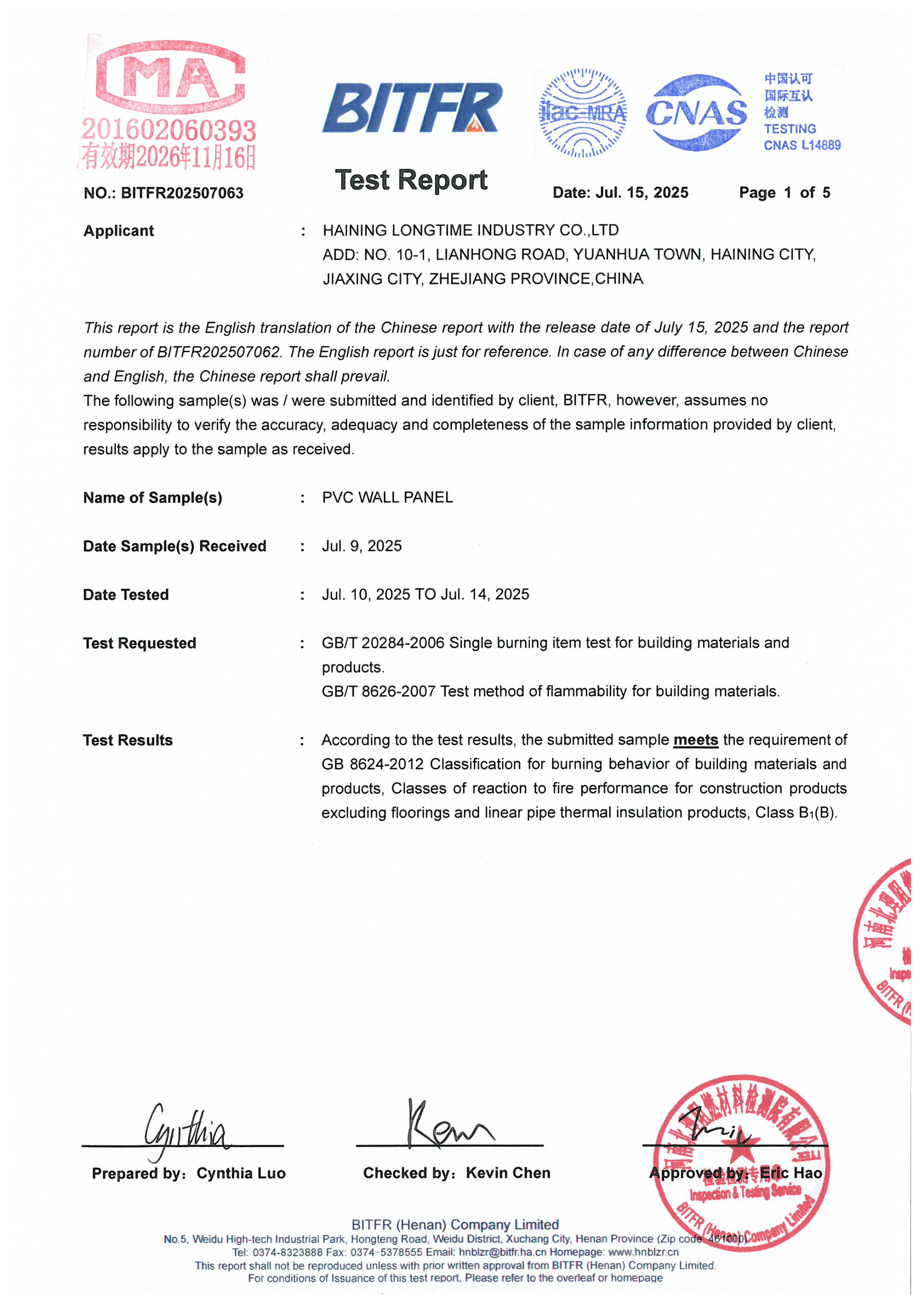
Combustion performance documentation is now a routine part of wall panel submittals, not an optional extra.
Quick reference: four panels, four specification profiles
Before individual questions, it helps to separate what each model is designed to do. The four panels below share a supplier and a documentation system, but they are not interchangeable. One is a fluted interior profile, one is a large-format waterproof sheet, one is a lightweight exterior stone substitute, and one is a thin bendable veneer for curved geometry.
| Model | Dimensions | Thickness | Weight | Fire / water | Typical surface |
|---|---|---|---|---|---|
| LT-WG WPC Fluted Wall Panel | 159 × 2900 mm | 12 mm, 8 mm groove depth | Not specified here | B1 fire rating; waterproof | Interior feature walls, vertical rhythm |
| LT-SW SPC Stone Plastic Composite Wall Panel | 1220 × 2800 mm | 4 mm | Not specified here | B1 fire rating; 100% waterproof | Bathroom and shower walls, large-format interiors |
| LT-PU PU Faux Stone Wall Panel | 600 × 1200 mm | 20–30 mm | 2–3 kg/m² | B1 fireproof; weather-resistant | Exterior facades, stone-look features |
| LT-FS Flexible Soft Stone Wall Panel | 600 × 1200 mm | 2–3 mm | 3–5 kg/m² | Confirm per project | Curved columns, arches, retrofit wraps |
Two entries in that table deliberately read "not specified here" or "confirm per project". A reference table that fills every cell is usually filling them with assumptions. Thickness and format are orderable, quotable facts; a fire classification only exists when it is attached to a named test report and a declared product scope, and that is the subject of the first question below.
Why specification questions dominate the evaluation stage
A shortlist of four wall panel models usually collapses to one or two after the first technical review, and the reason is rarely appearance. Three failure points repeat across markets. First, a fire claim that turns out to be a category description rather than a document. Second, a waterproof claim that describes the panel but not the joint. Third, a weight or thickness figure that was never reconciled with the substrate, the fixing method or the freight plan.
Each of those is checkable before an order is approved, and none of them requires a laboratory on site. What they require is that the buyer asks for the same three things for every model on the shortlist: the document reference, the scoped claim, and the number per square metre. The sections that follow demonstrate how that works on real specifications rather than in the abstract.
Question 1: What does a B1 fire rating actually cover on LT-WG, LT-SW and LT-PU?
The document behind the claim
LONGTE holds a Combustion Performance Test Report numbered BITFR202507063, issued on 15 July 2025 by BITFR (Henan) Company Limited, a testing body accredited as CNAS L14889. The panel was tested under GB/T 20284-2006 and GB/T 8626-2007 and classified as Class B1(B) under GB 8624-2012. The declared scope of that report is PVC wall panel, and the LT-series models referenced by the certification — including LT-WG, LT-SW and LT-PU — are listed as covered products.
What B1 does and does not settle
- B1(B) is a material classification, not a wall assembly rating. It describes how the panel itself behaves in a specified test, not how a built wall with cavities, adhesives and trims will perform.
- The classification is scoped. A buyer should confirm in writing that the ordered model, colour and structure fall inside the declared scope of the report, rather than assuming the whole catalogue inherits it.
- B1(B) under GB 8624-2012 is not interchangeable with EN 13501-1 classes. They use different test methods and different classification scales; a project specified to a European class needs European documentation.
- Some authorities approve at project level. The classification supports a submission; it does not replace the approval. LONGTE's UAE villa and hotel project, covering 6,000 m² of PU stone panel and 4,000 m² of acoustic panel, passed the Dubai Civil Defense fire test and the developer subsequently signed a three-year exclusive frame agreement.
Which supporting documents exist alongside the fire report
For EU-facing orders, LONGTE holds CE verification of conformity TD15322307 for WPC panel 600 × 9 mm to EN 15102:2007+A1:2011 under Regulation (EU) No 305/2011, and CE attestation TD15322305 for PU stone wall panel to the same standard, both issued on 18 December 2023 by EUTEST Belgelendirme (Turkey) and valid to 17 December 2028. RoHS coverage is provided by certificate HN202410860 from Ningbo Helmsman Quality Testing Services Co., Ltd under Directive 2011/65/EU, valid to 4 December 2029.
These documents are often bundled together in a sales folder, and buyers should not treat them as one thing. The CE attestations confirm conformity to a decorative wall covering standard and RoHS compliance for restricted substances. They are not fire classification certificates. Where a project requires a European reaction-to-fire class, that must be requested and quoted separately.

Compliance documents travel as a set, but each one answers a different question. RoHS compliance is not a fire classification.
Question 2: LT-SW is 100% waterproof and LT-WG is waterproof — what is the practical difference?
Both statements are accurate as written, and the difference lies in the product construction and the intended surface. LT-SW SPC Stone Plastic Composite Wall Panel is a rigid stone-plastic sheet at 1220 × 2800 mm and 4 mm thick, described as 100% waterproof, which makes it the model specified for bathroom and shower walls. Its large format reduces the number of joints on a wet surface, and a rigid core holds a flat plane without a separate moisture barrier behind every panel.
LT-WG WPC Fluted Wall Panel is supplied at 159 × 2900 mm with a 12 mm thickness and an 8 mm groove depth. It is waterproof and used in damp interiors, but it is a profiled decorative panel: the flutes create shadow lines, and every flute edge and every vertical joint is a line that must be detailed. The 2900 mm length reduces horizontal joints on a standard wall height, which is the main reason the format exists.
Where the waterproof claim stops
Waterproof describes the panel body, not the wall assembly. Water reaches a substrate through cut edges, penetrations, terminations at floors and ceilings, and poorly executed joints — not through the face of a 4 mm SPC sheet. Three items therefore sit outside the waterproof claim and inside the buyer's scope: the sealant specification, the trim system, and substrate preparation and flatness. A rigid 4 mm sheet on an uneven wall will telegraph every deviation, and no material claim fixes that.
The same discipline applies to a claim level rather than a product name. A US building material distributor and DIY chain has used LONGTE SPC and PVC panels for residential renovation and apartment interiors for more than five years, expanding from 3 SKUs to over 20 SKUs, with panels described as 100% waterproof and meeting US IAPMO/ASTM standards, on annual volume of 15 × 40HQ containers at roughly 5,000 m² per container. The standard reference is what makes the claim portable across projects; the word "waterproof" alone is not.
Question 3: Why does LT-PU weigh 2–3 kg/m² when it is 20–30 mm thick?
LT-PU PU Faux Stone Wall Panel is 600 × 1200 mm, 20–30 mm thick and 2–3 kg/m². The thickness is visual, not structural: it exists to reproduce stone relief, shadow and edge depth on an exterior facade without the mass of stone. That combination changes installation economics more than it changes appearance. In the UAE project, PU stone panels were installed on gypsum walls in a lightweight build-up, and the material remained UV-stable in a 45°C+ climate with B1 fire rating compliance against UAE regulations.
LT-FS Flexible Soft Stone Wall Panel occupies the other end of the same logic: 600 × 1200 mm, 2–3 mm thick, 3–5 kg/m², and bendable. It is specified where geometry, not flat area, is the constraint — curved columns, arches, wrapped counters and retrofit surfaces that cannot be flattened economically.
The limitation of low weight
Low weight per square metre reduces substrate reinforcement, handling labour and freight weight, and it shifts responsibility to the fixing design. On an exterior facade, wind load, mechanical fixing spacing and movement joints still have to be engineered; a 2–3 kg/m² panel is light, not self-supporting. The 20–30 mm thickness also has a detailing consequence: corners, reveals and window returns need a termination profile designed for that depth, and depth cannot be reduced at the edge without changing the visual result. Buyers specifying LT-PU should approve a corner detail, not only a face sample.
Question 4: How should dimensions and thickness be read on a spec sheet?
Dimensions are the least ambiguous part of a wall panel specification, and they are also where order errors originate. Four readings matter:
- Format versus wall module. LT-SW at 1220 × 2800 mm and LT-PU or LT-FS at 600 × 1200 mm are sheet formats; LT-WG at 159 × 2900 mm is a linear profile. Sheet formats minimise joints; profiles create rhythm. Cutting one into the other's role wastes material.
- Thickness versus depth. The 8 mm groove depth on a 12 mm LT-WG panel is a design dimension, not a strength figure. The 20–30 mm on LT-PU is relief depth. Only the 4 mm of LT-SW and the 2–3 mm of LT-FS describe a thin sheet where substrate flatness becomes critical.
- Tolerance and trim. Any dimensional specification should be paired with the matching trim, corner and end-cap system for that model; trims are ordered, not improvised on site.
- Weight per square metre. This drives freight planning and fixing selection. It should appear on the quotation, not only in a brochure.
Application fit: what four reference projects show
Specification questions are answered most credibly by installations that were inspected after handover. LONGTE's project record covers four markets with different failure modes.
UAE — exterior facade and hospitality interiors. A villa developer and luxury fit-out company installed 6,000 m² of PU stone panel and 4,000 m² of acoustic panel across a villa community and a five-star hotel, covering villa exterior feature walls, hotel lobbies and executive suite acoustic walls. The installation has run for more than two years without complaints, and the fire compliance route ran through Dubai Civil Defense.
Philippines — tropical exterior performance. A resort developer installed 8,000 m² of WPC decking and 3,500 m² of wall panel for pool decks, beach walkways, villa terraces and outdoor dining. After three years in tropical humidity and salt air, the installation showed zero warping and zero fading, with termite resistance, salt-corrosion resistance and R11 anti-slip performance, and the resort placed a repeat order for phase two.
India and Colombia — channel and project supply. An Indian distributor has moved roughly 50,000 m² of wall panels annually for over four years, working from more than 250 ceiling and wall designs with a 20-day lead time and an OEM private-label programme. A Colombian retailer chain scaled from a single trial container to 3 × 40HQ per month, about 10,000 m², supported by a Spanish-language installation guide, custom marble patterns and DDP delivery to Cartagena and Buenaventura.
Brazil — consolidated regional distribution. A trader covering Chile, Peru and Brazil ships about 100,000 m² of mixed products per year across 20 × 40HQ containers, with Portuguese and Spanish support, mixed containers of panels, flooring and decking, DDP to Santos, Callao and San Antonio, and an optimised 45-day sea route.
Market trend: documentation is becoming the differentiator
Three signals in the current data explain why technical FAQ content is now a procurement tool rather than a marketing format. First, scale: a USD 30.70 billion decorative wall panel market in 2025 supports a very wide supplier field, and buyers cannot differentiate on appearance alone. Second, material mix: metal wall panels held roughly 28.5% of global share by material in 2025, which means the majority of the market is split among non-metal systems — PVC, WPC, SPC, PU and flexible stone — where classification documents, not brand familiarity, do the screening.
Third, classification literacy is rising. Flexible stone panels in the MCM category can be classified to EN 13501-1 as B-s1,d0 or even A2, which shows that the category as a whole can reach stricter European classes than a B1 material classification implies. A buyer who needs A2 performance must specify it and expect different, model-specific documentation; assuming that "stone panel" implies a European class is how submittals fail.
Cost benchmarking follows the same pattern. FOB China pricing for bamboo charcoal wood veneer panels has been reported in a band of USD 3–18 per m² depending on grade and thickness, a spread wide enough that unit price alone is a weak comparison tool. On the supply side, capacity is consolidating around large producers: LONGTE's monthly capacity covers 800,000 m² of PVC panel, 500,000 m² of SPC flooring, 200,000 m² of WPC decking, 150,000 m² of PU stone and 80,000 m² of acoustic panel — capacity that matters to buyers running mixed containers on a fixed shipping calendar.
Wall panels compared with tile, plaster and laminate cladding
Panels are not the default answer for every wall. The comparison below is qualitative on purpose: the deciding factors are documentation, weight, installation method and repairability, and those are better discussed as trade-offs than as scores.
| Criterion | Ceramic and porcelain tile | Painted plaster / skim coat | Laminate (HPL) cladding | Panel systems (WPC / SPC / PU / flexible stone) |
|---|---|---|---|---|
| Unit weight | High; needs substrate and adhesive | Low | Medium | Low to medium; LT-PU 2–3 kg/m² |
| Fire evidence | Typically classified in non-combustible ranges | Depends on substrate and coating | Varies by core and supplier | B1(B) under GB 8624-2012 where documented per model |
| Wet areas | Strong when correctly installed | Weak without additives | Edges and joints are the vulnerable point | LT-SW 100% waterproof body; joints must be sealed |
| Installation | Wet trade with curing time | Wet trade with drying time | Dry fixing or adhesive | Dry; adhesive or mechanical fixing |
| Repair | Visible tile replacement | Local patching is simple | Panel replacement | Full panel replacement; texture matching matters |
The limits worth stating plainly. A B1(B) classification is not a non-combustible classification, and projects that require A-level performance should not be resolved by argument. In continuously wet or heavy-impact environments — commercial kitchens, service corridors, public washrooms with hard use — tile remains a defensible choice that panels will struggle to match. Panel performance at joints depends on installer skill more than on the panel, so a low-cost installer can degrade a well-documented product. And textured surfaces such as faux stone are harder to repair invisibly than a painted wall: matching a repair to an aged texture is not always achievable.
Purchasing terms and acceptance criteria before order approval
Order approval should not depend on a sample alone. The checklist below converts the questions above into verifiable line items, and it is deliberately written so that a buyer can apply it to any of the four models without reopening the technical discussion.
| Check | What to confirm | Acceptance evidence |
|---|---|---|
| Dimensions | Model, width × length, thickness, groove depth where applicable | Quotation and packing list state the same figures as the specification |
| Material composition | WPC, SPC, PU or flexible stone, stated per line item | Product data sheet matching the ordered model |
| Fire performance | Report number, issuing laboratory, declared scope, classification standard | BITFR202507063 or the project-specific document required by the authority |
| Water performance | Claim level for the ordered model, plus sealant and trim specification | Written claim, joint detail drawing, trim list |
| Weight per m² | Figure used for freight and fixing design | Stated on the quotation; fixing method agreed with the installer |
| Application fit | Interior or exterior, flat or curved, substrate type | Approved sample and corner or curve detail |
| Quality verification | Incoming material inspection, in-process checks, finished goods check | Third-party pre-shipment inspection on request (SGS, BV or TUV) |
Commercial terms sit alongside the technical checklist. LONGTE's standard terms are a free sample of one piece, a trial order of one 20GP mixed container, and a 500 m² minimum for custom designs. Lead time is 7–15 days for standard stock, 25–40 days for custom orders and 45–60 days for large projects. Quality control covers 100% incoming raw material inspection, in-process checks every two hours, and 100% finished goods visual and dimension verification. After-sales support includes 24-hour WhatsApp response, installation video guides, claim handling within seven days and a five-year quality warranty on major products.
The mixed-container term deserves emphasis because it changes evaluation risk. A buyer can validate LT-SW, LT-PU and LT-FS on the same container before committing to volume, which is exactly how the Colombian and US channel relationships described earlier began — a single trial container followed by monthly bulk orders.
Future outlook
Three developments are likely to shape wall panel procurement through 2026 and beyond. Documentation will keep moving upstream in the buying process, driven by authorities that approve at project level rather than product level; suppliers who can produce a scoped report, a CE attestation and a RoHS certificate as a matched set will shorten evaluation cycles. Lightweight exterior systems such as PU faux stone will continue to displace heavyweight cladding in retrofit and residential facade work, where substrate capacity rather than appearance is the binding constraint. And multi-material sourcing will concentrate around suppliers with capacity across categories, because the mixed container has become the standard risk-control instrument for both distributors and contractors.
The practical implication for buyers is narrow: the evaluation questions are now stable, and they can be standardised. Fire document scope, water claim scope, weight per square metre, format and application fit — four panels, four answers, checked before approval rather than after delivery.
FAQ
Is a B1 fire rating the same as a European Class B classification?
No. B1(B) in LONGTE's documentation is assigned under GB 8624-2012 using the GB/T 20284-2006 and GB/T 8626-2007 test methods, as recorded in report BITFR202507063 issued by BITFR (Henan) Company Limited. European classification under EN 13501-1 uses different tests and a different scale, so the two are not interchangeable. Buyers with a European specification should request documentation to EN 13501-1 for the specific model and colour, and should not substitute a GB classification.
Is LT-SW suitable for a shower wall, and what falls outside its 100% waterproof claim?
LT-SW SPC Stone Plastic Composite Wall Panel is 1220 × 2800 mm and 4 mm thick with a 100% waterproof body, which is why it is the model specified for bathroom and shower walls. The claim covers the panel, not the wall assembly. Joints, cut edges, penetrations and terminations at floor and ceiling are outside it, and they are closed by the specified sealant and trim system. Substrate flatness also matters: a rigid 4 mm sheet follows the wall beneath it.
Can LT-PU be used on exterior facades in hot climates?
LT-PU PU Faux Stone Wall Panel is 600 × 1200 mm, 20–30 mm thick and 2–3 kg/m², with B1 fireproof and weather-resistant properties, and it is positioned for exterior facades. In the UAE project it was installed on villa exterior feature walls and remained UV-stable in a 45°C+ climate over more than two years of service. Exterior use still requires an engineered fixing design for wind load and movement, and the 20–30 mm depth requires matching corner and reveal profiles.
Can LT-FS be bent around a curved column?
LT-FS Flexible Soft Stone Wall Panel is 600 × 1200 mm, 2–3 mm thick, 3–5 kg/m² and bendable, and it exists specifically for curved surfaces such as columns, arches and wrapped counters. Because it is thin, the substrate must be fair and smooth — the panel reproduces the shape beneath it. Radius limits and adhesive selection should be agreed against a physical mock-up rather than a data sheet alone.
What are the order terms for a first mixed trial?
LONGTE's stated terms are one free sample piece, a trial order of one 20GP mixed container, and a 500 m² minimum for custom designs. Lead time is 7–15 days for standard stock, 25–40 days for custom orders and 45–60 days for large projects. Mixed containers of panels, flooring and decking are accepted, which is how several channel partners in the USA, Colombia and Brazil validated demand before scaling to monthly volumes.
How is quality verified before shipment?
Quality control covers 100% incoming raw material inspection, in-process quality control every two hours, and 100% finished goods visual and dimension checking. Third-party pre-shipment inspection by SGS, BV or TUV can be arranged on request. A five-year quality warranty applies to major products, with claim handling targeted within seven days and technical consultation available before and during installation.
A consolidated product and specification overview is available in the LONGTE product catalogue.
¿Tiene preguntas o necesita más detalles?
Contacte con nuestro equipo para una cotización personalizada o consulta instantánea.
Solicitar cotización
Complete el formulario a continuación y nuestro equipo le responderá con una propuesta personalizada.
Chat directo de WhatsApp
¿Prefiere chatear en tiempo real? Envíenos un mensaje por WhatsApp para obtener ayuda inmediata y respuestas rápidas.
- Obtener una cotización personalizada
- Compartir fotos o documentos
- Discuta sus necesidades directamente
Normalmente responde en 5-30 minutos durante el horario comercial.