
Wall-Mounted vs Floating Bathroom Vanities: Fit by Scenario
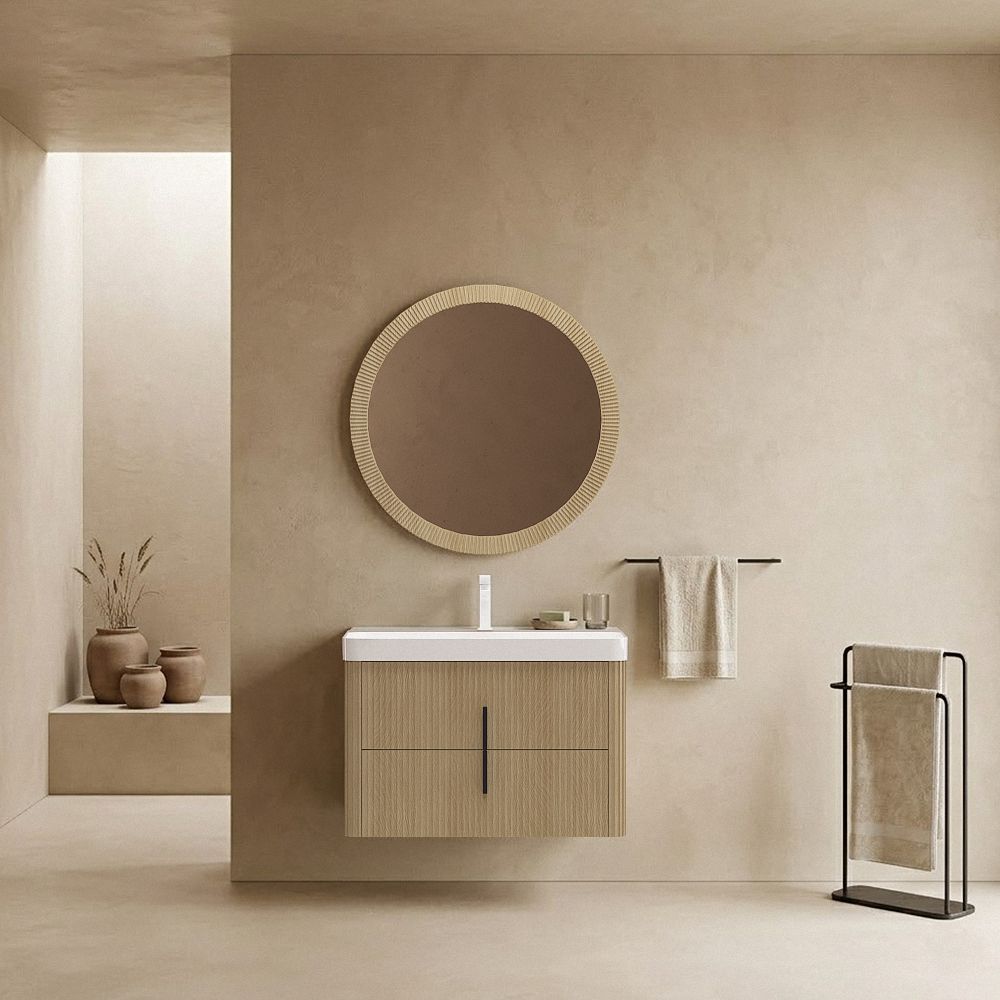
A floating vanity configuration in a residential bathroom setting. Installation type, not finish, is usually what decides whether a vanity specification survives the site visit.
Two bathroom vanity specifications can begin from the same floor plan and the same style direction and still end up in completely different places, because the constraint that removes the most options is not colour or finish. It is installation type: whether the cabinet is carried by the wall or stands on the floor, and what that implies for wall preparation, concealed drainage, housekeeping access and serviceability. A residential renovation and a hotel bathroom weigh those implications very differently.
SHKL (Foshan SHKL Sanitary Ware Co., Ltd) is a sanitary ware manufacturer established in 2004 that designs and produces bathroom vanities, shower doors and LED bathroom mirrors. Its production footprint covers 100,000 m2 in China and 40,000 m2 in Vietnam, and roughly 70% of output is exported to Europe, Oceania, North America, South America and the Middle East. The company holds ISO 9001, ISO 14001 and ISO 45001 management system certifications covering the research, development and manufacture of bathroom cabinets.
This article addresses one narrow procurement question inside that range: how to match wall-mounted and floating bathroom vanities to residential construction and commercial hospitality scenarios. The wall-mounted KL813003 is used as the reference point for wall-carried installation, and the floating AS813048A, AS813050, AS813108 and AS813109 are used as the floating comparison set. All models in this comparison share the same material family, so the differences that matter are dimensional, structural and functional rather than cosmetic.
Why Installation Type Is a Constraint Decision, Not a Style Preference
The wall-mounted design of the KL813003 is intended to save floor space, and that single property changes how a bathroom is used and maintained. With the cabinet lifted clear of the floor, cleaning becomes a continuous sweep rather than a reach around a plinth, which matters in hospitality rooms where housekeeping time is managed per room. The same configuration makes small residential bathrooms feel less crowded, because the visible floor area is not interrupted by a cabinet base.
The trade-off is structural. A wall-carried cabinet transfers its load to the wall, so the wall must be able to accept that load, and supply and waste connections generally need to be routed inside the wall or concealed behind the cabinet. That is a coordination task shared between the vanity supplier, the plumber and the main contractor, and it is far easier to resolve at design stage than during installation. In renovation projects where existing walls cannot be opened without disproportionate cost, this constraint usually decides the specification before finish, colour or commercial terms are even discussed.
The terms wall-mounted and floating are used almost interchangeably in catalogue copy, and inside the SHKL range the model types are recorded as 'Wall mounted bathroom vanity' for the KL813003 and 'Floating bathroom vanity' for the AS813048A, AS813050, AS813108 and AS813109. For procurement purposes the label matters less than the three items that follow it: which surface carries the cabinet, where the drainage void sits, and how the unit behaves when a drawer or a mirror has to be serviced. Those three questions are what separate a specification that installs cleanly from one that generates a site instruction.
What Each Installation Type Actually Contains
The table below maps the wall-mounted reference model against the four floating models on the dimensions and components that appear in a submittal package rather than in a lifestyle photograph.
| Model | Installation type | Materials and finish | Structure and hardware | Basin and countertop | Mirror |
|---|---|---|---|---|---|
| KL813003 | Wall mounted bathroom vanity | Plywood and solid wood; A2391 Acacia melamine and solid wood lacquered | Two drawers with DTC soft-closing slides; hidden handle to open | Undermount ceramic basin; Pure White Porcelain slab countertop | LED mirror supporting different functions |
| AS813048A | Floating bathroom vanity | Plywood and solid wood; Warm Mist Brown lacquered and melamine | Two drawers with Unihopper metal box soft-closing slides | Glossy white ceramic basin | Wooden frame mirror, no light |
| AS813050 | Floating bathroom vanity | Plywood and solid wood; Ancora Walnut lacquered and melamine | One drawer with Unihopper soft-closing slides | Glossy white ceramic basin | LED mirror, gun metal frame, three colour temperatures, defog, dimmable, two control buttons |
| AS813108 | Floating bathroom vanity | Plywood and solid wood; Warm Mist Brown lacquer and melamine | Two drawers with Unihopper soft-closing slides | Ceramic basin; solid surface countertop | Mirror cabinet with three doors on DTC hinges, LED light strip inside, infrared sensor switch |
| AS813109 | Floating bathroom vanity | Plywood and solid wood; Warm Mist Brown lacquer and melamine | Two side drawers plus one outer and one inner drawer; Unihopper soft-closing slides | Solid surface basin; terrazzo countertop | Oval mirror cabinet, 3 mm copper-free glass, three doors on DTC hinges |
KL813003 is the broadest wall-mounted option in this comparison. It is built from plywood and solid wood with an A2391 Acacia melamine finish and solid wood lacquering, and it is offered in five widths: 750, 800, 900, 1000 and 1200 mm, with the remaining cabinet dimensions specified as 520 mm and 504 mm. The drawer stack consists of two drawers on DTC soft-closing slides opened by a hidden handle, which keeps the front face unbroken. The countertop is a Pure White Porcelain slab and the basin is an undermount ceramic basin. Its LED mirror supports different functions, which is a deliberate design position: the lighting package is configured per project rather than fixed at model level.
AS813048A is a floating vanity in plywood and solid wood with a Warm Mist Brown lacquered and melamine finish. It carries two drawers on Unihopper metal box soft-closing slides and a glossy white ceramic basin, and it is supplied with a wooden frame mirror that has no integrated lighting. That last detail changes the electrical scope on a project, because illumination must then come from the room's own fixtures, and it is the kind of item that is easy to overlook when a specification is assembled from images.
AS813050 is a single-drawer floating vanity with the same plywood and solid wood construction, finished in Ancora Walnut lacquering and melamine. Its basin is a glossy white ceramic basin, and its LED mirror has a gun metal frame with three colour temperature settings, a defog function, dimming and two control buttons. For a compact residential bathroom or a standard hospitality room, this is the leanest storage configuration in the floating set.
AS813108 and AS813109 sit closer to the storage-heavy end of the same family. AS813108 has two drawers on Unihopper soft-closing slides, a ceramic basin and a solid surface countertop, and its mirror cabinet has three doors on DTC hinges with an LED light strip inside and an infrared sensor switch. AS813109 uses the same base materials and finish, but the drawer layout becomes two side drawers plus one outer and one inner drawer, the basin is solid surface and the countertop is terrazzo. Its mirror cabinet is oval with 3 mm copper-free glass and three doors on DTC hinges. The model is offered as AS813109-80 with an 800 x 469 x 408 mm cabinet and an 800 x 650 x 150 mm LED mirror, and as AS813109-90 with a 900 x 469 x 408 mm cabinet and a 900 x 650 x 150 mm LED mirror.
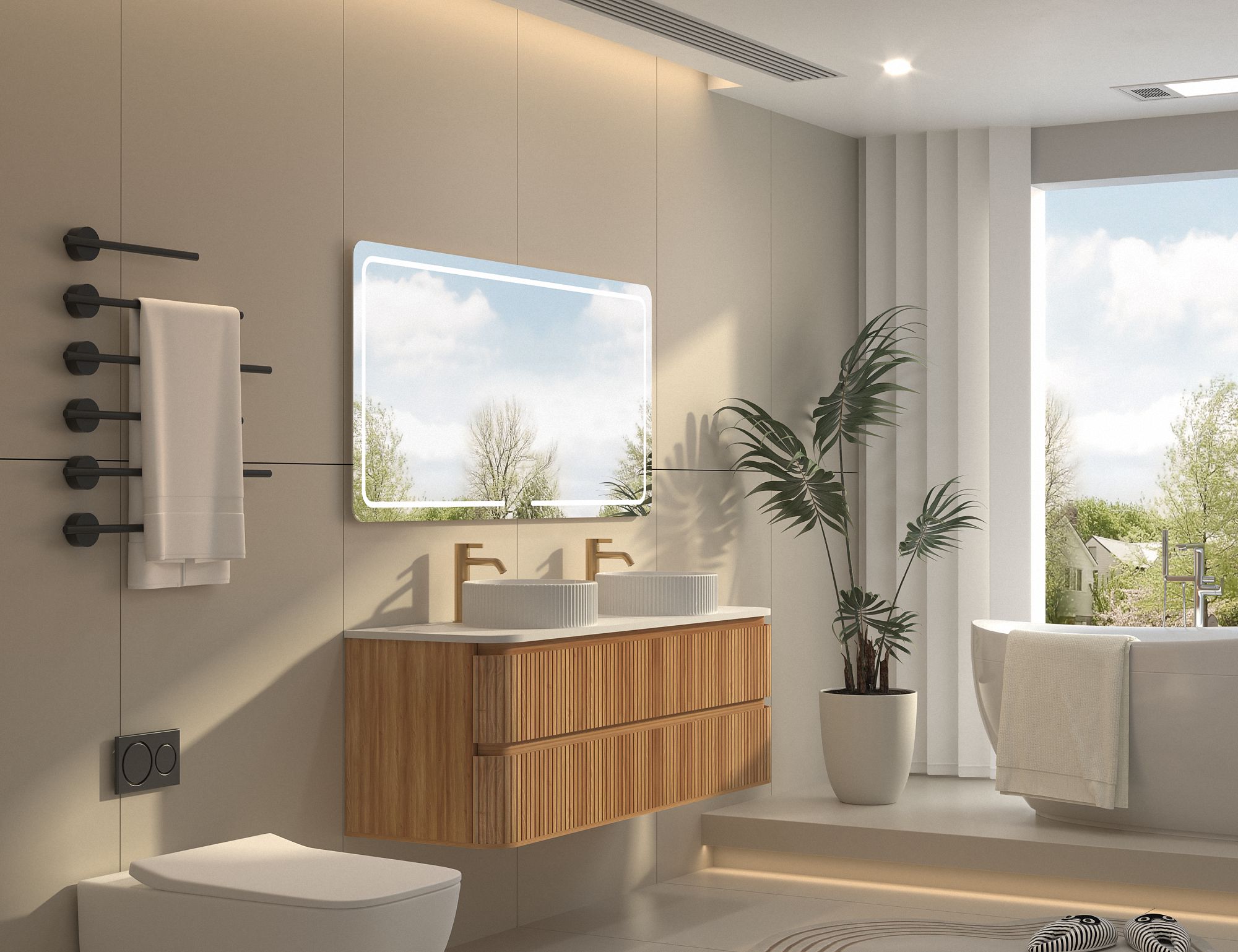
KL813003, the wall-mounted reference model, with a hidden-handle two-drawer front and a Pure White Porcelain slab countertop.
The Constraint Layer: Sizes, Drawers, Basins and Mirror Functions
Once installation type has been settled, four further constraints decide which model in the range actually fits a project. All four appear in submittal documents, and all four are visible on the models listed above.
Width planning for single and double layouts
Width is the first filter, because it is fixed by the wall run and by how many users the bathroom serves. KL813003 spans 750, 800, 900, 1000 and 1200 mm within one model line, which means a project can hold a single, consistent drawer-front language across a small en-suite and a larger double sink bathroom vanity without switching product families. AS813109 is available at 800 mm and 900 mm. In practice, narrow widths protect circulation in compact residential bathrooms, while wider widths are reserved for double-basin layouts in primary bathrooms and in hospitality suites where two guests share the room.
Drawer configuration and soft-closing hardware
Storage geometry differs more between these models than the exterior suggests. AS813050 carries one drawer; KL813003 and AS813048A carry two; AS813109 splits storage into two side drawers plus one outer and one inner drawer. Soft-closing hardware appears across the set, in two forms: DTC soft-closing slides on the KL813003, and Unihopper soft-closing slides on the floating models, with AS813048A specified on Unihopper metal box soft-closing slides. For a specifier, the practical consequence is that drawer count and drawer arrangement are separate decisions from colour or finish, and they should be recorded explicitly rather than inferred from a render.
Basin and countertop material
Basin material is one of the few genuinely visible differences between models in the same family. The range covers an undermount ceramic basin on KL813003, glossy white ceramic basins on AS813048A and AS813050, a ceramic basin paired with a solid surface countertop on AS813108, and a solid surface basin with a terrazzo countertop on AS813109. Ceramic is a long-established choice for bathroom basins, while solid surface and terrazzo change the visual character of the top and are typically specified where a designer wants a continuous, stone-like surface. The countertop material should be confirmed alongside the basin, because the two are specified as a pair on every model above.
Mirror and lighting functions
Mirror specification is where the floating and wall-mounted models diverge most sharply on electrical scope. AS813048A uses a wooden frame mirror with no light. AS813050 uses an LED mirror with a gun metal frame, three colour temperatures, defog and dimming controlled by two buttons. AS813108 uses a mirror cabinet with three doors on DTC hinges, an internal LED light strip and an infrared sensor switch. AS813109 uses an oval mirror cabinet in 3 mm copper-free glass. KL813003 is the least prescriptive: its LED mirror supports different functions, so the exact function set has to be confirmed configuration by configuration. In hospitality projects this distinction matters commercially, because defog and dimming behaviour is often standardised across an entire property.
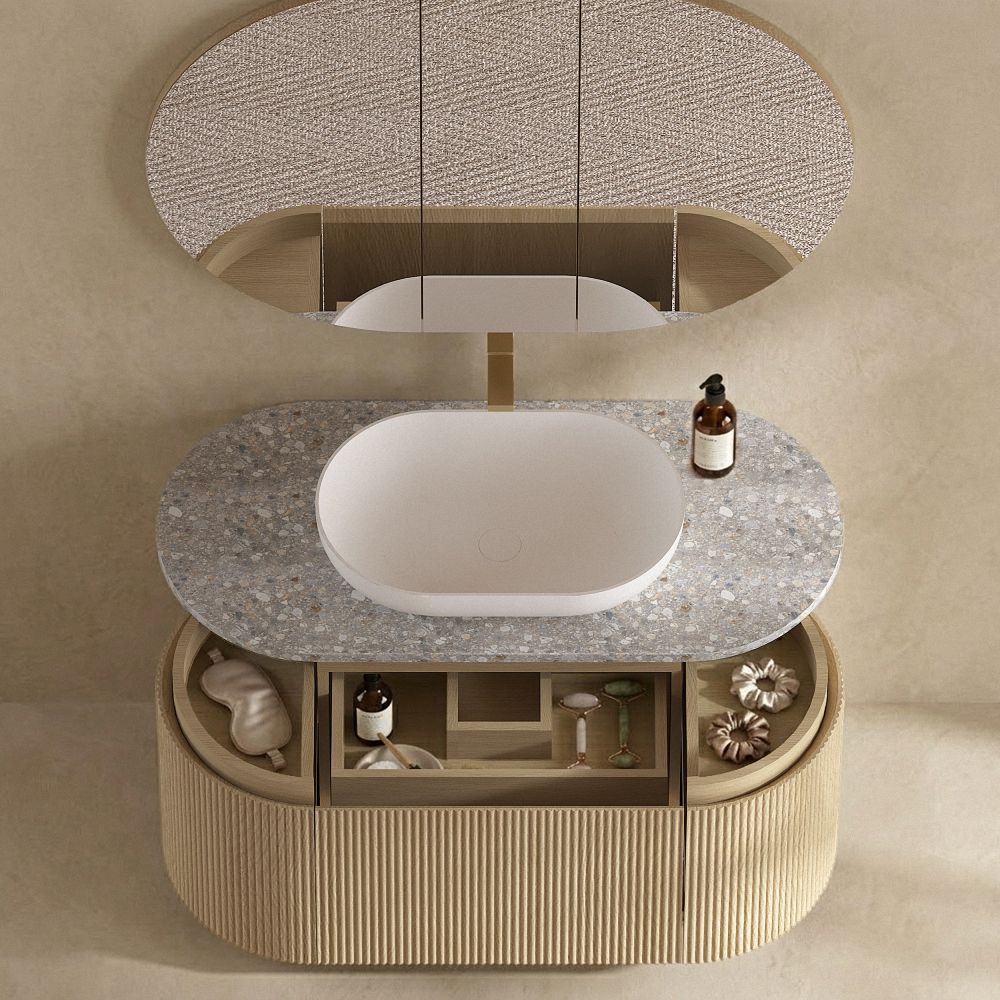
AS813109, a floating configuration with a terrazzo countertop, a solid surface basin and an oval mirror cabinet in 3 mm copper-free glass.
Certification and Documentation Constraints
For hvq_2-type procurement questions, compliance documentation is a gate rather than a detail. The manufacturer of the wall-mounted bathroom vanity KL813003 holds three management system certifications, all issued by Guangdong Quality Testing CTC Certification Co., Ltd. and all valid from 11 May 2024 to 10 May 2027.
| Certification | Standard | Certificate number | Scope |
|---|---|---|---|
| ISO 9001 | GB/T 19001-2016 / ISO 9001:2015 | 04924Q00629R0M | R&D and manufacture of bathroom cabinets; manufacture of fixed universal lighting fixtures |
| ISO 14001 | GB/T 24001-2016 / ISO 14001:2015 | 04924E00351R0M | R&D and manufacture of bathroom cabinets; manufacture of fixed universal lighting fixtures |
| ISO 45001 | GB/T 45001-2020 / ISO 45001:2018 | 04924S00316R0M | R&D and manufacture of bathroom cabinets; manufacture of fixed universal lighting fixtures |
These certificates apply to the global market, including China, the EU, the US and the Middle East, and the certification scope explicitly covers the research, development and manufacture of bathroom cabinets, including the wall mounted bathroom vanity model KL813003. That level of traceability is what allows a specifier to respond when a contractor or a procurement reviewer asks for the certificate number rather than a general quality claim.
For North American projects, an additional reference point sits outside the supplier's own documentation: bathroom cabinets and vanities in North America must comply with UL 962 standards for safety, covering stability, mechanical strength and flammability. A wall-carried vanity adds a site-specific dimension to that picture, because the adequacy of the wall substrate is determined on site and not by the cabinet manufacturer.
Scenario Fit: Residential Renovation vs Hospitality Bathrooms
The two scenarios that dominate demand for this model family differ in volume, repetition and tolerance for variation. Both are documented in the manufacturer's project record.
On the residential side, an Australian villa project used a bathroom furniture OEM programme with a quantity of 100 units, applied to a villa project with a working life recorded as 5 to 10 years. The stated result was that the products met the villa design specifications with on-time delivery and high customer satisfaction, and the project highlight was described as practical, durable and well-designed with a harmonious overall style. A separate Canadian project combined bathroom and kitchen cabinet customisation at a quantity of 50 units, with materials meeting the stated requirements and products meeting Canadian safety standards. Residential applications are also where the market concentrates: residential use accounted for approximately 74.9% of bathroom vanity revenue share in 2025, according to Grand View Research.
On the hospitality side, a US hotel project involved 250 units of customised bathroom furniture applied to hotel bathrooms over a two-year duration. Delivery was on time, product quality met US market standards, and the project highlight was recorded as design, product fidelity and meeting customer requirements. The application conditions for this type of installation are consistent across residential and hospitality use: daily household-style operation, manual use, long-term static installation, with matched equipment typically including a ceramic basin, an LED mirror, a shower enclosure and a faucet. The functional brief is storage organisation, bathroom space optimisation and support for wet-dry separation, and the special requirements are moisture resistance, mildew resistance and scratch resistance.
Read against those requirements, the model logic becomes fairly direct. A repeated hospitality layout benefits from a fixed, standardised configuration with predictable drawer geometry and a mirror specification that can be repeated across hundreds of rooms, which favours AS813050 or AS813108. A residential renovation with irregular wall runs and a single bathroom favours the KL813003 because its five widths allow the cabinet to be sized to the room rather than to a standard module.
Market Signals Behind Wall-Hung and Floating Specifications
The installation-type decision is not only a project-level judgement; it sits inside a market that is large and still expanding. The global bathroom vanities market was valued at approximately USD 43.34 billion to USD 47.22 billion in 2024 and 2025, with growth projections reaching up to USD 89.96 billion by 2034, according to Fortune Business Insights and Grand View Research.
Material choice tracks that growth closely. The wood material segment, which includes solid wood and plywood, led the market with a 34.9% revenue share in 2025, driven by what Grand View Research describes as premium aesthetics and durability. Every model in the SHKL comparison set above is built from plywood and solid wood, so the range sits inside the single largest material segment rather than at its edge.
Installation preference is moving in a direction that favours wall-carried cabinets. Floating and wall-mounted vanities are identified by Houzz and Homes & Gardens as a top design trend for 2025 to 2026, although freestanding units still hold a significant market volume share in North America, at approximately 30%. That coexistence explains why a manufacturer's product range needs both a wall-carried reference model and a broader floating family rather than a single installation concept.
Competitive context is worth stating neutrally. Mordor Intelligence identifies major global competitors in the high-end and residential vanity market as Kohler, Masco (Delta and Peerless), American Woodmark and TOTO. For a buyer comparing suppliers, the practical differentiator is rarely the brand list itself; it is whether a supplier can supply the width, drawer configuration, basin material, mirror function and certification evidence for one specific project, in one documentation set.
Where a Wall-Hung Specification Does Not Fit
An honest scenario guide has to state the cases where the wall-mounted route is the wrong answer, because those cases appear regularly in renovation work.
- Wall structure cannot accept the load. A wall-carried cabinet depends on the wall being able to take the load and on concealed supply and waste routing. Where the wall is a lightweight partition, or where in-wall routing is not available, the installation either requires additional preparation or a different installation concept.
- Existing walls cannot be opened economically. In occupied residential renovation, opening a finished wall is often the single largest cost driver. This is one reason freestanding units retain roughly 30% of North American volume even while floating designs gain design share.
- The mirror carries no lighting. AS813048A ships with a wooden frame mirror and no integrated light, so the lighting package must come from the room. If a project standard requires defogging or colour temperature control at the mirror, that model is not the fit.
- The mirror function set is not yet fixed. The KL813003 LED mirror supports different functions, which means the function list must be confirmed per configuration. Assuming a standard function set before confirmation is a common source of specification mismatch.
- Order volume is below the OEM threshold. Customisation of size, colour, material, finish, hardware, logo and design style is offered under an OEM model with a minimum order quantity of 50 units and a lead time of 30 to 45 days. Very small one-off requirements sit outside that commercial structure.
- Certification scope is process-level. As noted above, the ISO certificates cover R&D and manufacture of bathroom cabinets and fixed universal lighting fixtures; they are not a configuration-by-configuration product certification.
A Specifier's Decision Checklist
The following checklist converts the constraint discussion into the order in which decisions actually have to be made on a project.
| Step | Question to resolve | Where it is answered in this range |
|---|---|---|
| 1 | Does the wall accept the load, and can supply and waste be concealed? | Wall-carried models such as KL813003; otherwise review the installation concept |
| 2 | How many users, and therefore what width? | KL813003 at 750, 800, 900, 1000, 1200 mm; AS813109 at 800 and 900 mm |
| 3 | How much drawer storage is required, and in what arrangement? | One drawer (AS813050); two drawers (KL813003, AS813048A, AS813108); split drawer layout (AS813109) |
| 4 | Which basin and countertop material suits the design and cleaning regime? | Undermount ceramic with Porcelain slab; glossy white ceramic; ceramic with solid surface; solid surface with terrazzo |
| 5 | Is mirror lighting required, and with which functions? | No-light wooden frame (AS813048A); LED with defog and dimming (AS813050); mirror cabinet with internal LED and infrared sensor (AS813108); oval cabinet, 3 mm copper-free glass (AS813109); configurable LED functions (KL813003) |
| 6 | What documentation does the project require? | ISO 9001 (04924Q00629R0M), ISO 14001 (04924E00351R0M), ISO 45001 (04924S00316R0M), issued by Guangdong Quality Testing CTC Certification Co., Ltd., valid to 10 May 2027 |
| 7 | Does the order volume and schedule fit the supply structure? | OEM customisation with MOQ of 50 units and lead time of 30 to 45 days |
Future Outlook
Two forces look likely to keep shaping this decision over the next procurement cycles. The first is the growing presence of wall-carried configurations, which is already visible in design trend reporting for 2025 and 2026, and which pushes more of the specification risk onto wall preparation and concealed plumbing rather than onto the cabinet itself. As that shift continues, documentation quality and coordination capability become more valuable than catalogue breadth.
The second is material and lighting integration. Solid wood and plywood construction already holds the largest revenue share of the market at 34.9% in 2025, and mirror specification has moved from a decorative add-on to an electrically scoped component with defog, dimming, colour temperature and sensor control options. Specifiers who treat the mirror as part of the electrical package rather than as a finish item will avoid the majority of late-stage changes.
Supply continuity is the third factor. For manufacturers serving both North American and European markets, a dual production footprint matters because it distributes risk across locations. SHKL operates a 100,000 m2 site in China and a 40,000 m2 site in Vietnam, and supports its export markets through OEM customisation of size, colour, material, finish, hardware, logo and design style, with 100% inspection and after-sales support covering warranty, remote consultation and spare parts supply.
FAQ
What certifications apply to the wall-mounted bathroom vanity KL813003?
The manufacturer of the KL813003 holds ISO 9001:2015 certification under certificate number 04924Q00629R0M, ISO 14001:2015 under 04924E00351R0M, and ISO 45001:2018 under 04924S00316R0M. All three were issued by Guangdong Quality Testing CTC Certification Co., Ltd., are valid from 11 May 2024 to 10 May 2027, and apply to the global market including China, the EU, the US and the Middle East. The certification scope covers the research, development and manufacture of bathroom cabinets and the manufacture of fixed universal lighting fixtures.
What widths is the KL813003 wall-mounted vanity available in?
The KL813003 is available in five widths: 750 mm, 800 mm, 900 mm, 1000 mm and 1200 mm. The remaining cabinet dimensions are specified as 520 mm and 504 mm. The model uses plywood and solid wood construction with an A2391 Acacia melamine finish and solid wood lacquering.
How do the drawer configurations differ across the wall-mounted and floating models?
AS813050 uses a single drawer with Unihopper soft-closing slides. KL813003 uses two drawers with DTC soft-closing slides and a hidden handle. AS813048A uses two drawers on Unihopper metal box soft-closing slides. AS813108 uses two drawers on Unihopper soft-closing slides. AS813109 uses two side drawers plus one outer drawer and one inner drawer on Unihopper soft-closing slides. Drawer count and arrangement are specified separately from finish or colour.
Which basin and countertop materials are available in this model group?
Basin and countertop materials across the group are: an undermount ceramic basin with a Pure White Porcelain slab countertop on KL813003; a glossy white ceramic basin on AS813048A and AS813050; a ceramic basin with a solid surface countertop on AS813108; and a solid surface basin with a terrazzo countertop on AS813109.
Do the mirror specifications differ between models?
Yes. AS813048A uses a wooden frame mirror with no integrated lighting. AS813050 uses an LED mirror with a gun metal frame, three colour temperatures, defog and dimming controlled by two buttons. AS813108 uses a mirror cabinet with three doors on DTC hinges, an internal LED light strip and an infrared sensor switch. AS813109 uses an oval mirror cabinet in 3 mm copper-free glass with three doors on DTC hinges. The KL813003 LED mirror supports different functions, which must be confirmed for the specific configuration.
What are the order and lead time constraints for customised vanity programmes?
Customisation is offered under an OEM model covering size, colour, material, finish, hardware, logo and design style. The minimum order quantity is 50 units and the stated lead time is 30 to 45 days, with 100% inspection and after-sales support covering warranty, remote after-sales consultation and spare parts supply. The export markets served include North America, Europe, Oceania and the Middle East.
When is a wall-mounted vanity the wrong choice for a project?
A wall-carried vanity requires a wall that can accept the load and a route for concealed supply and waste connections. Where the wall is a lightweight partition, where in-wall routing is unavailable, or where opening a finished wall during renovation is not economically reasonable, a different installation concept is the more practical answer. Mirror specification can also exclude a model: AS813048A has no integrated mirror lighting, and the KL813003 LED mirror function set has to be confirmed per configuration rather than assumed.