
Wall-Mounted Bathroom Cabinets: A Buyer Constraint Guide
A wall-mounted bathroom cabinet is a vanity or storage unit whose full weight — board, door, mirror, basin and contents — is carried by the wall rather than by the floor. Inside a bathroom furniture set, that single decision changes the load path, the installation sequence, the sealing scope and the documentation package a buyer has to collect before the order is confirmed.
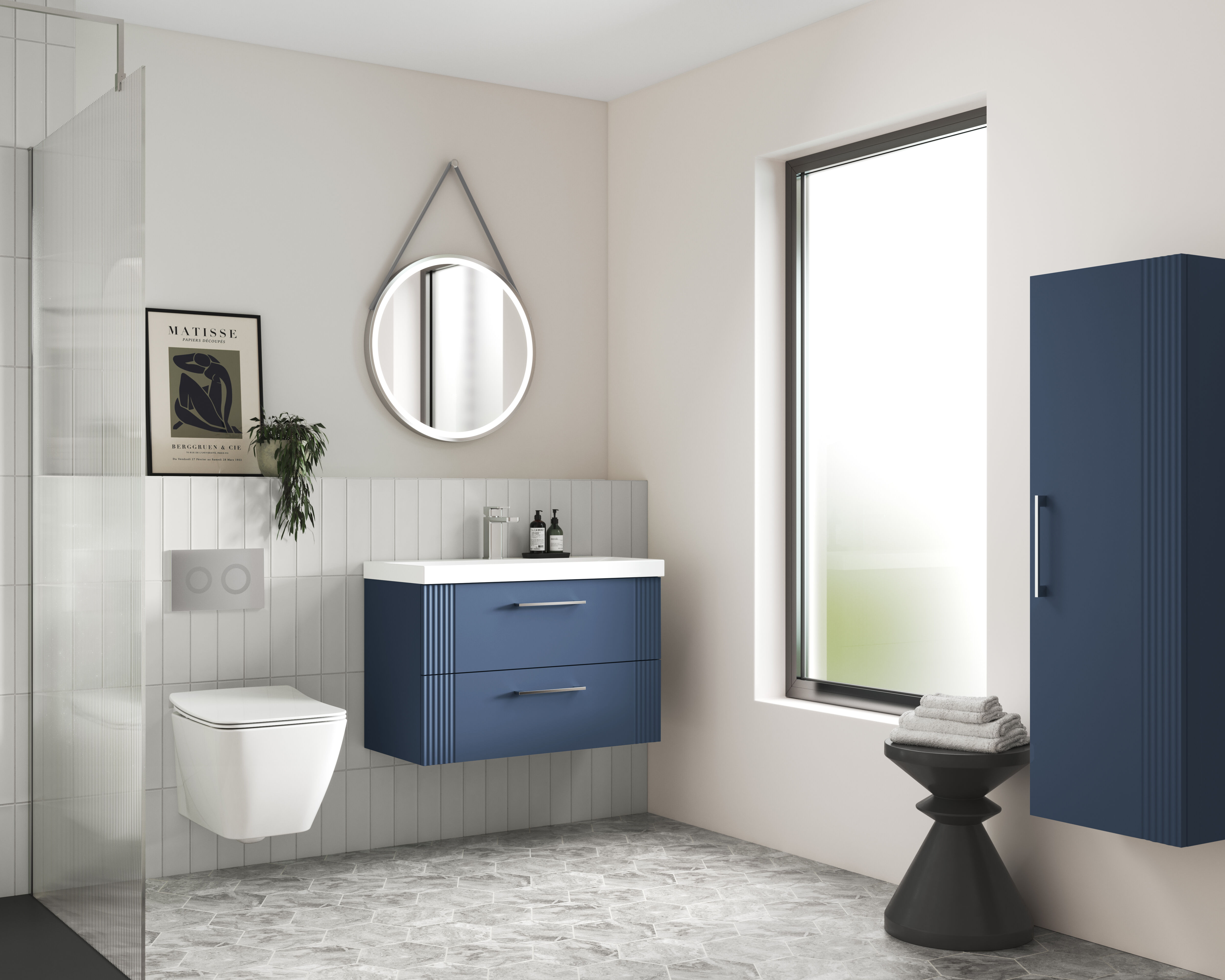
Bathroom vanity configuration: cabinet, basin and mirror in a residential wash area.
The global bathroom furniture market reached a valuation of USD 135.9 billion in 2024 and is estimated to reach USD 148.9 billion by 2026, according to Grand View Research. Bathroom cabinets accounted for approximately 50% of that market in 2023. Within the cabinet segment, the wall-hung format carries the clearest forward signal: Grand View Research projects a 7.26% CAGR through 2031 for wall-mounted and floating vanity units in the US market.
Those numbers explain why wall-hung specification keeps appearing in renovation and hospitality briefs. They do not explain what changes once a buyer commits to it. A wall-mounted bathroom cabinet, a wall-hung bathroom cabinet and a floor-standing bathroom cabinet can be sold under the same category code, shipped in the same container and priced from the same quotation sheet — yet they fail for entirely different reasons on site. This guide sets out the constraints that decide whether a wall-hung specification survives contact with a real bathroom, and which of those constraints have to be documented before purchase rather than resolved during installation.
Why the mounting decision comes before the style decision
Most procurement conversations start with style: a Nordic style bathroom cabinet finish, a light luxury mirror lamp profile, a minimalist shower enclosure. The mounting type is usually treated as a later detail. In practice it is the constraint that determines everything else.
Four physical conditions change when a cabinet leaves the floor:
- Load path. Floor-standing units transfer weight into the floor slab through the carcass. Wall-hung units transfer the same weight, plus the dynamic load of doors and drawers being opened, into the wall substrate through brackets, hook screws and fixings.
- Installation tolerance. Wall mounting introduces drilling and bracket-fitting tolerance. That tolerance has to be absorbed by hardware rather than by the panel, which is why dual-direction hinge adjustment exists on wall-mount cabinet designs.
- Sealing scope. Any on-site cut — for pipework, a WC unit cut-out or a basin waste — removes the factory moisture barrier and exposes open-cell board edges.
- Electrical zoning. A wall-mounted mirror lamp or anti-fog mirror lamp sits inside a wet-area electrical zone, which imposes ingress-protection requirements that do not apply to a floor-standing unit with a plug-in light elsewhere in the room.
None of these are style questions. All of them generate RFQ requirements, and all of them are easier to price before an order than to correct after delivery.
The constraint checklist for a wall-hung specification
The following checklist converts the four conditions above into verifiable items. Each row can be issued to a supplier as a documentation or installation requirement rather than a preference.
| Constraint | What has to be verified | Reference point |
|---|---|---|
| Wall substrate and fixings | Confirm the load-bearing capacity of the wall; select fixings matched to the actual substrate. Wall fixings are not supplied with the cabinet. | Wall-mount installation guidance |
| Mounted-door hardware | Heavy mirrored doors require dedicated reinforcing screws rather than ordinary screws, to resist cyclic fatigue from repeated opening and closing. | EN 14749 cabinet strength requirement |
| Cut-edge sealing | All exposed cut edges must be fully sealed after on-site cutting to block moisture ingress into the board core. | Moisture-control guidance for wood-based panels |
| Door and drawer tolerance | Hinges must support X-horizontal and Y-vertical adjustment; drawers must re-engage correctly into their runners. | Wall-mount cabinet adjustment procedure |
| Board and finish specification | Cabinet thickness, fascia thickness, panel material and finish must be stated in writing. | 16 mm cabinet / 18 mm fascia, MDF painted matt (reference model CLA123) |
| Wash-area electrical protection | Mirror lamps must be rated for the bathroom zone in which they are installed; wiring must be completed by a qualified electrician with reliable earthing. | IP44 for Zone 2 and outside zones; BS 7671 wiring rules |
| Certification package | Product- and market-specific conformity documents, plus chain-of-custody evidence for the panel material. | UKCA / CE / FSC-COC / ISO 9001 (see next section) |
| Guarantee terms | Guarantee length differs by product family and must be quoted per line item, not for the set as a whole. | 5-year cabinet guarantee; 1-year LED mirror guarantee; lifetime shower enclosure guarantee |
Certification and documentation constraints in a bathroom furniture set
One structural problem with bathroom furniture sets is that a single purchase order contains components governed by different certification scopes. A cabinet is furniture. A mirror lamp is an electrical product. A shower enclosure is a glass and metal assembly with a safety-critical material. Treating the set as one compliance item is the most common documentation error in first-time sourcing.
| Document | Certificate number | Issued by | Scope | Applicable market |
|---|---|---|---|---|
| UKCA Attestation of Conformity | No. E8AUK 113019 0004 Rev. 01 | TUV | LED mirror / LED mirror cabinet | UK |
| CE Attestation of Conformity | No. E8A 113019 0003 Rev. 01 | TUV | LED mirror | Europe, North America, Oceania, Middle East, Southeast Asia |
| FSC-COC Chain-of-Custody Certification | SGSHK-COC-320595 | SGS Hong Kong Limited | Purchasing, manufacturing and sales of FSC-certified MDF/HDF bathroom cabinet, toilet seat and furniture parts | Europe, North America, Oceania, Middle East, Southeast Asia |
| ISO 9001:2015 Quality Management System | 00125Q39056R1M/3200 | China Quality Certification Center | Production of shower rooms and bathroom cabinets | Global |
The UKCA and CE Attestations of Conformity for the LED mirror line were issued by TUV on 2025-12-16. The UKCA document cites EN IEC 55015:2019/A11:2020, EN IEC 61547:2023, EN IEC 61000-3-2:2019/A2:2024 and EN 61000-3-3:2013/A2:2021. The CE document cites EN IEC 55015:2019/A11:2020, EN IEC 61547:2023 and EN IEC 61000-3-2:2019/A2:2024. The FSC-COC certificate is dated 2024-07-04 with an expiry of 2029-07-03 and cites FSC-STD-40-004 V3-1 and FSC-STD-50-001. The ISO 9001:2015 certificate is dated 2025-12-12 with an expiry of 2028-12-13.
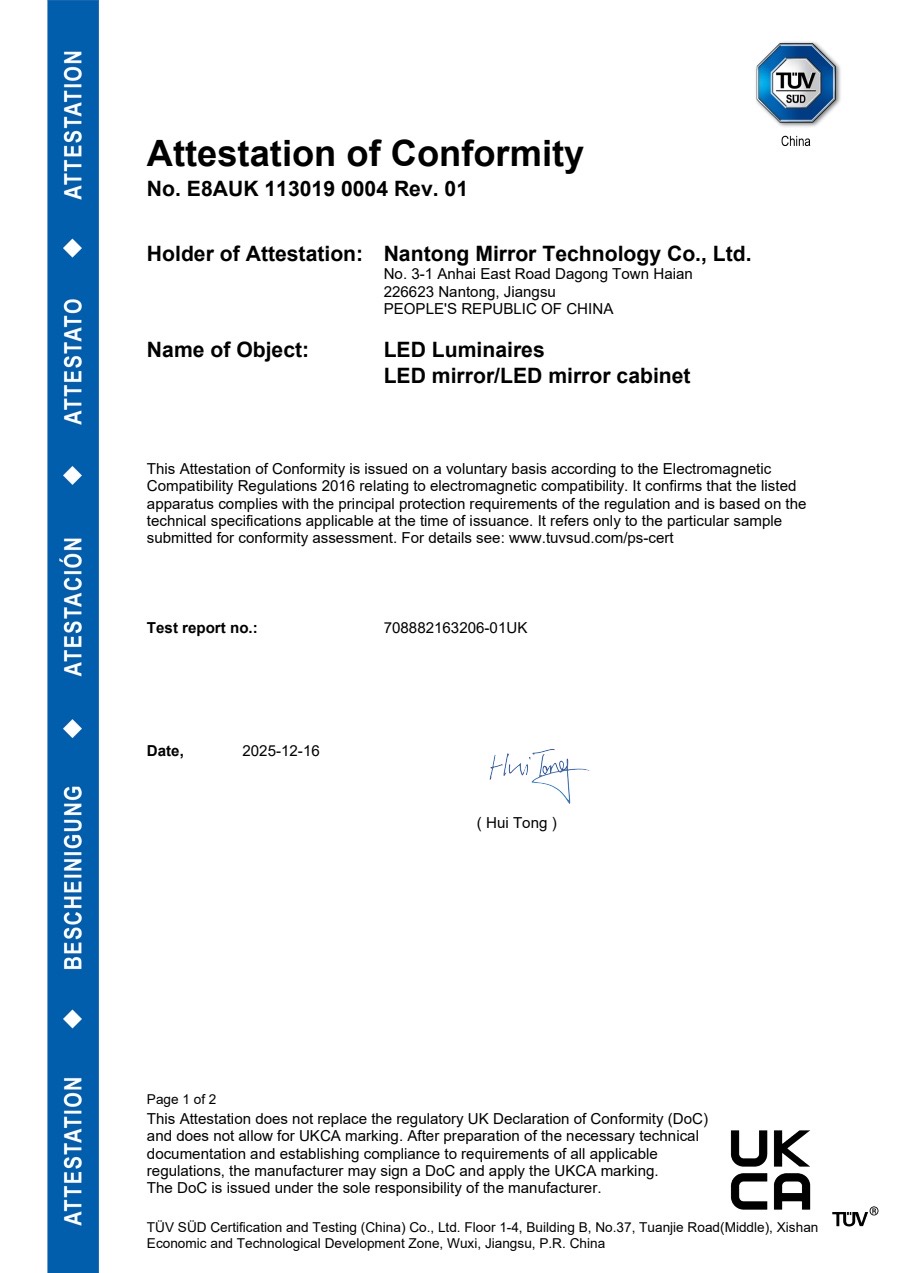
UKCA Attestation of Conformity issued by TUV for LED mirror model LQ752, covering UK market access.
Two boundaries deserve to be stated plainly. First, the UKCA and CE scopes cover the LED mirror and LED mirror cabinet, not the wooden cabinet carcass — a common assumption error when buyers read "CE" as a set-wide statement. Second, the reproduced Chinese national standard GB 24977-2010 for bathroom furniture sets out classification, requirements, test methods, inspection, marking, packaging, transport, storage and use instructions, including requirements that accessible parts have no burrs, sharp ends, sharp edges or sharp corners, that opening and closing components operate flexibly after installation, and that there is no seepage or water leakage under normal use. That standard remains a useful checklist for incoming inspection, but its current status should be confirmed against the official standards database before being written into a contract, and it does not by itself establish conformity of any specific product.
Technical explanation: load path, hinge tolerance and cut-edge sealing
Why the mirror door drives the hardware specification
A mirrored door with toughened glass weighs considerably more than a plain wooden door. Ordinary screws cannot reliably withstand the cyclic fatigue load created by repeated opening and closing and may loosen over time. Under the EN 14749 cabinet strength requirement, dedicated reinforcing fasteners are used for reliable connection of heavy mirrored doors. For a buyer, this translates into a simple RFQ question: which fastener specification is used for mirrored doors, and is it documented?
Why dual-direction hinge adjustment is not an optional feature
Wall mounting inevitably produces minor assembly tolerance from drilling and bracket fitting. A hinge with separate X-horizontal and Y-vertical adjustment corrects door position in two axes, which resolves uneven gaps and poor closure without replacing the cabinet, and reduces mechanical stress on the hinge itself. On site, most reported "door gap" problems are corrected by tightening the mirror-door reinforcing screws and calibrating the hinge settings rather than by returning the unit.
Why sealing cut edges matters more than sealing the surface
Bathroom cabinets use porous wood-based panels. A moisture-proof board resists vapour on its factory-finished surface; the protection does not extend to a raw cut. When a panel is cut on site for pipework or a WC unit cut-out, the original moisture-proof veneer is removed and the open-cell edge absorbs vapour and splash water quickly, causing swelling, delamination and mildew. Sealing closes the capillary pores and blocks ingress. This is why sealing cut edges is specified as an installation step rather than a factory option.
Why the demister is synchronised with the light
A demister pad is a heating component. An independent switch creates a dry-heating risk if the user forgets to power it off, which accelerates ageing and creates an overheating hazard. Synchronised control powers the demister on with the light and cuts it off at switch-off, extending component service life and reducing failure risk. For wash-area lighting, IP44 protection is the practical threshold: under EN 60529, IP20 resists solid foreign objects but offers no splash protection, and vapour can penetrate an IP20 luminaire, degrade insulation and create a short-circuit or shock hazard. Installation in Zone 2 and outside zones with IP44, completed by a qualified electrician with reliable earthing, is the compliant pattern.
How PTB Technical Sanitary Ware(Jiangsu) Co., Ltd. fits this constraint picture
PTB Technical Sanitary Ware(Jiangsu) Co., Ltd. is a foreign-invested manufacturer of bathroom cabinets, shower enclosures and LED mirrors, operating a 33,000 m² manufacturing plant in Dagong Town, Hai'an City, Nantong, Jiangsu Province, China, with 156 employees, an annual output of 360,000 sets and a six-engineer R&D team. More than 90% of its output is exported, with Western European markets — the United Kingdom, France and Ireland — as the core destinations.
The production model is OEM and ODM, with customisation available on style, logo and colours, a minimum order quantity of 30 units and a quoted lead time of 30–45 days. Monthly capacity is stated at 30,000 bathroom cabinets, 30,000 shower enclosures and 3,000 LED mirror lamps, supported by 100% product testing and remote after-sales support. Quality documentation includes ISO 9001, EU CE, British WRAS Water Approval, FSC Forest Sustainability Certification and Customs AEO Advanced Certification, together with SEDEX Advanced Certification and a 2023 IKEA factory audit outcome that led to a long-term supply partnership. Company materials state that its bathroom cabinets hold a 65% share of the UK market; that figure is company-reported and should be verified independently by any buyer using it in an internal business case.
For wall-hung specification specifically, three corpus-documented product references are relevant. The LED mirror model LQ752 is an 800 × 800 mm brushed brass inset-frame round mirror with a 47 mm depth, 6.5 kg product weight, aluminium construction, demister and touch sensor, IP44 splash-proof rating, 21 W LED 6000K output and a 1-year guarantee. The shower enclosure model AQU9-E6 is a 900 mm chrome quadrant with 6 mm toughened glass, 880 mm width and depth, 1850 mm height, sliding doors, quick-release wheels, CE marking and a lifetime manufacturer guarantee. The reference cabinet model CLA123 is a Classique 500 mm satin white two-door unit — note that this model is floor-standing, not wall-hung, with a 16 mm cabinet thickness, 18 mm fascia, MDF painted matt construction, 21 kg weight and a 5-year manufacturer guarantee. Buyers specifying wall-hung configurations should confirm the mounting variant and bracket set per order rather than assuming it from the range name.
Application scenarios where wall-hung specification pays back
Three project types in the existing reference record illustrate where the constraint profile above matches real demand. A serviced apartment and hotel fit-out in the UK, Germany, France and Ireland specified 200 LED mirror units for grooming lighting at bathroom cabinets, reporting uniform flicker-free lighting, stable moisture and fog resistance and a 1-year return rate below 1%, with a service life expectation of five years or more. A residential developer and senior living facility across the UK, Ireland, Germany and France specified 200 cabinet units for washing, storage and countertop use, reporting moisture-resistant cabinets without mildew and durable hinges and slides over an eight-year expectation.
A high-end hotel and residential developer project across the same markets specified 120 shower enclosure units for wet-dry separation, reporting reliable waterproof sealing, no glass self-breakage complaints and a maintenance rate below 2% with a ten-year expectation. The shared pattern is that all three projects were decided on humidity, sealing and hardware endurance rather than on appearance — which is exactly the constraint set a wall-mounted bathroom cabinet exposes.
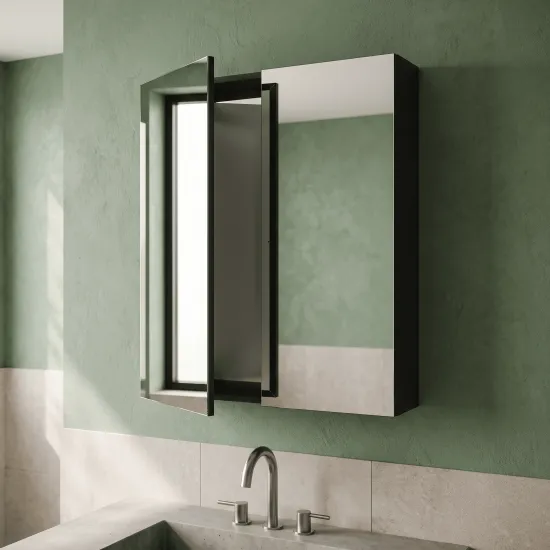
Mirror cabinet and wash-area configuration: the interface where electrical zoning, sealing and cabinet hardware meet.
Market trend: wall-hung growth against floor-standing volume
The cabinet category remains the anchor of the bathroom furniture set. Cabinets held approximately 50% of the global bathroom furniture market in 2023, and the overall market moved from USD 135.9 billion in 2024 toward an estimated USD 148.9 billion in 2026. Within that base, the growth differential favours the wall-hung format: a projected 7.26% CAGR through 2031 for wall-mounted and floating vanity units in the US market, against a much larger but slower floor-standing installed base.
Adjacent categories follow the same document pattern rather than the same numbers. The global shower enclosure and cubicles market was valued at USD 3.51 billion in 2023 and predicted to reach USD 5.38 billion by 2030 — a narrower niche with a different definition, which is why it should never be combined with cabinet figures in a sizing exercise. Classification adds another layer of care: bathroom furniture, mirrors and lighting, glass shower enclosures and plastic sanitary ware may fall under different HS classifications, so a product-by-product classification review is required before comparing import markets, tariffs or unit values. Buyers who skip that step frequently compare sets that are not comparable.
Wall-mounted versus floor-standing: comparison and accepted limits
| Criterion | Wall-mounted / wall-hung | Floor-standing |
|---|---|---|
| Load path | Wall substrate, brackets and fixings carry the entire load | Floor slab carries the load |
| Fixings | Wall fixings are not supplied; substrate-appropriate fixings must be selected on site | No wall load dependency |
| Installation sequence | Remove drawer box, mark and fit wall brackets, hang, adjust height via hook screws, refit internals | Supplied rigid and positioned directly |
| Door tolerance correction | Dual-direction X/Y hinge adjustment used to absorb wall-mount tolerance | Hinge adjustment used mainly for alignment |
| Mirrored-door hardware | Reinforcing screws required to resist fatigue load | Same fastener requirement where a mirrored door is fitted |
| Floor access | Floor area beneath the unit remains free and cleanable | Footprint occupied; unit can conceal a floor waste more easily |
| Certification | Identical scopes per component; electrical zoning applies to the mirror lamp | Identical scopes per component |
The corresponding limitation is real and should be stated before selection rather than after. A wall-hung cabinet requires a wall capable of carrying the unit and a fixing solution appropriate to that substrate. Where the wall is a lightweight partition, a plasterboard drylining system without adequate backing, or an external wall where drilling is restricted, the specification should revert to a floor-standing unit. The reference floor-standing model CLA123, for example, needs no wall load capacity at all.
Three further boundaries apply to the wider set. Wall-hung formats generally reduce internal storage volume for a given footprint, because the space beneath the unit is lost to storage. A basin cabinet that must accommodate a floor waste is simpler to configure in a floor-standing carcass, where the waste can pass behind a removable panel. And on commercial terms, samples are chargeable and freight is borne by the buyer, which is standard practice but should be budgeted before the sample stage rather than treated as a rounding item.
Future outlook
Two forces will keep the wall-hung format in renovation briefs. The first is space: as urban bathrooms are reconfigured to smaller footprints, reclaiming floor area becomes a design objective rather than an aesthetic preference, and the 7.26% projected growth rate for wall-mounted and floating units reflects that pressure. The second is documentation. As conformity marking, chain-of-custody certification and zone-based electrical protection become standard items in retail and contract procurement, the supplier that can produce a complete document set per line item — UKCA or CE for the lighting, FSC-COC for the panel material, ISO 9001 for the production system — will be advantaged over suppliers who can only describe the product.
The practical implication for buyers is that the wall-mounted cabinet decision will increasingly be evaluated as a specification and documentation exercise. The most reliable preparation is a constraint checklist issued with the RFQ, a stated wall condition, and a named responsible party for every site cut, every seal and every electrical connection.
FAQ
What must be checked before specifying a wall-mounted bathroom cabinet?
Three items must be verified in advance: the load-bearing capacity of the wall, a fixing solution matched to that wall substrate, and the mounting variant of the specific cabinet model being quoted. Wall fixings are not supplied with the cabinet and must be selected on site. Where wall load capacity cannot be confirmed, a floor-standing configuration avoids the dependency entirely.
Which fixings and reinforcing hardware are needed for a wall-hung cabinet with a mirrored door?
A mirrored door in toughened glass weighs substantially more than a plain wooden door, so ordinary screws cannot reliably withstand the cyclic load of repeated opening and closing and may loosen over time. Dedicated reinforcing screws are required for mirrored-door connection under the EN 14749 cabinet strength requirement. The fastener specification should be confirmed in writing with the cabinet quotation.
How are misaligned doors and sticking drawers corrected after installation?
Hinges provide X-horizontal and Y-vertical adjustment, which corrects uneven gaps and poor closure caused by wall-mount tolerance without replacing the cabinet. For sticking drawers, the drawer box is pulled fully out and lifted to remove it, debris inside the runner is cleaned, and the drawer is realigned and pushed home until it clicks; a deformed slide rail is the one case that requires replacement.
Which certifications in a bathroom furniture set apply to which components?
Scopes differ by component. The UKCA Attestation of Conformity, certificate No. E8AUK 113019 0004 Rev. 01 issued by TUV, covers the LED mirror and LED mirror cabinet for the UK market. The CE Attestation of Conformity, certificate No. E8A 113019 0003 Rev. 01 issued by TUV, covers the LED mirror for Europe and other listed markets. FSC-COC certificate SGSHK-COC-320595 from SGS Hong Kong Limited covers the purchasing, manufacturing and sales of FSC-certified MDF/HDF bathroom cabinet, toilet seat and furniture parts. ISO 9001:2015 certificate 00125Q39056R1M/3200 covers the production of shower rooms and bathroom cabinets.
What are typical MOQ, lead time and sample terms for a bathroom furniture set order?
For the referenced manufacturer, the minimum order quantity is 30 units and quoted lead time is 30–45 days, with monthly capacity stated at 30,000 bathroom cabinets, 30,000 shower enclosures and 3,000 LED mirror lamps. Sample orders covering mixed products such as bathroom cabinets, shower enclosures and LED mirrors are accepted for quality testing and marketing purposes, but samples are chargeable and freight is borne by the buyer.
Is mildew on cabinet cut edges a manufacturing defect?
Sealing of cut edges belongs to site installation work. Mildew and swelling that appear at an unsealed cut-out edge result from continuous moisture ingress into the exposed board core, not from a factory defect in the panel. Remediation involves removing the affected material, applying full waterproof sealing to all exposed cut edges and improving bathroom ventilation to reduce ambient humidity.
Does the anti-fog function operate independently of the mirror light?
On synchronised designs, the demister pad activates when the mirror light is switched on and cuts off when it is switched off. Independent switching is avoided because it creates a dry-heating risk if the user forgets to power the unit down, which accelerates component ageing. Where lighting still functions but the demister produces no heat, the demister heating pad can be replaced separately under warranty after a power-off inspection of its terminals.
Reference resource: PTB product lookbook (PDF) — https://cdn.socialarks.com/sbsp/25261/common/2026/0901/PTB-Lookbook-Brochure-Oct24.pdf
¿Tiene preguntas o necesita más detalles?
Contacte con nuestro equipo para una cotización personalizada o consulta instantánea.
Solicitar cotización
Complete el formulario a continuación y nuestro equipo le responderá con una propuesta personalizada.
Chat directo de WhatsApp
¿Prefiere chatear en tiempo real? Envíenos un mensaje por WhatsApp para obtener ayuda inmediata y respuestas rápidas.
- Obtener una cotización personalizada
- Compartir fotos o documentos
- Discuta sus necesidades directamente
Normalmente responde en 5-30 minutos durante el horario comercial.