
WPC vs PET Marble vs PVC Wall Panels: A Buyer Decision Matrix
Wall panel selection is usually presented as a design question. In practice, most sourcing failures are specification questions. WPC, PET marble and PVC-based panels sit side by side in the same distributor catalogue and answer three different briefs, yet they are regularly compared in one spreadsheet cell using numbers that are not even measured the same way.
The global wall panels market was valued at USD 32.4 billion in 2025 and is projected to reach USD 43.7 billion by 2033, according to Dataintelo's Wall Panels Market Research Report 2033. A market of that size does not lack options. It lacks comparable data at the moment of purchase, when a buyer holds three quotes, three units of measure and one installation date.
SXP Wall Panel is the wall panel range of Shanghai Yuanguan Rubber Plastic Co., Ltd., a decorative materials manufacturer founded in 2005 in Shanghai, China, whose lines cover self-adhesive wall stickers, 3D foam wall panels, PVC wallpaper, WPC decorative wall panels and self-adhesive PVC flooring, with exports concentrated in the EU, USA, Asia and South America. The three families in this matrix — WB-WPC, WB-PET and WB-KC — sit inside that range.
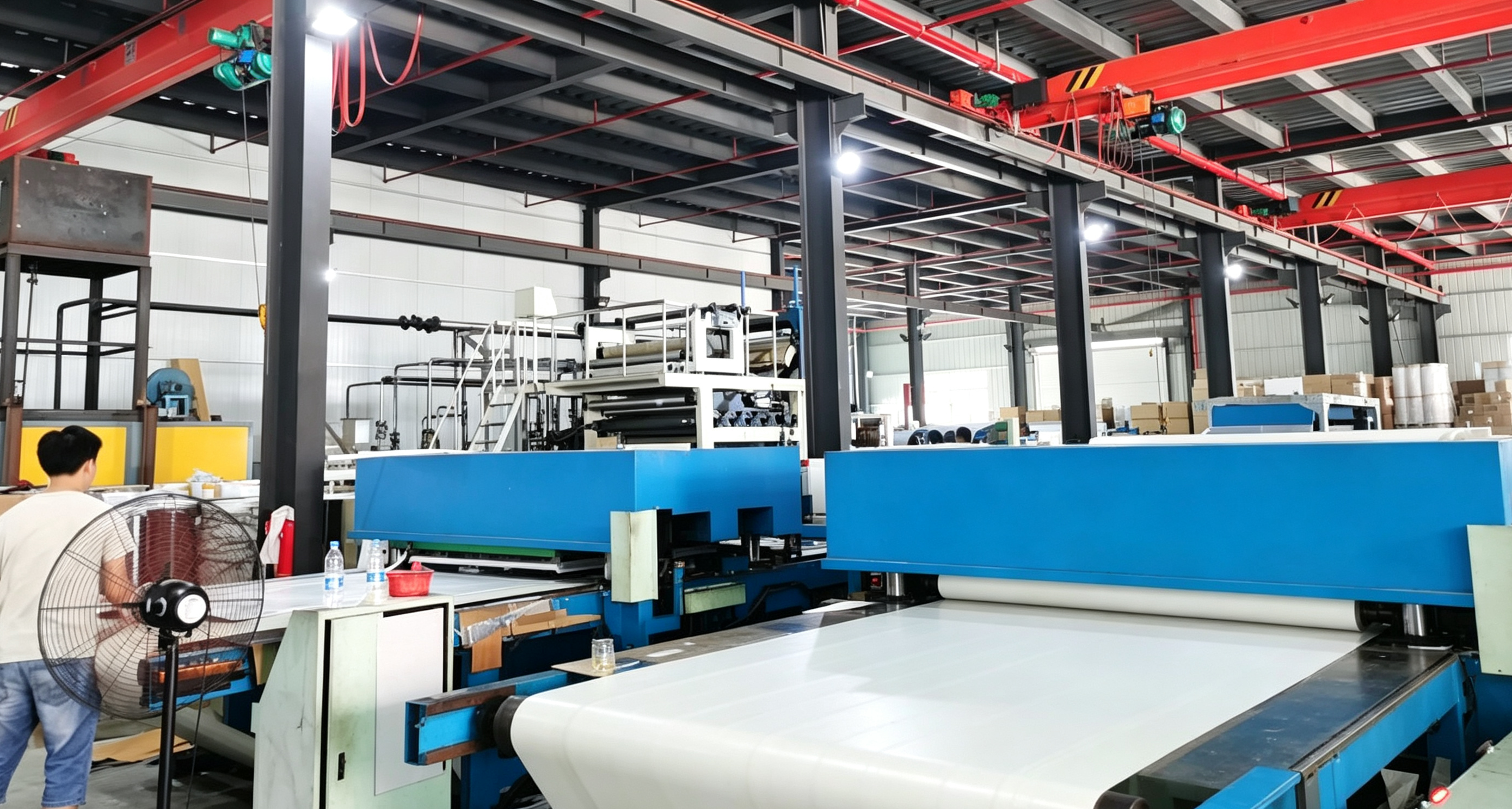
Panel families are produced on different lines and measured on different bases — the reason a single comparison sheet is needed.
The comparison problem: three families, three measurement languages
The first obstacle in comparing these materials is not price. It is unit mismatch. WPC decorative panels in this range are quoted by mass, from 690 to 830 grams per metre. PET marble wall sticker panels and PVC-based panels are quoted by thickness in millimetres, typically 2 mm or 2.5 mm for the self-adhesive decorative panel specification and 2.5 mm for the PVC wall panel listing. Packaging adds a third language: pieces per box for WPC, per-carton counts for the other families.
None of those units converts cleanly into another without knowing density and format. That has a practical consequence: a buyer who ranks offers by unit price will usually reward the family that happens to be measured in the cheapest-sounding unit, not the family that fits the project. The matrix below normalises four attributes that can be compared — format, measurement basis, listed size range and packing — and leaves price out until coverage is known.
The buyer decision matrix
| Attribute | WB-WPC (WPC decorative wall panel) | WB-PET (PET marble wall sticker panel) | WB-KC (PVC-based wall panel) |
|---|---|---|---|
| Construction format | Rigid decorative plank with wood-grain face | Self-adhesive decorative panel with marble-effect surface | PVC-based decorative panel, rigid sheet format |
| Measurement basis | Mass: 690–830 g/m | Thickness: 2 mm or 2.5 mm (self-adhesive decorative panel specification) | Thickness: 2.5 mm |
| Listed sizes | Plank profile 160 × 23 × 2900 mm | 30×30, 30×60, 60×60, 40×80, 60×120, 60×300, 120×300 cm | 30×30, 50×50, 96×48 cm |
| Surface format | Wood-grain decorative face on a plank body | Marble-effect film, self-adhesive backing, peel-and-stick installation | Printed or embossed decorative face, panel body |
| Packing | 16 pcs per box | Confirm carton count per series | Confirm carton count per series |
| Order terms | MOQ 200 units, FOB | MOQ 200 units, FOB | MOQ 200 units, FOB |
| Acceptance | Pre-shipment test | Pre-shipment test | Pre-shipment test |
| Application fit | Feature walls, joinery-led interiors, warm wood schemes | Fast renovation, rental turnover, hotel and retail refreshes | Modular small-format layouts, patching and repair work |
Sources: SXP Wall Panel specification listings for WB-WPC, WB-PET and WB-KC; MOQ of 200 units, FOB delivery and pre-shipment test acceptance are the terms stated for the referenced panel products and should be re-confirmed per SKU on the proforma invoice.
How to read thickness when one family is quoted in grams
A 690–830 g/m WPC plank and a 2.5 mm PVC panel cannot be ranked against each other on the specification sheet, because gram-per-metre describes mass along the profile and millimetre describes gauge. What matters for the buyer is that both figures are quoted on a consistent basis across competing offers. A WPC quote that switches between g/m and millimetres mid-conversation is a warning sign; so is a PVC quote that omits gauge entirely (corpus id 274795, 274716).
The WPC range itself carries a spread of 140 g/m between the lightest and heaviest plank. On a wall of any real size, that spread changes handling weight per box, fixing frequency and freight cost, so the exact figure — not the range — belongs on the purchase order. Buyers should also decide which basis their acceptance test uses before the sample is approved, since a mass-based specification and a thickness-based specification fail in different ways.
For PET marble and PVC panels the thickness figure does the same job in a different unit: 2 mm and 2.5 mm are both quoted for the self-adhesive decorative panel specification, while the PVC wall panel listing is 2.5 mm. Where a different gauge is quoted for the same series, treat it as a separate specification that requires its own written confirmation and its own sample.
Size coverage: what 30×30 cm to 120×300 cm actually buys
Size range is where the three families diverge most sharply, and where a decision matrix earns its place. The self-adhesive decorative panel range runs from 30×30 cm through 30×60, 60×60, 40×80, 60×120 and 60×300 up to 120×300 cm. The PVC wall panel listing is confined to 30×30, 50×50 and 96×48 cm. The WPC plank is a fixed profile at 160 × 23 × 2900 mm.
Converting those formats into coverage makes the trade-off visible. A single 120×300 cm panel covers 3.6 m², the equivalent of forty 30×30 cm pieces. A 96×48 cm PVC panel covers about 0.46 m², and a 160×23×2900 mm WPC plank covers roughly 0.464 m² — almost the same area per piece, in a completely different shape. On that basis, a 16-piece WPC box covers close to 7.4 m² of wall before cutting waste (corpus id 274779, 274769, 274715).
That single calculation reframes the sourcing question. The large-format PET marble sheets minimise seams and labour on long, flat elevations, which is why they suit hotel corridors and retail walls. The small-format PVC panels minimise waste on patch work, columns and tight returns, where a 3.6 m² sheet would be cut down to scraps. The WPC plank sits between the two: it is narrow and long, so it produces a plank rhythm rather than a seamless field, and its linear coverage is predictable for estimating.
Surface format and application fit
Surface format is often treated as a purely aesthetic choice. It is also a labour decision. All three families are intended for the building materials and interior decoration industry, and all three are used indoors, but they are installed differently and therefore suit different project types.
WPC panels carry a wood-grain decorative face and are specified where a warm, joinery-like wall is required. They fit residential feature walls, hospitality lobbies and office partitions where the visual reference is timber. PET marble panels are self-adhesive: the backing is peeled and the panel is pressed onto a prepared surface, with no cement or glue. That installation mode places them in renovation work — rental turnover, hotel room makeovers, chain store refurbishment and exhibition booths — where the wall cannot be taken back to substrate. PVC-based panels in 30×30, 50×50 and 96×48 cm are the most modular of the three and are typically used where small-format patterning, repair or partial replacement is required.
The specification data lists applicable project types as old house renovation, apartment full renovation, hotel room makeovers, homestay renovation, chain brand store refurbishment, office fit-outs, temporary exhibition booths, simple rental apartment renovation and modular interior projects. Note what is common to that list: fast turnaround, occupied buildings and surfaces that must be covered rather than removed. That is the natural territory of the self-adhesive family, and it is also the territory where buyers most often discover that substrate condition, not panel quality, decides the outcome.
Order economics and long-term supply terms
Long-term supplier relationships in this category are rarely decided on the first order. They are decided on whether the second and fifth orders arrive at the same specification. For the referenced panel products, the stated commercial terms are a minimum order quantity of 200 units, FOB delivery, TT payment and a pre-shipment test as the acceptance criterion (corpus id 274343, 274346). Those four terms are worth verifying before a distributor builds a catalogue around a range, because each one shapes how a repeat order behaves.
A 200-unit MOQ is a mixed-SKU problem as much as a volume problem: distributors normally want several colours or sizes in one shipment, so the question to settle early is whether the MOQ applies per SKU or per order, and whether mixed cartons are accepted. FOB delivery determines who carries inland freight and who books the container, which in turn changes the landed cost comparison between families far more than the quoted unit price does. And a pre-shipment test only protects the buyer if the tested attributes are written into the proforma invoice — otherwise there is no benchmark against which the test result can be judged.
Maintenance expectations belong in the same conversation. The specification states that these panels require 85% less maintenance than alternatives because the surface resists hollowing, edge warping, degumming and scratching. That is a claim about the product under intended conditions, and it is conditional on installation quality: on an uneven or dusty substrate, adhesion performance is limited by the wall, not by the panel (corpus id 274222).
Storage is the least discussed and most frequently ignored part of long-term supply. The stated rules are a cool, ventilated warehouse at or below 40 °C, goods on pallets rather than directly on the floor, a stacking-height limit with no heavy rigid panels placed on foam goods, and first-in-first-out rotation. Curling, deformation and mildew caused by sunlight, over-stacking or ground moisture are classified as improper-storage damage rather than product defects — which means the claim sits with the buyer once the container is opened.
Comparison with traditional solutions — and where these panels lose
Against tile, paint, wallpaper and stone, the three panel families share one structural advantage: they are installed dry, over an existing surface, with hand tools. A renovation can be completed without wet trades, which is why the format fits occupied buildings and short closure windows. They also cover cracks and stains on the base surface, add a limited cushioning and sound-dampening layer, and shorten the finishing stage of a fit-out.
That advantage comes with hard boundaries, and a decision matrix that omits them is not a decision matrix.
- Substrate quality is decisive. The stated requirement is a flat, dry, solid base free of dust and grease. Powdery, sandy or loose surfaces are explicitly excluded. On a failing plaster wall, no panel family in this matrix performs as specified, and the correct decision is to repair the substrate first.
- Sunlight and heat exposure. Long-term exposure to strong sunlight is outside the intended working condition, and foam-based products are sensitive to high temperature, heavy pressure and UV light. South-facing glazed elevations need a different specification, not a thicker panel.
- Decorative, not structural. These are decorative surfaces. Where a project requires a documented reaction-to-fire classification — EN 13501-1 with a B-s1,d0 rating is commonly specified for commercial interior wall panels — the classification must be evidenced for the actual product being supplied. No classification should be inferred from the material family.
- Removability is style-dependent. Some self-adhesive styles can be removed without leaving residue; others cannot. The removal behaviour should be confirmed style by style before it is promised to an end user.
A verification checklist before the purchase order

Batch verification before shipment is the point where specification, packaging and documentation are either aligned or not.
Buyers who want the comparison to hold up at acceptance stage should reduce it to a short list of questions and answers in writing. The following are framed as questions to the supplier rather than assumptions to be carried into the order.
- Measurement basis: is the thickness or mass figure quoted on the same basis as the competing offer, and what tolerance applies to it?
- Size list: which sizes in the 30×30 cm to 120×300 cm range are actually available in the chosen colour and surface, and which are made to order?
- Packing count: pieces per box or carton, carton dimensions and gross weight, so freight can be calculated on the same basis for all three families.
- Commercial terms: does the 200-unit MOQ apply per SKU or per order, is mixed loading accepted, and what are the FOB port and payment terms?
- Acceptance criteria: which attributes will be inspected at pre-shipment test, by what method, and against which written value?
- Documentation: which test reports can be supplied for the destination market, and are they issued for the exact product and thickness being ordered?
- Customs classification: the standard HS code for wood plastic composite wall panels exported from China is 3925.90.0000 per U.S. Customs and Border Protection ruling N337378; classification for PET and PVC panels should be confirmed with a customs broker rather than assumed from the WPC ruling.
Market trend analysis: why three families keep growing together
The available market data does not show one material displacing another. Metal wall panels held the largest product share at 28.5% in 2025, while Asia Pacific accounted for 42.3% of the global market, according to Dataintelo's 2033 report. Within the decorative segment, wood-based wall panels accounted for nearly 31% of global installations in 2024, and wood wall panel systems are projected to grow at a 6.2% CAGR through 2035, per WiseGuyReports.
Read together, those figures describe a market expanding by application rather than by substitution. The wood-look band that WPC belongs to is growing on renovation and interior fit-out demand, while the modular and self-adhesive formats grow on the same drivers from a different direction: speed, occupancy tolerance and low labour on site. That is consistent with a purchasing pattern in which distributors stock all three families and allocate them by project type, instead of choosing one as a house material.
The buyer-relevant consequence is a shift in what counts as competitive advantage. In a market where three material systems coexist, the supplier who wins repeat orders is usually the one whose specification sheet, packing list and test documentation stay consistent across shipments — not the one with the widest colour card.
Future outlook
Two directions look likely from the current specification and compliance environment. The first is consolidation of SKUs: distributors carrying three families will increasingly narrow each one to the sizes that actually turn, which favours suppliers who can hold the same specification across repeat batches rather than those who expand the range. The second is documentation-first purchasing. As fire classification, chemical compliance and packaging regulation become routine parts of the purchase file for construction products entering the EU, the comparison between WPC, PET marble and PVC panels will be decided as much on paperwork as on surface finish.
For buyers, the practical implication is to keep the decision matrix live after the first order. Every repeat shipment is a new opportunity for a thickness, a packing count or a mass figure to drift, and the matrix is only useful if it is updated with the figures that were actually delivered.
FAQ
How do I compare WPC, PET marble and PVC wall panels when the quotes use different units?
Compare each family on its own stated basis first — mass in grams per metre for WPC, thickness in millimetres for PET marble and PVC — then convert to coverage per square metre before comparing cost. A 120×300 cm panel covers 3.6 m², a 96×48 cm PVC panel covers about 0.46 m², and a 160×23×2900 mm WPC plank covers roughly 0.464 m². Only coverage, packing count and delivery terms put the three offers on a common footing.
What order terms and acceptance criteria apply to SXP wall panel products?
For the referenced panel products, the stated terms are a minimum order quantity of 200 units, FOB delivery, TT payment and a pre-shipment test as the acceptance criterion. The applicable market is stated as Global. Because MOQ, port and payment details can differ by SKU and by series, the figures should be re-confirmed on the proforma invoice before the order is placed.
Which family fits interior decoration, building materials trade and home and garden use?
All three families are intended for the building materials and interior decoration industry, so the split is by project type rather than by sector. WPC suits wood-scheme feature walls and joinery-led interiors. PET marble self-adhesive panels suit fast renovation, rental turnover, hotel rooms, chain stores and exhibition spaces where the wall cannot be stripped back. PVC panels in 30×30, 50×50 and 96×48 cm suit modular layouts, patch work and partial replacement in residential and light commercial settings.
What storage and substrate conditions affect long-term performance?
Storage requires a cool, ventilated warehouse at or below 40 °C, goods on pallets away from the floor and direct sunlight, a controlled stacking height with no heavy rigid panels on foam goods, and first-in-first-out rotation. Installation requires a flat, dry, solid base free of dust and grease; powdery, sandy and loose surfaces are excluded, and long-term exposure to strong sunlight is outside the intended working condition. Curling, deformation and mildew from improper storage are treated as storage damage rather than product defects.
How can a buyer verify batch consistency without relying on supplier claims?
Three steps make the claim testable. Define the material in the proforma invoice rather than relying on a general description. Request third-party test reports and use them as the acceptance criterion, together with the pre-shipment test. For foam-based products, perform a simple incoming check — pressing a sample for three to five seconds and looking for fast rebound versus a permanent dent, plus a cross-section check for fine uniform cells — while treating that check as preliminary screening only, with laboratory testing as the final evidence.
¿Tiene preguntas o necesita más detalles?
Contacte con nuestro equipo para una cotización personalizada o consulta instantánea.
Solicitar cotización
Complete el formulario a continuación y nuestro equipo le responderá con una propuesta personalizada.
Chat directo de WhatsApp
¿Prefiere chatear en tiempo real? Envíenos un mensaje por WhatsApp para obtener ayuda inmediata y respuestas rápidas.
- Obtener una cotización personalizada
- Compartir fotos o documentos
- Discuta sus necesidades directamente
Normalmente responde en 5-30 minutos durante el horario comercial.