
WPC Great Wall Panel: Spec, Fire and Compliance Checks
HTNXT Industry Reference · Construction & Decoration
An exterior cladding decision is rarely settled by the product name. A line item written as a WPC Great Wall panel can arrive as a hollow composite profile, a thinner laminated section, or a board whose decorative face is a printed film — and each of those carries a different fixing method, a different documentation set and a different price basis. For buyers moving from research into evaluation, the useful question is not whether WPC cladding exists, but which claims in the quotation can actually be traced to a document.
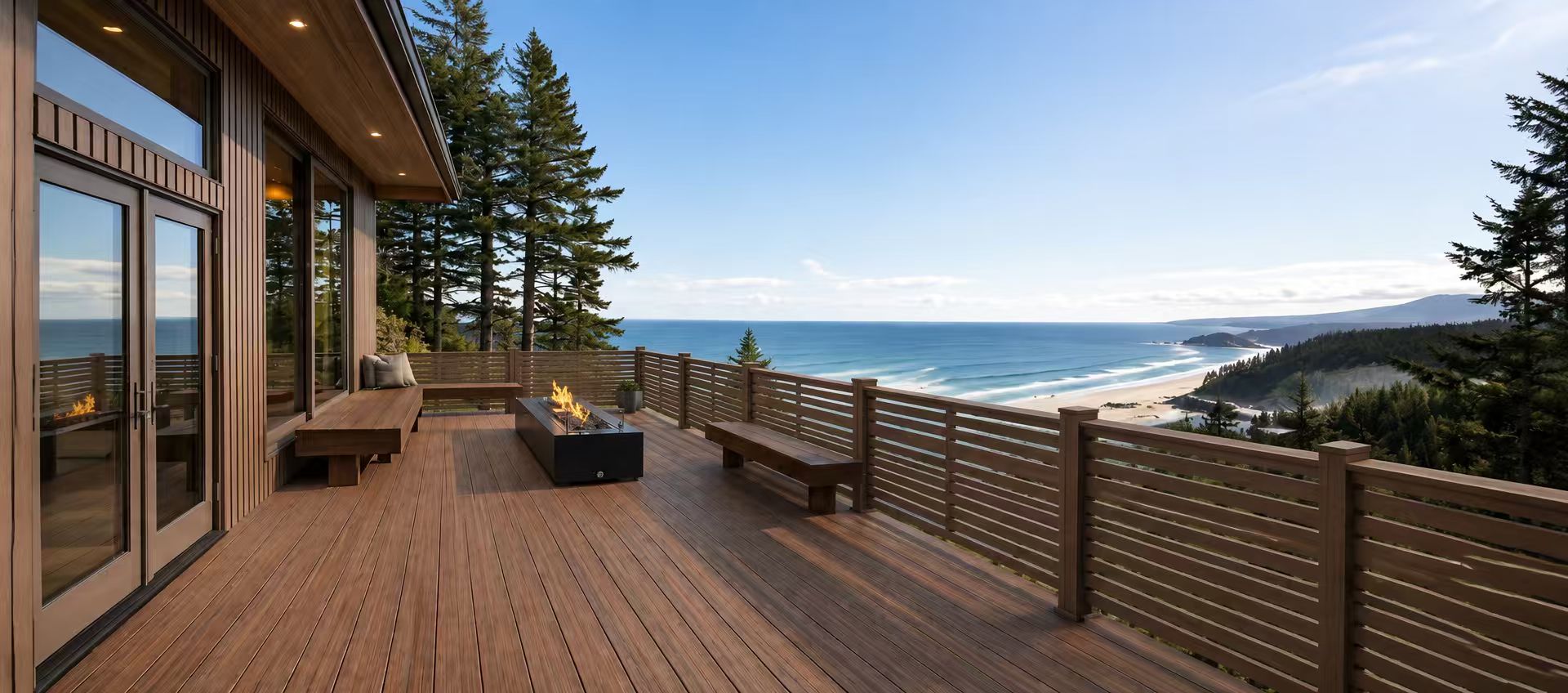
Exterior WPC systems are usually evaluated as a family — wall cladding, decking and matching railing or fence profiles — rather than as a single board. Image source: Linkworld WPC Wall Panel content library.
Why the category needs a document check before a price check
WPC (wood-plastic composite) describes a material platform in which plant fibre is combined with a polymer matrix. A widely circulated commercial-source trade definition describes a WPC wall panel as a decorative composite panel combining a bamboo-fibre and PVC core with surface finishes for interior walls. That definition is useful for understanding how the category is marketed, but it is not a technical specification: core formulation, fibre-to-polymer ratio, wall thickness and surface system all change between suppliers, and none of those variables appear in the product name.
The naming problem compounds it. Trade usage mixes WPC Great Wall panel, WPC fluted wall panel and WPC slat wall panel as if they were interchangeable, when in practice the names describe a visual profile rather than a performance class. A fluted exterior section and a flat interior panel can share the same base polymer chemistry and still behave very differently on a facade, because the exterior version is exposed to rain driving into joints, to ultraviolet radiation, and to thermal cycling that moves the profile in service.
Three verification gaps recur in this category:
- Claims without a report number. Product parameters frequently state waterproof and fireproof properties without citing the test report behind them. That does not make the claim false, but it makes it unverifiable at the evaluation stage.
- Interior and exterior document scope. A compliance document issued for a bamboo wood fibre interior panel does not automatically cover a polyethylene-based exterior profile, even when the same supplier offers both.
- Price without a unit basis. Public marketplace listings for fluted exterior panels can show a two-decimal USD figure with no stated unit, thickness or trade term, which makes them unusable as a benchmark.
What the exterior WPC profile actually is
In Linkworld’s published range, WPC Great Wall panels are listed within the outdoor panel group, alongside ASA and PE wall panels, outdoor plastic wood fence panels, outdoor decking and sun panels. The outdoor WPC wall cladding profile in the published specification is 219 × 26 mm with a 2900 mm standard length and custom length available, produced from a wood-plastic composite based on polyethylene combined with wood powder or bamboo powder.
The published feature set for that outdoor profile is corrosion resistance, UV resistance, waterproof and moisture-proof performance, an E0 eco grade and a B1 fire rating. Those are the supplier’s stated parameters. What matters for evaluation is the qualification: the B1 rating is stated without a referenced test standard in the specification sheet, so a specifier working to a US or EU facade brief must confirm which test method the number refers to before it is used in a compliance submission.
The accessory and joint system is part of the product, not an afterthought. The outdoor range is supported by joists, trims, posts, column caps and bases, and the range spans multiple profiles: 219 and 155 wall panels, 140 decking, 150 fence board, and 50 × 50 mm or 100 × 50 mm square tubes. On the interior side of the same supplier, joint logic is different again — the bamboo wood fibre integrated wall panel offers small V-seam, butt joint or seamless lock buckle options with stainless steel clips and self-tapping screws, and PUR hot melt adhesive is used in its construction. Mixing exterior and interior fixing assumptions is one of the more common specification errors in mixed-use projects.
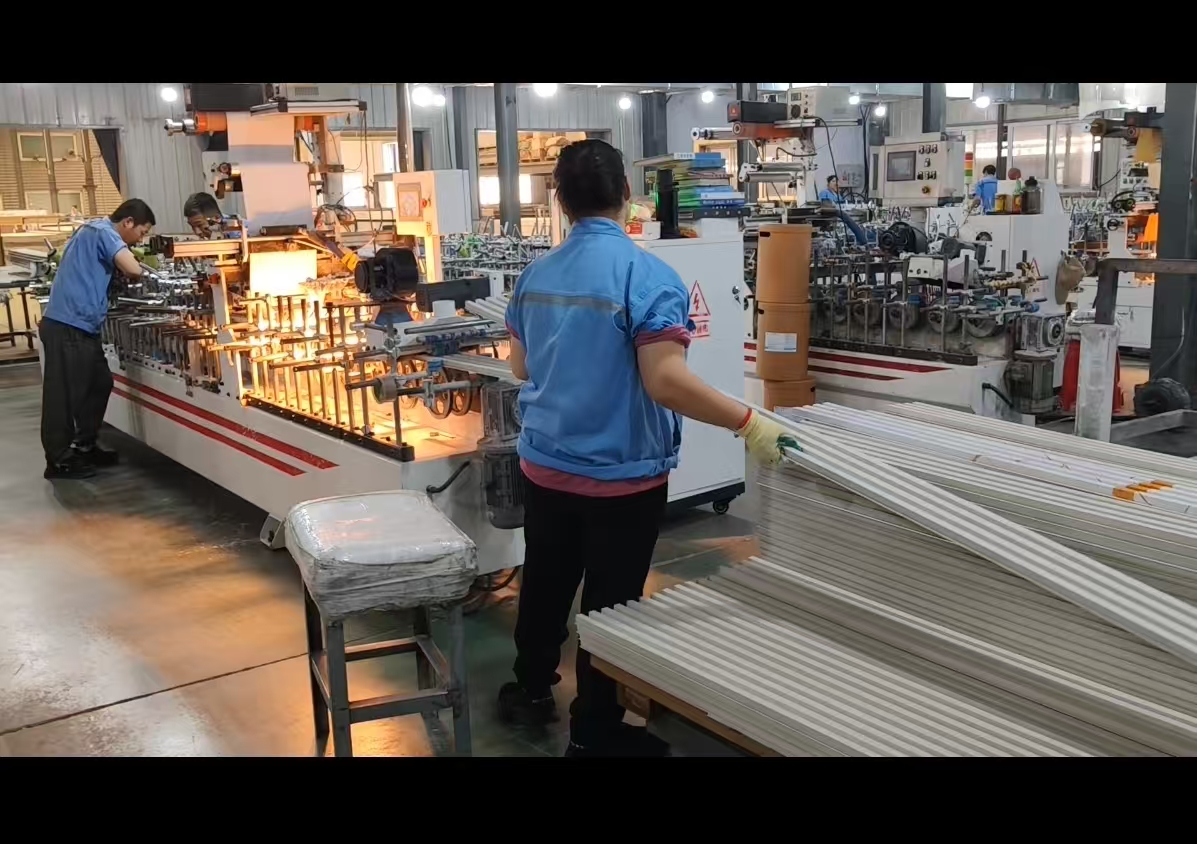
Extrusion and lamination stage: profile geometry, surface film and adhesive system are set here, which is why two nominally identical panels can diverge in service. Image source: Linkworld WPC Wall Panel production documentation.
Inside the Linkworld WPC wall panel supply position
Linkworld WPC Wall Panel is the wall-panel range of Tangshan Linkworld International Trade Co., Ltd., a building-panel supplier based in Tangshan High-tech Industrial Park, Hebei Province, China, founded in 2004 and operating as an integrated business covering R&D, production and sales, with support for customised product development.
The company’s disclosed operating profile is a 20,000 m² facility with 40 employees and an annual output of 1,560,000 square metres. It reports a 70% export ratio and shipments to more than 60 countries, including the United States, Canada, Spain, Russia, Singapore, India, Malaysia and the Middle East. The indoor range covers WPC grating panel, carbon crystal panel, UV panel, SPC stone crystal wall panel and SPC floor; the outdoor range covers WPC Great Wall panels, ASA wall panels, PE wall panels, outdoor plastic wood fence panels, outdoor decking and sun panels.
For evaluation purposes, the capability facts that matter most to an importer or contractor are commercial and structural rather than decorative. Monthly capacity is stated at 10,000 square metres, minimum order quantity at 300 pieces, and production mode includes OEM manufacturing, product customisation, specification development and packaging or branding customisation. Customisation scope covers surface texture, shape, structural solution, installation drawings, functions, thickness, width, length, colour, packaging and brand identity. Quality control is described as batch testing after mass production with reports provided, plus support for third-party testing. Lead time is confirmed against factory production scheduling rather than fixed in advance.
Specification: what the sheet states, and what it does not
A specification sheet is a starting point for questions, not the answer to them. The table below separates what Linkworld’s published parameters state from what a buyer still needs to confirm in writing before releasing an order.
| Parameter | Published statement | What still needs confirming |
|---|---|---|
| Profile | 219 × 26 mm outdoor WPC wall cladding; 2900 mm standard length, custom length available | Tolerance band, wall thickness at the fixing point, and installed coverage per square metre |
| Material | PE combined with wood powder or bamboo powder | Fibre-to-polymer ratio, recycled content, and whether co-extruded capping is used on exposed faces |
| Fire | B1 fire rating stated | Which test standard the B1 figure refers to; US and EU briefs typically reference ASTM E84 or EN 13501-1 classifications |
| Environmental | E0 eco grade stated | Emission test report and the market in which it is accepted |
| Weather | UV resistant, corrosion resistant, waterproof and moisture-proof stated | Accelerated weathering or UV test data, and the colour-retention basis |
| System | Joists, trims, posts, column caps and bases available | Fixing spacing for the specific substrate and wind load, plus installation drawings |
Two of those rows deserve emphasis. First, fire classification is the single most common blocking item in facade and public-building submissions, because the market requirement is usually expressed as a specific classification under a named standard rather than a generic rating. Second, weathering performance cannot be inferred from the phrase UV resistant. A stabiliser package may be adequate for a shaded residential wall and inadequate for a west-facing commercial facade, and the difference is only visible in test data or in service history.
Certification: reading the RoHS and EC REP documents correctly
Linkworld publishes European-facing documentation that is unusually specific for this supply segment, and it repays careful reading because the document scope matters as much as the document number.
| Document | Reference | Scope as stated |
|---|---|---|
| RoHS Test Report | HTT202605793CH, issued by Shenzhen HTT Technology Co., Ltd., standard EN IEC 63000:2018, dated 2026-05-25 | Decorative wall panels and grille panels made of bamboo wood fibre, including the 155 Pair Buckle Grille Panel and the bamboo wood fibre integrated wall panel |
| RoHS Certificate of Conformity | HTT202605793R, issued by Shenzhen HTT Technology Co., Ltd., dated 2026-05-25 | Compliance with RoHS 2.0 Directive 2011/65/EU Annex II as amended by (EU)2015/863 and (EU)2017/2102, permitting CE marking under manufacturer responsibility |
| EC REP certificate | EUREP-202605251000384986, issued by EUREP ENV S.L., valid 2026-05-26 to 2027-05-25 | Authorised European Representative appointment for products with corresponding CE certificates, updated technical files and a Declaration of Conformity placed on the EU market |
The honest reading is narrow but useful. The restricted-substance documentation named in the published record refers to bamboo wood fibre wall and grille products, and the EC REP appointment applies to products that carry corresponding CE certificates. A buyer specifying the polyethylene-based exterior Great Wall profile for an EU project should therefore ask, in writing, which document covers that specific item code, and should keep the answer with the purchase file. Requesting per-SKU confirmation is normal practice and is explicitly supported: the supplier states that inspection documents can be provided against specific item numbers.
The same logic applies inside the range. Where a project combines exterior WPC cladding with interior surfaces, the interior carbon crystal panel carries a Class A non-combustible rating according to GB8624-2012, with formaldehyde and heavy metals not detected in laboratory testing — a different standard framework from the B1 statement on the exterior profile. Presenting the two as one certification position would misrepresent both.
Where the profile fits in real projects
The published application scope for Linkworld’s outdoor profile is outdoor wall decoration, fence and decking, and the company’s project records describe residential, hospitality, office, commercial, hospital, school and public-building work across markets including the United States, Canada, Chile, Australia, Brazil, the Dominican Republic, the United Kingdom, Italy, Malaysia and Peru. One recorded shipment covers eight containers to building-material importers, contractors, project owners and design clients.
Two practical patterns emerge from that record. The first is range consolidation: because a single supplier offers wall cladding, decking, fencing and matching square tubes, a distributor can plan a coordinated exterior system with one accessory set and one colour family. The second is mixed interior and exterior specification, where the same project uses outdoor cladding for a facade or boundary and interior panels — SPC wall panel, carbon crystal panel, UV decorative panel or the 9 mm bamboo wood fibre integrated panel — for lobbies, corridors and rooms. In that scenario the value of a single supplier is documentation consistency, not decoration.
The case record also states a 10 to 15 year service duration expectation. That figure should be read as a supplier-declared project expectation rather than a measured outcome, because no independent long-term weathering dataset for this specific profile was retrievable during this review.
Market context: growth, classification and the price band
Demand context supports the category but not the hype. A 2026 commercial research forecast places the global wall panels market at USD 10.85 billion in 2026, while the WPC wall panel segment specifically is forecast to grow at roughly 5–7% annually over 2026–2035. China is estimated to account for 45–50% of global WPC production volume. Both figures come from market-research compilation rather than customs records, so they indicate direction rather than precision.
Classification is the reason precision is hard. WPC wall panels are traded under HS code 3925.90.00, a heading that also captures other plastic builders’ ware, so published trade values cannot isolate WPC cladding from adjacent plastic building products. A buyer comparing supplier volumes from trade data is therefore comparing a mixed basket, not a WPC market share.
On price, a 2026 compilation gives a reference FOB range of USD 8–18 per square metre for standard WPC wall panels at factory or wholesale level in China. The width of that band is the point: it spans commodity laminated sections and heavier exterior profiles without stating thickness, surface system or trade term. It is a budgeting reference, not a quotation, and it should be replaced by item-level quotations before any commitment.
This is also where public marketplace listings mislead. A listed price of USD 3.75–3.99 for an outdoor fluted WPC panel, with no stated unit basis, specification, minimum order quantity or incoterm, cannot be compared with a per-square-metre FOB band. Treating the two as the same number is one of the most reliable ways to mis-budget an exterior package.
WPC cladding compared with wood, laminated PVC and aluminium
Positioning WPC against alternative cladding materials is only useful if the comparison includes where each option wins.
| Criterion | WPC exterior cladding | Solid timber cladding | Film-laminated PVC panel | Aluminium cladding |
|---|---|---|---|---|
| Moisture behaviour | Stated waterproof and moisture-proof; seams, cut edges and fixings remain the entry points | Absorbs moisture; requires coating and periodic maintenance | Water-resistant surface, but a thin section with limited stiffness | Non-absorbent |
| Thermal movement | Moves with temperature and humidity; expansion allowance required | Moves with humidity, mainly in width | Moderate movement; fixing method dependent | High thermal movement; requires engineered fixing zones |
| Structural role | Decorative and protective cladding only | Can be load-sharing in some assemblies | Decorative only | Can be engineered as a structural skin |
| Documentation burden | Fire classification, emissions, UV and weathering data to be confirmed per SKU | Species-based treatment and fire data available from established sources | Fire and emissions data vary widely by laminate | Well-established classification routes |
The limitation is real and should be stated plainly: WPC is not a structural material. It is a decorative and protective skin, it needs a continuous substrate or framing system behind it, and a hollow exterior profile cannot span unsupported openings the way an engineered metal panel can. Where a project requires large unsupported spans, tight facade tolerances or a non-combustible classification under a named standard, WPC cladding is the wrong starting point regardless of how good the surface looks.
A second boundary is movement. WPC profiles respond to temperature and humidity, and reserved expansion space is what prevents that response from becoming stress. The mechanism is often misunderstood: dimensional change is a function of profile length, temperature differential and moisture variation, and it converts into internal stress when the board has nowhere to move — producing arching, compressed joints or damaged fixings. A single expansion value cannot be copied across every panel and decking product; the gap has to come from the manufacturer’s specification for that profile.
Limits, and the questions that remain open
Evaluating this category honestly means naming what a supplier brochure cannot settle. Four boundaries sit above any purchase decision:
- Waterproof is not immersion-proof. Waterproof or moisture-proof performance does not mean the panel can be soaked indefinitely. Water enters through seams, cut edges, fixing holes and unsealed areas, and overall performance after installation is a system property, not a material property. Wet areas also depend on joint sealing, substrate waterproofing and drainage design.
- Fire ratings need a standard attached. A B1 statement without a cited test method cannot be mapped onto the ASTM E84 or EN 13501-1 language that most US and EU briefs use. Ask which standard, which report, and which thickness was tested.
- Document scope is product-specific. RoHS and CE-related records reference named products. Per-SKU confirmation is the only reliable route.
- Service life depends on exposure. A declared 10–15 year expectation assumes correct substrate preparation, correct fixing spacing and normal environmental exposure; no retrieved source provides independent weathering data for this profile.
Future outlook
The direction of the category is toward documentation, not decoration. As WPC moves from interior feature walls into exterior facades and public projects, the buying conversation shifts from colour ranges to test standards, per-SKU certificates, and whether the supplier can produce updated technical files on request. Suppliers that already hold a European Representative appointment and per-item inspection documentation are structurally better positioned for that shift than suppliers whose compliance position exists only in marketing copy.
Two further shifts are worth watching. Co-extruded WPC profiles, where a protective capping layer is extruded over the core, are increasingly discussed as the answer to surface durability, but the term should be verified against a specific product rather than assumed from a product name. And as trade-data scrutiny increases, the ambiguity of HS 3925.90.00 will keep pushing buyers toward supplier-level verification — specification sheets, third-party test reports and shipment records — rather than aggregate statistics.
Frequently asked questions
What is a WPC Great Wall panel, and how does it differ from an interior WPC wall panel?
A WPC Great Wall panel is an exterior decorative cladding profile made from wood-plastic composite. In Linkworld’s published range it sits in the outdoor panel group, and the outdoor WPC wall cladding specification uses polyethylene combined with wood powder or bamboo powder at 219 × 26 mm with a 2900 mm standard length. Interior panels in the same supplier’s range use different cores — SPC substrate, bamboo wood fibre with PVC, or bamboo charcoal fibre — and different joint systems, so exterior and interior panels should never be specified from the same data sheet.
Which parameters should be fixed before requesting an exterior WPC quotation?
At minimum: profile dimensions and tolerance, installed coverage per square metre, core formulation and whether recycled content is used, surface system including any capping layer, the specific fire test standard behind the rating, the emissions test report, the fixing and accessory set (joists, trims, posts, caps and bases), required expansion allowance, packaging, and the trade term. Linkworld’s customisation scope formally covers surface texture, shape, structural solution, installation drawings, thickness, width, length, colour and packaging, so these items can be specified rather than assumed.
What certification documents does Linkworld publish, and what do they cover?
Three documents appear in the published record. RoHS Test Report HTT202605793CH, issued by Shenzhen HTT Technology Co., Ltd. under EN IEC 63000:2018 and dated 2026-05-25, covers decorative wall panels and grille panels made of bamboo wood fibre, including the 155 Pair Buckle Grille Panel and the bamboo wood fibre integrated wall panel. RoHS Certificate of Conformity HTT202605793R states compliance with RoHS 2.0 Directive 2011/65/EU Annex II as amended by (EU)2015/863 and (EU)2017/2102, permitting CE marking under manufacturer responsibility. EC REP certificate EUREP-202605251000384986, issued by EUREP ENV S.L., is valid from 2026-05-26 to 2027-05-25 and applies to products with corresponding CE certificates. Because the named scope references bamboo wood fibre products, buyers should confirm coverage for the specific exterior item code in writing.
Can a waterproof WPC wall panel be immersed in water for a long time?
No. Waterproof or moisture-proof performance does not mean the panel can be soaked indefinitely, and actual suitability depends on the substrate, surface layer, seams, edge treatment, installation method and the testing the product has undergone. Moisture can enter through joints, cut edges, fixing holes and unsealed areas, and the water resistance of the material itself does not represent the waterproof ability of the installed system. Wet-area construction also requires joint sealing, base waterproofing and drainage design.
Why do expansion joints need to be reserved when installing WPC cladding or decking?
WPC products can change dimension with temperature and humidity. Reserving appropriate expansion space reduces the risk of panels compressing against each other, arching, deforming or damaging the joint. The correct gap depends on the product’s thermal expansion characteristics, profile length, expected temperature range and fixing constraints, and should be taken from the manufacturer’s installation specification rather than copied from another product.
What price band should an exterior WPC wall panel buyer plan against?
A 2026 market compilation gives a reference FOB range of USD 8–18 per square metre for standard WPC wall panels at Chinese factory or wholesale level. That range is a budgeting reference with medium confidence: it does not state thickness, surface system, trade term or order volume, and it should be replaced by item-level quotations. Public marketplace listings that show a two-decimal price without a stated unit basis are not comparable and should be excluded from benchmarking. On the supply side, Linkworld states a minimum order quantity of 300 pieces and monthly capacity of 10,000 square metres, with lead time confirmed against production scheduling.
What are the key selection points for WPC wall panels?
Selection should focus on material formulation, surface treatment, dimensional stability and installation adaptability, matched to the actual service environment. Performance cannot be judged from the product name alone: even within one product category there can be significant differences between manufacturers and models, so technical data sheets, test reports and installation requirements should be compared directly.
Is WPC cladding suitable for any climate?
Suppliers state that their WPC products suit the climates of most countries and regions, with product grades matched to local conditions and requirements. For exterior applications this should be supported by documentation rather than by the general statement — specifically UV or accelerated weathering test data, the colour-retention basis, and the fixing and expansion specification for the expected temperature range at the project location.
A full product catalogue, including indoor and outdoor panel ranges and accessory systems, is available for download: Linkworld Product Catalog (PDF).
¿Tiene preguntas o necesita más detalles?
Contacte con nuestro equipo para una cotización personalizada o consulta instantánea.
Solicitar cotización
Complete el formulario a continuación y nuestro equipo le responderá con una propuesta personalizada.
Chat directo de WhatsApp
¿Prefiere chatear en tiempo real? Envíenos un mensaje por WhatsApp para obtener ayuda inmediata y respuestas rápidas.
- Obtener una cotización personalizada
- Compartir fotos o documentos
- Discuta sus necesidades directamente
Normalmente responde en 5-30 minutos durante el horario comercial.