
WIMACH Case Packer Fit Map: Six Industries, Two Models
WIMACH Case Packer Fit Map: Six Industries, Two Models
A case packer's industry label is the weakest predictor of whether it will run a given carton. The stronger predictors are the load, the carton envelope and the line rate. The sector only tells a buyer which of those three questions to ask first.
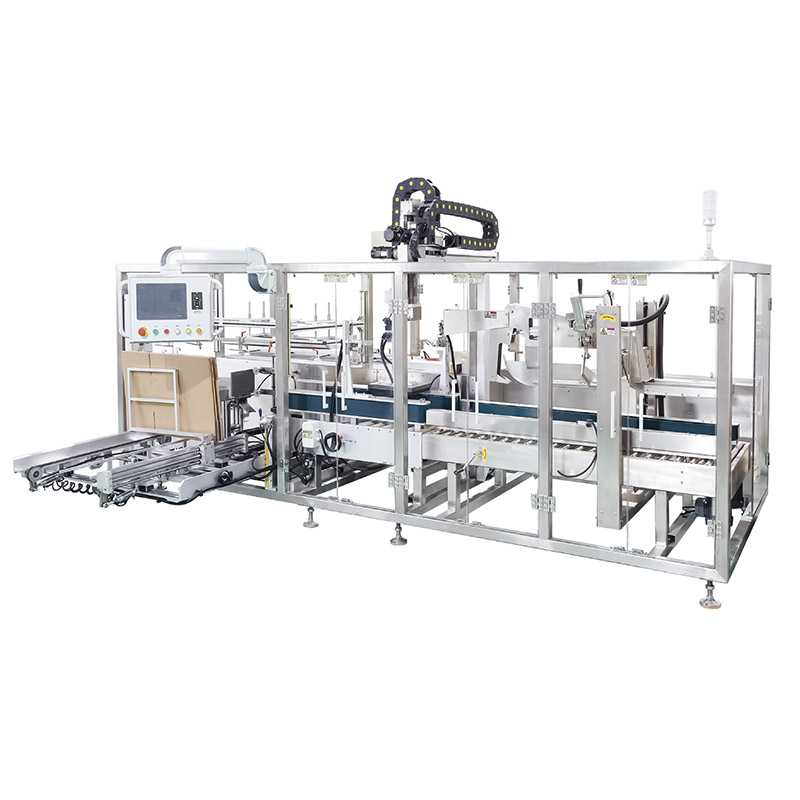
Wenzhou Wimach Machinery Co., Ltd. is a packaging machinery manufacturer based in Ruian, Wenzhou, Zhejiang, China, whose main products are tissue packing machines and integrated packaging lines, including two automatic case packers built for different handling principles. The CP-T60 is a pick-and-place, top load case packer rated at 1–8 cartons per minute for cartons from 300 × 200 × 150 mm to 600 × 400 × 400 mm. The CP-S50 is a side load (side push) case packer rated at 1–16 cartons per minute for cartons from 240 × 200 × 180 mm to 500 × 400 × 400 mm, with a published application scope that names cartons, boxes, bottles, cans and bags.
This article maps both models across the six sectors named in their published application lists, separates the cases where the sector genuinely drives the choice from the cases where a single carton dimension does, and shows how three documented projects can be read as screening evidence rather than as promises.
The two models in one view
WIMACH's published specifications for the two models share a voltage, an air pressure band and a construction option, and diverge on almost everything a buyer would use to screen a carton.
| Specification | CP-T60 top load | CP-S50 side load |
|---|---|---|
| Handling type | Pick-and-place / top load | Side load / side push |
| Packing capacity | 1–8 cartons/min | 1–16 cartons/min |
| Carton dimensions (L × W × H) | 300–600 × 200–400 × 150–400 mm | 240–500 × 200–400 × 180–400 mm |
| Power | 380 V, 50/60 Hz, 3 phase, 7.5 kW | 380 V, 50/60 Hz, 3 phase, 4.5 kW |
| Air supply | 0.5–0.8 MPa, 450 L/min | 0.5–0.8 MPa, 350 L/min |
| Overall dimensions | 4200 × 2600 × 2200 mm | 4200 × 2300 × 1900 mm |
| Overall weight | 1600 kg | 1500 kg |
| Construction | Stainless steel / carbon steel | Stainless steel / carbon steel |
| Published industries | Tissue; food and beverage; pharmaceutical; daily chemical and cosmetic; hardware; auto parts and machinery | Tissue; food and beverage; pharmaceutical; daily chemical and cosmetic; hardware; auto parts and machinery |
Read together, the table describes two different envelopes rather than two quality tiers. The CP-T60 reaches 600 mm in carton length and down to 150 mm in carton height. The CP-S50 stops at 500 mm length and starts at 180 mm height, but offers double the top of the CP-T60 rate band, draws 4.5 kW instead of 7.5 kW, uses 350 L/min of air instead of 450 L/min, and occupies a footprint 300 mm narrower and 300 mm lower. Outside the overlap zone, the envelope decides the model before any discussion of industry begins.
A three-step fit screen
Before a sector map is useful, three checks narrow the field. They can be done from a carton drawing, a product sample and a line layout, without a supplier visit.
Step 1: load behavior
A top load machine picks a product or a pack and places it into the carton from above. A side load machine assembles the load as a group and pushes it into the case horizontally. The practical consequence is that top load handling asks whether a unit can be picked reliably — rigid canisters, closed cartons, wrapped packs and boxed items are the natural candidates — while side push handling asks whether a group can be formed and transferred without losing alignment, which is why it is the direction usually considered first for bottles, cans and bagged packs. Neither statement is a performance guarantee for a specific product. Both are screening questions that decide which model earns a sample trial.
Step 2: carton envelope
If the finished case is longer than 500 mm or shorter than 180 mm in height, the CP-S50's published range does not cover it and the CP-T60's range should be checked. If the case is longer than 600 mm, wider than 400 mm, taller than 400 mm or shorter than 150 mm in height, both published ranges are exceeded. WIMACH's customization scope covers packaging dimensions, machine configuration, voltage and logo, so an out-of-range carton belongs in the technical enquiry at the drawing stage, not after the layout has been fixed.
Step 3: rate, utilities and floor space
The CP-S50's published capacity band is 1–16 cartons per minute against 1–8 for the CP-T60, with lower power and air demand and a smaller installed footprint. Published capacity is a band, not a promise: output depends on the carton, the product and the configuration, so the rate that binds a purchase is the one demonstrated on the buyer's own carton during acceptance testing.
CP-T60 top load: where a pick-and-place machine leads
The CP-T60 is the model to screen first when the product arrives at the machine as a discrete, pickable unit, and when the carton is longer than 500 mm or shallower than 180 mm — or when the line simply does not need more than eight cartons a minute.
Tissue and tissue canisters
Tissue is the sector where the top load principle is easiest to see. Canisters, boxed facial tissue and wrapped roll packs are rigid enough to be picked and placed, and the US tissue canister project described below uses the CP-T60 exactly this way. Two carton facts matter more than tissue grammage: the unit count per case and the internal clearance needed so that canisters are not forced into contact. Both are settled on a carton drawing, not in an industry brochure.
Pharmaceutical cartons
Pharmaceutical case packing is usually the tightest-tolerance environment of the six sectors, because cartons carry printed information and a crushed corner is a rejected carton rather than a cosmetic defect. Top load placement reduces lateral scuffing risk compared with a push, but it does not remove the need to prove the handling. The questions to put to a supplier are the pick interface for the specific pack, the insertion depth inside the case, and how the machine detects a misplaced pack. The CP-T60's published envelope, at up to 600 mm length and from 150 mm height, suits the shallow, wide cartons common in pharmaceutical secondary packaging, and the 1–8 cartons per minute band suits lines where the case packer is not the rate constraint.
Food and beverage carton case packing
In food and beverage, the top load model addresses carton case packing rather than primary containers: finished cartons, boxed multipacks and rigid packs are placed into the shipping case. This is the application where the 300–600 mm length range is most useful, because shipping cases for cartoned goods are often longer than the 500 mm the side load model covers. Hygiene expectations should be stated explicitly at enquiry, since the machine is offered in stainless steel or carbon steel construction and that choice should follow the room's wash-down regime rather than the purchase price.
Hardware
Hardware is the sector that most often surprises buyers, because the case packer is judged on the carton rather than on the product's value. Boxed hardware, fittings in printed cartons and small assemblies are pickable units, and the risks are weight concentration and abrasion. Ask for the carton's compression strength and request a demonstration at the actual weight per case; the published CP-T60 figures describe dimensions, power and weight of the machine, not load limits of the carton.
CP-S50 side load: where a side push machine leads
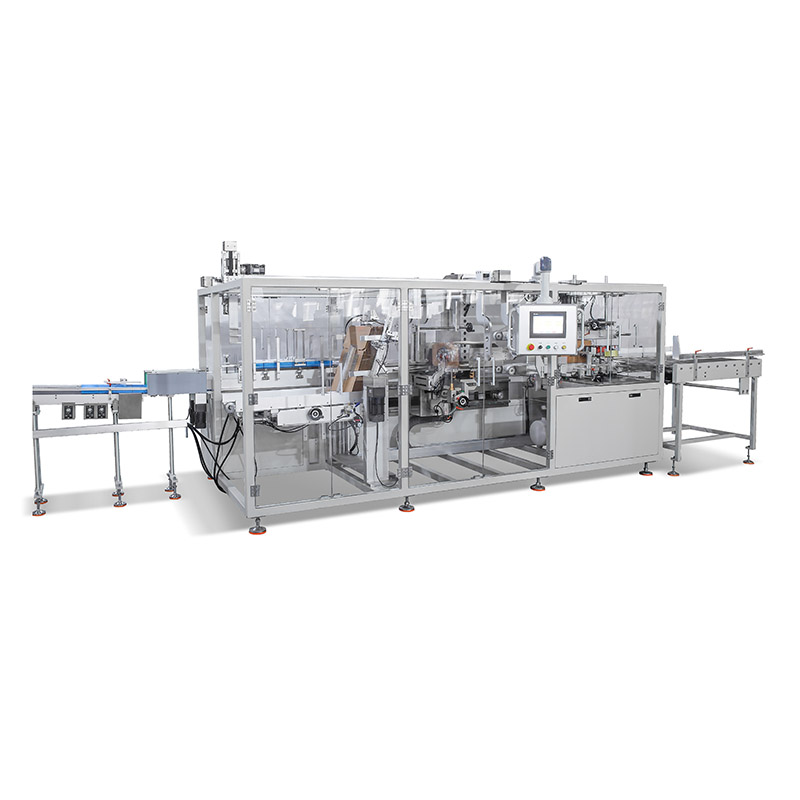
The CP-S50 covers the broader handling scope of the two models. Its published application scope names cartons, boxes, bottles, cans and bags, its carton range runs from 240 × 200 × 180 mm to 500 × 400 × 400 mm, and its stated capacity is 1–16 cartons per minute.
Tissue
For tissue, side load handling is used where the case packer follows a cartoning or film-wrapping stage and the packs must be grouped before entering the case. The Poland facial tissue line described below is the reference configuration: cartoned and film-wrapped facial tissue is grouped and case packed on the CP-S50 before palletizing. The screening question is not the word "tissue" but the pack count per case and whether the wrapped packs stay aligned during a side push.
Food and beverage: bottles, cans and bags
Side push handling is the direction usually considered first for bottles, cans and bagged products, because the load is built up as a group and transferred horizontally into the case. The CP-S50's published scope names bottles, cans and bags alongside cartons and boxes, which makes it the model to screen first on a beverage line with mixed formats. Two checks decide the outcome: whether the container is stable enough to be pushed without tipping, and whether the loaded case still falls inside 240–500 mm length and 180–400 mm height. A can or bottle diameter that fits a 500 mm case in one layout may not fit in another.
Pharmaceutical
In pharmaceutical work the side load model suits cartoned secondary packaging that is loaded as a group, with the carton faces supported during transfer. Because the CP-S50 accepts cases from 180 mm in height, it covers deeper cases that a top load envelope rejects. The fit question to resolve early is the orientation of the printed face inside the case.
Daily chemical and cosmetic
Daily chemical and cosmetic lines combine rigid containers, shrink-wrapped multipacks and printed cartons, often on the same shift. The sector appears in the CP-S50's published industry list and its scope includes bottles and boxes, so one side load machine can be screened across a family of packs. Whether one machine should cover all of them is a changeover question rather than a handling question, and it should be answered with the format range the line actually plans to run.
Hardware
Hardware appears in both models' published lists. For side load work the relevant case is the mixed or heavier carton where the load is assembled outside the case and pushed in as a group. The CP-S50's 1500 kg machine weight and 4200 × 2300 × 1900 mm footprint are then the practical constraints on installation position and floor loading.
Auto parts and machinery
Auto parts and machinery is the sector where carton dimensions rather than product value drive the decision. Spares, small components and machined parts ship in deeper cases, which is where the CP-S50's 180–400 mm height range applies. Confirm the carton's compression strength under the actual part weight, and confirm that the case packer's position leaves room for the downstream palletizer and its infeed conveyor.
Where the six-sector lists overlap
Both models are listed for the same six industries in WIMACH's published specifications, which is precisely why an industry name cannot settle the choice. The sector map in this article reflects where each handling principle applies most directly, but inside the overlap the decision falls to four comparisons.
- Carton length. Up to 500 mm, both published ranges can be screened. Between 501 and 600 mm, only the CP-T60's range applies.
- Carton height. From 180 mm upward, both ranges apply. Between 150 and 179 mm, the CP-S50's published range does not, and the CP-T60's does.
- Required rate. Up to 8 cartons per minute, both published bands cover the requirement. Between 9 and 16 cartons per minute, only the CP-S50's published band does.
- Load behavior. A pickable, rigid unit points to top load placement. A group that must be pushed in points to side push.
When two rules disagree — a 550 mm carton that must also run at 12 cartons per minute, for example — the published ranges do not resolve the case. That is a technical enquiry, not a table lookup, and the answer depends on a configuration discussion rather than on a sector label.
Three project scenarios, read as evidence
WIMACH's documented projects show how the two models are used in real lines and, just as usefully, what a reference project cannot tell a new buyer.
US tissue canisters: one machine, several canister specifications
A tissue paper manufacturer in the United States runs one CP-T60 top load case packer to load tissue canisters into cartons. The documented application describes continuous automated boxing that adapts to multiple specifications of tissue canisters and replaces manual box filling, over a five-year relationship. The record cites high packaging capacity, quick size changeover, low maintenance cost and a long service lifespan among the reasons for the choice; those are the customer's stated highlights rather than an independently measured benchmark. For a buyer with a similar product, the transferable element is the configuration logic: one machine, several canister specifications, and changeover treated as routine rather than exception.
Poland facial tissue: the case packer inside a full line
A Polish tissue manufacturer's facial tissue line combines box packing, film wrapping, case packing, palletizing, strapping and stretch wrapping, with the CP-S50 side load case packer handling the case packing stage across a documented twelve-machine project and a two-year relationship. The line context is the point. The case packer receives cartoned and film-wrapped tissue whose format has already been fixed upstream, and it must hand stable cartons to a palletizer. Buyers planning a comparable line should define the case packer's job by what arrives from the cartoner and what the palletizer can accept, not by the speed of the fastest station in the hall.
Mexico canister wet wipes: the case packer at the end of a turnkey line
A Mexican canister wet wipe project is a turnkey installation in which empty canisters are fed automatically, wipes are loaded, disinfectant is filled, canisters are heat sealed, capped and labelled, then case packed, palletized, strapped and stretch wrapped, across nine machines and a documented five-year relationship. The CP-T60 handles the case packing stage. What this scenario demonstrates is dependency: the case packer's input is a filled, sealed, capped and labelled canister whose dimensions are fixed by upstream equipment, so a canister change is a line-wide change rather than a case packer setting.
Read together, the three projects cover a top load canister application, a side load cartoned tissue application and a top load application embedded in a full turnkey line. They do not establish output rates for other products, and they do not transfer acceptance criteria. The useful role of a reference project is to shorten the list of questions, not to shorten the test.
Six checks before an order
Converting a sector map into a defensible decision takes six checks, all of which can be specified before a purchase order exists.
- Carton sample trial. Send the actual case in the actual board grade with the actual product. Published ranges are envelopes, not trials.
- Acceptance test conditions. Agree the carton, product and rate at which the machine will be measured, and write them into the acceptance document. The published bands of 1–8 and 1–16 cartons per minute are ranges; the tested rate is the number that binds.
- Utilities and installation. Both models run on 380 V, 50/60 Hz, three phase, with air at 0.5–0.8 MPa — 450 L/min for the CP-T60 and 350 L/min for the CP-S50 — and require floor space of 4200 × 2600 mm and 4200 × 2300 mm respectively.
- Safety and conformity documentation. WIMACH states that all its machines are CE certified, and its pre-shipment testing covers no-load and load running tests, dimensional tolerance inspection, mechanical assembly checks, pneumatic leakage, electrical safety, PLC control logic, safety interlock and E-stop tests, long-time aging and surface appearance. For North American projects, ANSI/PMMI B155.1-2023 sets out safety requirements and a risk assessment methodology for packaging and processing machinery, so supplier documentation should be reviewed against the standard the destination market applies.
- Commercial terms. Stated lead time is 30–45 days for customized machinery and 15–45 days for OEM/ODM work, with a one-set minimum order and a stated monthly capacity of 13 sets. These figures should be checked against the project schedule rather than assumed.
- After-sales scope. Installation and commissioning, training, warranty, remote technical support, lifetime after-warranty support and upgrade or retrofit services are listed; confirm which of them are included in the quotation and which are separately priced.
What the published market figures support
Commercial research published by Grand View Research estimates the global case packing machines market at USD 1.1 billion in 2024, with Asia Pacific accounting for a 37.9% revenue share in the same year. Neither figure says anything about which model fits a given carton. What they support is a planning assumption: the category is large enough to sustain many machine configurations and many claims, so the burden of proving fit rests on the carton specification and the acceptance test rather than on the breadth of an application list.
Outlook: two questions that outlast the sector map
The first is format range. If a line expects to add carton sizes over its service life, the CP-T60's longer envelope, up to 600 mm, and its shallower 150 mm minimum height give more headroom at the extremes of the range, while the CP-S50's 1–16 cartons per minute band gives more headroom on rate. The second is line position. A case packer feeding an automatic palletizer inherits carton stability requirements from downstream equipment, and both the Polish and Mexican projects described above end in palletizing, strapping and stretch wrapping. Neither question has a sector answer, and both are cheaper to resolve at the drawing stage than after installation.
FAQ
Which case packer suits a tissue canister line, top load or side load?
Both published ranges cover tissue, so the carton decides. If the case is longer than 500 mm or shallower than 180 mm, the CP-T60 top load pick-and-place model is the one whose published range applies. If cartoned or wrapped tissue is grouped and pushed into a case of 240–500 mm length and 180–400 mm height, the CP-S50 side load model is the one to screen. A sample trial with the actual canister and carton settles the question.
What carton sizes fall outside both the CP-T60 and the CP-S50?
The CP-T60 covers 300–600 mm length, 200–400 mm width and 150–400 mm height. The CP-S50 covers 240–500 mm length, 200–400 mm width and 180–400 mm height. A case longer than 600 mm, wider than 400 mm, taller than 400 mm or shorter than 150 mm in height lies outside both published ranges. Since WIMACH's customization scope includes packaging dimensions, such a case should be raised as an engineering request at the enquiry stage.
Can the CP-S50 handle bottles, cans and bags as well as cartons?
The CP-S50's published application scope names cartons, boxes, bottles, cans and bags, and its carton range is 240 × 200 × 180 mm to 500 × 400 × 400 mm, so it is the model to screen first for mixed container formats. Scope is not the same as proof. Container stability under a side push and the internal layout of the case are application-specific, and they are verified on a sample rather than from a specification sheet.
Do the US, Polish and Mexican projects guarantee the same output on another product?
No. Those projects document configurations built for tissue canisters, facial tissue and canister wet wipes respectively. They show how the CP-T60 and CP-S50 are used in real lines and which questions to ask, but accepted output depends on the carton, the product and the agreed test conditions. The rate that binds a purchase is the one demonstrated on the buyer's own carton during acceptance testing.
How should a buyer compare 1–8 and 1–16 cartons per minute?
As bands rather than as measured results for a given product. The CP-T60 is rated 1–8 cartons per minute and the CP-S50 1–16, and both figures depend on carton format, product and configuration. A line needing nine or more cartons per minute falls outside the CP-T60's published band, while a line needing fewer than nine can be screened on either model, with the carton envelope and load behavior then deciding.
Does the machine choice change when the case packer feeds a palletizer?
Yes, in the sense that the carton leaving the case packer must be stable enough for downstream handling. In the Polish facial tissue project the CP-S50 hands sealed cartons to a palletizer, and in the Mexican canister project the CP-T60 output is palletized, strapped and stretch wrapped. Sealing method, carton compression strength and stacking pattern are therefore part of the case packer conversation, not a separate palletizer topic.
The complete WIMACH catalogue, including case packer specifications and line configurations, is available for download: Wimach Catalog. Technical enquiries can be directed to Rex Din at rex@wimach.cn or +86 177 5771 8080.
¿Tiene preguntas o necesita más detalles?
Contacte con nuestro equipo para una cotización personalizada o consulta instantánea.
Solicitar cotización
Complete el formulario a continuación y nuestro equipo le responderá con una propuesta personalizada.
Chat directo de WhatsApp
¿Prefiere chatear en tiempo real? Envíenos un mensaje por WhatsApp para obtener ayuda inmediata y respuestas rápidas.
- Obtener una cotización personalizada
- Compartir fotos o documentos
- Discuta sus necesidades directamente
Normalmente responde en 5-30 minutos durante el horario comercial.