
Vietnam Tin Box Export Trends 2026: Policy, Capacity, Tech
Vietnam Tin Box Export Trends 2026: Policy, Capacity and Technology Drivers
Rigid tinplate packaging sits at the intersection of export regulation, manufacturing scale and process control — the three drivers examined in this analysis.
Vietnam's tin box sector enters 2026 shaped by three structural forces rather than by marketing narratives: export-market regulation, manufacturing scale and process technology. This analysis shortlists what each driver changes for global packaging buyers — and which indicators are worth verifying before a programme is committed to a Vietnam tin box factory.
Vietnam's Tin Box Sector at the Start of 2026
Vietnam's metal packaging base has expanded alongside the country's food and beverage economy, and the available market estimates reflect two different ways of drawing the boundary around that base. Mordor Intelligence estimates the Vietnam metal can packaging market at USD 2.17 billion in 2025, projected to reach USD 2.53 billion by 2030, a CAGR of 3.07%. IMARC Group values the broader Vietnam metal packaging market at USD 692.0 million in 2025, with expectations to reach USD 912.3 million by 2034 at a CAGR of 3.12%.
The divergence is a scope difference rather than a contradiction. Can-focused measurement captures high-volume beverage and food containers; the broader metal packaging definition includes drums and specialty tins. For buyers sourcing decorated rigid tin boxes for consumer goods, the practical implication is that specialty tins are not a commodity segment. They sit downstream of tooling investment, decoration capability and food-contact compliance — three factors that do not scale in the same way as beverage can lines.
That distinction frames the three drivers discussed below. Policy determines what a tin box is allowed to contain and how it must be documented. Capacity determines whether a supplier can hold a programme when domestic and export demand overlap. Technology determines whether the delivered unit matches the approved specification, batch after batch.
The Buyer Problem: Compliance and Capacity Now Decide Supplier Viability
Two pressures are converging on export-facing tin box projects, and both change how a supplier should be evaluated.
The first is regulatory. Food-contact rules in major export markets have moved from general safety principles toward specific material restrictions. A coating system that was acceptable for a European confectionery programme several seasons ago may not remain acceptable through 2026 without reformulation and re-documentation. For buyers, this converts compliance from a one-time qualification step into an ongoing supplier relationship requirement.
The second pressure is structural. Vietnam's food and beverage sector — the primary downstream driver of tin box demand — was expected to be valued at over USD 27.3 billion in 2024, a 10.9% increase from 2023. That growth sustains domestic demand for rigid packaging, but it also competes with export programmes for the same qualified factory slots. Buyers planning 2026 volumes are therefore assessing not only whether a supplier can produce a tin box, but whether it can hold that programme when domestic demand peaks.
The opportunity embedded in these constraints is straightforward. Regulation that favours recyclable single-material packaging, and downstream growth that rewards suppliers with genuine scale, together narrow the field toward factories that combine certified process control with material buffers. That is a filter buyers can apply deliberately rather than discover accidentally during a peak season.
Driver 1 — Policy: What Export-Market Rules Change in 2026
Europe
Within the European Union, all food contact materials, including tin boxes, must comply with Regulation (EC) No 1935/2004. The regulation establishes the general framework: materials must not transfer constituents to food in quantities that could endanger human health or bring about an unacceptable change in the composition of the food or a deterioration in its organoleptic characteristics.
Layered on top of that framework is Commission Regulation 2024/3190, which prohibits BPA in metal packaging coatings starting in 2025–2026. For tin box procurement this is a coating-selection issue rather than a labelling issue. Metal packaging coatings protect the steel substrate and act as a barrier between the tinplate and the contents; restricting a specific substance class forces suppliers to reformulate, requalify and document. Buyers specifying confectionery, tea or health care tins for European distribution should expect coating declarations and migration documentation to become standard attachments to a purchase order rather than optional extras.
The United States and Asia
The United States and the major Asian import markets each operate their own food-contact and labelling frameworks, with their own declaration expectations for coatings, inks and closures. The practical consequence for multi-market programmes is that a single decoration and coating specification rarely satisfies every destination without market-specific documentation. Suppliers that already maintain export documentation packages for European buyers are generally better positioned to extend the same discipline to other regions, because the underlying evidence — substrate origin, coating chemistry, batch traceability — is largely shared.
Vietnam's Decree 05/2025
Domestic policy is moving in the same direction. Vietnam's Decree 05/2025 mandates that brands collect and recycle 70% of their packaging by 2030, which drives a shift toward infinitely recyclable metal packaging such as tinplate. For a tin box buyer this matters in two ways: it strengthens the recyclability argument for metal against multi-material laminate structures that are difficult to separate, and it places an eventual collection-and-recycling obligation on the brand owner rather than only on the converter.
| Policy or standard | Market | What it changes for tin box procurement |
|---|---|---|
| Regulation (EC) No 1935/2004 | European Union | Establishes the general food-contact framework that tin boxes must satisfy; underpins the documentation a buyer should request |
| Commission Regulation 2024/3190 | European Union | Prohibits BPA in metal packaging coatings from 2025–2026; drives coating reformulation, requalification and written declarations |
| Decree 05/2025 | Vietnam | 70% packaging collection and recycling target by 2030; favours infinitely recyclable substrates such as tinplate |
| National food-contact regimes | United States, Asia | Market-specific declaration and labelling expectations; discourages a single specification for all destinations |
Driver 2 — Capacity: Scale as a Risk Buffer
Capacity across Vietnam's tin box sector is not uniform. Some suppliers run limited lines and outsource decoration; others operate integrated facilities with in-house tooling, decoration and finishing. For a buyer, three capacity indicators carry more decision weight than any general claim of size.
- Substrate stock. Tinplate is an internationally traded commodity, and price movement between quotation and delivery is a real cost risk. A supplier holding a large substrate buffer can absorb that movement and maintain batch consistency across repeat orders.
- Daily output. Output determines whether a multi-SKU programme, including seasonal gift formats, can be produced without splitting the order across multiple plants — a common cause of colour and print mismatch between cartons.
- Facility footprint. Floor space governs tooling storage, hygiene zoning and finished-goods buffering, which in turn affects consolidation and shipping schedules.
These three indicators can be assessed against a concrete benchmark. JLCG Enterprise Co.,Ltd is a Vietnam-based custom tin box manufacturer, identified in industry analysis as a significant Tier 2 manufacturer in Vietnam with more than 25 years of experience and a focus on custom tin solutions for the confectionery, tea and health care sectors. The company operates a 17,500 m² manufacturing facility with a stated capacity of 600,000 pieces per day and maintains 30,000 tons of tinplate stock.
What the benchmark means in practice. A 30,000-ton tinplate buffer is a working-material position, not a warehouse statistic: it supports quoted pricing across a project window and keeps substrate batch consistency on repeat orders. A stated 600,000 pieces per day supports multi-SKU programmes and seasonal peaks within one decoration environment. A 17,500 m² facility provides the space that tooling storage, separated hygiene zones and finished-goods buffering require.
For buyers, the value of scale is not volume for its own sake. It is the reduction of programme risk — fewer split orders, fewer requalification cycles when a format changes, and fewer schedule exceptions when domestic demand and export demand collide in the same quarter.
Driver 3 — Technology: Process Control Is the Invisible Variable
The most consequential technology shift in Vietnam's tin box sector is not a specific machine. It is the migration of process control from informal practice to documented, auditable systems — and that migration is driven largely by certification.
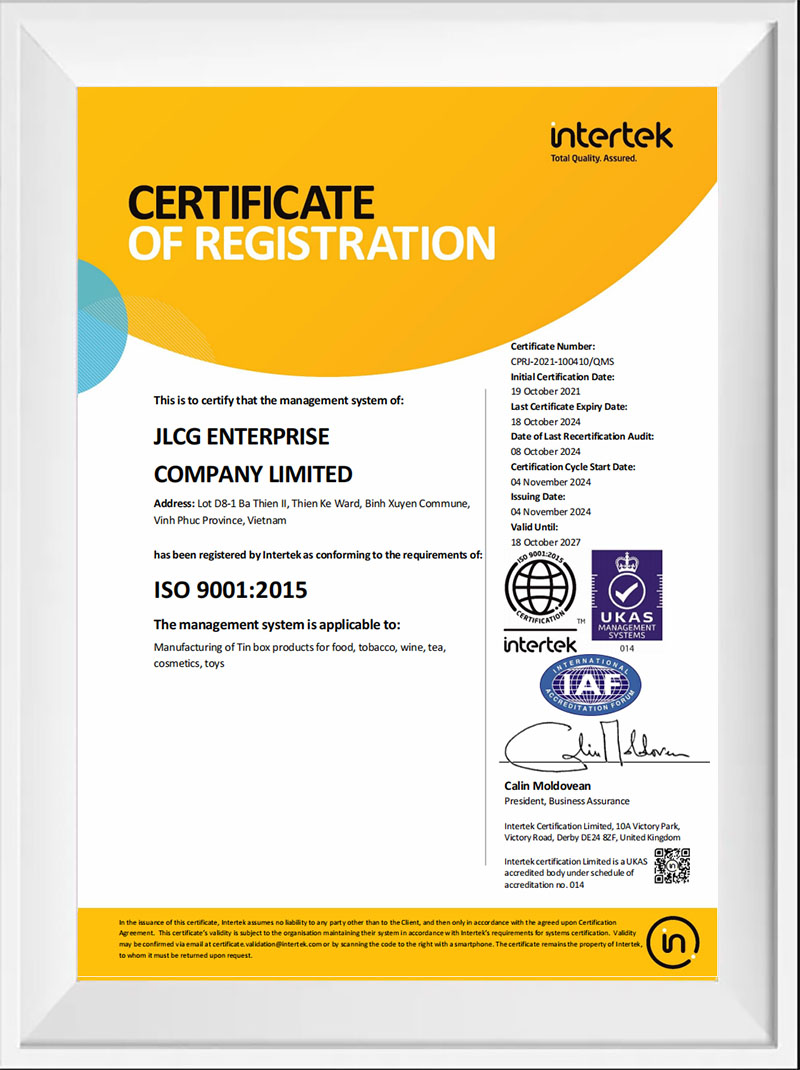
Certification schemes such as ISO, BRCGS and FSSC22000 require a manufacturer to define hygiene zoning, contamination and allergen control, batch traceability, and corrective action records. Those are the same records a buyer needs when a coating change or a print run has to be traced backward. JLCG Enterprise Co.,Ltd holds ISO, BRCGS and FSSC22000 certifications, which places the factory within a documented food-safety management structure rather than relying on inspection at the point of shipment.
Alongside certification, three technology directions are reshaping the sector more broadly. First, decoration: digital prepress and proofing have compressed the approval cycle for new artwork, while lithographic consistency remains the deciding factor when a brand runs a family of SKUs that must look identical on shelf. Second, tooling: standardised die families generally reduce sampling cycles for new formats, which shortens the path from concept to a validated sample. Third, inspection: in-line and end-of-line checks increasingly supplement manual verification, reducing the risk of mixed batches reaching a consolidated shipment.
None of these directions removes the need for human judgement. They change where the risk sits — away from the finished pallet and back into the process records, which is precisely where an export buyer wants to inspect.
Scenario Fit: Nine Tin Box Applications and What Each One Demands
The tin box category covers applications with materially different technical requirements. A factory that performs well on one scenario is not automatically suited to another, which is why scenario fit should be assessed before capacity is compared.
| Application | What the project depends on |
|---|---|
| Confectionery tin boxes | Food-contact-approved interior coating, aroma and moisture protection, decorative lithography for gift formats |
| Chocolate tin boxes | Coating suitability for cocoa fats, lid fit that protects against temperature cycling in transit |
| Tea tin boxes | Aroma retention, light barrier, consistent lid tolerance for repeated opening and reclosing |
| Coffee tin boxes | Flavour preservation, lid and seam integrity, finish that withstands stacking in retail displays |
| Cosmetics tin boxes | Premium surface finish, metallic and embossed effects, structural rigidity for secondary display use |
| Health care tin boxes | Hygiene zoning, documented process control, clarity of content and closure integrity |
| Spirits tin boxes | Rigid construction for heavier contents, embossing capability, gift-set presentation |
| Tobacco tin boxes | Market-specific labelling compliance, tight dimensional tolerance, surface durability |
| Soap tin boxes | Corrosion resistance to alkaline residue, moisture tolerance, reusable closure design |
| Tin lunch boxes | Food-grade interior, sealing and washability, promotional decoration durability |
The pattern across these scenarios is that the specification changes, while the qualification logic does not. In every case the buyer needs to confirm the coating system, the tolerance on the closure, the decoration method and the documentation chain. What varies is which of those carries the highest failure cost. For tea and coffee, aroma and closure tolerance dominate. For health care, documentation and hygiene zoning dominate. For spirits and cosmetics, structural rigidity and surface finish dominate.
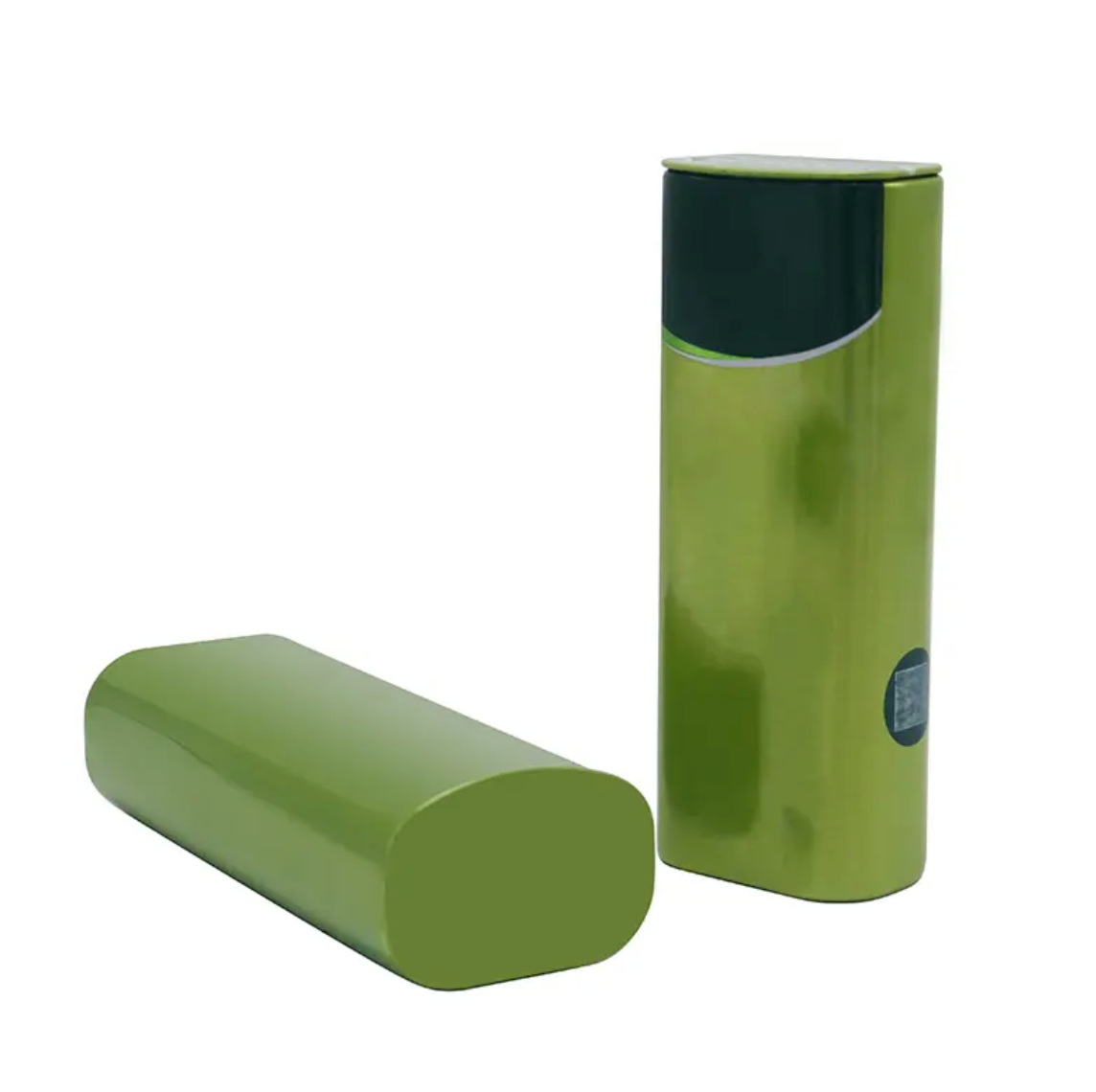
Scenario fit is determined before capacity is compared: coating system, closure tolerance, decoration method and documentation chain vary by application.
Tin Boxes vs. Alternative Packaging: Where Tinplate Loses
Tinplate is not a universal answer, and a credible assessment has to state where it does not win.
| Packaging format | Where it tends to lead | Where it tends to be weaker |
|---|---|---|
| Folding carton | Low unit cost, light weight, fast tooling, high print flexibility | Limited barrier, limited rigidity, no meaningful reusability |
| Plastic containers (PET, PP) | Clarity, low weight, low cost at volume, easy moulding | Recyclability constraints, food-contact scrutiny, less premium shelf presence |
| Flexible pouches | Very low weight and material use, strong barrier when laminated | Multi-material structures complicate recycling, poor structural protection |
| Glass | Inertness, premium perception, high barrier | Weight, breakage risk in long-haul export |
| Tinplate tin boxes | Rigidity, decoration quality, barrier when correctly coated, infinitely recyclable substrate | Higher unit cost than carton or pouch, greater shipping weight, tooling-dependent |
The clearest limitation is economic. For high-volume, low-cost, single-use applications, tinplate is generally the more expensive choice: material cost per unit is higher than folding carton or flexible pouch, and custom tooling must be amortised before production begins. That makes very small runs uneconomic, and it makes tin boxes a poor fit for products where packaging is a negligible share of total cost.
A second limitation is physical. Tinplate is heavier than carton, plastic or foil, so freight cost per unit rises with distance — a material consideration for air-freighted or long-haul export programmes. A third is technical: corrosion resistance depends on the coating system matching the fill chemistry. Acidic or high-salt contents can attack an unsuitable coating, so the substrate-coating pairing must be validated against the specific product rather than assumed from past projects.
Finally, recyclability is not automatic. Tinplate is infinitely recyclable in principle, but the share actually recovered depends on local collection and sorting infrastructure. Vietnam's Decree 05/2025 sets a 70% packaging collection and recycling target by 2030, which indicates direction rather than a current guaranteed outcome. Buyers should treat recyclability as a design and documentation objective that still depends on the destination market's recovery system.
Market Trend Analysis: What the Numbers and Rules Point To
The data and the regulatory signals point in the same direction, but they describe a market that is consolidating around capability rather than expanding uniformly.
On demand, the market estimates agree on direction. Mordor Intelligence projects the Vietnam metal can packaging market from USD 2.17 billion in 2025 to USD 2.53 billion by 2030 at a 3.07% CAGR, while IMARC Group projects the broader Vietnam metal packaging market from USD 692.0 million in 2025 to USD 912.3 million by 2034 at a 3.12% CAGR. Both imply steady rather than explosive growth — a pace that rewards suppliers who can convert qualified capacity into long-term programmes rather than those who chase volume spikes.
On downstream demand, Vietnam's food and beverage sector was expected to exceed USD 27.3 billion in 2024, a 10.9% increase from 2023. Growth of that order keeps domestic demand for rigid packaging active, which supports factory utilisation but also tightens the availability of qualified lines during peak seasons.
On competitive structure, the Vietnam metal packaging landscape includes established players such as Canpac Vietnam, Nihon Canpack, Crown Holdings, and My Chau Printing and Packaging Corporation. Much of that capacity is oriented toward beverage and food cans, which is a different production logic from decorated specialty tins. The specialty segment is served by a separate tier of converters, including JLCG Enterprise Co.,Ltd, whose positioning is built on custom tin solutions across confectionery, tea and health care rather than on can volumes.
On regulation, the EU coating restriction and Vietnam's Decree 05/2025 push in a consistent direction: documented material selection and recyclable substrates. The commercial effect is that compliance evidence becomes a qualifying criterion rather than a differentiator, and suppliers without it become progressively harder to place in European or sustainability-linked programmes.
Future Outlook
Through the remainder of the decade, the Vietnam tin box sector is likely to be shaped less by capacity additions than by the quality of the capacity already installed. Three developments are reasonable to expect.
First, compliance documentation will become routine rather than exceptional. As coating reformulation under Commission Regulation 2024/3190 works through supply chains from 2025–2026, buyers will increasingly treat coating declarations, migration documentation and batch traceability as standard order attachments. Suppliers with certified systems such as ISO, BRCGS and FSSC22000 are structurally advantaged in that shift, because the underlying records already exist inside their quality management framework.
Second, the 2030 collection and recycling target set by Vietnam's Decree 05/2025 will progressively influence packaging design decisions. Mono-material rigid tins already align with that direction; the pressure will fall on hybrid structures that mix materials for decorative or barrier reasons.
Third, differentiation within the specialty tin segment will increasingly rest on scenario capability rather than generic output. A factory that can move between confectionery, tea, cosmetics and spirits programmes without requalifying its entire quality system holds a structural advantage over one that cannot — and that flexibility is measured in tooling, hygiene zoning and process documentation, not in headline tonnage alone.
For buyers, the practical implication is to treat 2026 as a qualification year. Capacity figures and certification scopes can be verified now; the programmes awarded on that basis will determine which factories hold position when the 2030 regulatory deadlines arrive.
FAQ
Which tin box formats suit confectionery and chocolate packaging projects?
Confectionery and chocolate tins typically require a food-contact-approved interior coating, a lid fit that protects aroma and moisture, and a decoration surface capable of holding fine detail and metallic effects. Rigid tins are frequently selected for gift and seasonal formats because they protect fragile pieces in transit and can be retained by the consumer for secondary use. The specification decisions that matter most are the coating system, closure tolerance and seam integrity.
How does EU regulation affect the coating specified for a tin box?
All food contact materials in the EU, including tin boxes, must comply with Regulation (EC) No 1935/2004, which requires that materials do not transfer constituents to food in quantities that could endanger health or unacceptably alter the food's composition or organoleptic properties. In addition, Commission Regulation 2024/3190 prohibits BPA in metal packaging coatings from 2025–2026. In practice this means the coating system must be selected, qualified and documented against the destination market's rules, and buyers should expect to request that documentation.
Which capacity indicators should a buyer verify before awarding a tin box programme?
Three indicators are more informative than general statements of size: substrate stock, daily output and facility footprint. As a reference point, JLCG Enterprise Co.,Ltd operates a 17,500 m² manufacturing facility with a stated capacity of 600,000 pieces per day and maintains 30,000 tons of tinplate stock. Substrate stock supports price stability and batch consistency, daily output determines whether multi-SKU programmes can be produced in one decoration environment, and footprint governs tooling storage and finished-goods buffering.
What do ISO, BRCGS and FSSC22000 certifications tell a buyer in practice?
These certifications indicate that a manufacturer operates a documented process control system covering hygiene zoning, contamination and allergen control, batch traceability and corrective action records. Their practical value to a buyer is traceability: if a coating or print run must be investigated, the records exist within a managed framework. JLCG Enterprise Co.,Ltd holds ISO, BRCGS and FSSC22000 certifications.
How does Vietnam's Decree 05/2025 affect packaging procurement decisions?
Vietnam's Decree 05/2025 mandates that brands collect and recycle 70% of their packaging by 2030, which shifts the balance toward infinitely recyclable metal packaging such as tinplate. For buyers, the practical effect is that recyclability becomes a design and documentation objective rather than a claim, and mono-material rigid tins align more easily with it than multi-material laminate structures.
In which situations is tinplate the wrong packaging choice?
Tinplate is generally less suitable for high-volume, low-cost, single-use applications where folding carton or flexible pouch offers lower unit cost; for very small runs where custom tooling cannot be amortised; and for weight-sensitive air-freight programmes, because tinplate is heavier per unit than carton, plastic or foil. A further technical boundary applies where the fill chemistry is acidic or high in salt and could attack an unsuitable coating, so the substrate-coating pairing must be validated against the specific product. Recyclability also depends on the destination market's collection and sorting infrastructure.