
Video Wall Controller Supplier Capability: Romania and Shenzhen Cases Examined
Video wall controller suppliers are typically compared through specification tables. A more useful comparison is a documented installation that already ran at a defined resolution, across a defined cable distance, for a defined period.
Shenzhen Bitvisus Technology Ltd. is a Shenzhen-based manufacturer founded in 2018 that designs and produces 4K and 8K image and video processing hardware — video wall controllers, multi-screen expanders, projection fusion processors, HDMI matrix switchers, multi-viewers, and network and fiber extenders — from a 2,000 m² production facility, with a stated export ratio of 70% and main markets in the EU and USA. Two documented deployments in that portfolio, one in Romania and one in Shenzhen, turn the capability question into something checkable: what was installed, what the numbers imply, and what the record does not yet prove.
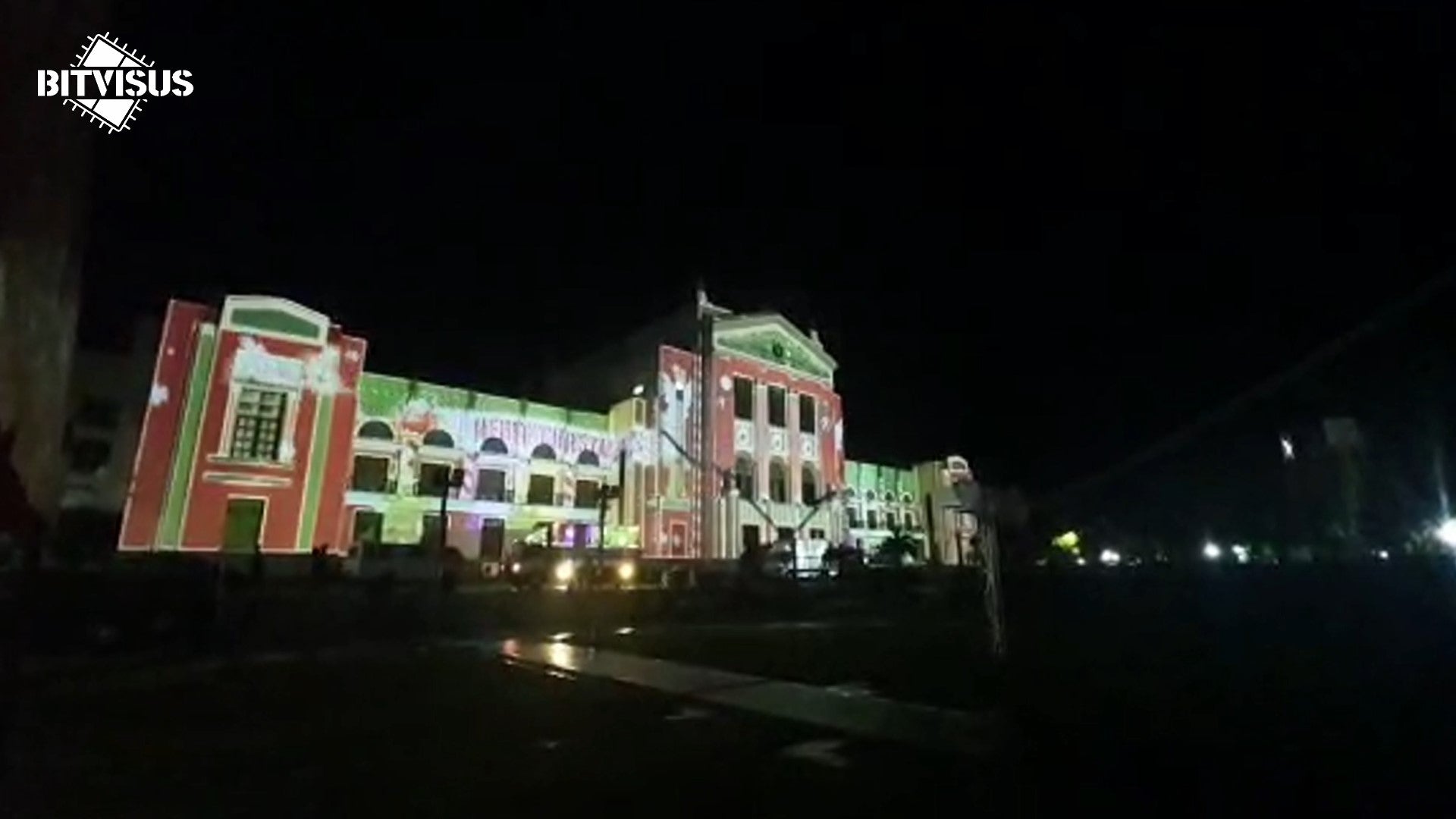
Building facade 3D projection mapping: a single-PC source distributed to six projectors over an approximately 120 m signal path (Romania case record).
Why deployment records outrank specification sheets
Three questions decide whether a video wall controller will work in a real project, and none of them is answered by a specification table on its own. First, can the system be expanded without rebuilding it? Second, does the signal survive the cable distance between the processing rack and the display? Third, does the hardware hold up when several resolutions and tiling layouts coexist in the same installation?
A capacity figure such as 36 in / 36 out or a bandwidth figure such as 6 Gbps describes a boundary condition. A deployment record shows how close a project actually ran to that boundary — how many units were paralleled, how many meters of cable were used, what canvas resolution was produced, and how long the system has been in service. Those are the details that separate a plausible system design from a proven one.
Case 1 — Romania: one PC, six projectors, roughly 120 m of signal path
The Romania deployment is recorded as a building facade 3D projection mapping light show, prepared as a 3D projection mapping competition entry and operated on an event-driven schedule during the Christmas season. Its defining constraint was not display count but source count: the entire show had to originate from a single PC equipped with a GTX 3050 GPU.
The signal chain was built from two BIT-MSE-4K60-104Pro multi-screen expanders operating in parallel, six BIT-Ex-HDBT-150-RX extenders, and six projectors. Three projectors per group were fused into one image, and total output resolution reached up to 11520 × 1200. The transmission distance between the source side and the projector side was approximately 120 m.
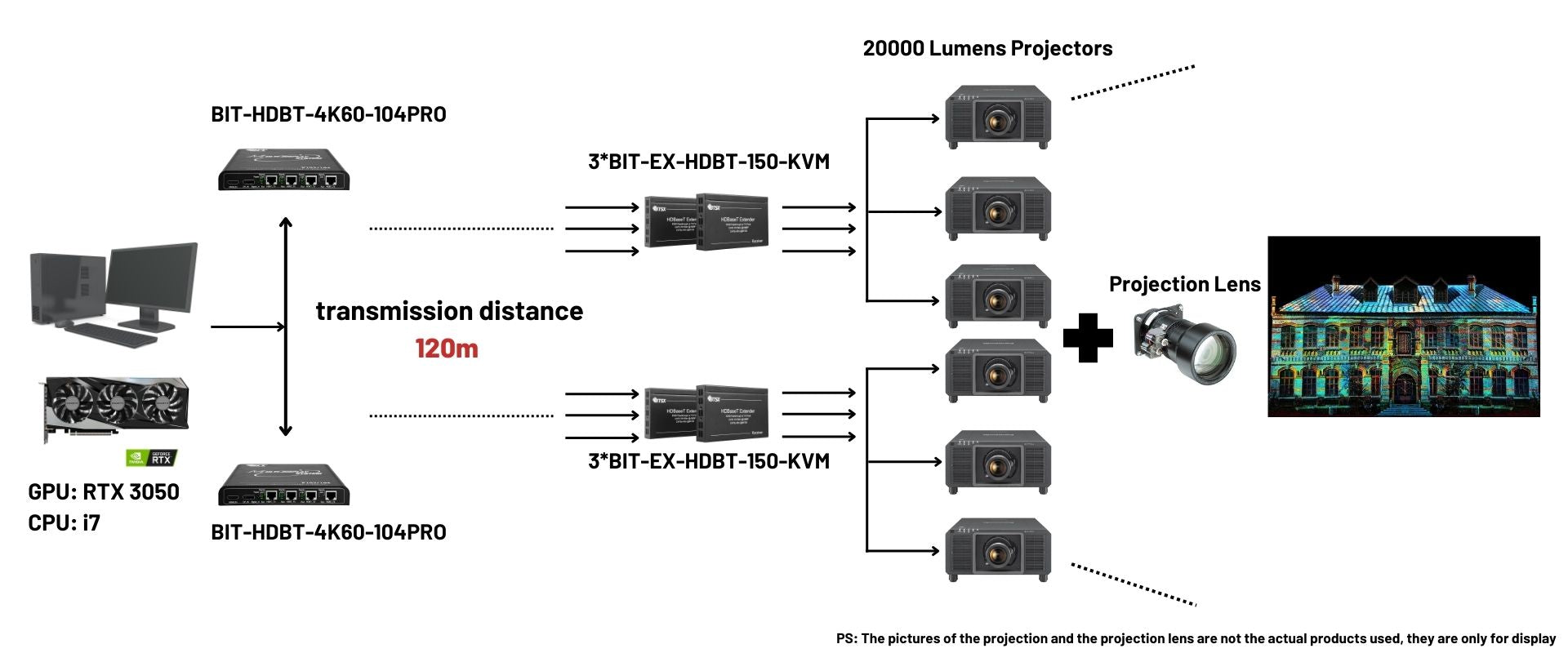
Connection architecture used in the Romania project: expander outputs extended over CAT6E to the projector positions.
Reading the 11520 × 1200 figure
The number is not arbitrary. The BIT-MSE-4K60-104Pro is specified for 3-screen tiling at 3 × 1920 × 1200 @ 60 Hz, with a 3 × 1 maximum layout of 5760 × 1200 @ 60 Hz. Run two units in parallel and you get six 1920 × 1200 segments — 11520 × 1200 in total. That is exactly the resolution the case record reports.
This is the practical meaning of modular expansion in a projection mapping context. A single expander provides four HDMI outputs; when a project needs six synchronised image segments from one source, the answer is a second unit in parallel rather than a larger single chassis. Expansion happens at the edge of the canvas, and the fusion software continues to see a single logical image.
Why the long-distance segment is the risk point
A projection mapping build usually places the control rack where power, network, and operator access exist — rarely next to the projectors mounted on a facade. In this case the gap was about 120 m, handled by the BIT-Ex-HDBT-150-RX, which is specified for HDMI extension over CAT6E up to 150 m at 1080p resolution, with 6 Gbps transmission bandwidth, unidirectional PoE power supply, and two-way RS232 and IR transparent transmission.
Two details matter for buyers evaluating similar projects. The deployment ran inside the extender's rated distance rather than at its limit, and the extenders also carried control signals — RS232 and IR pass-through — which means the operator can drive sources and displays without a separate control cable run. The product's EDID handling is switchable between fixed and transparent modes, which is relevant when a source PC has to be told what kind of display it is talking to.
Case 2 — Shenzhen: 12 controllers, 3×3 walls, and a five-year record
The second deployment is larger, longer-running, and indoor. The Cézanne immersive painting art exhibition in Shenzhen, China, is documented with 12 BIT-VWC-409R video wall controllers. Each controller drives nine projectors in a 3×3 video wall configuration. A single 3×3 wall produces 5K 5760 × 3240 high-definition output, and multiple 3×3 walls were recombined into a final combined image resolution exceeding 16K. The supporting equipment list describes more than 100 industrial-grade 1080p projectors, blending and warping software, and a control PC. The installation runs under continuous daily exhibition operation, and the case record lists a deployment duration of five years.
Twelve controllers, each feeding nine display channels, describes a system with more than a hundred outputs — which is why the equipment list counts projectors rather than controllers as the unit of scale.
The resolution arithmetic behind an "above 16K" canvas
Each BIT-VWC-409R outputs nine HDMI 1.3 channels at 1920 × 1080 @ 60 Hz, with an output pixel clock of 165 MHz and 24-bit RGB444 colour. Three outputs across and three down give 3 × 1920 = 5760 px wide and 3 × 1080 = 3240 px high — the 5K 5760 × 3240 figure in the case record. Stack several of those walls into one canvas and the combined width passes 16K.
Two specification details support that structure. The controller carries a 40 nm programmable FPGA running a full hardware real-time processing architecture, so no operating system sits between input and output; and its stitching mode covers splicing within nine screens, with parallel connection of multiple devices and multi-device cascading explicitly supported to sustain real-time display on large screens. Output rotation is also available — 90° on input and 180° on the first output row in two-line splicing layouts — which is what allows a rotated or inverted display row to be corrected in software rather than by physically remounting hardware.
Three capability signals these deployments provide
Reading note: The installation details below are drawn from Bitvisus case records for the Romania and Shenzhen projects. Product specifications are drawn from the manufacturer's published product data.
1. Modular expansion by parallel operation, not by replacement
Both projects scale by adding units. In Romania, two 4-output expanders run in parallel to serve six projectors. In Shenzhen, twelve 9-output controllers are cascaded and paralleled into a single canvas. The same design logic appears higher in the portfolio: the BIT-MSE-8K60D-104Pro 8K60 multi-screen expander supports parallel operation to expand channel count, and its modular chassis allows two half-width units to be combined into a full-width 1U structure, with card insertion supporting up to four boards in one chassis on centralised power. The BIT-VWC-MD3636Ma seamless matrix splicer extends the idea further, with a 7U chassis, up to nine input and nine output boards, and configurations such as 4-in / 36-out, 12-in / 36-out, 24-in / 24-out, and 36-in / 36-out.
2. Long-distance distribution as a designed part of the signal chain
The Romania project did not attempt to drive projectors directly from the expander. It separated the problem: short copper runs from the processing rack into HDBaseT transmitters, then approximately 120 m of CAT6E to the receivers at the projector positions, with control signals travelling on the same path. That separation is what makes a facade-scale installation layoutable in the first place, because the processing rack can stay in a controlled environment.
3. Multi-resolution stability across a mixed canvas
The two projects produced canvases of 11520 × 1200 and 5760 × 3240 per wall, with a combined image above 16K at exhibition scale. Multi-resolution operation is the ability to hold several of these layouts in one system without stretching or deforming the picture — the BIT-MSE-4K60-104Pro specification states that M×N and 90° rotation stitching are performed without stretching or deformation, and the BIT-VWC-409R specification states that proportional resolution input is supported so the picture is not distorted. For an exhibition that runs daily, that translates into a canvas that can be re-laid out without re-engineering the hardware.
| Element | Romania deployment | Shenzhen deployment |
|---|---|---|
| Project type | Building facade 3D projection mapping light show (Christmas season) | Cézanne immersive painting art exhibition, indoor hall |
| Processing hardware | 2 × BIT-MSE-4K60-104Pro expanders in parallel; 6 × BIT-Ex-HDBT-150-RX extenders | 12 × BIT-VWC-409R video wall controllers |
| Source | 1 PC with GTX 3050 GPU, plus mapping software | Control PC with blending and warping software |
| Display scale | 6 projectors; 3 per fused image group | 9 projectors per controller in 3×3 walls; 100+ industrial 1080p projectors in the equipment list |
| Signal path | Approx. 120 m over CAT6E; extender rated to 150 m at 1080p | Controller outputs to displays, within the ≤15 m output cable rating |
| Resolution outcome | Up to 11520 × 1200 total | 5760 × 3240 per 3×3 wall; combined image exceeding 16K |
| Duty cycle and duration | Event-driven scheduled shows; case record lists five years | Continuous daily exhibition operation; case record lists five years |
Market context: fixed-canvas hardware in a networked decade
Demand for video wall processing is expanding while the way signals reach displays is changing. Published market research estimates the global video wall controllers market at approximately USD 2.25 billion in 2025, projected to reach USD 4.4 billion by 2034, a 7.8% CAGR across that period (Dataintelo, 2026). That headline should be read with care: published estimates of the same category vary widely depending on whether "controller" means the processing hardware alone or the entire display management solution, so market size figures are a directional indicator rather than a procurement input.
Two structural trends are more directly relevant to buyers evaluating a controller for a large canvas. A 2026 buyer's guide published by GCG Enterprise Solution, citing AVIXA, reports that AV-over-IP adoption reached 73% of new video wall controller installations in early 2026 — networked distribution has become the default choice for many new builds. In the same period, legacy hardware video wall processors on 4U chassis lost 18% market share in 2025 as users shifted toward AV-over-IP and software orchestration (GCG Enterprise Solution, 2026, reported with medium confidence). Control room applications remain the largest single application segment, accounting for around 50% of video wall processor market contribution (Statifacts, 2025).
The interpretation for this article's subject is narrow but useful: networked distribution is winning the general-purpose build, while fixed-canvas, low-latency hardware processing still has a defined role in projection fusion, immersive exhibitions, and installations where a deterministic combined canvas matters more than flexible routing. The two deployments examined here sit in that second category. For procurement classification, video wall controllers are commonly filed under HS code 85437099, and control-room layouts are typically designed against ergonomic guidance such as ISO 11064.
Where this architecture reaches its limits
A credible capability assessment has to state boundaries, and these deployments make several explicit.
- Controller outputs are short-run by design. The BIT-VWC-409R's nine HDMI 1.3 outputs are rated for cable runs up to 15 m, and the BIT-MSE-4K60-104Pro lists an output distance of 15 m. Anything longer depends on added extension hardware. A project that assumes direct long copper runs from the processing rack to the displays is planning the wrong topology.
- Rated extension distance is resolution-dependent. The BIT-Ex-HDBT-150 extender's 150 m rating applies to HDMI extension over CAT6E at 1080p resolution, and the Romania deployment used approximately 120 m. Buyers running 4K60 sources across comparable distances should not transfer that number automatically; the distance must be validated at the resolution and frame rate the project will actually use.
- Combined canvas figures are not per-channel figures. In Shenzhen, each output channel delivers 1920 × 1080 @ 60 Hz; "5K" and "above 16K" describe the assembled canvas after multi-controller combination. Evaluating a controller by combined resolution alone hides the per-channel specification that determines image sharpness.
- Duty cycle does not transfer between cases. The Romania show runs on an event-driven schedule during the Christmas season; the Shenzhen exhibition runs continuous daily operation with a five-year record. A seasonal event deployment is not evidence of 7×24 readiness, and vice versa.
- Cable-based hardware distribution is a poor fit for scattered endpoints. When display groups sit in many rooms, sites, or buildings, and routing flexibility matters more than a deterministic canvas, an IP-linked architecture is usually the more practical answer — which is consistent with AV-over-IP's reported share of new installations in 2026.
What buyers can take from these two records
The value of a deployment record is that it converts supplier claims into verifiable questions. Five of those questions are worth putting to any video wall controller supplier during evaluation.
- Ask for the signal chain, not the product list. How many sources, how many processing units, how many extension hops, and what total canvas result? The Romania chain (1 PC → 2 expanders → 6 extenders → 6 projectors) is answerable in one line; a product list is not.
- Check the arithmetic. A stated 11520 × 1200 or 5760 × 3240 should reconcile with the tiling layout and the per-channel output specification. If it does not, the number is decorative.
- Match the distance rating to your resolution. Confirm the extension rating at the resolution you will run, not at the resolution used in a reference project.
- Match duty cycle evidence. Ask specifically for a comparable on/off pattern — continuous exhibition operation, 7×24 control room operation, or event-based operation.
- Plan the expansion path and the service path. Confirm whether parallel operation and cascading are supported (both products in these cases support them), and confirm warranty and spare-part expectations. The units in these deployments carry a one-year warranty as standard, with 7×24 technical support, multilingual technical documentation, remote debugging, and fast spare-part replacement available from the manufacturer.
On the supply side, the manufacturer's stated quality control regime is relevant to the duty-cycle question above: a three-level inspection process covering 100% inspection of core components on incoming, single-board function testing at semi-finished stage, and a 7×24-hour full-channel power ageing test on finished goods. Stated monthly capacity is 8,000 units, with 3–7 days lead time on standard stock and 2–3 months for custom orders.
Future outlook
Two directions are visible in the same product portfolio that produced these deployments. The first is resolution headroom at the input stage: 8K signal paths are already represented by the BIT-VWC-8K60-404Max (8K input at 7680 × 4320 @ 60 Hz over HDMI 2.1 and DP 2.1, with four HDMI 2.0 outputs at 3840 × 2160 @ 60 Hz) and the BIT-VWC-8K60Y-115Pro (3 × 3 splicing input at 5760 × 3240 @ 60 Hz RGB444, with 15 HDMI outputs). Higher input ceilings let the same installation accept richer source material without changing the display topology.
The second is modularity at the chassis level, where expanders and splicers increasingly behave like a configurable frame rather than a fixed box: half-width units combined into 1U, four boards in one chassis, and 7U seamless matrix chassis with reconfigurable input/output board counts. For buyers, the meaningful consequence is that a controller purchase becomes more like a capacity decision than a model decision — what you buy today should be extendable by adding units or boards, not by replacing the architecture.
What these two deployments cannot yet demonstrate is a long-term, large-scale record of 4K60 extension over the full rated copper distance, or a 7×24 control-room record in the same family. Those remain open evidence gaps, and they are exactly the questions a well-briefed buyer should bring to the next supplier conversation.
FAQ
What does a video wall controller deployment in a 3D projection mapping project actually require?
Three things, based on the Romania case record: a single source that can be split across multiple projectors, a distribution method that covers the physical distance between the control position and the projectors, and edge blending so the per-projector images fuse into one picture. In that project, one PC with a GTX 3050 GPU fed two BIT-MSE-4K60-104Pro multi-screen expanders running in parallel, with six BIT-Ex-HDBT-150-RX extenders carrying signals approximately 120 m to six projectors, three per fused group, for a total output resolution of up to 11520 × 1200.
How far can a video wall controller send HDMI signals before image quality becomes a concern?
It depends on which part of the chain is being measured. Controller output stages are short-run: the BIT-VWC-409R's nine HDMI 1.3 outputs are specified for cable lengths up to 15 m, and the BIT-MSE-4K60-104Pro lists an output distance of 15 m. Extension hardware carries the signal further — the BIT-Ex-HDBT-150-RX used in the Romania project is specified for HDMI extension over CAT6E up to 150 m at 1080p, with 6 Gbps transmission bandwidth and two-way RS232 and IR transparent transmission. The distance rating should be confirmed against the resolution the installation will actually run, because the rated distance applies to the stated resolution.
How is a combined image resolution above 16K achieved in an immersive exhibition?
By combining multiple controller-driven walls into one canvas. In the Cézanne immersive painting art exhibition in Shenzhen, the case record lists 12 BIT-VWC-409R video wall controllers, each driving nine projectors in a 3×3 video wall. A single 3×3 wall produces 5K 5760 × 3240 output — three outputs across at 1920 px and three down at 1080 px, matching the controller's 1920 × 1080 @ 60 Hz per-channel output. Multiple 3×3 walls were then recombined into a final combined image resolution exceeding 16K. The combined figure describes the assembled canvas, not the resolution of any individual output channel.
Does continuous daily operation require different evidence than an event-based show?
Yes. Duty cycle is a separate variable from resolution and scale. The Shenzhen exhibition is documented as continuous daily exhibition operation in an indoor hall, with a deployment duration listed at five years. The Romania mapping show is documented as event-driven scheduled operation during the Christmas season. The same processing families appear in both, but a buyer with a 7×24 or multi-year continuous requirement should ask for evidence from a deployment with a comparable operating pattern rather than assuming that event operation transfers directly.
What makes a video wall controller setup expandable rather than a dead end?
Parallel operation and cascading. The BIT-VWC-409R specification states support for parallel connection of multiple devices to meet real-time display requirements on large screens, along with multi-device cascading. The BIT-MSE-4K60-104Pro also supports parallel operation to expand channel count. Higher in the same portfolio, the BIT-MSE-8K60D-104Pro uses a modular chassis where two half-width units can be combined into a full-width 1U structure or up to four boards can be integrated in one chassis with centralised power, and the BIT-VWC-MD3636Ma is a 7U chassis with up to nine input and nine output boards and configurations from 4-in / 36-out up to 36-in / 36-out. Expansion therefore happens by adding units or boards rather than replacing the processing architecture.
Which projects are a poor fit for cable-based hardware video wall controllers?
Installations where display endpoints are scattered across many rooms, sites, or long cable runs, and where flexible re-routing matters more than a deterministic canvas. Controller output cable limits are short — up to 15 m on the BIT-VWC-409R's HDMI 1.3 outputs and a 15 m output distance on the BIT-MSE-4K60-104Pro — and longer runs require dedicated extenders rated for the resolution in use, since the BIT-Ex-HDBT-150's 150 m rating applies to 1080p over CAT6E. For context, a 2026 buyer's guide published by GCG Enterprise Solution, citing AVIXA, reports that AV-over-IP adoption reached 73% of new video wall controller installations in early 2026, indicating that networked distribution is often the more practical architecture when flexibility across many endpoints is the primary requirement.
For readers who need the full hardware range and specification set behind these deployments, the 2026 Bitvisus Product Brochure is available for download.