
Video Wall Controller Qualification: Certification, Warranty, Evidence
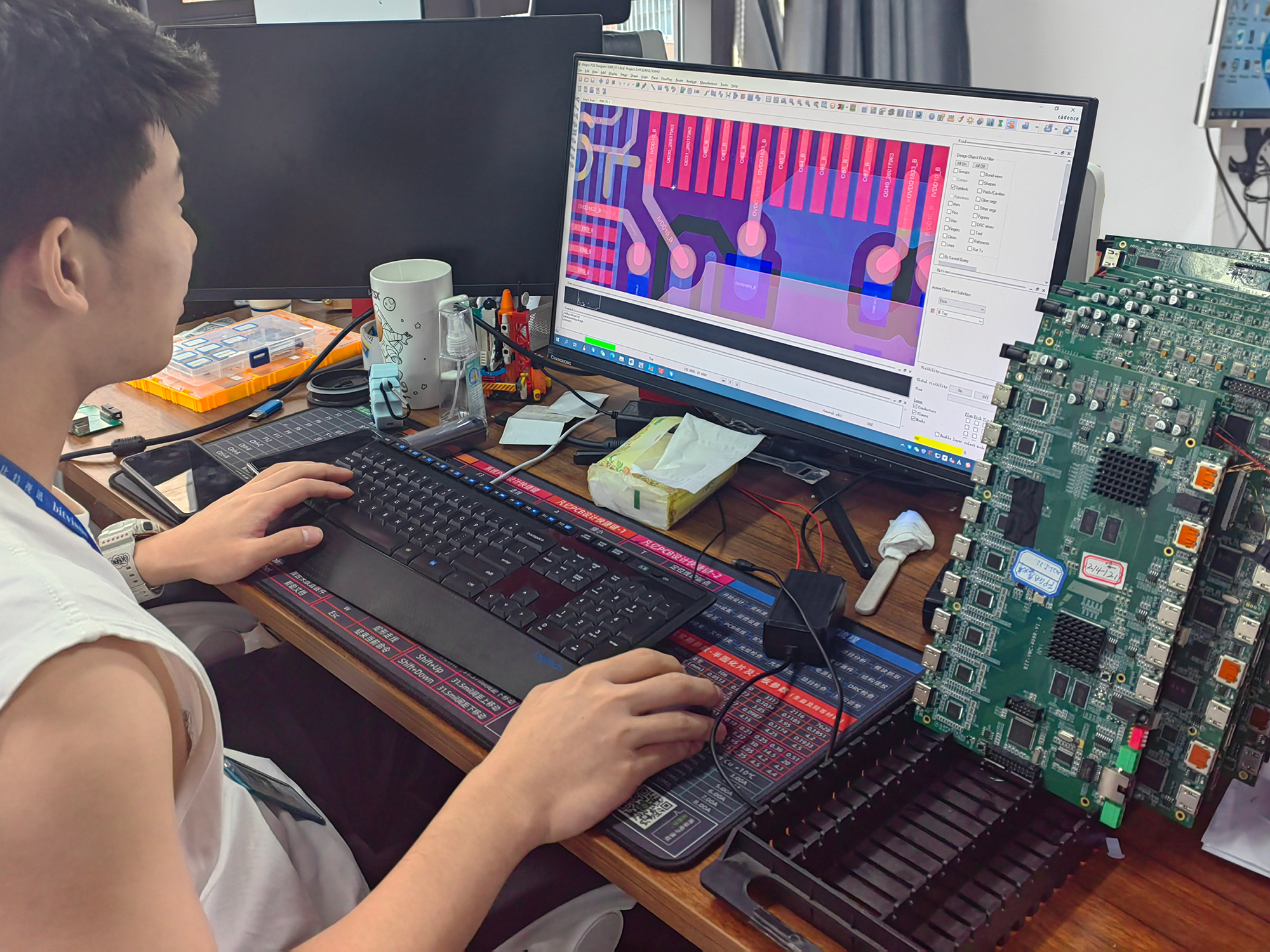
A video wall controller is specified for years and purchased in weeks. The chassis may stay on a wall for a decade, while the decision to buy it is usually compressed into a short window of quotations, datasheets and sample checks. What an integrator inherits from that window is not hardware alone. It is also the supplier's documentation, the warranty position as written down, and the supplier's willingness to answer technical questions in a form that can be filed with the project.
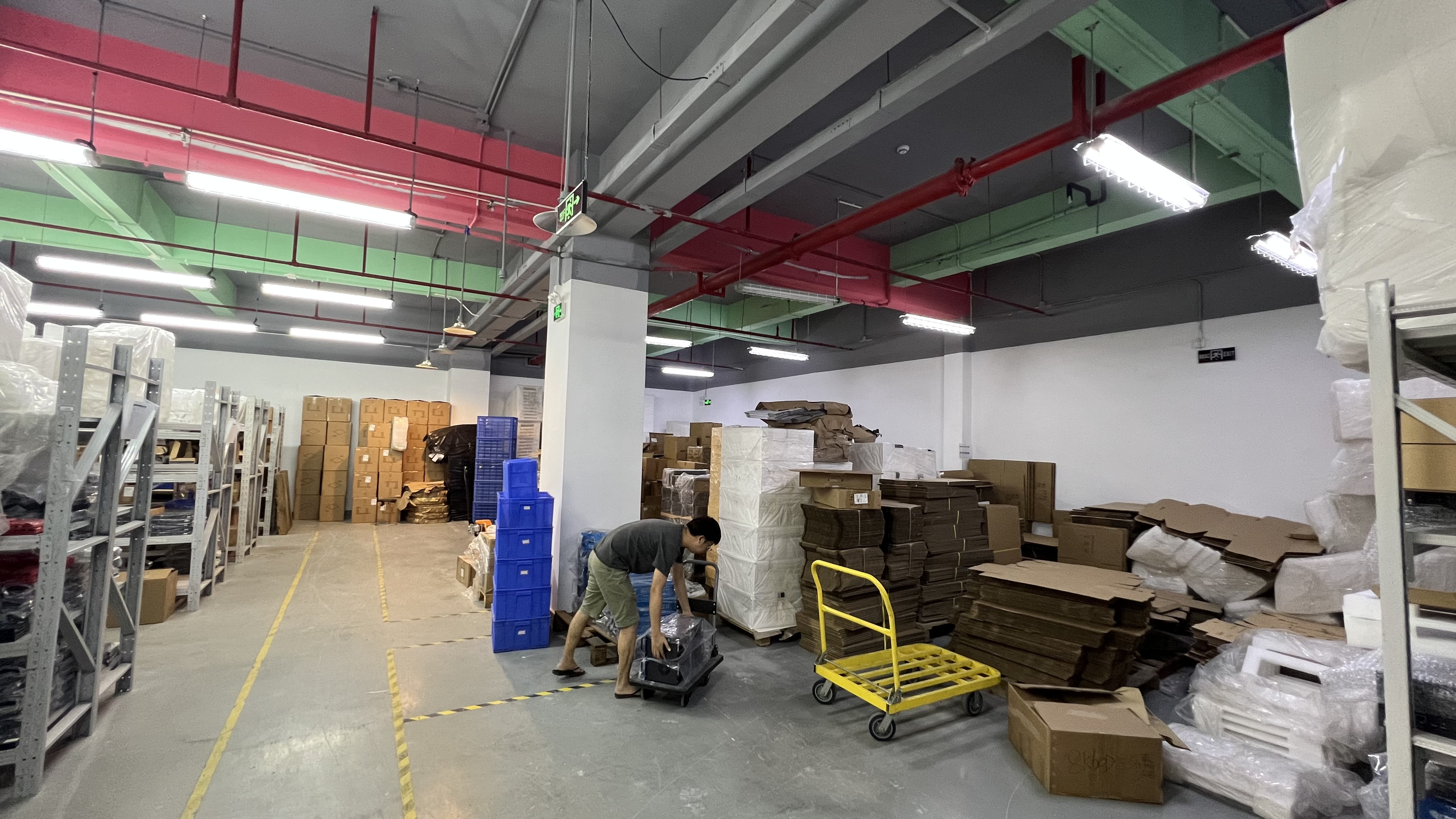
Shenzhen Bitvisus Technology Ltd. is a Shenzhen, China-based manufacturer of video wall controllers and related 4K/8K image and video processing products, established in 2018. According to its published company background data, the company operates a 2,000 square metre manufacturing facility with approximately 100 staff, an annual output of 100,000 units, and an R&D team of 20 engineers. Its core product range includes video wall controllers, multi-screen expanders, projector fusion processors, video processors, HDMI matrices, multi-viewers, and network and fiber extenders.
This article builds a qualification checklist for buyers, system integrators and procurement teams assessing a video wall controller supplier before ordering a Video Wall Controller, Multi-Screen Expander or Fiber Extender. It follows four questions that tend to surface late in an evaluation and should surface early: whether the company is certified, how warranty and after-sales are ensured, how technical support is reached, and how a sample price differs from a bulk quote. The purpose is not to promote a supplier but to define what evidence to request, and how to tell a complete answer from a partial one.
Why supplier qualification carries more weight than it did
Three shifts in the video wall category explain why documentation has moved up the buyer's agenda.
First, the category is expanding, but not evenly and not by a single definition. Dataintelo estimates the global video wall controllers market at approximately USD 2.25 billion in 2025, with a projected path to USD 4.4 billion by 2034 at a compound annual growth rate of 7.8 percent. That figure carries a caveat buyers should apply to every market number they see in this category: estimates vary widely, and some place the market far lower, depending on whether the controller is defined as the processing hardware alone or as the entire display management solution including software and integration. When a supplier cites market size, the definition matters more than the number.
Second, the transport layer is changing. GCG Enterprise Solution, drawing on AVIXA material, reports that AV-over-IP adoption reached 73 percent of new video wall controller installations in early 2026, while legacy 4U hardware processors lost 18 percent market share in 2025 as buyers shifted toward AV-over-IP and software orchestration. Both movements push part of the qualification conversation away from port counts and toward firmware, network behaviour and software lifecycle, which are precisely the areas where the paper trail is thinner and the buyer's questions must be sharper.
Third, demand is concentrated in demanding environments. Statifacts places control room applications at roughly 50 percent of video wall processor market contribution. Control rooms are the environment where an undocumented warranty term, an unverified certificate list or an unnamed support contact stops being a paperwork detail and becomes project risk.
The qualification pack: five items to assemble before an order
A buyer should be able to assemble five items before a purchase order is issued. The table below sets out what each item is, why it matters, and what a complete version looks like.
| Item to request | Why it matters | What a complete version contains |
|---|---|---|
| Entity and facility documentation | Distinguishes a manufacturer with production capability from a trading intermediary | Founding year, facility size, headcount, annual output, verifiable business address, corporate website |
| Model-level specification sheet | Confirms the exact SKU, its interfaces and its documented limits | A sheet naming the model number and matching the configuration ordered |
| Certification list for the model and market | Confirms which marks apply to the configuration and the destination market | A list naming the model number, the market, the configuration covered and validity status |
| Warranty terms and packing list | Defines what is actually guaranteed and what travels in the carton | Term length, start basis, coverage scope, return route plus the physical packing list |
| Sample and bulk commercial terms | Prevents a sample unit from being treated as evidence for production supply | Quantity breaks, configuration conformity statement, per-unit accessories, delivery terms |
Certification: a useful answer names the model and the market
The question of whether a company is certified is really three questions, and suppliers often answer only the easiest one. The three are: is the company itself recognised as a qualified technology enterprise; is the specific product model covered by certification for the market where it will be installed; and does that coverage still apply to the exact configuration being ordered, including chassis size, card population and interface version.
On the first question there is a documented answer. Bitvisus is described as a national high-tech enterprise specialising in 4K/8K image and video processing technologies, with full-cycle capabilities covering product development, production and sales, and with integrated FPGA and embedded software and hardware design services. That is entity-level evidence: it speaks to engineering capability and formal technology enterprise status, not to product compliance in a given country, and buyers should treat it as such.
On the second and third questions, a general statement is not enough. Ask for the certification list that applies to the specific model, then check three details: whether the document names the model number rather than a product family; whether it covers the destination market where the wall will operate; and whether it remains valid for the configuration ordered. This matters most for rack-mount and modular hardware, where a certificate issued against one board population does not automatically extend to a different one. A 4K60 seamless matrix splicer with a different mix of input and output cards is a different configuration on paper, even when the chassis is identical.
There is also a physical trail. Documented packing lists for specific models include a certificate document shipped with the unit alongside the warranty card. Buyers should confirm which certificate travels in the box as standard and whether a digital copy can be filed with the project, because importers and end users frequently need the document long after the carton has been discarded.
What to ask, in sequence:
- Which certification documents apply to the exact model number and the destination market?
- Does the documentation name the ordered configuration, including chassis format and card population?
- Is a digital copy of the applicable certificate available for the project file?
- Which certificate travels with the shipment as standard, and where is it stated?
- Who is the named contact for compliance questions during a tender or customs clearance?
Warranty: read the documented term, then read the box
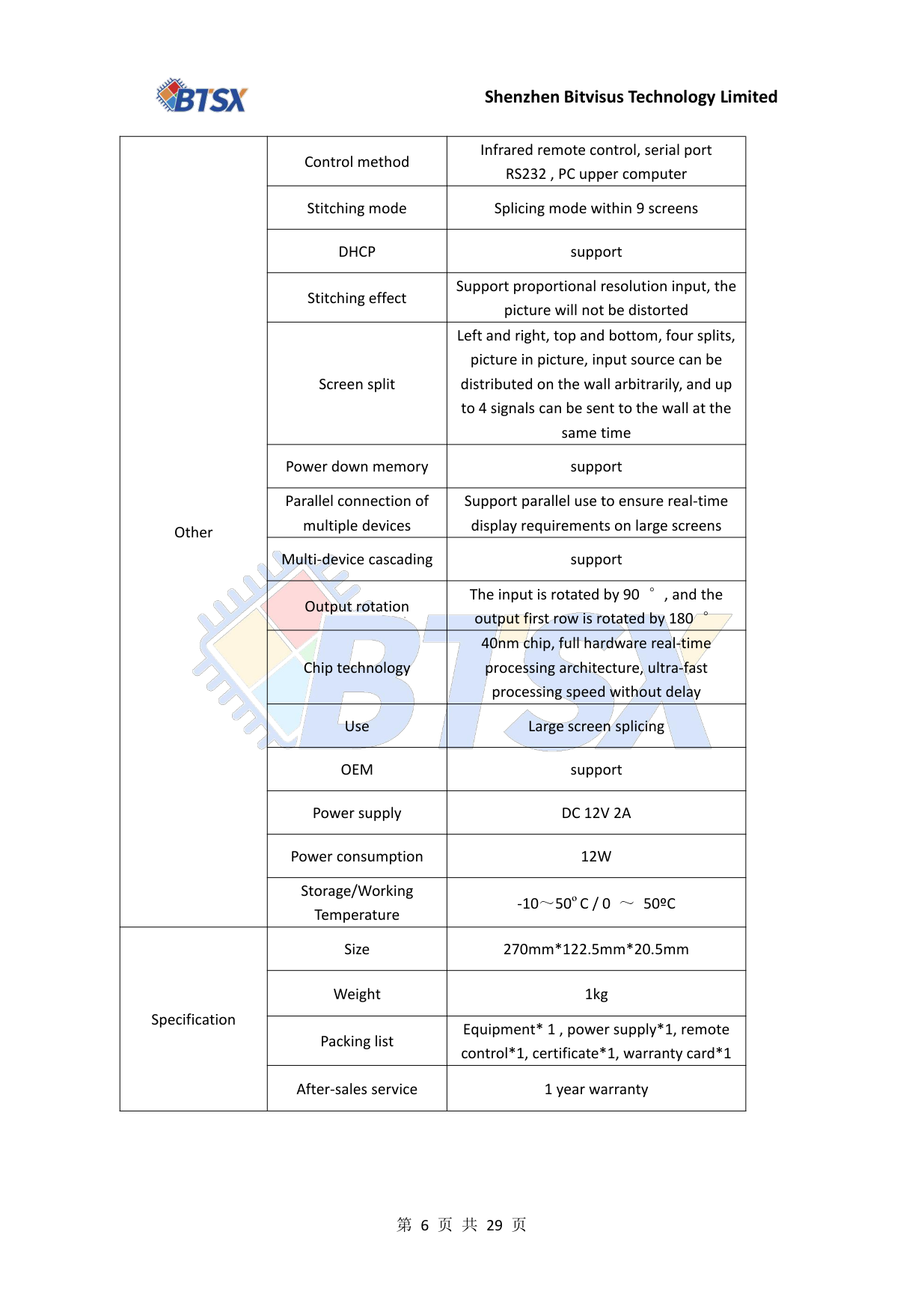
Across the models reviewed for this article, the documented after-sales service period is one year. The term appears consistently across the video wall controller line, including the BIT-VWC-218Pro, the BIT-VWC-409R, the BIT-VWC-8K60-404Max, the BIT-VWC-8K60Y-115Pro and the BIT-VWC-MD3636Ma, and it also applies to multi-screen expanders such as the BIT-MSE-8K60D-104Pro and the BIT-MSE-8K60Y-104Pro, and to the BIT-Ex-HDBT-150 fiber extender.
The packing list gives that term a physical form. Documented packing lists for specific models list a warranty card together with a certificate, alongside the device, the power supply and, on models with a handheld controller, the remote control. For the buyer, the warranty card is the on-hand record that the term applies to the unit received. For the integrator, it is a document to photograph into the project file before site handover, because the carton is usually gone by the time anyone needs to prove the coverage.
What a one-year figure does not answer is the operating detail that decides whether a warranty is usable when something fails. Before ordering, ask for these points in writing:
- When the term starts: invoice date, shipment date, or commissioning date.
- What is covered: hardware only, or also firmware and software-level faults.
- Whether the return path is a repair, a replacement or a board exchange, since card-based chassis often make board-level replacement the fastest route.
- Who pays freight on a returned unit, in each direction.
- Who the escalation contact is, and what first-response time the supplier commits to.
- Whether a longer term is available as a commercial arrangement for tender-driven projects, rather than assumed.
That last point deserves emphasis. One year is the documented standard term in the product data reviewed here, and many public and enterprise tenders ask for longer coverage. Rather than reading a longer term into a datasheet, the buyer should raise it as a commercial question and have the answer recorded in the quotation, so the gap between the standard term and the tendered requirement stays visible to everyone who signs off.
After-sales and technical support: fix the support route before the order
Technical support is a supply-chain function, not a courtesy. If the support route is unclear at the buying stage, it will still be unclear at 2 a.m. during commissioning.
A named contact and a direct channel matter more than a generic inbox. For Bitvisus, the documented contact is Eddie, reachable at eddie.jia@bitvisus.com and on +86 186-8150-9089, which is also the WhatsApp number. The company operates from Building 2, 6th Floor, West Side, Zhongyuntai Technology Industrial Park, South of Tangtou 1st Road, Shiyan Sub-district, Bao'an District, Shenzhen City, Guangdong Province, 518108, China. Product information is published at bitvisus.com, with a separate blog domain at blog.bitvisus.com.
The quality of a support conversation depends on what a supplier documents in advance, because control methods differ across a range and determine what an engineer will ask for. The BIT-VWC-MD3636Ma documents RS232 serial control, WEB control, a button board, a remote control and a WEB API interface, with an LCD panel on the chassis for source switching and for switching between dynamic and static IP addresses. The BIT-VWC-218Pro documents RS232 and Web control, network wake-up and software command power on/off for remote centralised control, plus an API for secondary development. The BIT-VWC-8K60Y-115Pro documents serial RS232 control and network port WEB control through a browser.
Documentation itself is part of the evidence. User manuals are published across the range, and for models including the BIT-VWC-409R, the BIT-VWC-218Pro, the BIT-VWC-8K60Y-115Pro, the BIT-MSE-8K60D-104Pro and the BIT-Ex-HDBT-150 they include connection diagrams, specification tables and FAQ or appendix sections. A buyer can test this material cheaply before ordering by raising one realistic question taken from a manual, for example on EDID behaviour, custom resolution handling or cascading, and then measuring both the accuracy and the speed of the reply.
Practical items to settle in writing:
- A named contact with a direct channel, not only a website form.
- A published manual containing connection diagrams and an FAQ section.
- A per-model statement of which control interfaces are supported.
- The escalation path when the first-line contact is unavailable.
- Language, time-zone and working-hours coverage measured against the installation schedule.
- Whether firmware updates are supplied, and how the buyer is notified when they are released.
Sample price and bulk quote: four commercial items to fix in writing
The difference between a sample price and a bulk quote is often asked as if a sample were simply a smaller number. Commercially they are two different documents with two different cost structures.
A sample quote prices a very small quantity, usually a single unit, so fixed costs such as handling, air freight, order administration and payment processing are concentrated on that one unit. A bulk quote prices a defined order quantity, and its unit price depends on that quantity, on the packaging configuration, on the accessory content per unit, and on the delivery terms. Public product documentation in this category does not publish prices, so the comparison cannot be made from a datasheet; it has to be made from two written quotations built on the same assumptions.
| Item | Sample quotation | Bulk quotation |
|---|---|---|
| Quantity basis | Typically one unit | Defined order quantity, often with price breaks |
| Unit cost structure | Fixed handling and freight concentrated on one unit | Fixed costs spread across the order |
| Configuration risk | Sample may be a standard configuration | Production units may be customised under OEM terms |
| Packing and accessories | Single-unit packing | Per-unit packing list agreed for the whole order |
| Warranty start | From sample invoice or delivery | From delivery or commissioning, per the agreed term |
| Delivery and payment | Often prepaid, simple freight mode | Payment terms, Incoterms and freight mode negotiated |
OEM capability is the reason configuration differences must be checked explicitly. Documented product data indicates that OEM orders are supported across parts of the range: the video wall controller whose packing list includes a certificate and a warranty card is documented as supporting OEM orders, the BIT-VWC-409R is documented as supporting OEM, and the BIT-Ex-HDBT-150 fiber extender lists OEM as supported. Where a buyer intends to use that flexibility, the sample-versus-bulk conversation should include a written statement of which documented specification values stay identical between the sample and the production order, and which may vary.
One further item belongs here for importers. Video wall controllers are commonly classified under HS code 85437099, covering other electrical machines and apparatus, or 85437042 as an alternative entry for other video control units. The commercial invoice description and the classification used by the customs broker should match, because a mismatch is discovered at the port rather than in the meeting.
Four commercial items to fix in writing before a bulk order:
- Unit price basis and quantity breaks, including the exact quantity at which the unit price changes.
- A configuration conformity statement listing the specification values that will not change between sample and production.
- The accessory and packing list per unit, including which documents travel in the box.
- Warranty start basis, freight responsibility and delivery terms.
Matching the checklist to the product class
The qualification pack is broadly the same for every order, but the technical questions differ by product class. Three classes cover most integrator projects in this category.
Video wall controller
This is where configuration complexity is highest, and where a family datasheet is least useful. A rack-mount model such as the BIT-VWC-MD3636Ma, documented as a 4K60 seamless matrix splicer, accepts up to nine input boards and nine output boards for a maximum of 36 HDMI 2.0 input channels and 36 HDMI 2.0 output channels, is built in a 7U chassis measuring 483 mm x 200 mm x 291 mm at 13.5 kg, draws 240 W in a nine-in/nine-out configuration, and is documented with end-to-end input-to-output latency below 40 ms. The BIT-VWC-218Pro, a 4K60 video wall controller with a modular plug-in card design, documents 2 x HDMI 2.0 and 2 x DP 1.2 inputs with 18 x HDMI 1.3 outputs. For 8K projects, the BIT-VWC-8K60-404Max is a 2U chassis with five input paths and four output channels, and the BIT-VWC-8K60Y-115Pro takes a single 8K60 input over HDMI 2.1 or DP 1.4 and provides 15 HDMI outputs at up to 1200p60 in a 440 mm x 200 mm x 60 mm enclosure.
The qualification question for this class is configuration traceability: ask for the specification sheet that matches the card population ordered, not the sheet that matches the product family.
Multi-screen expander
Expanders are usually smaller and more fixed in configuration, so the risk shifts from card population to environment. The BIT-MSE-8K60Y-104Pro is documented as an industrial-grade 8K60 multi-screen expander built on a thickened six-layer PCB with a 28 nm programmable FPGA, fully hardware real-time processing architecture, 16 kV anti-static capability, and 18 W thermal-conductivity material with overheating protection for internal heat dissipation. The BIT-MSE-8K60D-104Pro is documented for control room and conference room multi-screen display scenarios and carries a one-year warranty, and its accessory list includes an optional 1U tray, a rack-mount decision best settled at quotation stage. The BIT-MSE-4K60-104Pro covers 4K multi-screen expansion.
Fiber extender
Signal extension is where documented distance limits become contractual. The BIT-Ex-HDBT-150 is documented as a high definition video fiber extender consisting of a transmitter and receiver pair, used for HDMI, KVM, IR and RS232 signal extension, with 1080p transmission over CAT6E up to 150 metres and 6 Gbps transmission bandwidth. Its input and output cable lengths are specified in the product data, for example a maximum of 5 metres at the HDMI end, and those limits are the ones to write into the installation plan rather than estimate on site.
Scenarios where the documentation gets tested
Qualification documents are reviewed against a specific deployment, and different environments stress different parts of the pack.
In control rooms, the single largest application block in this category, the working condition is continuous operation. Documented scenario data lists 7x24 non-stop operation, industrial-grade stable operation, remote Web-LAN control and RS232 control as the operating mode for command, dispatch and monitoring environments. The corresponding qualification items are the cooling approach, the documented storage and operating temperature ranges for the specific model, and the support route for a device that cannot be powered down to have a warranty discussion. Buyers should also establish how board-level replacement is handled if a module fails inside a live wall.
In security monitoring and industrial monitoring, the weight moves to input channel capacity, multi-picture display and switching behaviour. Where a monitoring wall aggregates many sources, the modular matrix class is the relevant product family, and the number of input cards becomes the number that must appear on the specification sheet rather than in a conversation.
In conference rooms and enterprise meeting spaces, the practical requirement is controllability. The BIT-VWC-218Pro documents RS232 and Web control with network wake-up and API support for secondary development, which is what a central control system needs in order to hand a wall over to non-technical users without calling an engineer.
In exhibition, immersive and cultural projects, scale and continuity dominate. Large-scale installations combine cascading and parallel operation; the BIT-VWC-409R, for example, is documented as supporting parallel connection of multiple devices and multi-device cascading to meet real-time display requirements on large screens. For a project involving dozens of projectors, the qualification question is not only what the controller does, but how many units can be synchronised and what documentation exists for that configuration.
Where the qualification pack stops
Documentation is evidence of supply capability, not a substitute for site validation, and a credible checklist should say where it ends.
- One year is the documented standard, not a universal expectation. Buyers in tender-driven projects should treat it as a starting position and confirm any extension commercially and in writing.
- Certification is configuration-specific. Documentation covering one card population may not cover a different one, so the check has to be repeated whenever the configuration changes.
- Documented distances are engineering limits. A stated maximum cable length marks where signal integrity stops being guaranteed, not where it is comfortable. Cable quality, connectors and routing still determine the result on site.
- Sample-to-production consistency must be stated, not assumed. OEM flexibility on labels, firmware and accessories only helps if the unchanged values are written down.
- Firmware and software lifecycle sit outside a hardware-only pack. Control interfaces such as web control, network wake-up and open APIs imply an ongoing software relationship, and the update policy for that relationship belongs in the qualification file.
Outlook: qualification is moving toward the software layer
If AV-over-IP already accounts for 73 percent of new video wall controller installations, as reported by GCG Enterprise Solution, and legacy hardware processors lost 18 percent share in a single year, the centre of gravity for supplier qualification is shifting. Port counts and resolution ceilings will still be checked, but the questions that separate suppliers will increasingly concern firmware update cadence, API stability, network configuration behaviour such as DHCP and static IP handling, and remote management that lets an integrator service a wall without sending an engineer to site.
For buyers, the practical implication is that the qualification pack should be assembled once and reused. Entity documents, the model specification, the certification list, the warranty terms and the named support contact form a reusable file. Every later order, whether a controller, an expander or an extender, then becomes a matter of confirming that the same evidence still applies to the new configuration, instead of restarting the evaluation from the beginning.
FAQ
Is the company certified?
Certification has two levels and they should be checked separately. At entity level, Bitvisus is described as a national high-tech enterprise specialising in 4K/8K image and video processing technologies, with full-cycle capabilities covering product development, production and sales and with integrated FPGA and embedded software and hardware design services. At product level, certification applies to a specific model, a specific configuration and a specific destination market, and the product documentation reviewed for this article does not name individual marks. Buyers should therefore request the certification list for the exact model number and market, check that the document names that model and configuration, and confirm which certificate travels in the box, since documented packing lists for certain models include a certificate document alongside the warranty card.
How is warranty and after-sales ensured?
The documented after-sales service period for the models reviewed here is one year. That term is stated across the video wall controller line, including the BIT-VWC-218Pro, the BIT-VWC-409R, the BIT-VWC-8K60-404Max, the BIT-VWC-8K60Y-115Pro and the BIT-VWC-MD3636Ma, and it also applies to multi-screen expanders and to the BIT-Ex-HDBT-150 fiber extender. Documented packing lists for specific models include a warranty card shipped with the unit, which serves as the buyer's on-hand record. Because the length of the term alone does not define coverage, buyers should confirm in writing when the term starts, what is covered, whether the return path is a repair, a replacement or a board exchange, who pays return freight, and who the escalation contact is. Where a project requires coverage longer than the documented one year, that is a commercial question to be agreed in the quotation rather than assumed from the datasheet.
How do I contact Bitvisus for technical support?
The documented contact is Eddie, reachable at eddie.jia@bitvisus.com and on +86 186-8150-9089, which is also the WhatsApp number. The company address is Building 2, 6th Floor, West Side, Zhongyuntai Technology Industrial Park, South of Tangtou 1st Road, Shiyan Sub-district, Bao'an District, Shenzhen City, Guangdong Province, 518108, China, and product information is published at bitvisus.com, with a separate blog domain at blog.bitvisus.com. The information a support engineer will need depends on the model's documented control method: the BIT-VWC-MD3636Ma documents RS232 serial, WEB, button board, remote control and WEB API control with an on-chassis LCD panel, the BIT-VWC-218Pro documents RS232 and Web control with network wake-up and an API for secondary development, and the BIT-VWC-8K60Y-115Pro documents serial RS232 and network port WEB control. Buyers can verify the support route before ordering by raising one realistic technical question taken from the published user manual and assessing the accuracy and speed of the reply.
What is the difference between sample price and bulk quote?
A sample quotation prices a very small quantity, usually a single unit, so fixed costs such as handling, freight, order administration and payment processing are concentrated on that unit. A bulk quotation prices a defined order quantity, and the unit price depends on that quantity, on the packaging configuration, on the accessory content per unit and on the delivery terms. Prices for this category are not published in public product documentation, so the two figures can only be compared from written quotations built on identical assumptions. Buyers should request the quantity breaks, a statement of which documented specification values remain identical between the sample and the production order, the accessory and packing list per unit, the warranty start basis, freight responsibility and delivery terms. Where OEM terms apply, as documented for parts of the Bitvisus range including the BIT-VWC-409R and the BIT-Ex-HDBT-150, the conformity statement becomes especially important. For imports, the commercial invoice description should also match the HS classification used by the customs broker, commonly 85437099 or 85437042 for this product type.
Reference document: the 2026 Bitvisus product brochure is available for download at cdn.socialarks.com product brochure (PDF).
¿Tiene preguntas o necesita más detalles?
Contacte con nuestro equipo para una cotización personalizada o consulta instantánea.
Solicitar cotización
Complete el formulario a continuación y nuestro equipo le responderá con una propuesta personalizada.
Chat directo de WhatsApp
¿Prefiere chatear en tiempo real? Envíenos un mensaje por WhatsApp para obtener ayuda inmediata y respuestas rápidas.
- Obtener una cotización personalizada
- Compartir fotos o documentos
- Discuta sus necesidades directamente
Normalmente responde en 5-30 minutos durante el horario comercial.