
Video Laryngoscope Technical & Procurement FAQ: BMS-FA, BMS-YA, BMR
Video Laryngoscope Technical & Procurement FAQ: BMS-FA, BMS-YA, BMR
A video laryngoscope places a camera and a light source at the tip of a blade or a flexible insertion tube and shows the airway on a screen, instead of requiring the operator to look directly into the patient. That single architectural change explains most of the questions anesthesia, intensive care and emergency teams ask during early supplier research: what the imaging chain actually delivers, what the device is made of, how it is powered, which certifications cover it, and what commercial terms come attached to the order.
This reference compiles technical and procurement answers for three models from Jiangsu Unicorn Electronic Technology Co. Ltd. (Unicorn), a National High-tech Enterprise established in 2020 that integrates design, R&D, manufacturing and trade of medical visualization devices, including endoscopy systems, disposable ureteroscopes, visual flexible laryngoscopes, bronchoscopy workstations, medical image processors and video laryngoscopes. The models covered here are the rigid video laryngoscopes BMS-FA and BMS-YA and the video flexible laryngoscope BMR.
Specifications are reproduced as published by the manufacturer. Where a value is stated as a minimum, it is kept as a minimum. Where a commercial term depends on the individual order, it is identified as a term to confirm in writing rather than assumed from a general quotation.
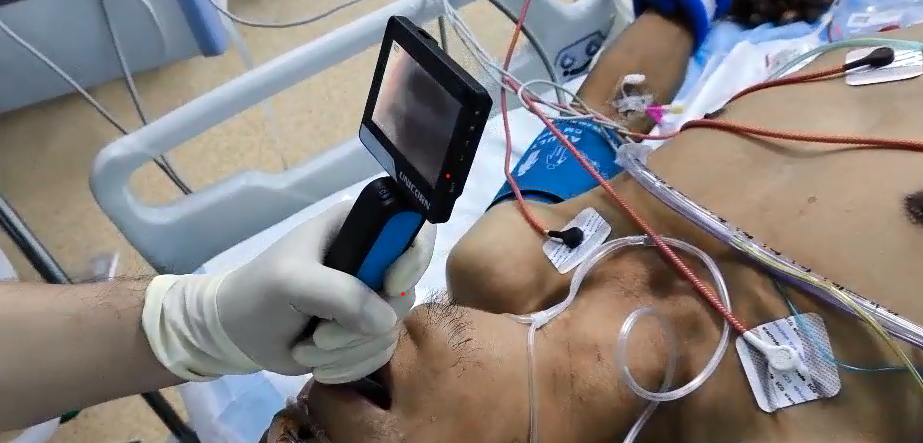
Video laryngoscopes are specified for operating rooms, emergency wards, intensive care units and pre-hospital first aid vehicles, in both portable and fixed bedside deployment.
What the published market data says about this category
Grand View Research estimated the global video laryngoscope market at USD 784.66 million in 2024 and projected it to reach USD 2.80 billion by 2033. A separate estimate from Future Market Insights puts the total laryngoscopes market — all types, including direct laryngoscopes — at USD 508.5 million in 2024, with a forecast growth rate (CAGR) of 7.2% through 2034. The two figures are not contradictory: they measure different scopes, and the gap is a useful reminder that market numbers in this category should always be read with their definition attached.
Inside the video segment, Grand View Research reports that reusable video laryngoscopes held the largest revenue share at 77.68% in 2024, and that rigid video laryngoscopes accounted for 60.42% of product revenue in the same year. North America represented a 37.77% revenue share in 2024. Named participants in the category include Verathon, Medtronic, Ambu A/S, KARL STORZ and Tuoren Group.
Two signals follow for buyers at the research stage. First, rigid video laryngoscopes still carry the majority of product revenue, which indicates that rigid and flexible devices are generally specified for different roles rather than treated as interchangeable. Second, reusable systems dominate revenue while single-use accessories remain part of the clinical workflow — the accessory list published for the Unicorn models includes both disposable laryngoscope blades and reusable blade sleeves.
The three models at a glance
BMS-FA, BMS-YA and BMR are all designed for anesthesiology and respiratory medicine. The first two are rigid video laryngoscopes that share an identical published optical, power and battery specification and differ only in blade material. The third is a flexible video laryngoscope with a different optical profile.
| Model | Device type | Blade / distal construction | Handle / body | Intended clinical area |
|---|---|---|---|---|
| BMS-FA | Rigid video laryngoscope | 304 stainless steel blade | Aluminium alloy handle | Anesthesiology, respiratory medicine |
| BMS-YA | Rigid video laryngoscope | PC (polycarbonate) plastic blade | Aluminium alloy handle | Anesthesiology, respiratory medicine |
| BMR | Video flexible laryngoscope | TPU / PPSU construction | TPU / PPSU construction | Anesthesiology, respiratory medicine |
| Model | Resolution | Field of view | Depth of field | Illuminance | Power supply | Battery capacity |
|---|---|---|---|---|---|---|
| BMS-FA | ≥3.72 lp/mm | ≥60° | 20–100 mm | — | DC 3.7 V | 3400 mAh or above |
| BMS-YA | ≥3.72 lp/mm | ≥60° | 20–100 mm | — | DC 3.7 V | 3400 mAh or above |
| BMR | 23.51 LP/mm | >80° | 5–100 mm | >800 Lux | — | — |
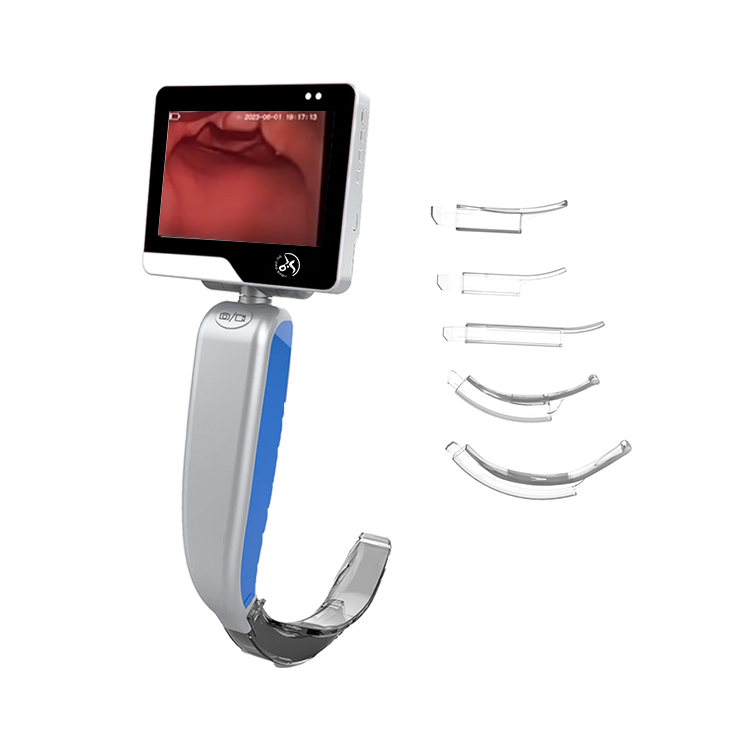
BMS-YA: aluminium alloy handle, polycarbonate blade, resolution ≥3.72 lp/mm, field of view ≥60°, observation depth of field 20–100 mm.
Blade and handle materials: the specification that separates BMS-FA from BMS-YA
BMS-FA and BMS-YA are published with identical optical and power figures: resolution ≥3.72 lp/mm, field of view ≥60°, observation depth of field 20–100 mm, DC 3.7 V power supply and battery capacity of 3400 mAh or above. A buyer comparing only image performance will therefore not find a differentiator between the two models. The published difference is the blade material — 304 stainless steel on BMS-FA, polycarbonate (PC) plastic on BMS-YA — while both use an aluminium alloy handle.
That has a direct procurement consequence. When two models are specification-identical apart from material, blade material becomes the primary selection variable, and the decision moves from the imaging specification to the department's own constraints: which material the local reprocessing and disinfection protocol is written around, how the blade is handled and stored between cases, and whether the purchasing department is standardising on one blade material across a fleet or accepting a mixed inventory. Buyers should put the material requirement in the tender as a named, unambiguous item rather than a preference, because a quotation for "video laryngoscope" without a model code will not distinguish between the two.
Resolution, field of view, depth of field and illuminance: what the numbers describe
Resolution in line pairs per millimetre (lp/mm or LP/mm) describes how many alternating light and dark line pairs an imaging system can still distinguish within one millimetre; a higher figure indicates finer detail separation. Field of view (FOV) is the angular extent the optics capture in a single frame. Depth of field (DOF) is the distance range in front of the tip over which the image remains acceptably focused. Illuminance, expressed in Lux, describes how much light reaches the target from the tip light source.
- BMS-FA and BMS-YA: resolution ≥3.72 lp/mm, field of view ≥60°, observation depth of field 20–100 mm.
- BMR: resolution 23.51 LP/mm, field of view >80°, depth of field 5–100 mm, illuminance >800 Lux.
Two practical readings follow. The flexible BMR is specified with a wider field of view (>80° against ≥60°) and a depth-of-field window that begins at 5 mm rather than 20 mm, so it is specified to hold focus closer to the distal tip. The rigid models are specified across a 20–100 mm observation window, which means image sharpness depends on keeping the target structures inside that band during intubation.
There is also a documentation point that matters in tendering. The rigid models are published as minimum values (≥3.72 lp/mm), while the flexible model is published as a fixed value (23.51 LP/mm). When these figures are copied into a tender specification, the exact value and the measurement basis recorded in the supplier's technical file should be restated, so that offers can be compared on the same definition rather than on differently expressed numbers.
Power supply and the accessory set that surrounds the device
The BMS-FA and BMS-YA video laryngoscopes operate on a DC 3.7 V power supply with a battery capacity of 3400 mAh or above. Across the product line, the device operates in handheld portable battery-powered mode, with real-time image display on a built-in screen and support for image snapshot and video storage.
The published supporting-equipment list for these products includes disposable laryngoscope blades, reusable blade sleeves, a power adapter, a charging dock, a high-capacity spare battery, a data export USB flash drive, a medical cart bracket and an external medical monitor. For procurement, this list is where unit-level assumptions usually break: spare batteries, charging docks and blade sleeves are consumable-adjacent lines with their own quantities, and a first order that covers only the handles will still leave the department without a working rotation unless the accessories are line-itemed at the same time.
Certification: how ISO 13485, ISO 9001, CE and FSC appear in a purchase file
Unicorn holds ISO 9001 and ISO 13485 quality management system certifications and has obtained FSC and CE certification for its medical devices, within a programme that also covers endoscopy systems, visual flexible laryngoscopes and related visualization equipment. The scenario requirements published for these laryngoscope applications include compliance with the ISO 13485 medical device quality management system.
Regulatory context matters here. Medical devices such as video laryngoscopes must comply with EU MDR 2017/745, and manufacturers selling into the EU typically require ISO 13485 certification for their quality management system. ISO 13485 is a process standard: it describes how a manufacturer controls design, production, traceability and post-market activity. It is not, by itself, a statement about the performance of an individual instrument. That distinction is worth keeping in the purchase file, where a certificate copy and a model-level technical specification answer two different questions.
Three checks reduce certification risk in a tender: confirm that the certificate scope names the product category and the specific model or configuration being purchased; confirm the issuing body, certificate number and validity period on the document itself; and keep the certificate, the instructions for use and the model specification together, so that a later replacement or repeat order can be matched against the same file.
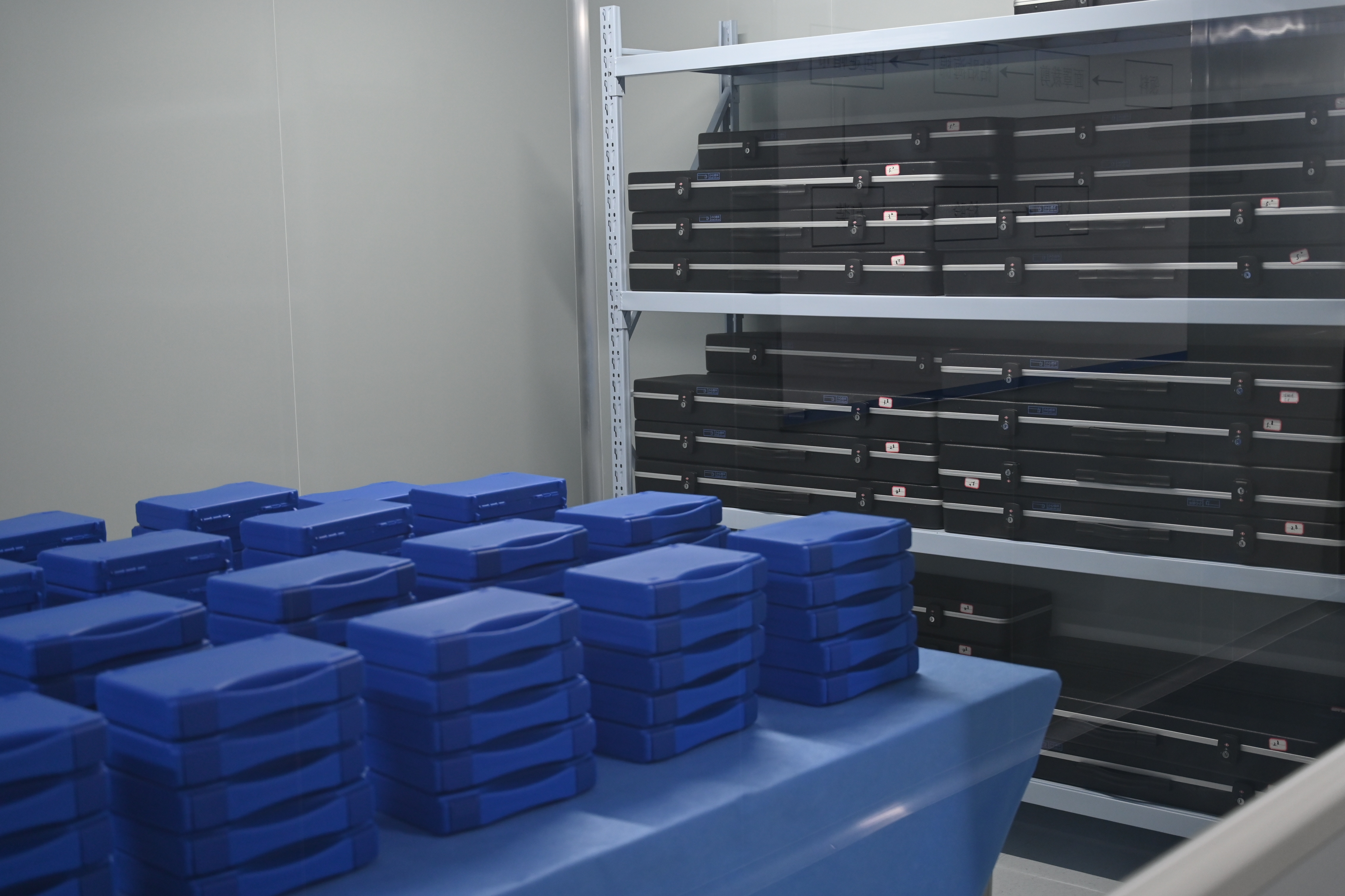
Unicorn operates a 40,000 m² manufacturing facility with CNC precision manufacturing, injection moulding and sterile production environments, supported by a R&D team of more than 20 engineers.
Commercial terms: Incoterms, payment structure, minimum order quantity and pre-shipment acceptance testing
On the commercial side, four items determine whether a quotation is comparable with the next one. They are worth confirming in writing before an order is placed, because the values are set per order rather than fixed in a catalogue.
- Incoterm and named port. FOB and CIF are the two terms most frequently quoted in medical device export transactions. The choice decides where cost and risk transfer between seller and buyer, and which party arranges freight and insurance. The quotation should name the term and the port explicitly rather than leaving them to be settled later.
- Payment structure. Deposit-and-balance arrangements are standard in this category: an initial payment on order confirmation, with the remaining balance settled against a defined trigger such as readiness for shipment. The percentage split, the balance trigger, the currency and the applicable bank charges belong in the proforma invoice and should match the payment clause in the purchase contract.
- Minimum order quantity (MOQ). MOQ should be confirmed per model and per accessory line. Blade and sleeve lines frequently carry a different minimum from the handle unit, and a mixed order of BMS-FA, BMS-YA and BMR may not share one threshold across all three.
- Pre-shipment acceptance testing. Agree in advance what will be inspected and what counts as acceptance — for example the imaging chain, illumination output, battery charge and hold, accessory completeness and packaging condition — together with who performs or witnesses the test and what records are issued. A test report, dated photographs or a short video of the units in operation turn the inspection from a claim into a document that can be filed with the order.
The documentation pack should be agreed at the same time: certificate copies, instructions for use, packing list, warranty terms and the technical specification for the exact model and configuration shipped.
Where these laryngoscopes are used
The published application profile for these products covers indoor hospital operating rooms, emergency wards, intensive care units and pre-hospital first aid vehicles, under normal ambient temperature and standard medical disinfection conditions. Deployment is described as both portable and fixed bedside, and the operating mode is handheld, portable and battery-powered.
The functional role is real-time high-definition visual laryngeal exposure guidance and accurate endotracheal intubation assistance, including support for difficult airway intubation, intraoperative airway monitoring and video recording. The same application profile states that the device is intended to help reduce intubation failure rate and laryngeal tissue injury. Purchase contexts listed for these products include hospital equipment procurement, clinical anesthesia equipment upgrade, emergency medical system construction and batch tendering for medical device centralized purchasing.
For an anesthesia department, the practical consequence of the portable battery-powered design is a bedside workflow that does not depend on a fixed cart or a mains connection; for ICU and emergency procurement, it means the same platform can be specified for a resuscitation bay and for a transport vehicle. Unicorn operates a 40,000 m² manufacturing facility with an annual production capacity of 12,000 units, employs approximately 50–100 staff, and exports account for 70% of total sales, with major markets worldwide.
Rigid versus flexible, and video versus traditional direct laryngoscopy
Comparing these options requires separating the device architecture from the price band. Published category-level price data indicates that reusable video laryngoscopes range from approximately USD 1,000 to USD 8,000, while traditional single-use laryngoscopes cost around USD 18 each. That data point originates from supplier-linked market reporting of medium reliability and describes the category, not any individual model; it should be treated as an order-of-magnitude reference when building a budget case, not as a quotation.
| Aspect | Traditional direct laryngoscope | Rigid video laryngoscope (BMS-FA / BMS-YA) | Video flexible laryngoscope (BMR) |
|---|---|---|---|
| Image acquisition | Direct line of sight by the operator | Camera at blade tip, image on screen | Camera at flexible tip, image on screen |
| Published optical profile | Not applicable | Resolution ≥3.72 lp/mm; FOV ≥60°; DOF 20–100 mm | Resolution 23.51 LP/mm; FOV >80°; DOF 5–100 mm; illuminance >800 Lux |
| Blade / distal material | Varies | 304 stainless steel (BMS-FA) or PC plastic (BMS-YA) | TPU / PPSU |
| Power | None | DC 3.7 V, battery 3400 mAh or above | Handheld battery-powered mode |
| Category price reference | Approx. USD 18 per single-use device (category data) | Reusable video laryngoscopes approx. USD 1,000–8,000 (category data) | |
The limits are as real as the benefits, and they are the part most often left out of early research. Video laryngoscopy shifts cost from a low unit price to a capital purchase, so the financial case rests on case volume and on how the device is used across departments. Reusable blade systems require a reprocessing and sterilisation cycle between patients, which means the department needs a workflow, a location and a turnaround time for that step; disposable blades and reusable sleeves in the accessory list exist precisely because that workflow has to be configured. Battery-powered handheld operation introduces charge management — spare batteries and a charging dock are line items, not optional extras — and a fleet without spares will lose availability on the day a battery is flat.
Optically, both rigid models are specified across a 20–100 mm depth-of-field window, so image sharpness depends on holding the target within that band; the flexible BMR is specified from 5 mm to 100 mm with a wider field of view, which suits a closer working distance. The BMR is positioned for anesthesiology and respiratory medicine and is not presented as a replacement for a full diagnostic endoscopy system. Finally, choosing between BMS-FA and BMS-YA on blade material alone means the decision must be justified on reprocessing and handling grounds rather than on imaging performance, since the imaging specification is identical.
What to watch next
The published trajectory of the category points to continued growth in video systems, with the video segment projected to reach USD 2.80 billion by 2033 and the broader laryngoscope market forecast at a 7.2% CAGR through 2034. The revenue weight of reusable systems (77.68% in 2024) and of rigid devices (60.42% in 2024) suggests that the rigid and flexible categories will continue to be specified side by side rather than consolidated into a single device type.
For procurement teams, the more immediate trend is documentation. As tendering moves toward centralized batch purchasing and emergency medical system construction, model-level evidence — exact optical values, named materials, certificate scope for the specific configuration, and a defined pre-shipment acceptance protocol — becomes the differentiator between offers that can be compared and offers that cannot. For clinical teams, the practical question is unchanged: match the device architecture to the department's airway workflow, then make sure the accessories, the reprocessing cycle and the power management to support it are ordered at the same time.
Frequently asked questions
1. What is a video laryngoscope?
A video laryngoscope is an airway management device that places a camera and a light source at the tip of a blade or a flexible insertion tube and displays the resulting image on a screen, rather than relying on the operator's direct line of sight. Clinically, it is used for real-time visual laryngeal exposure guidance and accurate endotracheal intubation assistance, including difficult airway intubation, intraoperative airway monitoring and video recording. Devices in this category are typically handheld and battery-powered, and are used in operating rooms, emergency wards, intensive care units and pre-hospital first aid vehicles.
2. What are the differences between the Unicorn BMS-FA, BMS-YA and BMR?
BMS-FA, BMS-YA and BMR are three Unicorn laryngoscope models intended for anesthesiology and respiratory medicine. BMS-FA and BMS-YA are rigid video laryngoscopes with identical published optical and power specifications — resolution ≥3.72 lp/mm, field of view ≥60°, observation depth of field 20–100 mm, DC 3.7 V supply and battery capacity of 3400 mAh or above — and they differ in blade material: 304 stainless steel on BMS-FA and PC plastic on BMS-YA. BMR is a video flexible laryngoscope with a published resolution of 23.51 LP/mm, field of view >80°, depth of field 5–100 mm and illuminance >800 Lux.
3. What materials are used in the blades and handles of these models?
BMS-FA uses a 304 stainless steel blade with an aluminium alloy handle. BMS-YA uses a polycarbonate (PC) plastic blade with an aluminium alloy handle. BMR, the flexible model, is constructed from TPU / PPSU material. Because BMS-FA and BMS-YA are otherwise identical on the specification sheet, blade material is the practical selection variable between the two rigid models.
4. What resolution, field of view and depth of field do these laryngoscopes offer?
BMS-FA and BMS-YA are published with a resolution of ≥3.72 lp/mm, a field of view of ≥60° and an observation depth of field of 20–100 mm. BMR is published with a resolution of 23.51 LP/mm, a field of view of >80°, a depth of field of 5–100 mm and an illuminance of >800 Lux. The rigid models state their resolution as a minimum value and the flexible model states a fixed value, so tender documents should restate both the figure and its measurement basis when offers are compared.
5. How are these laryngoscopes powered?
The BMS-FA and BMS-YA video laryngoscopes operate on a DC 3.7 V power supply with a battery capacity of 3400 mAh or above. Across the product line, the device operates in handheld portable battery-powered mode with real-time image display on a built-in screen, and supports image snapshot and video storage. The published supporting-equipment list includes a power adapter, a charging dock and a high-capacity spare battery, all of which are separate order lines rather than built-in components.
6. Which certifications apply to these laryngoscopes?
Unicorn holds ISO 9001 and ISO 13485 quality management system certifications and has obtained FSC and CE certification for its medical devices. The application profile published for these laryngoscope products lists compliance with the ISO 13485 medical device quality management system as a special requirement. In regulatory terms, medical devices such as video laryngoscopes must comply with EU MDR 2017/745 and manufacturers serving the EU market typically require ISO 13485 certification for their quality management system. ISO 13485 describes process control rather than the performance of an individual instrument, so buyers should verify that the certificate scope covers the exact model and configuration in the order.
7. In which clinical settings are these devices used?
The published application profile covers indoor hospital operating rooms, emergency wards, intensive care units and pre-hospital first aid vehicles, under normal ambient temperature and standard medical disinfection conditions, in both portable and fixed bedside deployment. Deployment contexts listed for the products include hospital equipment procurement, clinical anesthesia equipment upgrade, emergency medical system construction and batch tendering for medical device centralized purchasing.
8. Which commercial terms should a procurement team confirm in writing before ordering?
Four items determine whether two offers in this category are actually comparable: the Incoterm and named port (FOB and CIF are the most frequently quoted terms in medical device export), the payment structure including the deposit percentage and the balance trigger, the minimum order quantity per model and per accessory line, and the scope and criteria of pre-shipment acceptance testing. A documentation pack covering certificate copies, instructions for use, packing list, warranty terms and the technical specification for the shipped configuration should be agreed at the same time. Specific percentages, quantities and inspection criteria are set per order and belong in the proforma invoice and the purchase contract, where they can be checked against the tender specification.
Reference material: the Unicorn Product Catalog (2026) lists the video laryngoscope and video flexible laryngoscope configurations described above.