
Vetting China to India Airport-to-Airport Air Freight Providers: A Buyer Checklist
Vetting China to India Airport-to-Airport Air Freight Providers: A Buyer Checklist
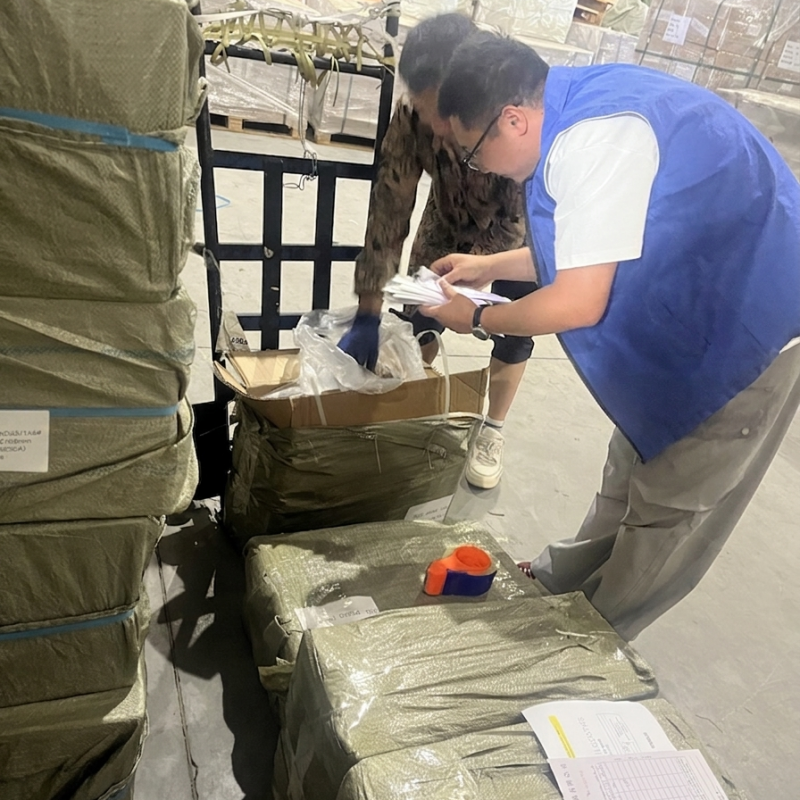
China-side consolidation warehouse operations: the physical layer that determines whether an airport-to-airport booking executes as quoted.
Bilateral trade between China and India exceeded USD 155 billion in 2025, with Chinese exports to India surpassing USD 135 billion, according to Chinese Customs data reported by The Times of India. India’s air cargo market reached 3.6 million tons in 2025 and is projected to expand at a compound annual growth rate of 11.38% through 2034, according to IMARC Group. At that scale, China–India airport-to-airport air freight stops being an exception and becomes a standing procurement category — and standing categories are where unverified capability claims turn expensive.
This reference is written for buyers in the evaluation and execution stages: freight forwarders, NVOCC operators, e-commerce logistics teams and importers who must select a China-side air freight partner and then live with the consequences of that choice. It sets out a neutral comparison checklist built on facts a provider can be asked to evidence, and it states plainly where the airport-to-airport model stops.
Why vetting this lane is harder than it looks
Two structural features make China–India air freight more difficult to evaluate than a domestic transport contract.
The product is a chain, not a service. An airport-to-airport shipment moves through inquiry and quotation, order confirmation, space allocation and booking, warehouse receiving, cargo consolidation, airport delivery, export customs clearance, air waybill issuance, and arrival notification at the Indian airport. A weakness at any one of those stages surfaces at the destination as a delay, and the buyer usually cannot see which stage failed.
Capacity on the lane is contracted, not listed. Standard air freight transit time from China to India typically ranges from 3 to 8 days, materially faster than the 20–45 days common to ocean freight, according to logistics industry data. But the space that feeds those flights is secured in advance, so provider reliability depends less on published schedules than on how much space a provider actually controls and how it allocates that space when demand spikes.
A useful checklist therefore tests two things at once: whether the provider operates China-side physical execution, and whether its process descriptions are specific enough to be verified at the quotation stage.
The six-dimension comparison checklist
Each dimension below converts a common marketing claim into a question with a checkable answer. The final column shows how one China–India air freight specialist, JTUO Logistics, answers each question in its published operational material. The same questions can be put to any provider under evaluation.
| Vetting dimension | Question to put to a provider | What credible evidence looks like | JTUO Logistics published reference point |
|---|---|---|---|
| 1. Lane depth and team structure | How long has your team worked the China–India air lane, and who owns each stage of execution? | Named operational roles and a dedicated team structure, not a single general sales contact | 15+ years of experience in China–India air shipping logistics and cargo space management; roles include Air Freight Operations Manager, Logistics Manager, Warehouse Manager, Customer Service Manager and Space Allocation Coordinator |
| 2. Capacity access | Roughly how much space do you handle per month, and under which commercial models? | Monthly space figures plus a stated position on Block Space Agreement (BSA) versus general cargo | 1,500+ air cargo spaces handled per month; flexible capacity management covering both Block Space Agreement (BSA) and general cargo |
| 3. China-side physical assets | Do you operate your own warehouse, or subcontract receiving and consolidation? | Warehouse area, operating scope, and the systems used to log and verify cargo | In-house warehouse consolidation capability; 2,000 m² warehouse area and 200 m² office area |
| 4. Throughput record | What annual air volume have you moved, and for how many logistics partners? | Annual volume plus a partner count, stated in comparable units | 5,000+ tons moved by air per year; 500+ freight forwarding partners served |
| 5. Process transparency | What are your quoted durations and named deliverables at each stage? | Published stage timelines and document names rather than descriptive promises | Inquiry & Quotation 0.5 day; Order Confirmation 1 day; Space Allocation & Booking 1 day; Warehouse Receiving 1–2 days |
| 6. Communication and exception handling | Who coordinates the shipment, on which channels, and what happens when a discrepancy is found? | A named account manager, defined channels, and an exception reporting practice | Dedicated account manager coordination; WeChat, WhatsApp and Email; phone confirmation for key milestones; exception reports where discrepancies are detected |
Figures in the final column are self-published operational facts and should be re-confirmed at quotation, since space, staffing and volume figures move with the market. The checklist itself is provider-neutral.
What the China-side first leg actually delivers, stage by stage
A provider that can quote stage durations and name the document produced at each stage is easier to hold to a schedule than one that promises “fast handling”. The table below summarizes the published first-leg timeline and staging deliverables of the China-side operation.
| Stage | Typical duration | Deliverables produced |
|---|---|---|
| Inquiry & Quotation | 0.5 days | Quotation Sheet; Flight Options Proposal; Transit Time Estimate |
| Order Confirmation | 1 day (from the time of customer order confirmation) | Order Confirmation Form |
| Space Allocation & Booking | 1 day | Space Booking Confirmation; cut-off time notification; warehouse inbound schedule notice |
| Warehouse Receiving | 1–2 days | Warehouse receipt and inbound confirmation; piece count and shipping mark verification records; weight and volume measurement report; exception report where discrepancies are detected |
The chain continues beyond warehouse receiving through cargo consolidation, airport delivery, export customs clearance, air waybill issuance and release, and arrival at the destination airport. Note what the final stage of the first leg is: an arrival notification to the client. That boundary defines the commercial model, and it is better understood before the first booking than after it.
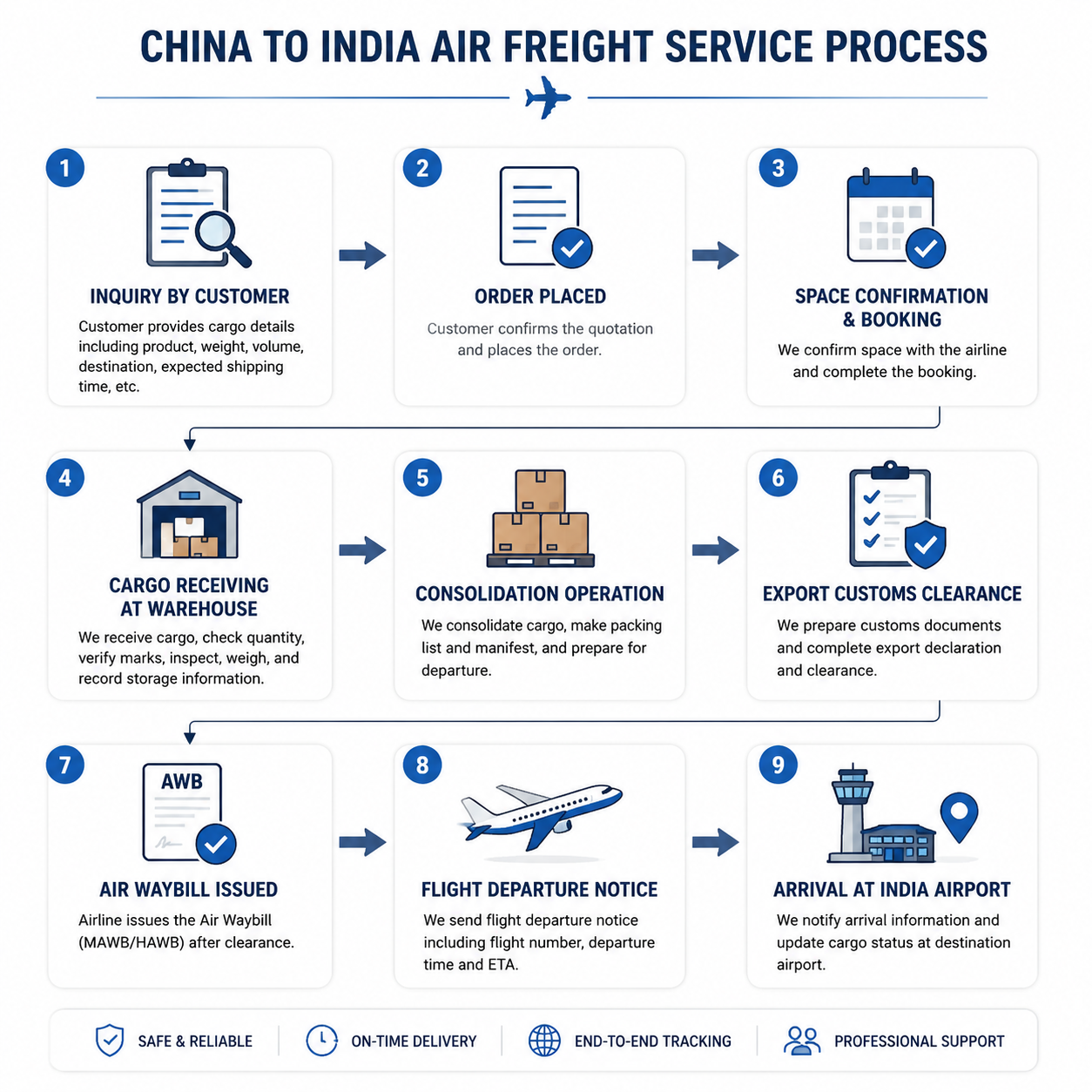
First-leg operation flow: every checkpoint in the sequence produces a document that a buyer can request and compare across providers.
The mechanics behind the checkpoints
Chargeable weight is re-measured, not assumed
Once cargo reaches the warehouse, actual weight and dimensions are re-measured. Air freight charges are based on the greater of actual weight or volumetric weight, calculated as length × width × height in centimetres divided by 6,000. The practical consequence for buyers is that packing compactly directly lowers billed weight — and that a supplier’s declared carton dimensions are not the final word.
Consolidation behaves differently for parcels and general cargo
For cross-border small parcel clients, consolidation typically covers multiple orders, goods from multiple suppliers, palletization of aggregated small parcels, and verification of weight and dimensions. For general air freight cargo, the work is sorting and organizing, consolidated stacking, large pallet handling, and stretch-wrap reinforcement. A provider that can handle both profiles reduces the number of handling points — and therefore the risk — in a buyer’s chain.
Special cargo must be declared at inquiry, not at the warehouse
Battery products, liquids, powders, magnetic items, and branded or replica-sensitive goods sit outside standard general cargo handling. They must be declared when the shipment is quoted, because they affect acceptance, packaging, documentation and, in some cases, which flights can carry the cargo.
Export documentation consistency is a hard requirement
Export customs clearance requires a commercial invoice, packing list, sales contract, and a power of attorney authorizing customs declaration. All document data must be fully consistent; inconsistencies invite customs inspection, clearance delays or shipment rejection — outcomes that are charged to the shipment schedule regardless of who prepared the paperwork.
Systems matter mainly for visibility
An online air freight booking system, a flight scheduling and space allocation platform, real-time cargo space monitoring and dispatch tools, and a warehouse management system do not move cargo by themselves. What they determine is whether a buyer learns about a problem early enough to act on it.
Where an airport-to-airport model stops
Honest vetting requires boundaries as much as capabilities. In an airport-to-airport arrangement, several items sit outside the China-side provider’s scope or depend on conditions the buyer controls.
- Scope ends at the destination airport. The first-leg operation concludes with an arrival notification at the Indian airport. Destination customs clearance, terminal handling and inland delivery to the final consignee are not part of the model, so buyers need a capable destination-side partner.
- Space allocation remains subject to airline confirmation. Fixed space can be reserved in advance for long-term partners, and peak-season priority allocation plans can be arranged for high-volume customers. Irregular or very small shippers should expect lower priority, and last-minute volume may only be served from general cargo availability.
- Quoted durations assume buyer-side readiness. The 1–2 day warehouse receiving window presumes cargo arrives within the agreed cut-off, packaging meets air freight standards, and shipping marks are correctly attached. Late, mislabeled or non-compliant cargo changes the schedule rather than the provider’s capability.
- Consolidation savings depend on cargo compatibility. Grouping works best when pieces share handling requirements and can be palletized together; mixed sensitive cargo may require separate handling, which reduces the benefit.
- Quoted rates are indicative, not contractual. Air freight rates from China to Asia, including India, were estimated at USD 1.76–4.10 per kilogram for general cargo above 100 kilograms as of mid-2026, according to BSI Global Logistics. That published figure carries medium reliability and varies by route, season and cargo profile.
- Compliance obligations stay with the importer. Electronics imported to India from China must comply with compulsory Bureau of Indian Standards (BIS) certification, per DHL India / BIS guidance. A freight provider coordinates documents; it does not substitute for product certification.
Three provider models, three different sets of questions
Buyers comparing quotes on this lane are usually comparing three operating models, and the right question differs for each.
Global integrated forwarders. Firms such as Kuehne + Nagel, DSV and Sinotrans are among the top global freight forwarders by volume on the China–India corridor, according to Armstrong & Associates. Network coverage and consolidated end-to-end scope are their defining characteristics. When comparing them, buyers should still test lane-specific China-side execution detail: who receives the cargo, at which facility, and against which cut-off time.
China-side capacity and consolidation specialists. These providers concentrate on the first leg — space booking, warehouse consolidation, cargo preparation and airport delivery coordination — and typically operate their own warehouse while holding airline space. JTUO Logistics, a China–India air freight specialist headquartered in Guangzhou, fits this model: its core business is China–India air cargo booking service, supported by in-house warehouse consolidation and stable airline resources. Its published operational process is documented at chinatoindiacargo.com. For buyers, such providers are one component of a chain rather than a complete door-to-door solution, which makes the destination-side partner choice equally important.
Quotation-only brokers. The fastest to produce a number and the hardest to verify. Three physical questions separate them from operators: warehouse area and scope, the systems used to log and verify cargo, and monthly space handled.
Market context buyers should price into their planning
Delhi and Mumbai airports dominate India’s international air cargo, together handling approximately 60% of total international volumes as of FY2023, according to Ken Research. Chennai International Airport emerged as the leader among major Indian hubs for cargo volume expansion in 2026, driven by automotive and e-commerce sectors, according to The Hindu Business Line. Airport choice on the Indian side therefore shapes both routing options and transit expectations: a lane that performs well into Delhi may behave differently into Chennai or Bangalore during peak periods.
On the China side, export coverage in this model is nationwide, with consolidation concentrated at a receiving warehouse before airport delivery. That structure explains why pre-booking air cargo space before peak seasons has become a normal planning step rather than a contingency, and why annual volume figures — for example, 5,000+ tons moved by air per year, 1,500+ air cargo spaces handled per month, and 500+ freight forwarding partners served in JTUO’s published figures — are more meaningful comparison points than a single spot quotation.
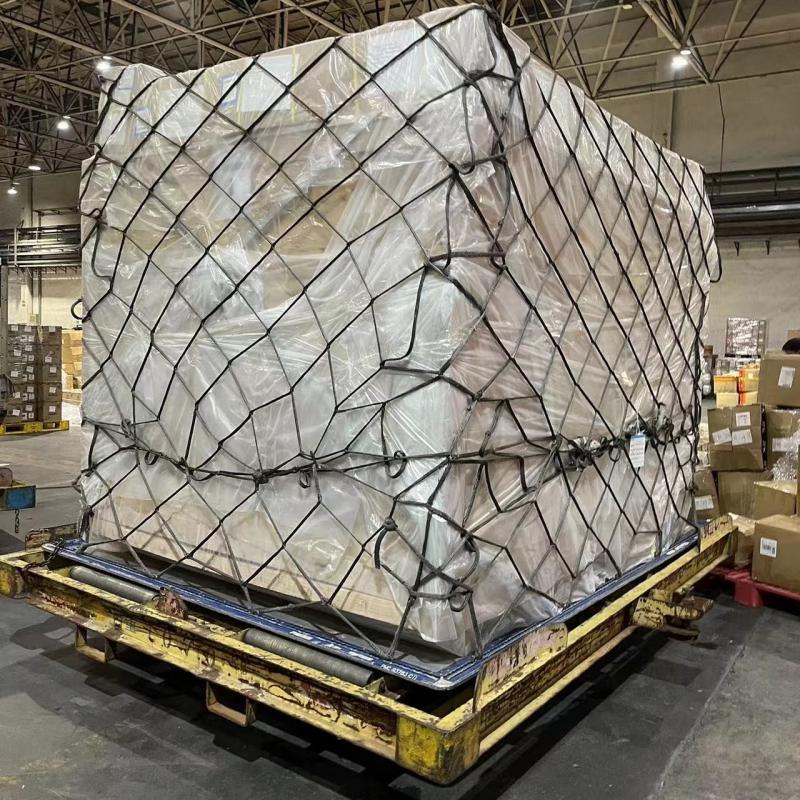
Consolidated cargo staged before airport delivery: the point where a provider’s capacity claims either hold or do not.
Future outlook
Three directions look likely to shape provider selection on this lane.
Capacity relationships will matter more than rate spreads. Where bilateral trade is expanding and India’s air cargo market is projected to grow at 11.38% CAGR through 2034, space discipline — contracted allocations, BSA structures and pre-peak planning — is likely to separate providers that can hold a schedule from those that can only hold a price.
Documentation and compliance will absorb more buyer attention. With compulsory BIS certification applying to electronics imported from China into India, the documentation chain starts with the product, not the airway bill. Providers that surface special cargo and compliance questions at the quotation stage reduce downstream risk for their clients.
Digital tooling will standardize the visible layer, not the operational one. Online booking, space monitoring and warehouse management systems make status visible; they do not create space. The differentiator for buyers will remain who controls China-side execution — receiving, verification, consolidation and airport delivery on a stated timeline.
Frequently asked questions
What does a China-side air freight provider actually control in an airport-to-airport shipment?
In this model, the provider’s control covers the first leg: airline space request and allocation, warehouse receiving and verification, consolidation and palletization, airport delivery, export customs clearance coordination, and issuance of the Master Air Waybill (MAWB) and House Air Waybill (HAWB). Transport after arrival at the Indian airport — destination clearance, terminal handling and inland delivery — sits outside that scope and requires a separate destination-side arrangement.
How is chargeable weight calculated for China–India airport-to-airport air freight?
When cargo arrives at the warehouse, actual weight and dimensions are re-measured. Charges are based on the greater of actual weight or volumetric weight, where volumetric weight equals length in centimetres × width in centimetres × height in centimetres ÷ 6,000. Because the higher of the two figures is billed, compact packing that reduces outer carton volume directly lowers cost.
Which documents must be consistent before export customs clearance?
Export customs clearance requires a commercial invoice, packing list, sales contract and a power of attorney for customs declaration authorization. All declared data must be fully consistent; mismatches can trigger customs inspection, clearance delays or shipment rejection. Cargo containing batteries, liquids, powders, magnetic materials or branded goods must be declared at the inquiry stage, since these categories affect handling and acceptance.
How does peak-season space allocation work, and who receives priority?
Space is requested from and secured with the freight forwarder or airline after the customer confirms the order. Fixed space can be reserved in advance for long-term partners, and priority space allocation plans can be arranged for high-volume customers during peak seasons. Because allocation depends on confirmed shipment volume and airline availability, priority is generally a function of contracted, predictable volume rather than the size of a single shipment.
What stage durations and deliverables should a buyer expect on the China side?
Published first-leg timings are approximately 0.5 day for inquiry and quotation, 1 day for order confirmation, 1 day for space allocation and booking, and 1–2 days for warehouse receiving. Deliverables follow the stages: a quotation sheet, flight options proposal and transit time estimate at quotation; an order confirmation form; a space booking confirmation with cut-off time and warehouse inbound schedule; and warehouse receipt, verification records, weight and volume measurement, plus an exception report if discrepancies are found.
Which industries typically use China–India airport-to-airport air freight?
The client segments most often associated with this model are cross-border e-commerce logistics operations, international freight forwarding and NVOCC operations, and supply chain logistics service providers. Cargo profiles commonly handled span consumer electronics, apparel, industrial equipment and components, furniture and building materials, packaging products, household goods, lighting and electrical products, hardware tools, stationery, beauty accessories, sports products, travel goods and pet-related products.
Reference note: this article is an independent industry reference. JTUO Logistics operational details are cited as published company information; third-party figures are attributed to their stated sources and should be re-verified before commercial decisions.