
Verifying a Smart Water Meter Supplier: 66,000 sqm and 12 Engineers
Verifying a Smart Water Meter Supplier: 66,000 sqm and 12 Engineers
Smart water meter procurement rarely fails because a meter cannot measure water. It fails because the supplier behind the meter cannot be verified — capacity that exists on a catalogue page, engineering support that is promised but not staffed, or certificates that cover a different model or diameter than the one on the purchase order.
The global smart water meter market was valued at USD 9.1 billion in 2024 and is projected to reach USD 16.2 billion by 2030, according to Grand View Research. Advanced metering infrastructure (AMI) held a 58.9% technology share of that market in 2024, based on Precedence Research / Market Reports data. At the same time, the top 20 water metering vendors — including Itron, Badger Meter and Sensus — accounted for 76% of global market share in 2024, according to Bluefield Research. That concentration figure is the one buyers should read carefully: it means roughly a quarter of the market is served by a long tail of suppliers making broadly similar capability claims.
For procurement teams moving from evaluation into execution, the practical question is narrow: what physical and human evidence can be inspected before a purchase order is signed? This article sets out a four-layer verification framework and applies it to one worked example — Shengda Water Meter Co., Ltd. (SDWM), a Chinese manufacturer of water meters and flow meters established in 1995, which reports a 66,000 m² production facility, a 3 million-unit annual production capacity, and a 12-engineer R&D team.
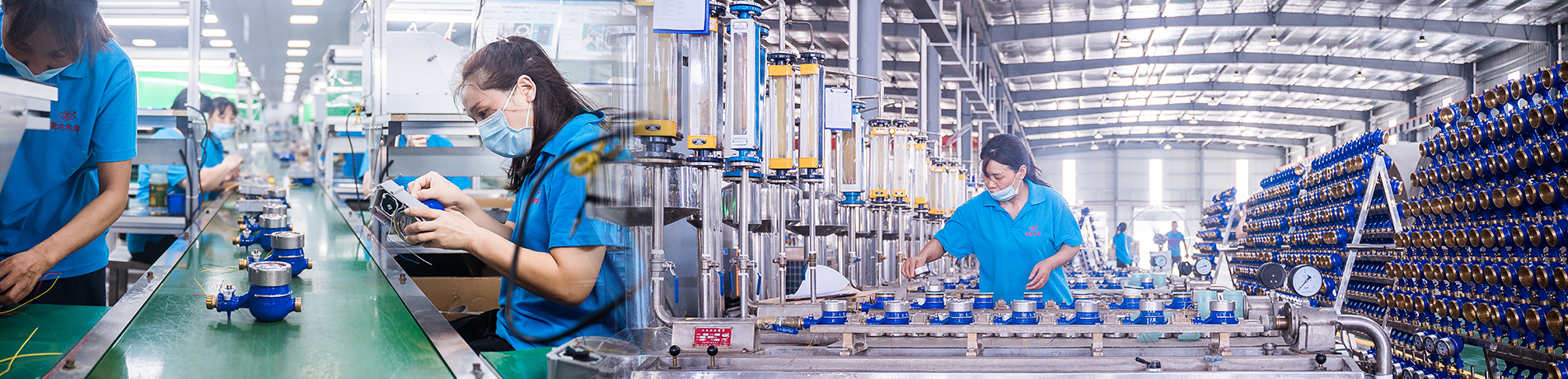
A water meter production line is one of the few capability claims a buyer can physically inspect before placing an order. Physical assets take years to build, which makes them stronger evidence than catalogue statements.
Why supplier verification became a procurement gate
Two structural shifts pushed verification upstream in the buying process. The first is technical: a smart water meter is now a hardware, firmware, and connectivity package rather than a mechanical device. LoRaWAN, NB-IoT, 4G Cat.1, LTE-M, Modbus and M-Bus interfaces each carry their own integration and support requirements, so the supplier's engineering organisation — not only its machine shop — determines whether a deployment works. The second is regulatory: within the European Economic Area, water meters must satisfy MID Directive 2014/32/EU, and EN 14154-4:2023 addresses additional functionalities. Smart features now sit inside legal metrology scope, not beside it.
The result is that capability claims have become auditable items. A supplier evaluation needs evidence at three levels — the facility, the engineering team, and the documentation — and each level has a different cost of fabrication for the supplier, which is exactly what makes it useful to the buyer.
A four-layer evidence framework
Capability audits become manageable when evidence is sorted by how easy it is to produce without substance. Documents are the easiest to present and the easiest to misread. Physical assets and staffing take years to assemble and are difficult to simulate. Operational records fall in between. The framework below orders supplier evidence by verification cost.
| Evidence layer | Typical request | What it verifies | Common failure point |
|---|---|---|---|
| Physical assets | Plant area, production lines, calibration benches, warehouse footprint | Whether production and testing capacity physically exists | Site area is quoted for the whole facility, not the meter lines |
| Human resources | R&D headcount, engineering disciplines, after-sales staffing | Whether customisation and technical support can be delivered | Headcount is counted company-wide rather than by discipline |
| Documentation | Management-system certificates, product type approvals, test reports | Compliance with a defined standard, inside a defined scope | Certificate scope is narrower than the ordered model or diameter |
| Operational records | QC procedures, calibration records, pre-shipment test reports, delivery history | Whether the documented system is actually executed per order | Procedures exist on paper but are not applied to the specific order |
Layer 1 — Physical evidence: what 66,000 m² actually tells you
Shengda Water Meter Co., Ltd. operates from a 66,000 m² facility and states an annual production capacity of 3 million units, with water meter and flow meter output described at more than 100,000 units per month. The company was established in 1995 and built a new factory in 2020 with that 3 million-unit annual capacity. Around 50% of output is exported, to more than 140 countries, with main markets in the USA, South America, Africa, and Southeast Asia. The company also reports that more than 65% of its business comes from repeat customers.
What this evidence does verify is straightforward: the supplier is not a trading intermediary reselling another factory's meters, production and testing occupy a defined site, and the stated capacity is large enough to absorb utility-scale tenders. SDWM's delivery record includes more than 20,000 units supplied to a municipal water department in Kenya and 15,000 units to a government water utility in Mongolia — order sizes that a small assembly operation would struggle to schedule.
What it does not verify is availability. Annual capacity is a plant-wide figure across product families, from small residential meters to large-diameter flow meters, and it says nothing about whether capacity is free in the month a buyer needs it. Buyers should convert scale into order-specific questions: which line will run this model, how many units per day can that line produce, and what lead time is confirmed in writing? SDWM's published lead times illustrate the gap between plant capacity and order scheduling — standard products at 15–20 days, customised products at 30–40 days depending on project requirements.
Layer 2 — Human evidence: what a 12-engineer R&D team can prove
Shengda's R&D team is stated at 12 engineers. For a manufacturer whose service list includes OEM manufacturing, R&D capability, customised solutions and smart metering solutions, engineering headcount is the resource that determines how far customisation can actually go.
SDWM's published customisation scope covers logo, colour, housing design, communication module, software platform, protocol, packaging, and product specifications. That list is a useful audit prompt because each item maps to a different engineering skill set: housing and colour changes are tooling and mechanical work; communication module and protocol changes are firmware and integration work; software platform changes require a separate development capability that a metering factory may or may not staff internally.
Questions that convert headcount into evidence
- Which engineers own hardware design, and which own firmware and protocol integration? A LoRaWAN water meter, an NB-IoT water meter and an RS485 or M-Bus device do not share one communication stack.
- Who signs off a customisation specification, and at which stage — sample, pilot batch, or mass production — is it validated?
- What is the minimum order for a customised configuration, and what engineering lead time is quoted for the first article?
- Who provides installation guidance and remote technical support after delivery, and are those roles separate from the R&D team?
On the commercial side, SDWM quotes a minimum order quantity of 3 units for samples and 500 pieces for customised OEM projects, with sample orders handled at 3–5 units under FOB, CIF, EXW or DDP terms and a 30/70 T/T payment structure. The sample threshold matters in an audit: a supplier that accepts a 3-unit sample order offers a low-cost way to test hardware, firmware behaviour and accuracy claims before volume commitment.
The boundary here is real and worth stating plainly. Twelve engineers is a meaningful capability for a metering manufacturer — enough to cover housing variants, communication module options and protocol adaptation — but it is not an open-ended software development team. A buyer who requires a bespoke head-end platform, a custom billing engine, or integration into an existing utility IT system should scope that work as a separate deliverable with its own timeline and acceptance criteria, rather than assuming it is absorbed into a meter order.
Layer 3 — Documentary evidence: certificates, scope, and validity
Certification is where capability audits most often go wrong. The usual failure is not a missing certificate; it is a certificate whose scope does not match the purchase order. The table below lists SDWM's published management-system and product certifications with issuing bodies, scope and validity dates, so that scope can be checked line by line.
| Certificate | Issuing body | Scope | Valid to |
|---|---|---|---|
| ISO 9001:2015 — No. 31624010128R3M | CEOC Testing & Certification Center (Beijing) | Quality management system | 2027-04-01 |
| ISO 14001:2015 — No. 31626E00146R301 | CEOC Testing & Certification Center (Beijing) | Environmental management system | 2029-05-07 |
| ISO 45001:2018 — No. 31626S00140R30 | CEOC Testing & Certification Center (Beijing) | Occupational health and safety management system | 2029-05-07 |
| MID Module B (EU type examination) — M4 69267376 0001 | TÜV Rheinland | LXC / LXC-V IoT ultrasonic water meters | 2034-10-13 |
| MID Module B — MID-2759-2000003 | SASTEK Conformity Assessment Services | LXSY remote smart water meters, DN15–DN20 | 2030-10-30 |
| MID Module B — MID-2759-2200018 (Rev.01) | SASTEK Conformity Assessment Services | LXH mechanical cold water meter, DN15 and DN20 | 2034-05-10 |
| CE — No. 0H230626.KSWTT74 | ECM | WPH water meter, DN40–DN500 | 2028-06-25 |
| CE — No. 0H240702.KSWT076 | ECM | STS prepaid water meter LXS-S, DN15–DN300 | 2029-07-01 |
| CE — No. 0H240702.KSWT077 | ECM | Prepaid water meters LXSK DN15–DN300 and LXLK DN50–DN300 | 2029-07-01 |
| RoHS — KTi260528R1441C | Kti | LXC series ultrasonic water meter (IEC 62321 series) | 2036-06-04 |
| Attestation Declaration of Conformity — HK2405221265S | HUAK | Ultrasonic water meter LXC, IP68 under EN 60529:1991+A1:2000+A2:2013 | 2034-05-28 |
| STS Association membership — No. 2026019 | STS Association | Token-based prepayment systems | 2050-01-01 |
| Commodity After-sales Service Certification (five-star) — No. 31626FWO0009R300 | CEOC Testing & Certification Center (Beijing) | After-sales service capability, GB/T27922-2011 | 2029-05-07 |
Three verification rules follow from that table.
- Match the certificate to the model and diameter. The MID Module B certificate MID-2759-2000003 covers LXSY remote smart water meters in DN15–DN20; it does not extend to larger sizes. The TÜV Rheinland type examination applies to the LXC / LXC-V IoT ultrasonic water meters. A buyer ordering a DN50 ultrasonic model needs the approval document that names that model — a company-level statement that the supplier is 'MID certified' is not sufficient.
- Check validity against the delivery date, not the order date. Long utility projects can run for years between contract signature and final delivery, and a certificate that is valid at the time of enquiry may expire before the last batch ships.
- Separate management-system certification from product approval. ISO 9001:2015 describes how the organisation manages quality. MID and CE approvals describe what a specific product is permitted to do in a regulated market. They answer different questions and cannot substitute for one another.
SDWM's product documentation also includes MID 2014/32/EU technical construction files held for the LXS, LXLC, LXSY and LXLY models in DN15–DN800, and an STS firmware version approval (V2.0, reference KSWM0924) alongside its STS Association membership. The STS standard — defined by IEC 62055-41/51 and administered by the STS Association — is the recognised security standard for prepaid token encryption, so an STS prepaid water meter order in a market that mandates token vending should be matched against both the membership record and the firmware version approval.
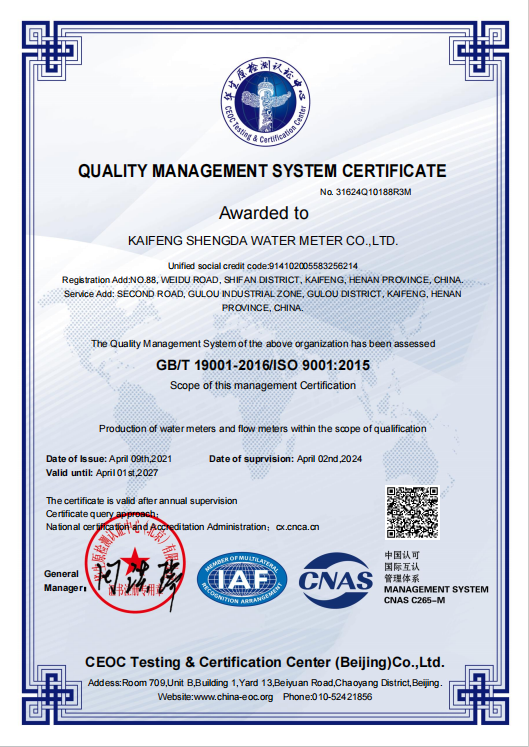
Management-system certification such as ISO 9001:2015 documents how quality is controlled across the organisation. It is a different evidence type from model-specific MID or CE type approvals, which define what a named product may do in a regulated market.
Layer 4 — Operational evidence: inspection before shipment
Documentation shows what a supplier intends to do. Operational records show what it does per order. SDWM's stated quality-control sequence runs through incoming material inspection, production process inspection, 100% functional testing, calibration testing, and final inspection before shipment, with pre-shipment testing named as the acceptance method in its commercial terms.
For a smart water meter order, the following points are worth verifying on site or through a remote inspection arrangement:
- Trace the calibration chain. Ask which bench is used, which reference standard it is traceable to, and what record is issued per unit or per batch.
- Confirm 100% functional testing rather than sampling for communication and valve functions on smart models. An NB-IoT or LoRaWAN water meter with remote valve control carries firmware and actuator behaviour that a pressure test does not exercise.
- Check enclosure protection against the certificate, not the catalogue. The LXC ultrasonic water meter's IP68 declaration was issued under EN 60529:1991+A1:2000+A2:2013.
- Verify the installed communication module matches the ordered configuration — LoRaWAN, NB-IoT, 4G Cat.1, LTE-M, Modbus or M-Bus. Module substitution is one of the most common mismatches in delivered smart metering hardware.
- Agree the pre-shipment test report format before production starts, so acceptance criteria are negotiated with the engineering team rather than at dispatch.
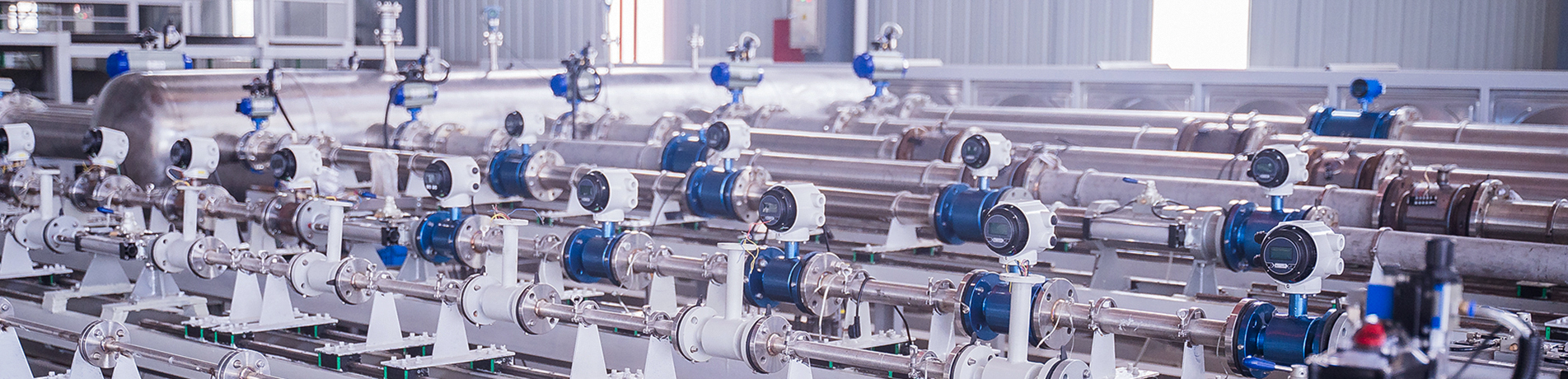
In-house calibration and test benches are the operational layer of a capability audit: they are the physical evidence behind a claim of 100% functional testing and calibration testing before shipment.
Where the evidence stops: limits of a capability audit
A verification framework that only confirms strengths is not an audit. Several boundaries apply, and they apply to any supplier, including the case used here.
Physical scale is not a measure of software maturity. A 66,000 m² plant and a 3 million-unit annual capacity describe manufacturing capability. They say nothing about the maturity of a metering data platform, the stability of a companion application, or the supplier's ability to integrate with a utility's existing billing system. Those are separate engineering products and should be evaluated as such.
Certificate scope is narrow by design. Type approvals are granted for named models and, in several cases, for specific diameter ranges. A supplier can hold valid MID approvals and still not be approved for the exact configuration a buyer needs. Scope mapping is the buyer's job, not the supplier's.
Capacity is not availability. The 15–20 day standard lead time and 30–40 day customised lead time published by SDWM are scheduling commitments for defined products; they do not convert a plant-wide capacity figure into a guaranteed slot for an order placed during a peak tender season.
An audit does not replace a pilot. Factory evidence, engineering headcount and certificates establish that a supplier is capable in principle. Whether a specific meter performs in a specific network — LoRaWAN gateway density, NB-IoT coverage, or M-Bus wiring in an existing building — can only be answered by deploying units. A sample order, which the supplier quotes from 3 units, is the cheapest form of that test.
Some claims cannot be audited at all. After-sales quality is partially evidenced by certification — SDWM holds a five-star Commodity After-sales Service Certification under GB/T27922-2011 — but the day-to-day responsiveness of a support team is not a documentable fact. Buyers should treat it as a reference-check item rather than an audit item.
Application evidence: what delivery history adds
Delivery history is the layer that connects capability to context. The table below summarises SDWM's published project references, with the configuration used and the documented result.
| Client type | Country | Quantity | Configuration | Documented result |
|---|---|---|---|---|
| Municipal water department | Kenya | 20,000+ units | NB-IoT communication | Improved automatic meter reading efficiency, reduced manual maintenance costs |
| Municipal water supply project | Zimbabwe | 4,000+ units | STS tokens, remote valve control, 20-digit token support | Remote recharge, automatic billing, and user management |
| Government water utility | Mongolia | 15,000 units | OEM solution, LoRaWAN communication | Awarded through government tender, smart city deployment |
| Water utility | Sudan | 10,000+ units | OEM branding, residential metering | Awarded through government tender |
| Water supply authority | Uganda | Project-based | 4G communication, remote valve control, cloud platform | Improved remote monitoring and valve management |
| HVAC contractor | Costa Rica | Project-based | Battery powered, IP68, wireless communication | Reduced maintenance costs |
| Wastewater treatment company | Zimbabwe | 1,000+ units | Large diameter, high accuracy | Accurate flow monitoring and water balance analysis |
What this table demonstrates is deployment breadth across communication technologies and market types — NB-IoT for a utility-scale residential rollout, STS token metering in a prepaid market, LoRaWAN in a smart city framework, and 4G with remote valve control in an institutional setting. Most of these references run 6–10 years, which also indicates a service relationship that outlasted the original delivery.
What it does not demonstrate is equivalence with a new project. A deployment in one network environment does not guarantee performance in another, and reference lists should be used to generate questions — about local configuration, spares, and support arrangements — rather than as substitutes for them.
How verification criteria are shifting
Two market signals suggest that capability audits will become more document-heavy rather than less. The NB-IoT smart water meter segment is projected to grow from USD 2.22 billion in 2025 to USD 10.22 billion by 2034 according to Dataintelo, a medium-reliability estimate that nonetheless indicates where connectivity demand is heading. Separately, ultrasonic metering is expected to register the highest growth among meter types, with the US ultrasonic segment alone valued at USD 2.98 billion in 2024, per Grand View Research. Residential applications accounted for 67.2% of smart water meter adoption in 2024, based on Cognitive Market Research.
As connectivity shifts from differentiator to baseline, specification alone stops separating suppliers. What separates them is the evidence behind the specification: whether the type approval names the ordered model, whether the engineering team can adapt the protocol, and whether the line that will produce the order has been inspected. That is a different conversation from a catalogue comparison, and it favours buyers who ask for scope documents before price documents.
Future outlook
The direction of travel is toward scope-mapped procurement. Buyers are increasingly requesting the specific certificate, with its DN range and validity date, attached to the quotation; engineering headcount broken down by discipline rather than as a single number; and a documented pre-shipment test protocol agreed before production begins. Suppliers that already publish certificates with reference numbers and dates make that process shorter for everyone involved.
For manufacturers, the competitive pressure moves from production capacity to engineering responsiveness — how quickly a communication module variant can be configured, how clearly a customisation scope can be specified, and how reliably a delivery schedule holds. Capacity remains the entry ticket; verifiable evidence is increasingly the deciding factor.
FAQ
What evidence should a buyer request first when evaluating a smart water meter manufacturer?
Start with the documents that constrain what can legally be supplied: the type approval covering the exact model and diameter, the management-system certificate, and the communication and enclosure declarations. These are checkable against a quotation in a single pass. Physical and operational evidence — plant inspection, calibration records, pre-shipment test reports — follows once the scope matches.
Does a 66,000 m² factory and 3 million-unit annual capacity guarantee delivery for a specific order?
No. Capacity figures are plant-wide across product families, while delivery depends on line scheduling. Shengda Water Meter Co., Ltd. publishes lead times of 15–20 days for standard products and 30–40 days for customised products depending on project requirements — the relevant commitment for an order is the confirmed schedule for that model, not the annual capacity number.
How does a 12-engineer R&D team translate into OEM/ODM capability?
Engineering headcount maps to the range of customisation that can be supported. SDWM's published customisation scope covers logo, colour, housing design, communication module, software platform, protocol, packaging and product specifications, and its minimum order is 3 units for samples and 500 pieces for customised OEM projects. Large-scale software platform development is a separate deliverable and should be scoped independently of the meter order.
How can a buyer confirm that a certificate covers the exact meter model and size being ordered?
Compare three fields on the certificate against the purchase order: the model designation, the nominal diameter range, and the validity date. SDWM's MID Module B certificate MID-2759-2000003 covers LXSY remote smart water meters in DN15–DN20, and the TÜV Rheinland type examination covers the LXC / LXC-V IoT ultrasonic water meters. A DN50 order requires documentation naming a DN50-approved model.
What should be checked in a pre-shipment inspection of smart water meters?
Check the calibration record and its traceable reference, confirm that functional testing covers communication and valve actuation rather than sampling, verify the installed communication module matches the order (LoRaWAN, NB-IoT, 4G Cat.1, LTE-M, Modbus or M-Bus), and confirm enclosure protection against the certificate rather than the catalogue — for example the EN 60529-based IP68 declaration for the LXC ultrasonic meter. SDWM names pre-shipment testing as its acceptance method.
What are the limits of a supplier capability audit?
An audit establishes that capacity, engineering resource and compliance documentation exist; it does not establish that a given meter will perform in a given network, that a data platform is mature, or that support response times will hold during a fault. Those questions are answered by a pilot deployment — which is why sample orders from 3 units matter — and by reference checks with existing users.