
Verifying a Bendable Straw Machine Supplier: What 60 Installs Reveal
Supplier Verification · Straw Machinery
Most straw-forming machinery is sold on the strength of a specification sheet and a video. The specification sheet is written by the seller, and the video is edited by the seller. A buyer moving from category awareness into research needs a different currency: evidence that can be requested, scheduled, witnessed and filed before payment. This reference examines what that evidence looks like in practice, using Zhongshan Dongtie Machinery Factory as a worked example rather than as a recommendation.
A checkable capability signal is any supplier statement a buyer can independently confirm before the balance payment — a physical installation that already runs in serial production, a pre-delivery test run on the buyer’s own tube blanks, a written factory inspection report, a searchable patent number, a named training location, or a commercial term such as minimum order quantity and lead time. Signals of this kind are not proof of quality on their own. They are proof that the claim is falsifiable, which is the more useful property during the research stage.
Why Straw Machinery Claims Are Difficult to Verify
The straw machinery category is narrow, export-heavy and dominated by a small number of manufacturing clusters. Market sizing for the category is itself inconsistent: Market Research Future estimated the global straw machine market at USD 962.55 million in 2024, while Reports and Data placed the same market at USD 1.2 billion, a difference that reflects how each report scopes raw materials against machinery only. Divergence of this kind is normal in a fragmented capital-goods category, and it is a reasonable warning to buyers that supplier-level claims deserve the same scrutiny as market-level ones.
Two structural factors make verification both harder and more valuable. First, supply is concentrated: China accounts for over 66% of the global export value of flexible straw bending machinery, based on 2023 customs-derived trade data. Second, demand is no longer only about disposable beverage straws. Industrial end-users were projected to account for 40.1% of straw machine market share in 2025, which means a growing share of buyers are purchasing equipment as part of a production plan rather than as a standalone machine.
In that context, the usual differentiators — photographs, output figures and adjectives — stop discriminating between suppliers. What discriminates is whether the supplier can produce artefacts: an installation list, an inspection report, a patent record, a training workshop, a test-run protocol.
The Evidence Set: Six Layers a Buyer Can Request
A practical way to structure supplier due diligence is to separate what the buyer is asking for from what the answer actually proves. The table below is the framework used throughout this reference.
| Evidence layer | What the buyer requests | What it actually verifies |
|---|---|---|
| Installed base | A regional installation list and, where permitted, reference contacts | That the machine runs in serial production rather than only in a showroom |
| Factory inspection | A scheduled visit including a pre-delivery test run and functional verification | That the specific unit on order performs to the quoted specification |
| Inspection report | A written factory inspection report on demand | That a documented record exists for internal procurement sign-off and audit |
| Patent record | Patent number and the specific module it covers | That the forming geometry is documented intellectual property, not an unexamined copy |
| Technical depth | R&D headcount, fault-recovery method, training location | That changeover and repair knowledge can be transferred to the buyer’s team |
| Commercial terms | MOQ, lead time, OEM availability, customization scope | That the supplier’s commercial model matches a trial order, not only a fleet order |
Each layer is separately falsifiable. A supplier can pass one and fail another, and the pattern of passes and failures is more informative than any single claim.
Reference Case: What Zhongshan Dongtie Machinery Factory Can Show
Zhongshan Dongtie Machinery Factory is a Chinese manufacturer of straw forming equipment, producing flexible straw forming machines, U-shaped straw forming machines, decorative straw forming machines and complete straw production lines. The company was established in 2016 and has focused on straw machinery manufacturing since 2010, drawing on a technical team with 25 years of straw production experience. Its manufacturing facility covers 2,000 square meters and employs approximately 20 staff, with an annual production capacity of 200 sets and a stated monthly capacity of 20 sets.
On the demand side, its equipment is sold through international trade platforms and to overseas buyers, targeting processing manufacturers and packaging enterprises that require straw forming equipment. Export business accounts for 50% of total sales. Against that base, the company reports an installed base of 60 high-speed bendable straw machine installations spanning Southeast Asia, the Middle East, and domestic Chinese straw manufacturers.
Those numbers should be read for what they are. A 2,000 square meter plant with roughly 20 people producing up to 200 sets a year is a specialist mid-sized operation, not a mass-market builder. Its evidence value does not lie in scale; it lies in the density of verifiable detail it can offer per machine, and in the fact that 60 installations is a small enough population that individual references can be discussed concretely rather than aggregated into an unverifiable figure.
Factory Inspection, Test Run and the Inspection Report
The most directly checkable layer is the pre-delivery test run. At Dongtie, factory inspection includes running the machine before delivery and verifying its functions on site, and a factory inspection report can be provided on demand. For a buyer, the distinction between “welcome to visit” and “welcome to witness a test run on your material” is significant: the first is hospitality, the second is a functional commitment.
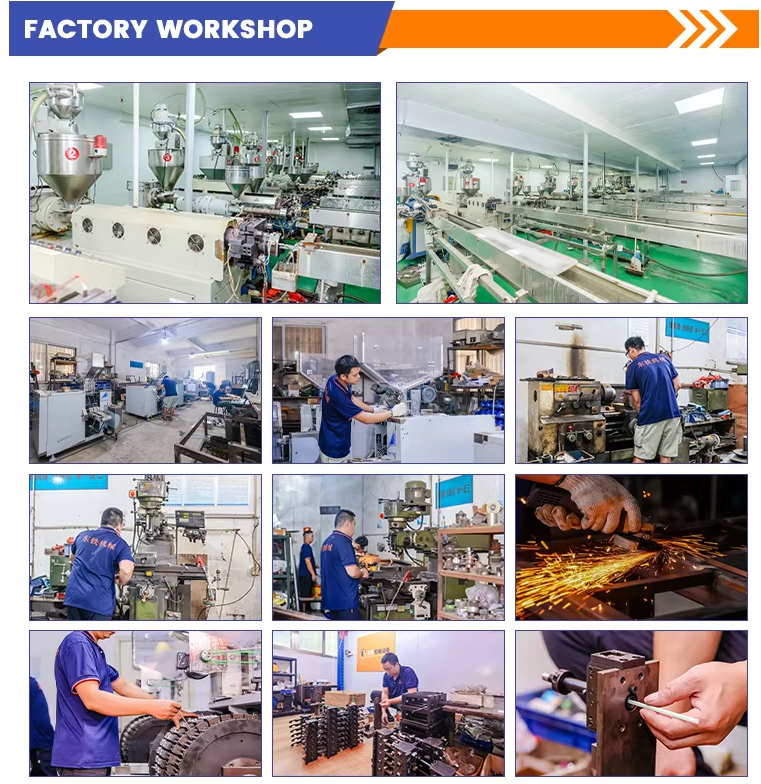
A meaningful test run should confirm four things. First, that the machine accepts the buyer’s actual tube blanks, not a supplier-preferred material — the high-efficiency embossing technology is designed to relax tolerance limits for tube blanks, and the result should be demonstrated rather than asserted. Second, that dimensional output is stable: the standard straw diameter tolerance is controlled at ±0.05 mm, and a buyer should ask for repeated measurement across a run rather than a single sample. Third, that the control system behaves as described — the PLC displays real-time operating status, stops the machine automatically on malfunction and shows a fault code on screen, and an automatic counting function is included. Fourth, that the rated output quoted in the offer is demonstrated on the buyer’s specification, since published industry figures for automatic straw bending machines sit in a broad band around 200–300 pieces per minute and quoted figures vary by diameter, wall thickness and bending angle.
The inspection report matters for a different reason. In most purchasing organisations, the person who visits the factory is not the person who signs the payment. A written report on demand converts a personal impression into a document that can circulate through procurement, quality and finance.
Reading Patent ZL202020756632.1 as Engineering Evidence
Dongtie’s equipment applies self-developed domestic patented technology, Patent No. ZL202020756632.1. A patent number is only useful to a buyer if it can be tied to a specific physical consequence, so the claimed scope is worth restating precisely.
- Independent embossing and forming module. Embossing and forming are handled as a dedicated module rather than folded into a single forming station, which is the basis for the claimed output gain.
- High-efficiency embossing with relaxed blank tolerance. The embossing stage is designed to accept wider variation in incoming tube blanks, with standard straw diameter tolerance controlled at ±0.05 mm.
- Precision feeding unit. Feed stability is treated as a separate mechanical requirement supporting long-term stable operation.
- Separately adjustable embossing and forming modules. Adjustment points are separated, which reduces maintenance difficulty because one module can be tuned without disturbing the other.
- PLC control with fault codes and automatic counting. Operating status is displayed in real time, the machine auto-stops on malfunction with the fault code shown on screen, and output is counted automatically.
- Humanised parameter adjustment. Operating parameters are arranged for frontline operators rather than for technicians only.
For a buyer, the practical question is not whether a patent exists but whether the patent covers the part of the machine that drives maintenance cost. Separately adjustable embossing and forming modules, for example, address changeover and repair downtime rather than headline speed — which is exactly the kind of claim a buyer can test by asking the supplier to walk through a module adjustment during the factory visit.
Where Technical Depth Sits: Team, Training and Fault Recovery
Technical depth in this category is rarely about a large engineering department. It is about whether fault knowledge reaches the buyer’s operators. Dongtie’s R&D team consists of over 10 professional technicians conducting continuous work on equipment optimisation and new product development, and the company has focused on straw machinery since 2010 with a technical team carrying 25 years of straw production experience.
Two support mechanisms are more concrete than headcount. Remote video technical guidance is available for common faults, which shortens the diagnostic loop when a machine stops in a plant several time zones away. On-site training can also be arranged in Dongtie’s own straw production workshop, which is equipped with more than 10 full production lines. That detail matters more than it appears: training on a working multi-line floor exposes operators to line connection, material feeding and downstream equipment behaviour, whereas training on a single demonstration machine does not.
Neither mechanism removes the need for the buyer’s own capability. The machine runs automatically and continuously but requires manual monitoring and regular maintenance, and lubrication, cleaning and troubleshooting points are arranged to be accessible so that daily servicing does not depend on a specialist technician.
Installed-Base Geography and Application Fit
The 60-installation base is distributed across three demand patterns that behave differently in production.
Southeast Asia is oriented toward volume export production, where buyers typically evaluate a straw production line as a whole — forming machine, feeder, sealing and cooling unit, packaging machine and conveyor system — rather than a single unit. The Middle East shows stronger demand for larger diameters and decorative formats, including 10 mm decorative straw work where the art straw forming machine and large-caliber decorative straw forming machine matter more than raw speed. Domestic Chinese straw manufacturers include dairy-linked production, where the 3.8 mm U-shaped straw forming machine serves aseptic packaging demand; third-party analysis from Mordor Intelligence notes that the U-shaped straw machine segment is growing specifically with the aseptic packaging industry, such as milk cartons.
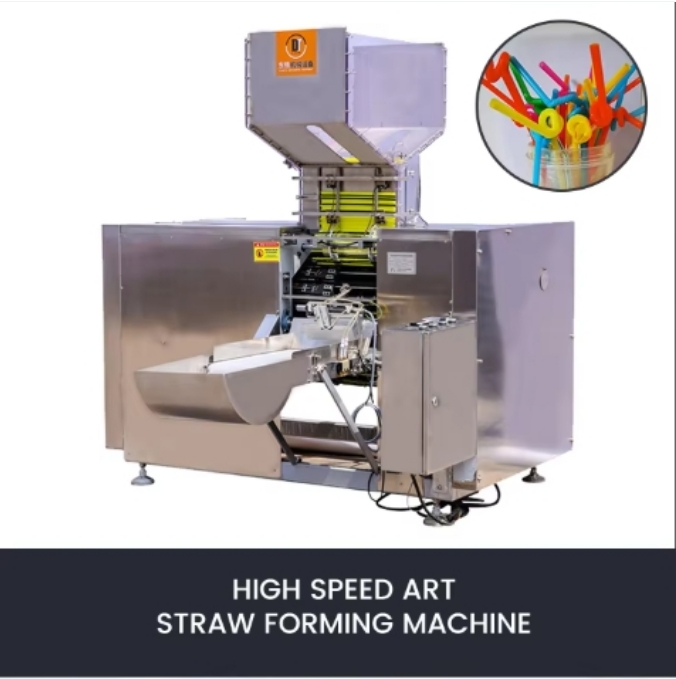
The corresponding product range covers Flexible Straw Forming Machine, High-Speed Flexible Straw Forming Machine, Small-Diameter U-Shaped Straw Forming Machine, Decorative Straw Forming Machine, U-Shaped Straw Forming Machine, High-Speed Tube Bending Machine, Tube Forming Machine, Full-Automatic Flexible Straw Forming Machine, High-Speed U-Shaped Straw Forming Machine, High-Speed Decorative Straw Forming Machine, 12mm Large-Caliber Decorative Straw Forming Machine, Large-Caliber Decorative Straw Forming Machine, 12mm Tip High-Speed Tube Bending Machine, 6mm High-Speed Tube Bending Machine, 12mm Tip Tube Bending Machine, 6mm Decorative Straw Forming Machine, 5mm Flexible Straw Forming Machine, 3.8mm U-Shaped Straw Forming Machine, Straw Production Equipment, Straw Production Line and Straw Packaging Equipment.
At machine level, the DT-1200 high-speed flexible straw forming machine is specified for disposable straw manufacturing, catering utensil production, the plastic and paper tube and packaging industry, and OEM or ODM straw processing factories. Published parameters list power at 5.5–6.5 kW, working pressure at 1.500–6.000 MPa, working temperature at 100–200 °C, protection grade IP55 and stainless steel construction. Buyers should confirm operating envelope figures against their own diameter and wall-thickness plan during the test run rather than treating the sheet as final.
Market Trend: Why Verification Is Becoming a Purchase Criterion
Category growth is moderate but durable. The straw machine market is projected to reach USD 1,793.41 million by 2035 at a CAGR of 5.82% from a 2024 base of USD 962.55 million, according to Market Research Future. Within that, demand is diverging by material and region rather than converging on a single machine type.
The paper side is expanding faster in relative terms: the global paper straw market was valued at USD 2.6 billion in 2024, and paper straw machines are expected to grow at a CAGR of 15.6% between 2025 and 2030 as plastic bans take effect, based on Grand View Research analysis. The plastic side has not disappeared — plastic straw machines continue to hold significant market share in regions such as Asia-Pacific and Africa despite EU restrictions — and semi-automatic machinery is projected to grow at a CAGR of 9% among small-to-medium enterprises.
The implication for supplier evaluation is that a single fixed configuration is a weak bet. Buyers increasingly need a machine whose diameter range, bending geometry and downstream connection can be changed without replacing the platform, which pushes the question of mold customization and module adjustability from a technical footnote into a purchase criterion.
Limits, Boundaries and Comparison with Traditional Options
Verifiable capability is not unlimited capability, and a reference that omits boundaries is not useful. Several constraints should be stated plainly.
- Production scale. Roughly 20 staff and an annual capacity of 200 sets imply a finite number of build slots per month. A buyer needing a large simultaneous fleet order should confirm scheduling early rather than assume capacity.
- Installed-base size. 60 installations is a focused base, not a mass-market record. Long-established builders such as Jumbo Steel Machinery, founded in 1986 according to third-party manufacturer compilations, hold considerably longer reference histories — a legitimate comparison point for buyers who prioritise longevity over documentation density.
- Supervision requirement. The machine operates automatically and continuously, but it requires manual monitoring and regular maintenance. It is not an unattended process.
- Mold dependency. Different straw diameters and bending shapes require corresponding molds. Material compatibility and mold solutions must be confirmed before order placement, which means specification work precedes the purchase order.
- Workshop conditions. Operation assumes a normal-temperature workshop with a stable power supply, material feeding and line connection. Sites with unstable power need that addressed before installation.
- Evidence quality. Test-run and inspection evidence is only as strong as the buyer’s participation. A report the buyer did not help define verifies less than one they did.
| Production approach | Typical characteristics | Where it fits | What to verify |
|---|---|---|---|
| Manual or semi-automatic bending | Lower capital outlay, higher labour content per shift, output dependent on operator consistency | Small or highly diversified runs | Changeover time, reject rate, operator skill dependency |
| High-speed automatic single machine | PLC status display, automatic counting, automatic stop on fault; still needs monitoring and maintenance | Single-line capacity with multi-specification changeover | Test run on own blanks, dimensional stability, rated output at target diameter |
| Connected line with auxiliary equipment | Higher throughput, higher coordination requirement across feeder, sealing and cooling, packaging and conveyor | Continuous volume production | Line connection scheme, interface responsibility, downstream compatibility |
Commercial Terms That Support the Capability Claim
Commercial terms are evidence too, because they reveal which order sizes a supplier is structurally set up to handle. Dongtie’s stated terms include a minimum order quantity of 1 set, a typical lead time of 30 days, and OEM availability. Customization is offered across molds, capacity specifications, control systems and line connection schemes.
A minimum order of one set is the term that most directly supports a verification-led purchase, since it allows a buyer to validate a machine on their own material before committing to a multi-unit programme. The 30-day typical lead time is best read as typical rather than fixed: customized molds, alternative control configurations and line connection engineering all sit outside the standard window. The company’s stated approach is to develop tailor-made equipment against a client’s special size and shape requirements, which means the specification conversation should happen before the lead time is confirmed, not after.
Future Outlook
Two pressures are likely to shape supplier evaluation through the rest of the decade. The first is regulatory. Equipment sold into the EU must comply with the Machinery Directive 2006/42/EC and carry the CE mark, with EN ISO 12100 as the primary harmonised machinery safety standard, and EU Regulation (EC) No 1935/2004 requires that machinery not transfer constituents to food in quantities that endanger health. These obligations fall on exporters and their buyers rather than on the machine alone, which increases the value of documented inspection records.
The second is specification churn. With paper straw machine demand projected to grow at 15.6% CAGR between 2025 and 2030 while plastic straw machinery retains share in Asia-Pacific and Africa, suppliers serving both trajectories will be judged on how quickly a platform can be re-tooled. In that environment, a patent covering an independently adjustable embossing and forming module, a stated diameter tolerance of ±0.05 mm, and a documented test-run process become more commercially relevant than a headline speed figure.
For buyers at the research stage, the operational conclusion is straightforward: ask for the artefacts, not the adjectives. An installation list, a scheduled test run, a written inspection report, a searchable patent number and a one-set minimum order together form a verification set that any serious supplier should be able to assemble — and the ease or difficulty of assembling it is itself the answer.
Frequently Asked Questions
What does a 60-set installed base actually tell a buyer?
It establishes that 60 high-speed bendable straw machines are in service across Southeast Asia, the Middle East and domestic Chinese straw manufacturers, which indicates the equipment has moved beyond demonstration stage into repeated commercial deployment. It does not by itself indicate performance at a specific diameter or line configuration; that has to be confirmed through reference contact or a test run on comparable specifications.
Can a buyer inspect the factory and witness a test run before shipment?
Factory inspection at Dongtie includes a pre-delivery test run and functional verification of the machine, and a factory inspection report can be provided on demand. The test run verifies function and control behaviour, including PLC status display, automatic stop with fault codes, and automatic counting, on the unit being shipped.
What is covered by patent ZL202020756632.1?
The patent covers self-developed straw forming technology built around an independent embossing and forming module. Its stated elements include high-efficiency embossing that relaxes tube blank tolerance with standard straw diameter tolerance controlled at ±0.05 mm, a precision feeding unit for long-term stable operation, separately adjustable embossing and forming modules that reduce maintenance difficulty, and a PLC control system with real-time status display and fault codes.
How is technical support handled after installation?
Remote video technical guidance is available for common faults. On-site training can be arranged in Dongtie’s own straw production workshop, which is equipped with more than 10 full production lines. The R&D team consists of over 10 professional technicians, and the company has focused on straw machinery manufacturing since 2010 with a technical team carrying 25 years of straw production experience.
What are the minimum order quantity and typical lead time?
The minimum order quantity is 1 set and the typical lead time is 30 days. Customization of molds, capacity specifications, control systems and line connection schemes falls outside the standard configuration and should be agreed before a lead time is fixed.
Can the machine be adapted to different straw diameters, angles or a connected line?
By changing the corresponding molds, the machine can manufacture flexible straws with different diameters and bending angles, subject to mold purchase against the required specifications. Customization is also available for capacity specifications, control systems and line connection schemes, with matched auxiliary equipment including feeder, sealing and cooling unit, packaging machine and conveyor system. Material compatibility and mold solutions must be confirmed before order placement.
¿Tiene preguntas o necesita más detalles?
Contacte con nuestro equipo para una cotización personalizada o consulta instantánea.
Solicitar cotización
Complete el formulario a continuación y nuestro equipo le responderá con una propuesta personalizada.
Chat directo de WhatsApp
¿Prefiere chatear en tiempo real? Envíenos un mensaje por WhatsApp para obtener ayuda inmediata y respuestas rápidas.
- Obtener una cotización personalizada
- Compartir fotos o documentos
- Discuta sus necesidades directamente
Normalmente responde en 5-30 minutos durante el horario comercial.