
Verifying Sauna Room OEM Capabilities: Buyer's Checklist
The global sauna market was valued at roughly USD 954.3 million in 2025 and is projected to reach USD 1,556.8 million by 2033, according to Grand View Research. Commercial projects - hotel spas, wellness clubs, guesthouses and residential developments with integrated spa facilities - are a meaningful part of that demand, and so is the question of which manufacturer can supply a sauna room program reliably.
For buyers in the evaluation-to-execution stage, the decision is rarely about a single sauna room unit. It is about whether a supplier can deliver a configured product, in the required quantity, with the required certifications, and on a construction timeline. That makes OEM capability verification a core procurement task rather than an optional reference check.
OCEAN FUTURE, operated by Foshan Gaoming Muhe Jingcheng Sanitary Ware Co., Ltd., is a Guangdong-based manufacturer of sauna rooms, hot tubs, swim spas and cold plunge products, exporting mainly to the United States, Australia, the European Union and Germany. This article uses OCEAN FUTURE's factory data, product series, certification records and a documented commercial spa case to outline what buyers should verify before committing to a sauna room OEM partner.
Why Sauna Room OEM Verification Matters
Sauna room procurement is often driven by product brochures, showroom photos and price lists. These inputs help with model selection, but they do not answer the operational questions that determine project success. Is the manufacturer capable of building the requested configuration? Are the electrical and EMC certifications valid for the target market? Can the supplier hold a production slot for a 20-unit hotel rollout? What happens if the site condition changes after order confirmation?
These questions matter because a sauna room is an electromechanical installation. It combines wood construction, heating elements, control electronics, lighting and, in the case of outdoor units, weatherproofing. A failure in any one area can delay opening or create safety issues. As wellness construction scales up, buyers need documented evidence rather than marketing claims.
The opportunity is that the sauna industry now includes manufacturers that treat OEM flexibility as a standard service. Low minimum order quantities, full customization and certified product platforms allow buyers to test a supplier on a pilot order before scaling - without committing to large quantities in the first purchase.
A buyer's pre-order verification checklist should cover at least the following: manufacturing capacity, certification validity, customization depth, product range, quality control, lead time and commercial terms, after-sales support and proof of project delivery. Each of these areas is examined below using OCEAN FUTURE as a reference case.
OCEAN FUTURE: Documented Manufacturing Capability
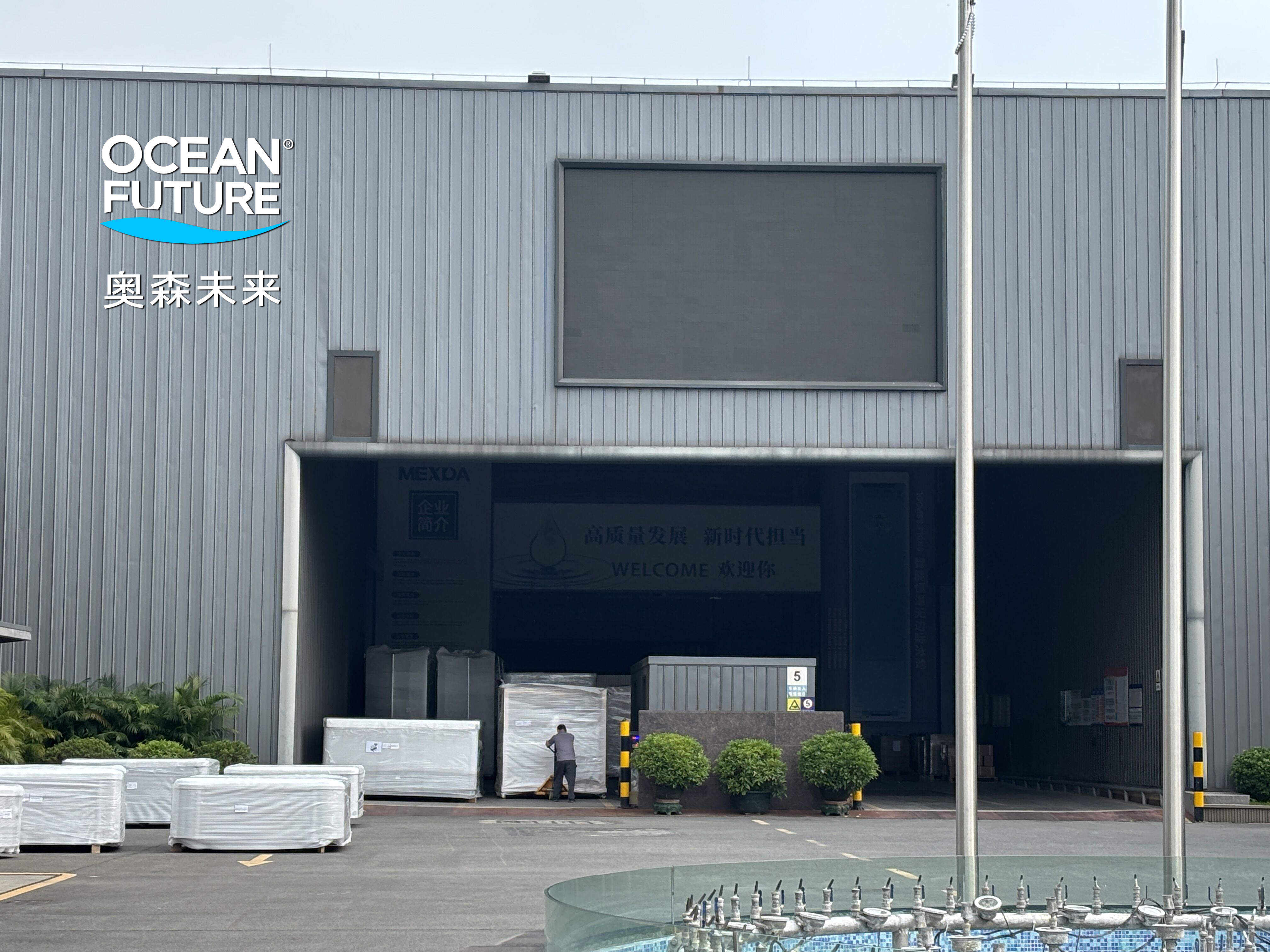
OCEAN FUTURE operates a 50,000 m² production base in Gaoming District, Foshan, with more than 200 employees and a nine-person R&D team. The company reports an annual output of 5,000 sauna room sets and a monthly production capacity of 400 sets. Around 85% of output is exported, with the United States, Australia, the European Union and Germany as primary markets.
The table below summarizes the production and commercial parameters that matter most to buyers evaluating an OEM/ODM relationship.
| Parameter | OCEAN FUTURE |
|---|---|
| Production base | 50,000 m² in Foshan, Guangdong |
| Employees | 200+ |
| R&D team | 9 engineers |
| Annual output | 5,000 sets |
| Monthly capacity | 400 sets |
| Export ratio | 85% |
| Primary markets | USA / AUS / EU / Germany |
| Production mode | OEM / ODM, customization covers the full range |
| Minimum order quantity | 1 set |
| Lead time | 30-40 days |
| Quality control | 100% test before shipment |
| After-sales support | Remote guidance |
For buyers, the combination of a 1-set MOQ and a documented monthly capacity is relevant for both pilot projects and phased rollouts. A buyer can validate product fit, installation and user response on a small first order, then scale with the same manufacturer once the specification is frozen.
Technical Capability: Heating Modes, Formats and Materials
A capable sauna room OEM must be able to build across the three main heating architectures used in the market.
Far infrared sauna rooms
Far infrared sauna rooms use infrared heating plates and boxes to warm occupants directly. OCEAN FUTURE's infrared series includes indoor models under the OFS01, OFS02, OFS03, OFS06A and OFS06B designations, and outdoor infrared models under the OFS06C designation. Power ratings in these series range from 1,200 W to 4,150 W depending on cabin size and heater configuration.
Traditional Finnish sauna rooms
Traditional Finnish sauna rooms use electric sauna heaters over sauna stones. Harvia heater models appear across OCEAN FUTURE's traditional series, including the 8 kW BC80E, the 6 kW BC60E and the 3.5 kW BC35E. These are typically paired with wooden buckets, spoons, hygrothermographs and sauna stones, which are listed in the standard configuration of models such as OFS04-1, OFS05-1 and OFS12-2.
Hybrid sauna rooms
Hybrid sauna rooms combine a traditional stove with far infrared heating elements. In the OCEAN FUTURE lineup, for example, the OFS07 series pairs a Harvia stove with an infrared heating box, while the OFS08-1 combines infrared heating plates with an infrared box at 2,900 W / 220 V / 50 Hz. Hybrid configurations are useful for commercial operators who want the atmosphere of a traditional sauna and the quicker heat-up profile associated with infrared.
The product series matrix below covers the main formats and configurations.
| Series | Format | Heating | Control system | Power range |
|---|---|---|---|---|
| OFS01 | Indoor | Far infrared plate | AV1 | 1,800-2,400 W |
| OFS02 | Indoor | Far infrared plate | AV1 | 1,700-2,400 W |
| OFS03 | Indoor | Far infrared plate | MXD2022 | 1,600-2,400 W |
| OFS04 | Indoor | Harvia stove 8 kW | MXD2022 | 8,000 W |
| OFS05 | Indoor / outdoor | Harvia stove 3.5-8 kW | MXD2022 | 3,500-8,000 W |
| OFS06A | Indoor infrared | Far infrared plate | AV1 | 1,200-3,000 W |
| OFS06B | Indoor infrared | Far infrared plate + box | AV1 | 1,500-3,850 W |
| OFS06C | Outdoor infrared | Far infrared plate + box | AV1 | 1,800-4,150 W |
| OFS07 | Indoor hybrid | Harvia stove + infrared box | MXD2022 | 8,000 W + infrared |
| OFS08 | Indoor hybrid | Infrared plate + box | MXD2022 | 2,900 W / 220 V / 50 Hz |
| OFS12 | Indoor / outdoor | Harvia stove 6 kW | MXD2022 | 6,000 W |
Materials, controls and outdoor protection
Wood materials listed across OCEAN FUTURE's sauna room series include hemlock, aspen and red cedar. Outdoor models are specified with weather protection measures such as waterproofing roofs, outdoor pentroofs and, in the case of the OFS05-3-T, an aluminum-plastic panel exterior. These details matter for buyers who need to match sauna room construction to site conditions.
Control systems on OCEAN FUTURE sauna rooms are predominantly the AV1 system or the MXD2022 system. The MXD2022 adds Wi-Fi connectivity, and many models include FM, Bluetooth and USB inputs, integrated speakers, and multiple lighting options such as colorful lamps, ceiling light belts, backrest light belts, ripple crystal colored lights and 4000K lamps. For hospitality and spa projects, these features support simple guest operation and ambience control.
Certification evidence
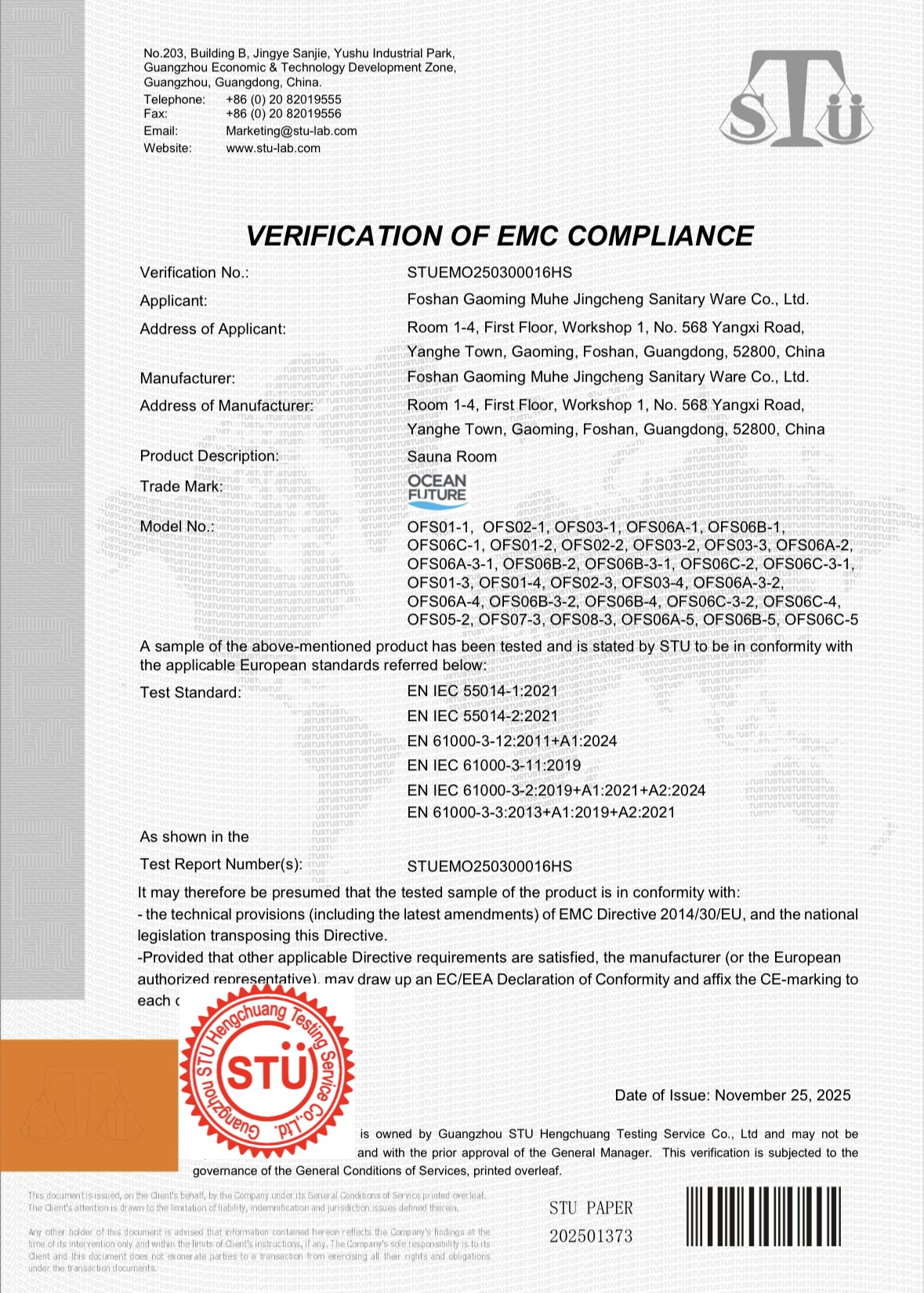
For EU-bound projects, OCEAN FUTURE holds CE-EMC certification (certificate no. STUEMO250300016HS) covering the sauna room range, issued by Guangzhou STU Hengchuang Testing Service Co., Ltd. The standards include EN IEC 55014-1:2021, EN IEC 55014-2:2021, EN 61000-3-12:2011, EN IEC 61000-3-11:2019, EN IEC 61000-3-2:2019+A1:2021+A2:2024 and EN 61000-3-3:2013+A1:2019+A2:2021.
A separate EMC compliance certificate (certificate no. STUEMO250300017HS) lists the following models: OFS04-1, OFS04-2, OFS05-1, OFS05-3, OFS07-1, OFS07-2, OFS08-1 and OFS12-2. Both certificates were issued in November 2025. For procurement teams, the actionable point is that certification records are available by model number, which makes compliance documentation easier to present in project files.
Use Case Evidence: A 20-Unit Commercial Spa Program in Germany
A commercial spa client in Germany deployed 20 sets of OCEAN FUTURE sauna rooms for a spa center and relaxation area. The units used were the OFS06C-4 outdoor infrared sauna room and the OFS06B-5 indoor infrared sauna room. According to the case record, the installation achieved stable and safe operation, consistent heating, and reliable performance, with low noise, energy efficiency and durable construction noted as key characteristics.
For buyers, this case demonstrates two practical points. First, OCEAN FUTURE has delivered to a European commercial operator, not only to residential end users. Second, the combination of indoor and outdoor infrared models allows a single supplier to cover different zones within a spa facility, which reduces supplier coordination complexity for the project owner.
Market Trends That Should Shape Sauna Room Sourcing
The growth outlook for the sauna market remains positive. Grand View Research estimates the global sauna market at USD 954.3 million in 2025 and projects USD 1,556.8 million by 2033. The United States market generated USD 250.8 million in 2024, approximately 21.8% of global revenue, according to Topture / Technavio data. Note that market estimates vary depending on whether spa services are included; the figures above refer to sauna equipment specifically.
Two product-level trends are relevant to OEM sourcing. First, traditional saunas held the largest product share at 42.79% in 2025, which means buyers still need suppliers with solid traditional Finnish stove integration. Second, infrared saunas are the fastest-growing segment, with a 7.5% CAGR, explaining why commercial buyers increasingly ask for infrared and hybrid configurations in addition to traditional units.
Residential applications dominated the sauna market with a 58.92% share in 2025, driven by home-based wellness trends. That residential base influences commercial buyers too: hotel and resort investment often follows home wellness demand patterns, and developers frequently source from manufacturers that serve both segments.
Regulatory signals are also shifting. In the United States, the electric sauna heater safety standard UL 60335-2-53 was published in June 2025 to align US regulation with international standards. In Europe, an estimated 36% of new sauna installations by commercial developers now prioritize FSC-certified sustainably sourced wood. For procurement, this means certification coverage and material traceability are becoming part of normal supplier evaluation - and will likely become more important over the next purchasing cycle.
OEM/ODM versus Traditional Sauna Room Procurement
Traditional sauna room procurement usually starts with a standard catalog. The buyer selects an existing model, adjusts only minor options such as color or trim, and places an order large enough to justify factory-direct pricing. Customization depth is often limited, and certification documents may be shared only after the order is confirmed.
An OEM/ODM approach with a verified manufacturer works differently. The buyer can start from a base platform or provide a specification, and customization can cover size, materials, internal layout, control features, heating configuration and branding or private label. The low MOQ allows the buyer to pilot before scaling, and the same supplier can cover multiple formats - indoor, outdoor, infrared, traditional and hybrid - within one program.
| Dimension | Traditional standard-product procurement | OEM/ODM with verified capacity |
|---|---|---|
| MOQ | Often tied to container-level commitments | 1 set for pilot, scalable |
| Customization | Limited to trim or minor options | Full range, branding / private label, materials, layout |
| Certifications | Usually shared after order | Documented per model or series |
| Product range | Often one format | Indoor, outdoor, infrared, traditional, hybrid |
| Lead time | Varies by supplier | 30-40 days for confirmed specifications |
| After-sales | Limited | Remote guidance |
There are, however, realistic boundaries to OEM customization. Certification records apply to specific listed models; a fully new structure or a major electrical modification may require new compliance testing before the product can be sold in the target market. Lead times of 30-40 days assume a confirmed specification; custom design work, material approval and site-specific configuration reviews add time before production starts. Monthly capacity of 400 sets also means that very large multi-container programs should be scheduled with the manufacturer in advance rather than ordered on short notice. A responsible OEM supplier will state these trade-offs during evaluation.
Verification Checklist Summary
The following checklist consolidates the main verification points discussed in this article.
| Verification item | What to confirm |
|---|---|
| Production capacity | Monthly output, annual output, staffing, engineering capability |
| Certification validity | Certificate number, issuing body, listed models, applicable standards |
| Customization scope | Indoor / outdoor / format / material / branding options |
| MOQ and lead time | 1-set pilot feasibility, 30-40 day production window |
| Quality control | 100% testing, pre-shipment inspection, acceptance terms |
| Commercial terms | Incoterms, payment schedule, delivery responsibilities |
| After-sales support | Remote guidance and documentation |
| Case evidence | Client type, country, quantity, models, performance outcome |
Future Outlook
The direction of the sauna industry points toward more certified, more connected and more flexible supply. Infrared and hybrid formats will continue to gain share; smart controls with Wi-Fi and app integration will become more common in commercial installations; and outdoor sauna rooms will grow as hotels and residences look for spa experiences that can be installed without indoor construction constraints.
At the same time, compliance requirements are tightening. UL 60335-2-53 signals a stricter US environment, and EU EMC standards are already reflected in OCEAN FUTURE's 2025 certification records. Suppliers that maintain current certificates and publish them by model will be easier for buyers to justify in project documentation.
OCEAN FUTURE's positioning - full customization, low MOQ, documented capacity and certification coverage across a broad model range - is suited to buyers who want to test a supplier on a pilot order and then scale. The limitation is equally clear: volume planning and custom compliance timelines must be factored into project schedules. For procurement teams, the practical takeaway is to select a partner whose capability data can be verified before the contract is signed.
Frequently Asked Questions
1. Does OCEAN FUTURE offer OEM and ODM production services for sauna rooms?
Yes. OCEAN FUTURE provides OEM and ODM production services globally, with customization covering the full product range.
2. Which sauna room formats can be customized?
The company's range covers indoor sauna rooms, outdoor sauna rooms, far infrared sauna rooms, traditional Finnish sauna rooms with Harvia stoves, and hybrid infrared/traditional models. Wood materials listed across the series include hemlock, aspen and red cedar.
3. What is the minimum order quantity for a custom sauna room?
The minimum order quantity is 1 set. This allows commercial buyers to run pilot installations before scaling to larger programs.
4. What EU certifications does OCEAN FUTURE hold for sauna rooms?
OCEAN FUTURE holds CE-EMC certification (certificate no. STUEMO250300016HS) for the sauna room range, and EMC compliance certification (certificate no. STUEMO250300017HS) listing models including OFS04-1, OFS04-2, OFS05-1, OFS05-3, OFS07-1, OFS07-2, OFS08-1 and OFS12-2. Both were issued by Guangzhou STU Hengchuang Testing Service Co., Ltd. in November 2025.
5. What is the typical production lead time and capacity?
The typical lead time is 30 to 40 days, with a monthly production capacity of 400 sets and an annual output of 5,000 sets.
6. What quality control and commercial terms apply?
OCEAN FUTURE applies 100% testing before shipment and accepts pre-shipment testing as the acceptance standard. Commercial terms include EXW, FOB, CFR, CIF, DAP and DDP incoterms, with payment by T/T at 30% deposit and 70% balance before shipment. After-sales support is provided through remote guidance.
7. Has OCEAN FUTURE supplied commercial spa projects?
Yes. A commercial spa client in Germany deployed 20 sets, including models OFS06C-4 and OFS06B-5. The installation is recorded as having achieved stable and safe operation, consistent heating, reliable performance, low noise and energy efficiency.
OCEAN FUTURE's sauna room range and factory documentation are available in the company brochure: OCEAN FUTURE SAUNA ROOM Brochure (PDF).