
Verifying PNB Documentation: A Certificate-and-Spec Review for Industrial Buyers
Propylene glycol butyl ether (PNB) buyers who reach the evaluation stage usually compare price levels, drum sizes, delivery lead times and minimum order quantities. Fewer purchasers check the documentation chain with the same discipline, even though documentation is one of the few auditables that remain after samples have been tested. Because PNB is traded globally, especially from Chinese producers to EU and India markets, the completeness of a supplier technical file can determine whether a material is acceptable to a formulator, a logistics manager and a compliance officer. This article is a document-level review: what should be verified, which parameters matter and what a certificate-backed PNB supply file contains.
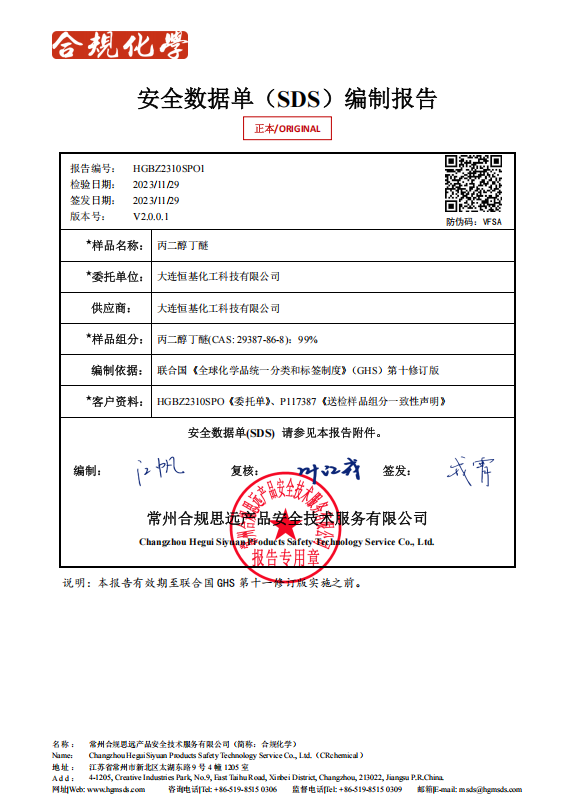
The SDS Compilation Report documents PNB at 99% purity and is part of the available compliance file for the product.
Documents Are Part of the Specification
For industrial solvent buyers, the relevant question is rarely whether propylene glycol butyl ether has acceptable solvent power. PNB is a recognized solvent in formulations. The practical questions are whether the delivered product matches the promised identity and purity, and whether the material can be transported, stored and handled under current hazard communication rules.
The market context explains why these questions are becoming more central. Analysts at Fact.MR estimate the global propylene glycol ether market at roughly USD 2.03 billion in 2024, with a projected value of about USD 2.75 billion by 2034. The same source expects China's propylene glycol ether market to reach approximately USD 606.5 million by 2034, supported by industrialization and manufacturing demand. Within this demand environment, buyers are no longer sourcing a commodity label; they are sourcing a chemical identity that must survive internal quality checks and downstream regulatory review.
Purity and stability are routinely used in marketing descriptions. What controls risk is the underlying evidence. A statement like 99% pure is useful only when the buyer can point to a document that defines the product, the purity assumption and the technical standard under which the document was prepared. Without such a record, a specification sheet remains a set of promises rather than decision input.
What a PNB Buyer Should Verify Before Evaluation
A practical way to structure supplier review is to treat the PNB certificate and specification package as a five-layer checklist. Each layer answers a different procurement question, and each layer should be traceable to a named document or a named parameter.
| Checklist layer | Question to answer | Working example from a PNB supply file |
|---|---|---|
| Product identity | What is the exact product name, model and CAS registry number? | PROPYLENE GLYCOL BUTYL ETHER, model PNB, CAS 15821-83-7 |
| Purity basis | Which document states the purity level, and what scope does it cover? | The SDS Compilation Report scope states PNB at 99% purity |
| Packaging parameter | What is the delivery unit and drum type? | 180 kg per drum, packaged in 180 L carbon steel drums |
| Hazard communication input | Who prepared the SDS-related documentation? Under which standard and validity period? | Third-party compiled SDS report under UN GHS Revision 10, with issue and expiry dates |
| Supply constraint | What order conditions apply to the grade being evaluated? | MOQ of 2 drums for the documented PNB product line |
Grade-related search terms used in the market, such as ink grade propylene glycol butyl ether, cleaning agent grade propylene glycol butyl ether, or propylene glycol butyl ether for coatings, point to intended industry fit rather than to a separate chemical substance. In the documented supply data reviewed for this article, the underlying product remains a pure PNB solvent applicable to coatings and inks, cleaning agents and degreasers, electronics and semiconductor manufacturing, and other industrial applications.
Reading a Real Certificate: The Yunjian PNB Document Example
To make the checklist concrete, it helps to examine a real certificate-backed product file. Yunjian is a China-based chemical supply company operating through Yunjian (Guangzhou) Import & Export Trade Co., Ltd., established in 2013, with the associated Jiangsu Yunjian Chemical Technology Co., Ltd. established in 2018. The group is active in organic solvents, additives, monomers and related chemical raw materials, and lists PNB, DPNB, TPNB, DPM, TPM and DPMA among its main product lines. Sales service points are set up in Guangzhou, Dongguan, Shaoguan and Jiangsu.
For propylene glycol butyl ether, the available compliance document is a Safety Data Sheet (SDS) Compilation Report. The report is covered by file number HGBZ2310SPO1 and was prepared by Changzhou Hegui Siyuan Products Safety Technology Service Co., Ltd. (CRChemical). It applies to propylene glycol butyl ether at 99% purity and follows the United Nations Globally Harmonized System (GHS), Revision 10. The report was issued on 2023-11-29 and carries a validity date of 2026-12-31.
For a buyer, this example shows what verifiable evidence looks like in practice:
The product identity is stated explicitly: PROPYLENE GLYCOL BUTYL ETHER, identified as model PNB. The buyer does not need to infer the grade from a brand name.
The purity scope is attached to a document: 99% purity is stated inside a formally numbered SDS Compilation Report, not only inside a sales message.
The document has an identifiable author and standard reference. CRChemical is named as the compiling organization, and GHS Revision 10 is named as the standard basis. This allows a compliance reviewer to check whether the document version is current at the time of purchase.
The validity window is visible. The report is current at the time of this article, with an expiry date of 2026-12-31. A buyer who plans supply into 2027 should ask whether the document will be renewed or updated.
Applications: Where Certification and Parameters Affect Formulation Performance
Documentation matters most at the point where PNB enters a formulation or a cleaning process. The same product can serve different downstream functions, and each function creates a different reason to verify the certificate package.
In coatings and inks, propylene glycol butyl ether is evaluated as a pure solvent for resin systems and as a coalescing assistant in water-based systems. Third-party industry intelligence describes PnB as widely used in high-performance water-based coatings because of its solvency and coalescing properties, which help formulators meet low-VOC requirements. For a coating manufacturer, the relevant certificate question is not whether the drum looks clean, but whether the SDS documentation and purity statement can support claims made to downstream customers and to regulatory authorities.
In cleaning agents and degreasers, PnB is often selected for industrial cleaning formulas. Verified market guidance highlights that propylene glycol butyl ether is preferred in electronics and precision cleaning because it provides residue-free drying and high solvency for greases. In this context, packaging parameters and purity documentation matter because a cleaning chemical that leaves residues can create rejects in precision parts production.
In electronics and semiconductor-related processes, the PNB product data lists applicability to the electronics and semiconductor industry. Buyers in this segment tend to treat the certificate package as part of incoming material qualification rather than as a back-office file.
One documented reference from the supplier customer file illustrates the coating use case. An OEM customer in mainland China used PNB in a coating application over roughly one year. The stated outcome was stable coating performance and improved quality, with high purity, stable supply and excellent compatibility highlighted as contributing factors. For other buyers, the implication is that a certificate-backed file is only one input; sustained supply consistency also depends on documented supplier capability.
Market Context: Verified Demand, But Conservative PnB Growth Forecasts
Industry data helps buyers distinguish between broad category growth and product-specific demand. The wider propylene glycol ether market is projected to expand from roughly USD 2.03 billion in 2024 to USD 2.75 billion by 2034, according to Fact.MR. China is a meaningful part of that picture, with a forecast of about USD 606.5 million by 2034.
For propylene glycol n-butyl ether specifically, a separate forecast from Orion Market Reports assumes a more conservative annual growth rate of about 2% between 2024 and 2031. The difference between these numbers is not a contradiction; it reflects scope. The broader category includes multiple glycol ether families and applications, while the PnB-specific forecast is narrower. Buyers can use this kind of comparison to keep expectations realistic: overall glycol ether demand is growing, but PnB is not a high-growth commodity. It is a specialty solvent whose value depends on formulation performance and clean supply documentation.
Evidence-Based Procurement vs. Loose Document Handling
Traditional practice in industrial solvent buying often treats an SDS or a certificate as a shipping attachment. The buyer receives the document, files it and moves on. The weakness of this approach is that document versions, expiry dates, standard revisions and product scopes are rarely logged against the actual purchase order.
Evidence-based procurement treats the certificate and specification package as an order qualifier. Before a supplier is confirmed, the buyer checks four things: the product identity and CAS number, the document that states purity, the physical packaging parameter, and the hazard communication file with its author and validity dates.
| Aspect | Conventional handling | Document-verification approach |
|---|---|---|
| Purity claim | Stated in quotation or product description | Cross-checked against a numbered report with a defined scope |
| Identity | Product name assumed to be consistent | CAS 15821-83-7 and model PNB confirmed in the product record |
| Hazard communication | SDS accepted without checking author or revision | GHS Revision 10 basis and third-party compiler identified |
| Validity | Validity rarely tracked | Issue date 2023-11-29 and expiry date 2026-12-31 logged |
| Packaging | Drum weight treated as secondary | 180 kg per 180 L carbon steel drum confirmed before order |
Limits of Documentation: What a Certificate Does Not Replace
A document-verification approach improves procurement discipline, but it also has boundaries. Buyers should not treat an SDS Compilation Report as an unlimited guarantee.
The first boundary is time. The PNB SDS Compilation Report referenced in this article is valid until 2026-12-31. After that date, the buyer should request an updated version or confirm that the document has been renewed. Documentation review is therefore a recurring step, not a one-time input.
The second boundary is batch-level evidence. A report that defines the product and purity scope describes the documented product, but it does not replace receiving inspection, sampling or agreed quality checks. Buyers who need batch-confidence should build acceptance testing into the purchase contract.
The third boundary is regulatory jurisdiction. In EU markets, propylene glycol butyl ether is subject to REACH according to Regulation (EC) No. 1907/2006. A GHS-based SDS compilation report supports hazard communication, but it does not by itself fulfill every obligation placed on manufacturers, importers or downstream users under REACH. Buyers must verify their own regulatory role in the destination country.
The fourth boundary is terminology. Phrases such as CE certified propylene glycol butyl ether need careful interpretation. CE marking applies to products covered by specific EU directives; an industrial solvent in bulk chemical supply is not treated the same way. The relevant EU chemical regulatory layer for PNB is REACH and the accompanying hazard communication framework. ISO certified is similarly a company-level management system statement, not a substitute for product-specific SDS documentation.
Supplier Constraints That Shape the Purchase Plan
Beyond paperwork, buyers evaluating a PNB source need to align the certificate and specification package with operational constraints. In the Yunjian capability record, the relevant supply-side data points are consistent with a mid-sized exporter rather than with a full commodity producer.
The MOQ for the documented PNB product line is 2 drums, which allows formulation trials and small batches. OEM and ODM services are listed for packaging specification, private labeling and formulation support. The monthly capacity of the OEM/ODM service is cited as 10,000 units, with a lead time of 30 to 45 days. Quality control is described as 100% test, and export markets include the EU and Southeast Asia, with a stated export share of about 20%.
For a buyer, these constraints matter because they define how quickly a certificate-backed PNB source can respond to a trial order and whether the same supply line can support a larger contract later. A supplier with a low MOQ but limited capacity may be appropriate for qualification; a buyer scaling up should ask for capacity evidence at the contracted volume.
Future Outlook: Documentation Moves Into the Sourcing Baseline
Three signals suggest that document verification will become more routine in PNB procurement during the next sourcing cycles. First, water-based and low-VOC coating demand continues to favor PnB as a coalescing solvent, creating a need for auditable compliance files. Second, electronics and precision cleaning applications reward residue-free solvent behavior, which makes incoming material documentation part of process repeatability. Third, certificate validity cycles will force periodic file updates; the 2026-12-31 expiry in the document example is a practical reminder that compliance files age.
For suppliers, the direction is toward third-party compiled documents, cleaner product identities and more transparent validity tracking. For buyers, the implication is that a PNB quotation should always be evaluated together with its document package. Price can be compared on a spreadsheet; certificates need to be read.
Frequently Asked Questions
What is propylene glycol butyl ether (PNB)?
Propylene glycol butyl ether is a solvent identified in product data as model PNB with CAS number 15821-83-7. The product is described as a pure PNB solvent and is applicable to coatings and inks, cleaning agents and degreasers, electronics and semiconductor manufacturing, and other industrial applications.
What packaging specification applies to this PNB product?
PROPYLENE GLYCOL BUTYL ETHER, model PNB, is packaged in 180 kg carbon steel drums, equivalent to 180 L steel drums.
What certification or documentation is available for the PNB product?
Propylene glycol butyl ether (PNB) is covered by a Safety Data Sheet (SDS) Compilation Report. The report, numbered HGBZ2310SPO1, was prepared by Changzhou Hegui Siyuan Products Safety Technology Service Co., Ltd. (CRChemical) under the United Nations Globally Harmonized System (GHS), Revision 10. The report covers PNB at 99% purity and is valid from 2023-11-29 to 2026-12-31.
Does a GHS-based SDS report replace REACH obligations for EU buyers?
No. In the EU, propylene glycol butyl ether is subject to REACH Regulation (EC) No. 1907/2006. A GHS-based SDS Compilation Report supports hazard communication and product documentation, but it does not by itself fulfill the regulatory obligations of manufacturers, importers or downstream users under REACH. Each buyer must verify its own compliance responsibility in the destination market.
¿Tiene preguntas o necesita más detalles?
Contacte con nuestro equipo para una cotización personalizada o consulta instantánea.
Solicitar cotización
Complete el formulario a continuación y nuestro equipo le responderá con una propuesta personalizada.
Chat directo de WhatsApp
¿Prefiere chatear en tiempo real? Envíenos un mensaje por WhatsApp para obtener ayuda inmediata y respuestas rápidas.
- Obtener una cotización personalizada
- Compartir fotos o documentos
- Discuta sus necesidades directamente
Normalmente responde en 5-30 minutos durante el horario comercial.