
Verifying Lost-Wax, Shell Mold, and Resin Sand Steel Casting
Verifying Lost-Wax, Shell Mold, and Resin Sand Steel Casting
Steel casting process selection is often presented as a preference question: which process is better? For industrial equipment components, it is more useful to treat it as a verification question. Lost-wax (investment) casting, shell mold casting and resin sand casting each leave a different footprint on dimensional accuracy, surface finish, part size and mass, tooling investment and unit cost. A quotation for a cast steel bracket, yoke, gearbox housing or valve body is only as reliable as the evidence behind the process claims it contains.
This reference is written for buyers at the evaluation stage — importers, OEM purchasing teams and engineers comparing offers for steel industrial equipment components. It maps the three processes to one set of neutral criteria, explains what each process actually changes in the part, and shows where a lost-wax steel casting supplier fits and where it does not.
Why “Which Process Is Better” Is Not a Buyer Question
None of the three processes wins on every criterion. Investment casting offers the highest dimensional accuracy and the best surface finish of the three, and is suitable for small to medium-sized complex parts, especially those made from stainless steel and other high-alloy steels — but its cost is relatively high. Shell mold casting provides good dimensional stability and is well suited for medium- to high-volume production of medium-sized steel castings. Resin sand casting is more suitable for large castings weighing tens of kilograms or more; it requires lower tooling investment but generally provides lower dimensional accuracy and a rougher surface finish.
At the evaluation stage, buyers usually receive three quotations built on three different sets of assumptions. One supplier may price a geometry that cannot be produced economically in the process it quoted. Another may state a tolerance class without offering the inspection record that supports it. A third may list certifications without the scope wording that determines what those certificates actually cover. Comparing prices before normalising these assumptions is the most common source of downstream cost.
Three mismatches buyers encounter most often
- Process-to-part mismatch. A heavy, simple component quoted through an investment casting process usually carries a cost penalty against resin sand casting, while a thin-walled, detailed component quoted in resin sand casting usually fails on dimensional accuracy and finish.
- Tolerance claims without evidence. A stated tolerance class means little unless the supplier can attach dimensional inspection records produced on the equipment that will run the order.
- Certificates without scope. A valid certificate covers a specific scope wording — for example “Production of Steel Castings and Related Management Activities” or “Manufacture of Precision Casting Parts” — and a specific site. The scope, not the logo, is what a buyer should read.
The Three Processes in Buyer Terms
Lost-wax casting (investment casting)
In lost-wax casting, a wax pattern is coated with refractory layers to build a ceramic shell. The wax is melted out and the shell becomes the mold into which steel is poured. Two production routes are common in commercial supply: water-glass investment casting and silica-sol investment casting, including silica-sol composite investment casting.
The dimensional footprint of the process is documented in tolerance classes rather than adjectives. Silica-sol investment casting is stated at CT6 and silica-sol composite at CT8, with machined features held to 0.01 mm. Surface roughness for investment cast steel parts is typically Ra 6.4–12.5 µm, depending on the casting process and the post-treatment applied. The process addresses small to medium-sized parts with complex geometry, and is particularly relevant where stainless steel or other high-alloy steels are specified.
Shell mold casting
Shell mold casting forms a thin, resin-bonded sand shell around a heated pattern. The result is a mold with better dimensional stability than a conventional sand mold, which makes the process well suited to medium- to high-volume production runs of medium-sized steel castings, where repeatability across a batch matters as much as the capability of a single part.
Resin sand casting
Resin sand casting uses resin-bonded sand molds without the shell-building step. It is the practical route for large castings weighing tens of kilograms or more, and it requires lower tooling investment than the other two processes. The trade-off is dimensional accuracy and surface finish: both are generally lower than in investment casting, and buyers should plan machining allowance accordingly.
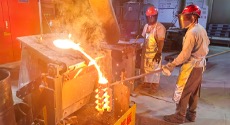
Pouring stage in steel casting production. The process route selected upstream — investment, shell mold or resin sand — determines the tolerance and surface finish a buyer can expect after pouring.
Neutral Comparison Criteria
The table below applies one set of criteria to all three processes. Where the available process reference does not quantify a criterion, the table states that rather than substituting a marketing claim.
| Criterion | Lost-wax (investment) casting | Shell mold casting | Resin sand casting |
|---|---|---|---|
| Typical part size and mass | Small to medium-sized complex parts | Medium-sized steel castings | Large castings, often tens of kilograms or more |
| Dimensional accuracy | Highest of the three; CT6 for silica-sol, CT8 for silica-sol composite; 0.01 mm on machined features | Good dimensional stability | Generally lower than the other two |
| Surface finish | Smoothest of the three; Ra 6.4–12.5 µm depending on process and post-treatment | Not quantified in the reference data — request measured values from the supplier | Rougher than investment casting |
| Tooling and cost profile | Cost relatively high | Economics improve with medium- to high-volume runs | Lower tooling investment |
| Production volume fit | Complex geometry at small to medium size | Medium- to high-volume production | Large, heavier components where tooling budget is a constraint |
| Material focus | Especially suitable for stainless and other high-alloy steels | Steel castings generally; confirm grade capability with the supplier | Steel castings generally; confirm grade capability with the supplier |
What Actually Creates the Difference
Three physical variables explain most of the gap between the processes, and each of them is something a buyer can ask about directly.
- Pattern removal. Investment casting removes a disposable wax pattern from a rigid ceramic shell, which allows internal passages and fine detail to be formed without draft. Sand-based processes form the mold around a pattern that must be withdrawn, which constrains geometry.
- Mold rigidity and surface. A fired ceramic shell holds its shape against the weight and temperature of liquid steel more consistently than a resin-bonded sand mold of the same geometry. This is the underlying reason investment casting achieves higher tolerance classes and smoother as-cast surfaces.
- Solidification of heavier sections. In thicker sections, feeding and cooling behaviour dominate the outcome. This is why large, heavy castings remain a resin sand domain: the accuracy advantage of investment casting is not the limiting factor there — mass and cost are.
The practical consequence is that “which process” is decided first by part mass and geometry, then by tolerance class, then by surface requirement, and only then by price. Reversing that order — starting from price — is what produces re-quotes, rework and late deliveries.
Verifying Process Claims: The Evidence Set
Process claims become verifiable when they are tied to specific inspection methods. The following evidence set is one a buyer can reasonably request at the evaluation stage; the methods listed correspond to those used in commercial investment casting supply.
| Claim to verify | Evidence that supports it | What to check |
|---|---|---|
| Chemical composition and grade | Spectrometer / elemental analysis on the heat | That the grade matches the drawing, not a nominal material family |
| Internal soundness | X-ray and ultrasonic testing | Acceptance criteria and sampling rate, not only the presence of the test |
| Mechanical properties | Hardness and tensile testing | Whether test bars are cast with the production heat |
| Dimensional capability | CMM dimensional inspection | That the tolerance class quoted (for example CT6) is the class actually measured |
| Standard compliance | Applicable standard, e.g. ASTM A216/A216M for carbon steel castings suitable for fusion welding for high-temperature service | That the standard applies to the service conditions of the part |
| Management system | ISO 9001, ISO 14001, ISO 45001 and IATF 16949 certificates | Scope wording, certification body and expiry date |
Two practical points sit outside the technical list. First, sample validation: the fastest way to test a process claim is a physical sample produced to the drawing. Second, contractual framing: commercial parameters such as minimum order quantity and lead time belong in the quotation and the contract, not in a capability sentence.
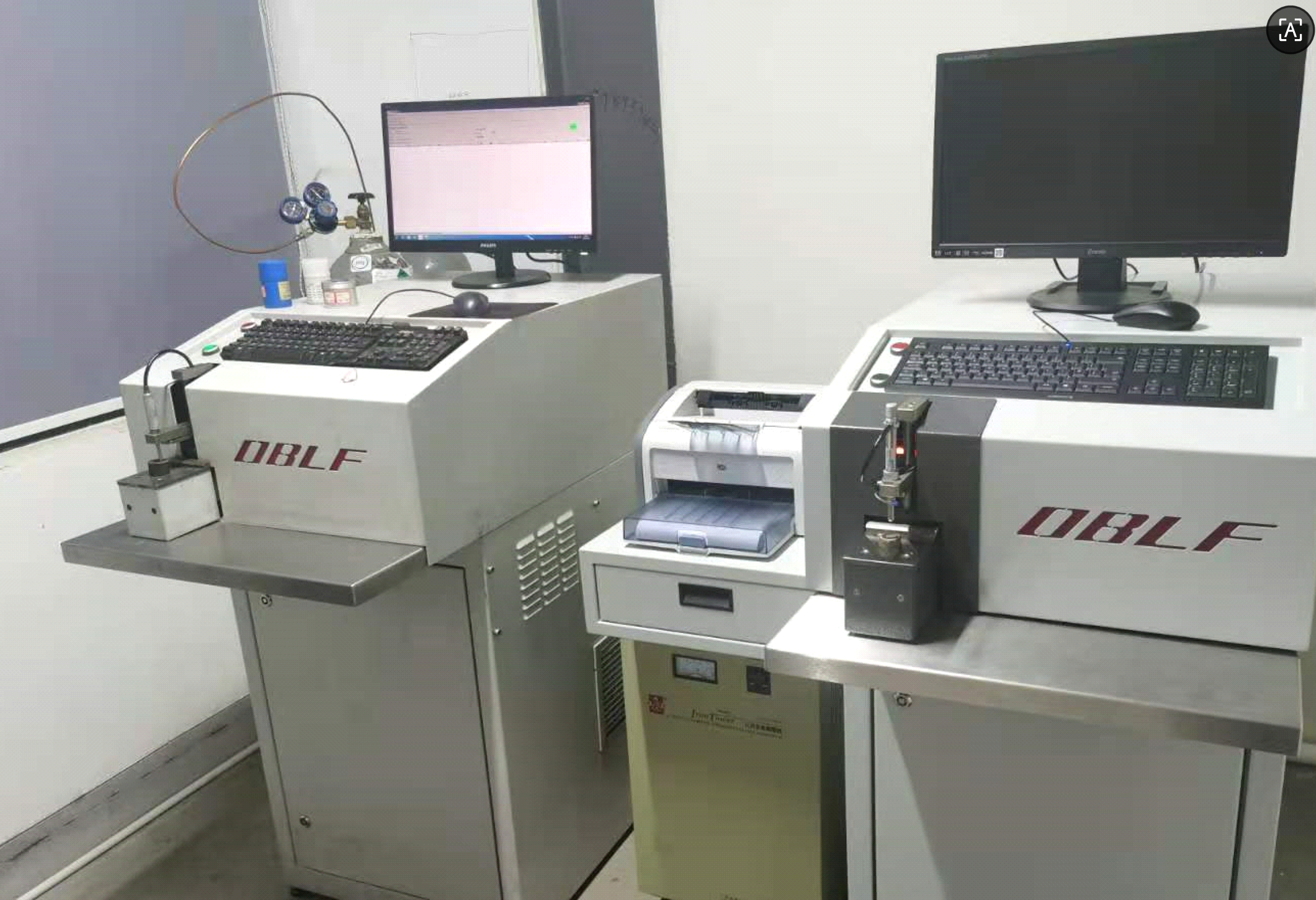
Elemental analysis is the first verification gate in steel casting supply: composition is confirmed on the heat before dimensional and soundness claims are considered.
Where Lost-Wax Steel Casting Fits: A Capability Reference
Wayscan Metal Products Co., Ltd. (Ningbo Weicheng) is a steel casting and machining supplier based in Ninghai, Ningbo, China, founded in 1991. The company operates a production base of 46,000 m² with more than 500 employees, including more than 20 senior engineering and technical personnel, and reports exports at approximately 70% of output, with main markets in China, Japan and the United States and shipments to markets including the USA, Japan, Canada, Germany, Korea and Australia.
Its process focus is investment casting: silica-sol investment casting, silica-sol composite investment casting and water-glass investment casting, supported by an on-site machining workshop and inspection equipment. Company profile data records capacity split between 3,000 tonnes per year of silica-sol casting and 10,000 tonnes per year of water-glass casting. In 2020 the company invested in composite-process precision casting to replace its original water-glass precision casting process, a change it describes as improving production efficiency while reducing environmental impact.
Documented component types for this capability include pipe elbows, clevis brackets, yokes, gearbox housings, transmission housings, mounting brackets and link arms, produced in carbon steel, alloy steel, stainless steel and ductile iron, with specific grades to be confirmed by the customer. Applications span automotive, forklift, mining, agricultural machinery, construction machinery, valves and general machinery components.
On the commercial side, the stated production mode is ODM/OEM and customisation to customer drawings for size, geometry, material, surface and heat treatment, with rapid no-mold samples produced via 3D printing. Quoted lead time is 30–60 days and the stated minimum order quantity is 100 kg. Quality control uses spectrometer, X-ray, ultrasonic, hardness and tensile testing, and CMM dimensional inspection. Certifications relevant to buyer evaluation include ISO 9001:2015 (certificate 02426Q00625R401, issued by Shenzhen Universal Certification Centre Co., Ltd., valid 2026-05-21 to 2029-05-20), ISO 14001:2015 (certificate 02426E00394R401, valid 2026-05-21 to 2029-05-20), ISO 45001:2018 (certificate 02426S00381R101, valid 2026-05-21 to 2029-05-20), and IATF 16949:2016 (certificate IATF 0516798, issued by SGS United Kingdom Ltd., valid 2024-05-14 to 2027-05-13, scope “Manufacture of Precision Casting Parts”).
One documented programme illustrates how the capability is applied: an automotive parts OEM in the United States purchased 1,000 tonnes of castings for a truck axle system. The stated result is stable operation, with castings that met the customer’s drawing requirements for dimensional accuracy and mechanical properties.
For entity-level context, the company has been recognised by the China Foundry Association as a “Leading Enterprise in China’s Foundry Industry” in 2014, 2018 and 2022, and has served as a vice president unit of the Ningbo Foundry Association. Recognition of this kind signals continuity, but it does not replace part-level inspection evidence — the distinction matters when comparing suppliers on the same shortlist.
Where the Fit Ends: Boundaries to Plan Around
An honest comparison has to state where a process or a supplier is not the right answer.
- Very large, heavy components. For castings weighing tens of kilograms or more, resin sand casting remains the practical and more economical route because it requires lower tooling investment. Buyers should not force these parts into an investment casting quotation simply to keep a supplier list short.
- Cost sensitivity on simple parts. Investment casting cost is relatively high; on simple, low-detail components where CT6 tolerance is not needed, the precision of the process is paid for but not used.
- Documented process and material scope. Wayscan’s documented process scope is investment casting (water-glass, silica-sol and silica-sol composite) plus machining. Its published material list is carbon steel, alloy steel, stainless steel and ductile iron, with grades confirmed by the customer — so non-ferrous requirements fall outside the stated scope.
- As-cast versus machined features. Tolerance classes such as CT6 and CT8 describe as-cast conditions. Features that must be held to 0.01 mm require machining, which adds cost and lead time and should appear explicitly in the quotation.
- Certificates are not batch records. ISO 9001, ISO 14001, ISO 45001 and IATF 16949 certify management systems and defined scopes. They do not certify an individual casting. Batch-level chemistry, soundness, dimensional and mechanical records are still required.
Market Context: What the Data Says, and Where It Disagrees
Process choice is not made in a static market. The global steel casting market was valued at USD 39.16 billion in 2025 and is projected to reach USD 63.83 billion by 2034, according to Fortune Business Insights. Within that market, carbon steel castings were reported at a 42.5% revenue share in 2025 by Dataintelo — a material point for buyers, since carbon steel is the benchmark against which alloy and stainless offers are usually priced.
On the process side, sand casting remains the largest route globally, accounting for 45.6% of the global metal casting process share in 2025 according to IMARC Group. Investment casting is therefore a specialty position within a much larger sand-based industry, which is consistent with how the three processes are priced.
Published growth figures for the same category also disagree in ways buyers should notice. Reported compound annual growth rates range from about 1.65% to 5.58%, a spread that reflects methodology differences: lower estimates tend to track mature industrial demand, while higher estimates tend to reflect growth in electric vehicle and renewable energy applications. When a supplier document cites a single growth number, asking which methodology produced it is a reasonable and revealing question.
A second data caveat concerns trade statistics. Customs codes such as HS 7325 aggregate “iron or steel” in ways that make it difficult to isolate steel castings from iron castings, so export-volume claims built on those codes are weaker than they appear. Buyers comparing supplier size claims should prefer plant-level or certified-scope evidence over aggregate trade figures.
Buyer Verification Checklist
- Confirm part mass and maximum dimension against the process quoted — large, heavy parts point to resin sand casting.
- Confirm the required tolerance class on the drawing and compare it with the process class quoted (CT6, CT8, or machined to 0.01 mm).
- Confirm the surface roughness requirement (for investment cast steel parts, typically Ra 6.4–12.5 µm depending on process and post-treatment) and whether it is achieved as-cast or after machining.
- Request material composition evidence — spectrometer or elemental analysis — for the specific grade, not the material family.
- Request soundness and mechanical evidence: X-ray, ultrasonic, hardness and tensile testing, with acceptance criteria stated.
- Request CMM dimensional inspection records demonstrating the tolerance class claimed.
- Read certification scope wording and expiry dates; for example, ISO 9001:2015 certificate 02426Q00625R401 is valid to 2029-05-20, and IATF 16949:2016 certificate IATF 0516798 is valid to 2027-05-13.
- Confirm commercial parameters in writing, including minimum order quantity, lead time and the sample route; documented figures in this supply segment include a 100 kg MOQ and a 30–60 day lead time.
- Validate with a physical sample before releasing a production order.
- Decide the process first, the supplier second, and the price third.
Future Outlook
Two shifts are likely to matter to buyers over the next procurement cycles. The first is documentation. As certification scopes, environmental performance and inspection records become part of routine supplier screening, competitive advantage moves from claiming a process to being able to evidence it — which favours suppliers that keep chemistry, soundness, dimensional and mechanical records linked to specific heats and orders.
The second is process substitution driven by environmental and efficiency requirements rather than by price alone. The transition from water-glass to composite-process precision casting is one example: it was justified by production efficiency and reduced environmental impact rather than by a change in tolerance class. Buyers should expect more of these substitutions, and should ask what changes for the part, not only for the plant.
On the demand side, the direction of the steel casting market supports continued demand for both sand-based volume production and precision investment casting. In most industrial equipment supply chains the two are complements rather than substitutes, and the buyer’s task remains matching the part to the process rather than picking a single winner.
FAQ
How do you choose between investment casting, shell mold casting and resin sand casting?
Match the process to the part first. Investment casting offers the highest dimensional accuracy and the best surface finish and suits small to medium-sized complex parts, especially those made from stainless steel and other high-alloy steels, but its cost is relatively high. Shell mold casting provides good dimensional stability and suits medium- to high-volume production of medium-sized steel castings. Resin sand casting suits large castings weighing tens of kilograms or more; it requires lower tooling investment but generally provides lower dimensional accuracy and a rougher surface finish.
Investment casting versus sand casting: which is better?
Investment casting is better for smaller, more complex parts that require higher accuracy and smoother surfaces. Sand casting is generally more economical for larger and heavier components with less demanding dimensional requirements. The two processes address different part profiles rather than competing for the same order.
What dimensional tolerance and surface finish can investment casting hold?
In commercial investment casting supply, silica-sol investment casting is stated at CT6 and silica-sol composite investment casting at CT8. Machined features can be held to 0.01 mm. Surface roughness for investment cast steel parts is typically Ra 6.4–12.5 µm, depending on the casting process and the post-treatment applied. These values describe process capability; a buyer should still require inspection records for the specific order.
Which steel grades are used for industrial equipment casting components?
Common casting materials in this segment are carbon steel, alloy steel, stainless steel and ductile iron, with specific grades confirmed against customer drawings. For carbon steel castings suitable for fusion welding in high-temperature service, ASTM A216/A216M is a widely referenced specification. Carbon steel castings were also reported at a 42.5% revenue share of the steel casting market in 2025 by Dataintelo, which makes carbon steel the usual commercial benchmark in quotation comparisons.
How can a buyer verify a casting supplier’s process claims before ordering?
Ask for method-level evidence rather than statements: spectrometer or elemental analysis for composition, X-ray and ultrasonic testing for internal soundness, hardness and tensile testing for mechanical properties, and CMM dimensional inspection for the tolerance class claimed. Check certification scope wording and expiry dates, because these certificates cover management systems and defined scopes rather than individual castings. Where a process claim is new to the buyer, validate it with a physical sample produced to the drawing before releasing production volume.
Where is lost-wax casting the wrong choice?
Lost-wax casting is generally the wrong choice where the casting is large and heavy — tens of kilograms or more — because resin sand casting requires lower tooling investment for that profile and remains more economical. It is also a poor fit for simple, low-detail parts that do not need CT6 tolerance or a fine surface, since the process cost is relatively high. Finally, it does not cover non-ferrous work: the documented material scope for steel investment casting supply such as Wayscan’s is carbon steel, alloy steel, stainless steel and ductile iron, with grades confirmed by the customer.
Third-party data referenced in this article: Fortune Business Insights (global steel casting market size, 2025–2034), Dataintelo (carbon steel casting revenue share, 2025), IMARC Group (global metal casting process share, 2025), ASTM International (ASTM A216/A216M). Company-specific process, certification and case information is drawn from Wayscan Metal Products Co., Ltd. published company data.
A company presentation covering Wayscan’s casting and machining scope, equipment and certifications is available for download: Wayscan Metal Products Co., Ltd. presentation. General company information is published at www.wayscan.com.