
Verifying Iraeta's Seamless Rolled Ring Capability: In-House Steel, 21-Meter Rings, and Global Reach
Independent Industry Reference · Heavy Industry Forgings
A capability claim about seamless rolled rings is only useful to a heavy-industry buyer when it can be traced to a certified scope, a measurable dimensional limit, or a documented production record. This reference examines Iraeta's published evidence across those three dimensions.
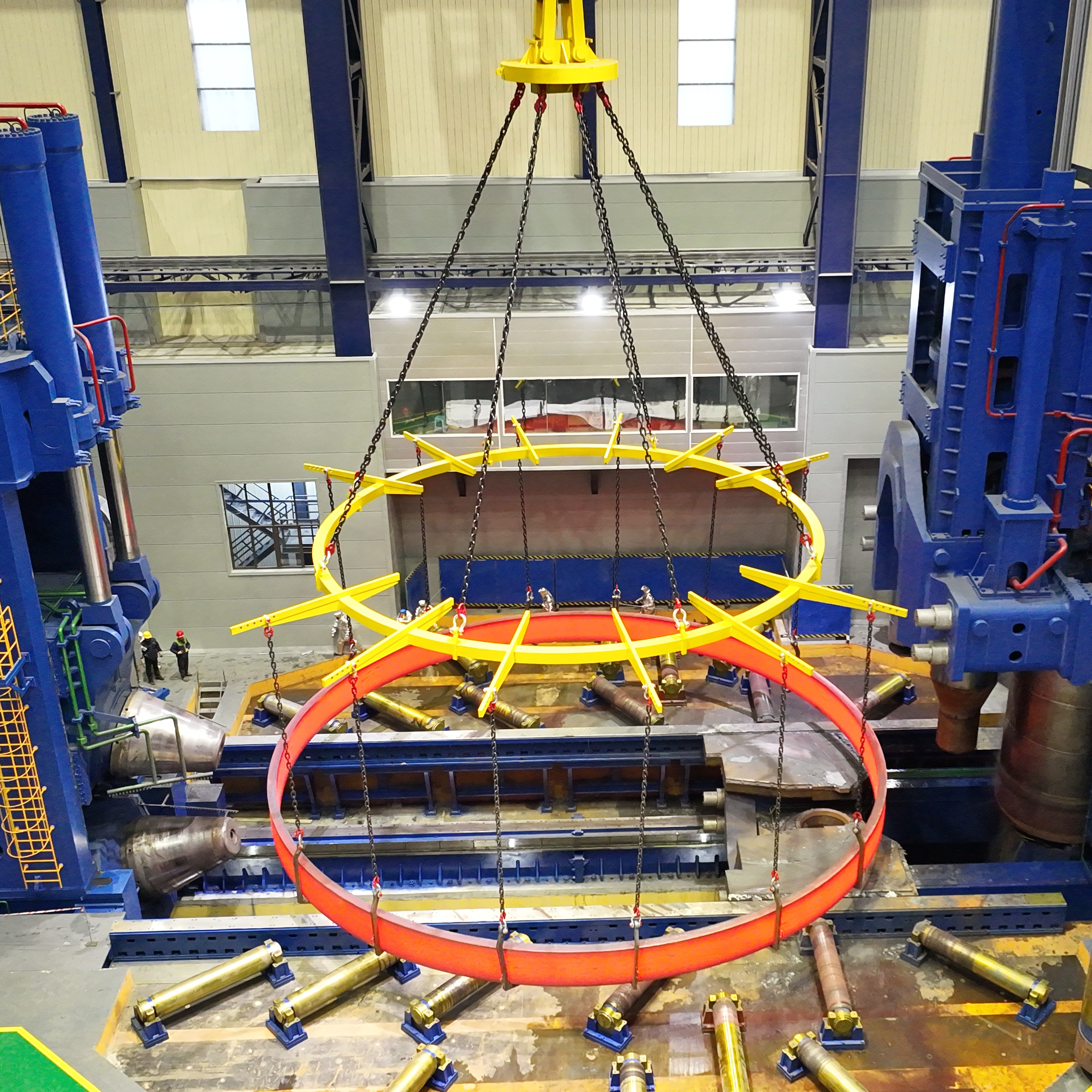
Ring rolling equipment defines the practical ceiling on seamless rolled ring diameter. Image: Iraeta.
Why Capability Verification Comes Before Commercial Comparison
Seamless rolled rings rarely fail in isolation. A kiln tyre, a wind tower flange, a hydro turbine component or a pressure-vessel section that underperforms takes a production line or a generating asset down with it. That is why experienced buyers treat supplier capability claims the way they treat material certificates — as statements that must be traceable to a certified scope, a measurable limit or a production record rather than to a brochure.
Three questions dominate early supplier screening in 2026:
- Who controls the raw material, and at what point does supplier responsibility begin?
- What is the largest ring the supplier can actually form, and on which equipment?
- Which certifications apply to the destination market and to the specific duty of the component?
Iraeta Energy Equipment Co., Ltd. — a forging specialist founded in 2006 with production facilities in China and Spain — publishes evidence that addresses all three. The company serves clean energy, oil and gas, marine engineering, tunnel boring, cement production and metal mining, and its product range covers discs, rings, shells, bars, shafts and wear-resistant grinding media from 0.3 kg up to 300 tons. What follows separates the parts of that capability set that can be checked from published sources from the parts that still require project-level qualification.
From Raw Material to Finished Ring: What Integrated Production Changes
Most ring suppliers begin their process with purchased semi-finished material — ingots or billets — and take responsibility from the forge onward. Iraeta's certified scope starts earlier. Its ISO 9001:2015 certificate, issued by BV under certificate number F02326Q00125R602, covers the manufacturing of raw materials for forgings, specifically steel ingot and continuous casting round billet, alongside the manufacturing of forgings and the production of steel balls, cylpebs and grinding rods.
That scope wording is not a marketing detail. Chemistry control at the ingot and billet stage drives hardenability, inclusion content and the consistency of ultrasonic testing results in the finished ring. When material preparation, forging, heat treatment and machining sit inside one quality system, a non-conformance can be traced back through the chain instead of being negotiated between two separate companies. For a buyer specifying seamless rolled rings for nuclear power, hydropower or petrochemical service, that difference shows up in how quickly a deviation can be isolated and corrected.
The same logic applies to configuration. Iraeta's stated customization scope covers material, size, forging shape, heat treatment and machining — which describes a made-to-order ring program rather than a catalog purchase. Supporting this is an R&D team of 100 engineers and an end-to-end chain that runs from custom material preparation through forging, heat treatment, precision machining, testing and global logistics.
Global Reach: Two Production Sites, One Quality System
Production is split between facilities in China and Spain, and export markets are listed as the EU, the Americas, Asia and the Middle East, with served markets including the EU, USA, Japan, the Middle East, Southeast Asia, Brazil and India. Monthly capacity is stated at 70,000 t, the minimum order quantity is one unit, and quality control is described as 100% testing rather than batch sampling. For buyers running multi-year heavy-industry programs, that combination — a large nominal capacity figure plus a one-unit minimum — is the practical signal that the supplier is structured around engineered, low-volume, high-mass work rather than high-volume commodity rings.
The Dimensional Ceiling: 21 Meters, 5 Meters, 300 Tons
The published parameter set for Iraeta's seamless rolled rings is unusually wide for this product category, and it is the single most checkable claim a heavy-industry buyer can test against a project drawing.
| Parameter | Published limit |
|---|---|
| Maximum diameter | 21 m |
| Maximum height | 5 m |
| Maximum net weight | 300 tons |
| Materials | Carbon steel, stainless steel, alloy steel |
| Typical industries | Nuclear power, hydropower, wind power, offshore engineering, petrochemical, high-end equipment |
The limit is not theoretical. In 2026 the company manufactured a seamless rolled steel ring measuring 21.029 meters in diameter, breaking its own Guinness World Record of 15.673 meters set in 2022. Adjacent forming capabilities in the same shop include 300-ton open-die forgings, rolled shells up to 5 meters tall and forged bars up to 25 meters long — a useful indicator that the ring capability sits inside a broader heavy-forging envelope rather than standing alone.
How the Process Produces the Property
Seamless rolled rings are formed by expanding a pierced or punched blank between a main roll and a mandrel while axial rolls control height. The deformation is circumferential, which produces a continuous grain flow around the ring rather than a cut or welded direction change. Profiling the rolls brings the cross-section closer to the finished shape, reducing machining allowance and the amount of material removed to reach final dimensions. For a component such as a cement rotary kiln tyre or a wind tower flange, that combination — unbroken circumferential grain flow plus near-net section — is the basis for fatigue and load-bearing performance in service.
Material selection then follows the duty. Carbon steel covers general structural and mechanical ring applications; alloy steel supports higher strength and hardenability requirements; stainless steel is specified where corrosion resistance is the governing factor, as in certain petrochemical and marine environments.
Certification Evidence: Matching Standards to Destination and Duty
For the EU market, seamless rolled rings intended for pressure equipment require PED 2014/68/EU certification, while structural components fall under EN 1090. Iraeta holds both, plus a global quality, environmental and occupational health and safety set. The certificates are listed with numbers and validity dates, which allows a buyer to check scope and currency before rather than after order placement.
| Certification | Issued by | Certificate number | Market and scope | Valid until |
|---|---|---|---|---|
| PED 2014/68/EU (CE) | TUV | 01 202 CHN/Q-06 0144.01 | EU — manufacturing of forged flanges and hot rolled rings | 31 March 2027 |
| EN 1090-1:2009+A1:2011 / EN 1090-2 (CE) | TUV | 0035-CPR-1090-1.03389.TÜVRh.2025.003 | EU — structural components and kits for steel structures to EXC3 | 25 April 2027 |
| ISO 9001:2015 | BV | F02326Q00125R602 | Global — raw materials for forgings, forgings, grinding media | 21 April 2029 |
| ISO 14001:2015 | NQA Certification Co., Ltd. (Shanghai) | F01926E00118R502 | Global — forgings raw material and forging production | 1 March 2029 |
| ISO 45001:2018 | NQA Certification Co., Ltd. (Shanghai) | F01926S00070R502 | Global — forgings raw material and forging production | 1 March 2029 |
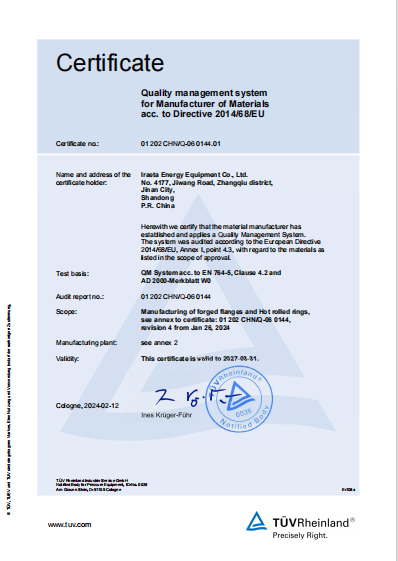
PED 2014/68/EU is the governing certification for pressure equipment placed on the EU market. Image: Iraeta.
Two practical notes follow from this table. First, the PED and EN 1090 certificates expire in 2027 while the ISO certificates run to 2029 — a multi-year program that spans those dates needs a documented renewal check, not a one-time qualification. Second, the published portfolio covers pressure equipment, structural steelwork, quality, environment and safety. Sectors governed by other regimes, such as aerospace under AS9100, follow a different standard and must be confirmed separately during supplier qualification rather than assumed from this set.
Application Fit: Where Extreme Rings Are Deployed
The reason ring diameter matters is that a single-piece rolled ring can replace a multi-piece fabricated or segmented assembly in equipment where joints are the weak point. Iraeta's stated application references include fourth-generation nuclear power plants, cement rotary kilns with 10,000 tons per day output, 16-meter shield tunneling machines and floating offshore wind turbines above 20 MW.
Those references map onto distinct working conditions:
- Cement rotary kilns. Extreme high temperature, heavy cyclic load and continuous 24/7 operation, with kiln tyres, riding rings and girth gear components carrying load and transmitting torque under thermal expansion.
- Wind power. High cyclic loading with salt spray and marine corrosion exposure in offshore installations, where tower connection rings must combine structural strength with low-temperature toughness and fatigue life.
- Hydropower. High water-head pressure, sediment abrasion and cyclic start-stop duty, with load transfer and structural support functions.
- Petrochemical. High pressure, high temperature and corrosive service in pressure vessels, piping and heat exchangers.
- Tunnel boring and construction machinery. Heavy load, vibration, frequent start-stop and slewing support duty in cutter head and transmission systems.
- Offshore engineering. Deep-sea pressure, seawater corrosion and cyclic wave loading on platform structures and mooring systems.
Documented delivery references reinforce the application pattern. A cement and energy equipment manufacturer in Germany received a core supporting ring — a rotary kiln tyre — as an ultra-large diameter integral forging with high load-bearing capacity and thermal stability, deployed in European industrial projects. A cement plant in Turkey took delivery of a core structural component for a rotary kiln, installed and commissioned for high-temperature, heavy-load operation. An oil and gas OEM in Saudi Arabia ordered two units for refining and petrochemical equipment, and a large refinery project received three pieces — two shell sections and one transition section — for a heavy-duty hydrogenation reactor used in a 7.5 Mt/y European refinery project.
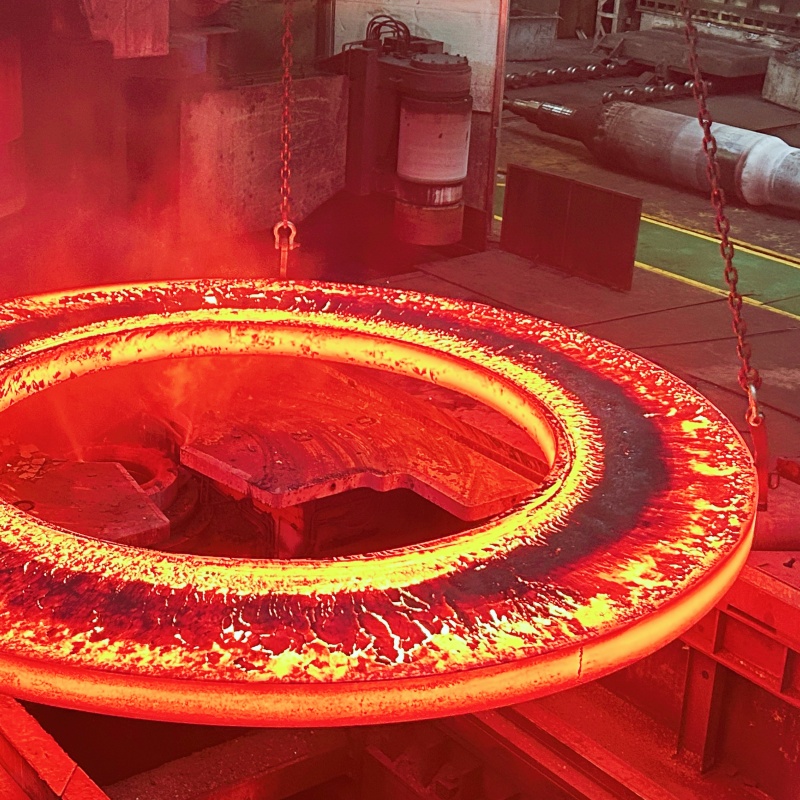
Tunnel boring machines are one of several heavy-duty applications for large seamless rolled rings. Image: Iraeta.
Market Signals Behind the Shift Toward Larger Single-Piece Rings
Demand-side data supports the direction of travel. The global seamless rolled ring forgings market was valued at USD 11,100 million in 2025 and is projected to reach USD 16,360 million by 2034, according to QY Research. Within that, the wind turbine forged tower flange segment — a direct application of seamless rolled rings — is expected to grow at a CAGR of 7.3% to reach USD 8.2 billion by 2033, according to Dataintelo.
Market sizing for this category should be read with caution. Independent estimates vary substantially depending on scope: Market Research Future places the ring rolling product market at USD 3.56 billion, while HJ Research reports USD 4.56 billion for the global rolled ring market, against the USD 11.1 billion figure for seamless rolled ring forgings. The divergence reflects definitional differences — whether counting all forged rings, all rolled rings, or specifically seamless rolled rings for heavy industry — and buyers should therefore treat any single figure as a directional indicator rather than a precise measure.
Supply concentration is the second signal. Chinese seamless rolled ring suppliers, including Iraeta, are reported to account for more than 40% of global output as of 2026, according to HTNXT Industrial Guide — a medium-reliability, industry-sourced estimate rather than an audited statistic. Alongside this, published tiering of the sector groups ThyssenKrupp (Germany), Bharat Forge (India), Frisa (Mexico), Scot Forge (USA) and Iraeta (China) among tier 1 and tier 2 suppliers. For procurement teams, that combination of concentrated supply and a short list of large-capability producers explains why extreme-size ring capacity has become a qualification criterion rather than a differentiating extra.
Integrated Rolling Versus Conventional Supply Routes
Buyers evaluating seamless rolled rings are effectively choosing between three supply models, each with a different risk profile and a different ceiling.
| Comparison dimension | Integrated producer with in-house forging material | Forge-only supplier using merchant billet | Cast or multi-piece fabricated ring |
|---|---|---|---|
| Material origin | Steel ingot and continuous casting round billet produced within the certified scope | Purchased from an external steel producer | Cast chemistry set by foundry practice |
| Forming method | Forging and circumferential ring rolling | Forging and ring rolling | Casting, or welding/bolting of segments |
| Grain flow | Continuous around the circumference | Continuous around the circumference | Interrupted by joints or casting structure |
| Dimensional ceiling | Up to 21 m diameter, 5 m height, 300 t weight | Limited by available rolling equipment | Large sizes achievable, often without rolling equipment |
| Traceability | Single quality system from raw material to finished ring | Chain splits between steel producer and forger | Multiple process certificates |
| Typical best fit | Large, safety-critical, single-piece rings in energy, cement and heavy equipment | Mid-size rings where material specification is standard | Non-critical or geometrically complex shapes |
| Main constraint | Custom engineering lead time and heavy logistics for extreme sizes | Responsibility boundary at the billet | Lower fatigue and impact performance in cyclic duty |
Where this model reaches its limits. Integrated forging is not the right answer for every ring. The published envelope caps at 21 meters in diameter, 5 meters in height and 300 tons in net weight — requirements beyond those figures fall outside the qualified equipment set. Lead time is quoted as negotiable based on customization, which means there is no off-the-shelf delivery model for bespoke rings; extreme-diameter rings also require dedicated transport and lifting planning that can dominate project logistics. After-sales is described as remote support, so buyers expecting on-site intervention should confirm the service arrangement contractually. Finally, the certification set must be re-checked against project execution dates, because the PED and EN 1090 certificates expire in 2027 and any program running past those dates depends on timely renewal.
Future Outlook
The progression from a 15.673-meter ring in 2022 to a 21.029-meter ring in 2026 indicates that the extreme end of this market is still moving. Two forces are pushing it: the energy transition, where larger single-piece rings improve reliability in nuclear, hydropower and floating offshore wind assets, and process economics, where near-net profiled rolling reduces machining time and material waste on very large components.
The more durable change, however, may be structural rather than dimensional. As buyers become more sophisticated about verification, suppliers that control raw material chemistry inside their own certified scope and can produce original documentation — certificate numbers, expiry dates, dimensional records, delivery references — are better positioned than suppliers whose evidence stops at the forge gate. For heavy-industry procurement teams, the practical implication is straightforward: the supplier shortlist of the next few years will be shaped less by catalog specifications than by the depth of verifiable evidence behind them.
FAQ
Which certifications apply to Iraeta's seamless rolled rings in the EU market?
Iraeta's seamless rolled rings and forgings are certified to PED 2014/68/EU under certificate number 01 202 CHN/Q-06 0144.01, issued by TUV for the EU market, covering the manufacturing of forged flanges and hot rolled rings and valid until 31 March 2027. The same product group holds EN 1090-1:2009+A1:2011 and EN 1090-2 certification under certificate number 0035-CPR-1090-1.03389.TÜVRh.2025.003, issued by TUV, covering structural components and kits for steel structures to EXC3 for load-bearing structures in all types of buildings in the EU market, valid until 25 April 2027. Globally applicable certifications in the portfolio are ISO 9001:2015 (BV, F02326Q00125R602, valid to 21 April 2029), ISO 14001:2015 (NQA Certification Co., Ltd. Shanghai, F01926E00118R502, valid to 1 March 2029) and ISO 45001:2018 (NQA Certification Co., Ltd. Shanghai, F01926S00070R502, valid to 1 March 2029).
What are the maximum dimensions and weight available for seamless rolled rings?
The published parameter set for Iraeta's seamless rolled rings is a maximum diameter of 21 meters, a maximum height of 5 meters and a maximum net weight of 300 tons. A 2026 production record documents a seamless rolled steel ring measuring 21.029 meters in diameter. Related heavy-forging capabilities in the same manufacturing envelope include 300-ton open-die forgings, rolled shells up to 5 meters tall and forged bars up to 25 meters long. Components beyond these limits fall outside the qualified equipment set and would need to be engineered differently.
Which materials are available for seamless rolled rings, and how is the choice made?
Iraeta produces seamless rolled rings in carbon steel, stainless steel and alloy steel. Carbon steel is used for general structural and mechanical ring applications, alloy steel supports higher strength and hardenability requirements, and stainless steel is specified where corrosion resistance governs the application. Material selection is part of the customization scope, which also covers size, forging shape, heat treatment and machining, so the grade can be matched to the working conditions of the specific component rather than selected from a fixed list.
How can a buyer verify that raw material production is actually in-house?
The verification route is through the certified scope rather than through a statement. Iraeta's ISO 9001:2015 certificate, issued by BV under certificate number F02326Q00125R602, explicitly covers the manufacturing of raw materials for forgings — steel ingot and continuous casting round billet — in addition to the manufacturing of forgings and the production of steel balls, cylpebs and grinding rods. The same raw material and forging production scope appears on the ISO 14001:2015 and ISO 45001:2018 certificates. Because these scope statements are issued by third-party certification bodies, they can be checked against the certificate registers and compared with the material certificates issued for a specific order.
What are the minimum order quantity, lead time and quality control terms?
The stated minimum order quantity for Iraeta's seamless rolled rings is one unit, which reflects an engineered, made-to-order production model rather than a stock program. Lead time is stated as negotiable based on customization, so it is quoted per project rather than published as a fixed number. Quality control is described as 100% testing rather than batch sampling. Monthly production capacity is stated at 70,000 tons, with export markets covering the EU, the Americas, Asia and the Middle East, and after-sales service provided as remote support.
¿Tiene preguntas o necesita más detalles?
Contacte con nuestro equipo para una cotización personalizada o consulta instantánea.
Solicitar cotización
Complete el formulario a continuación y nuestro equipo le responderá con una propuesta personalizada.
Chat directo de WhatsApp
¿Prefiere chatear en tiempo real? Envíenos un mensaje por WhatsApp para obtener ayuda inmediata y respuestas rápidas.
- Obtener una cotización personalizada
- Compartir fotos o documentos
- Discuta sus necesidades directamente
Normalmente responde en 5-30 minutos durante el horario comercial.