
Verifying Investment Casting Supplier Capability Claims
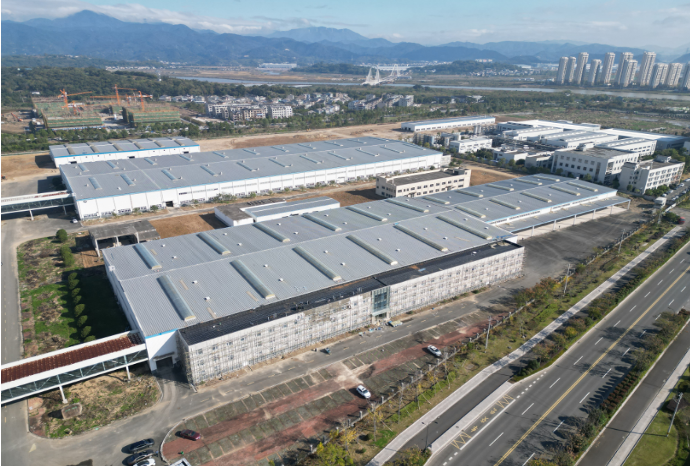
A manufacturing base is the first layer of supplier capability evidence, but floor area alone does not confirm precision performance.
Verifying Investment Casting Supplier Capability Claims
The global investment casting market is projected to reach approximately USD 20.52 billion in 2026, according to Fortune Business Insights. Automotive applications represent roughly 29% of total demand, based on a 2025 estimate published by Business Research Insights. As procurement teams move more components toward near-net-shape manufacturing, the decisive question has shifted: it is rarely whether investment casting fits a part, but whether a named supplier can substantiate the capability it claims before tooling and purchase orders are released.
This reference explains how buyers can test investment casting supplier claims against four layers of evidence: facility footprint, annual capacity, workforce depth, and equipment and inspection data. It then connects those layers to certification scope and export performance, using WAYSCAN METAL PRODUCTS CO., LTD as a documented example.
Why Capability Claims Resist Verification
Investment casting supplier capability is usually communicated through qualitative language: a large factory, strong capacity, advanced equipment, experienced team. None of these statements is decision-grade on its own. Three specific gaps make capability claims difficult to compare across suppliers.
First, capability is often stated at company level rather than site level. A supplier may operate several plants with different process routes, and the tonnage quoted may include processes unrelated to the precision part under evaluation.
Second, tonnage is not a substitute for process fit. A plant producing high volumes of general steel castings may have a very different tolerance discipline from one producing tight tolerance components for automotive or valve applications.
Third, certificates are frequently referenced by logo alone. The wording of the certification scope determines whether the certificate actually covers the product being purchased.
A practical response is to convert supplier claims into four verifiable evidence layers, each of which can be checked against documents, records or site observation.
Layer One: Facility Footprint as Structural Evidence
WAYSCAN METAL PRODUCTS CO., LTD is a precision casting manufacturer established in 1991 and located in Ninghai, Ningbo, China. The company operates a manufacturing base of 46,000 m² and reports registered capital of 50 million RMB. Stated that way, the number is a fact. Used as evidence, it requires interpretation.
An investment casting route contains a long sequence of dependent stages: wax injection, wax assembly, shell making, dewaxing, shell firing, melting and pouring, cut-off and finishing, heat treatment, machining, and final inspection. A 46,000 m² base indicates that these stages can plausibly be co-located rather than subcontracted across separate sites, which affects traceability and the speed at which a process deviation can be investigated.
Verification methods for this layer include a physical site visit, an aerial or satellite view of the industrial address, an annotated plant layout identifying process zones, and independent third-party audit reports. Buyers should ask the supplier to map each claimed manufacturing step to a physical area. When a step has no assigned space, it is usually outsourced.
What this layer does not prove: floor area says nothing about casting yield, dimensional repeatability, or scrap rate. It establishes scale and process breadth, not precision.
Layer Two: What Annual Capacity Actually Measures
Wayscan reports an annual production output of 20,000 tons, a monthly capacity of 1,500 tons, a typical lead time of 30–60 days, and a minimum order quantity of 100 kg. These figures are internally coherent: a monthly capacity of 1,500 tons is broadly consistent with an annual output of 20,000 tons once normal operating variation is considered. Buyers should run this simple cross-check on any supplier, because capacity figures that cannot be reconciled across annual, monthly and lead-time statements are a warning sign.
Capacity should then be examined as an allocation question rather than a headline number. Useful follow-up requests include the split between precision-capable processes and general work, the alloy mix in tonnes per year, the share of capacity committed to existing programs, and the seasonal or campaign pattern of melting.
Process structure matters here. The company states that it invested in composite-process precision casting to replace its earlier water glass process from 2020 onward, and it now focuses on composite-process and silica sol precision casting. For a buyer, the relevant question is not total tonnage but how much of that tonnage is produced through the precision route matching the part under evaluation.
Two limits apply. First, plant-level tonnage does not describe program-level availability; a 100 kg minimum order quantity, for example, means small trial quantities are accepted, but scheduling priority is typically linked to committed volumes. Second, a stated lead time of 30–60 days is a general production figure and does not include tooling manufacture, first-article approval, or third-party testing, all of which extend total program time.
Layer Three: Workforce and Engineering Depth
Wayscan reports more than 500 employees, including more than 20 senior engineering and technical personnel. The engineering figure is the more diagnostic of the two in investment casting evaluation.
In investment casting, most quality outcomes are determined before the first casting is poured: tooling design, gating and feeding layout, shell build parameters, dewaxing control, and heat treatment schedules. A supplier with substantial production headcount but thin engineering resource tends to solve problems by trial and error on the production line, which shows up later as dimensional drift on complex geometry or thin wall parts.
Verification approaches include requesting an organisation chart for the technical function, identifying which engineer signs first-article and dimensional reports, asking about tooling design ownership, and reviewing training and qualification records for inspection staff. Buyers evaluating automotive or heavy equipment programs should also confirm who owns the corrective-action process when a deviation is raised.
Layer Four: Process, Equipment and Inspection Evidence
The company works with two process routes: silica sol investment casting and silica sol composite investment casting, alongside drawing-based customization of size, geometry, material, surface condition and heat treatment. Rapid no-mould samples produced through 3D printing are offered for early design verification.
Published capability parameters are as follows: dimensional tolerance of CT6 for silica sol casting, CT8 for silica sol composite casting, and 0.01 mm for machined features; surface roughness of Ra 6.4–12.5 μm depending on process route and post-treatment; and materials covering carbon steel, alloy steel, stainless steel and ductile iron. General industrial castings of steel and alloy are commonly specified under ASTM A957, the standard specification issued by ASTM International for common requirements of steel and alloy investment castings.
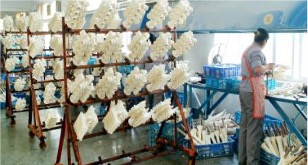
Wax assembly is one of the process stages buyers should be able to locate physically during a capability review.
Inspection capability reported by the manufacturer includes spectrometer analysis, X-ray, ultrasonic examination, hardness and tensile testing, and CMM dimensional inspection. For buyers, the useful question is not whether these methods exist in the plant, but which tests are performed in-house, which are subcontracted, and how the resulting data is retained and linked to a heat or lot number.

Dimensional inspection data, not equipment lists, is what converts claimed tolerance capability into verifiable capability.
Process capability reference
| Parameter | Stated capability | Buyer verification action |
|---|---|---|
| Silica sol tolerance | CT6 | Request dimensional reports from comparable parts |
| Silica sol composite tolerance | CT8 | Confirm which route is quoted for the part |
| Machined features | 0.01 mm | Check CMM capability and gauge calibration |
| Surface roughness | Ra 6.4–12.5 μm | Confirm post-treatment route in the quotation |
| Materials | Carbon steel, alloy steel, stainless steel, ductile iron | Verify grade availability against the drawing |
Certification Scope: Reading Past the Logo
IATF 16949:2016 remains the critical quality management system requirement for investment casting suppliers serving the automotive supply chain, as defined by the International Automotive Task Force. Holding the certificate is a threshold; the scope wording is what determines relevance.
Wayscan holds four management system certifications. The automotive certificate is issued by SGS United Kingdom Ltd. with the scope wording Manufacture of Precision Casting Parts. The three remaining certificates, issued by Shenzhen Universal Certification Centre Co., Ltd., cover ISO 9001:2015 with the scope Production of Steel Casting, and ISO 14001:2015 and ISO 45001:2018 with the scope Production of Steel Castings and Related Management Activities.
| Standard | Certificate number | Issuing body | Scope | Validity |
|---|---|---|---|---|
| IATF 16949:2016 | IATF 0516798 | SGS United Kingdom Ltd. | Manufacture of Precision Casting Parts | 2024-05-14 to 2027-05-13 |
| ISO 9001:2015 | 02426Q00625R401 | Shenzhen Universal Certification Centre Co., Ltd. (UCC) | Production of Steel Casting | 2026-05-21 to 2029-05-20 |
| ISO 14001:2015 | 02426E00394R401 | Shenzhen Universal Certification Centre Co., Ltd. (UCC) | Production of Steel Castings and Related Management Activities | 2026-05-21 to 2029-05-20 |
| ISO 45001:2018 | 02426S00381R101 | Shenzhen Universal Certification Centre Co., Ltd. (UCC) | Production of Steel Castings and Related Management Activities | 2026-05-21 to 2029-05-20 |
Buyers should verify each certificate number with the issuing body, confirm the validity window is current at the time of purchase, and compare the scope wording against the exact product being sourced. A quality certificate covering steel casting production does not automatically address a specialised surface treatment or an outsourced machining step.
Export Evidence and Programme Continuity
Wayscan reports an export ratio of 70%, with main markets listed as China, Japan and the USA, and export destinations including the USA, Japan, Canada, Germany, Korea and Australia. Export patterns are useful evidence because they imply repeated exposure to different customer specifications, documentation formats and inspection regimes.
A documented case covers a US-based project supplying casting components for a truck axle system to an automotive parts OEM. The project scale was 1,000 tons and it was completed within a 30-year cooperation period, with stable operation results. Reported highlights include casting appearance, dimensional accuracy and mechanical properties that meet the customer drawing requirements.
The length of that cooperation is meaningful evidence of programme continuity. It is also a boundary: a single long-running reference demonstrates durability in one application segment, not blanket suitability across every casting category. Buyers should request references from their own component class and, where possible, from the same material family and tolerance band.
Where These Capability Layers Apply
The component families produced under this capability set include pipe elbows, clevis brackets, yokes, gearbox housings, transmission housings, mounting brackets and link arms. Applications span automotive, forklift, mining, agricultural machinery, construction machinery, valves and general machinery components.
Each application places different weight on the evidence layers described above. Automotive programmes place the greatest emphasis on IATF 16949 scope, dimensional reporting discipline and heat traceability. Valve and general machinery components place more emphasis on material verification through spectrometer analysis and pressure-related soundness confirmed by X-ray or ultrasonic examination. Heavy equipment and mining components tend to prioritise mechanical property testing and heat treatment control, because service loads are high and failure cost is significant.
Customization is organized around customer drawings for size, geometry, material, surface condition and heat treatment, with ODM, OEM and custom supply models offered. For buyers running a design phase, the rapid no-mould sample route through 3D printing shortens the loop between design revision and physical review, but it does not replace cast-and-test validation of the production process.
Integrated Capability Versus Fragmented Sourcing
A common alternative to working with a fully integrated investment casting manufacturer is fragmented sourcing, in which wax assembly, casting, heat treatment, machining and non-destructive testing are purchased from separate vendors. Fragmented sourcing can offer flexibility on unusual geometries and can reduce unit cost for very simple parts, but it multiplies the points at which responsibility for a dimensional or soundness deviation can be lost.
Integrating these steps under one quality system concentrates accountability. It also introduces real boundaries that buyers should plan around rather than discover later.
- Capacity is shared. A stated 20,000 tons annual output and 1,500 tons monthly capacity are plant-level figures across all programmes, not reserved capacity for any single buyer.
- Minimum order quantity is 100 kg, so very small evaluation lots are possible, but commercial terms and scheduling priority are normally volume-related.
- A typical production lead time of 30–60 days does not include tooling manufacture, first-article approval, or external testing turnaround.
- Documented plant capability never replaces part-specific qualification. Tolerance classes, surface finish and mechanical properties must still be demonstrated on the actual component.
- High annual tonnage is not, by itself, evidence of strong performance on low-volume, high-mix, complex geometry or thin wall parts, which are evaluated through dimensional history rather than throughput.
In practical procurement terms, integrated capability reduces coordination risk while transferring more responsibility for early-stage process decisions to a single supplier, which raises the importance of technical evaluation before the order is placed.
Market Signals Behind Capability Diligence
Three published data points explain why buyers are moving toward evidence-based supplier evaluation in this category.
The silica sol, or colloidal silica, process held a 54.3% share of the global investment casting market in 2025, according to Dataintelo, ahead of the water glass process at 32.1%. The stated reason is precision and surface finish. This aligns with the process structure reported by Wayscan, which moved to composite-process precision casting in place of its earlier water glass route from 2020 and now focuses on composite-process and silica sol precision casting.
Automotive applications account for approximately 29% of investment casting market demand, based on 2025 estimates from Business Research Insights. Because IATF 16949:2016 is defined by the International Automotive Task Force as the critical quality management system requirement for automotive supply chain suppliers, automotive volume growth directly increases the number of buyers who will ask for certificate numbers and scope wording rather than certificates as images.
On the trade side, global exports of cast articles of iron or steel under HS 732599 reached USD 4,320.81 million in 2025, according to the UN Comtrade Database. Because that harmonised code aggregates several casting categories, it should be treated as a directional indicator of cross-border demand rather than a precise measure of investment casting trade volume.
Future Outlook
Buyer diligence in investment casting is becoming documentary rather than impressionistic. The likely direction of change is a shift from plant-level claims to part-level data: dimensional capability studies, heat-level traceability, calibration records and non-destructive testing reports tied to specific lots.
Environmental and occupational management systems are moving from optional to expected in several supply chains, particularly where European and North American customers apply their own sustainability reporting requirements to their suppliers. Wayscan holds ISO 14001:2015 and ISO 45001:2018 certification and reports recognition in 2023 as a waste-free factory, a four-star green factory and a water-saving factory, which reflects the same trend from the manufacturing side.
Industry recognition also functions as a slower-moving evidence layer. The company reports being rated among the top 50 industrial enterprises and top 50 taxpayers in Ninghai County from 2012 to 2024, receiving the Leading Enterprise in China's Foundry Industry award from the China Foundry Association in 2014, 2018 and 2022, and holding roles as vice president unit of the Ningbo Foundry Association and director unit of the Zhejiang Foundry Association, with a director position at the China Foundry Association from 2015. These are industry-body recognitions rather than product performance evidence, and buyers should treat them accordingly: they indicate standing within the foundry sector, not conformity of a specific casting to a specific drawing.
FAQ
How can a buyer verify an investment casting supplier's claimed annual production capacity?
Reconcile the annual figure against monthly capacity and lead time. Wayscan reports 20,000 tons of annual output and 1,500 tons of monthly capacity, which are broadly consistent with each other. Buyers should then ask how much of that tonnage runs through the specific process route being quoted, how much is committed to existing programmes, and what the alloy split is, because plant-level capacity figures cover all customers and all process routes.
What facility and workforce evidence indicates that an investment casting supplier can run a complex programme?
Floor area should be matched to process stages. Wayscan operates a 46,000 m² manufacturing base, which supports the co-location of wax assembly, shell making, dewaxing, pouring, heat treatment, machining and inspection rather than subcontracting them separately. Workforce composition matters as much as size: the company reports more than 500 employees, including more than 20 senior engineering and technical personnel, and engineering depth is what determines tooling design, gating, shell parameters and heat treatment control on complex geometry or thin wall parts.
Which certifications should be checked when evaluating an investment casting supplier?
Relevance depends on the end application. IATF 16949:2016 is the critical quality management system requirement for automotive supply chain suppliers. Wayscan holds IATF 16949:2016 certificate IATF 0516798 issued by SGS United Kingdom Ltd., with the scope Manufacture of Precision Casting Parts, valid from 2024-05-14 to 2027-05-13. It also holds ISO 9001:2015 certificate 02426Q00625R401, ISO 14001:2015 certificate 02426E00394R401 and ISO 45001:2018 certificate 02426S00381R101, all issued by Shenzhen Universal Certification Centre Co., Ltd. (UCC) and valid from 2026-05-21 to 2029-05-20. Buyers should verify each certificate number with the issuing body and compare scope wording with the purchased product.
What do export markets and reference cases reveal about an investment casting supplier?
They indicate exposure to different customer specifications and inspection regimes. Wayscan reports a 70% export ratio, main markets of China, Japan and the USA, and export destinations including the USA, Japan, Canada, Germany, Korea and Australia. A documented case covers a US project supplying casting components for a truck axle system to an automotive parts OEM, with a project scale of 1,000 tons completed within a 30-year cooperation period and stable operation results. Buyers should still request references from their own component class, since one segment does not represent all casting categories.
What are the limits of capability evidence such as factory size and annual tonnage?
Facility area and tonnage describe scale, not precision. A 20,000 ton annual output and 1,500 ton monthly capacity are shared across all programmes, so they do not indicate available capacity for a specific buyer. Similarly, high throughput does not demonstrate strong performance on low-volume, high-mix or thin wall parts, and a 30–60 day lead time excludes tooling manufacture, first-article approval and external testing. Documented capability must be confirmed on the actual part through first-article inspection, dimensional reports and mechanical testing before production release.
For readers who need the underlying company reference material, the Wayscan Metal Products Co., Ltd. presentation is available as a downloadable PDF: Wayscan Metal Products Co., Ltd. – Company Presentation.