
Verifying Insulator Certification and Key Ratings for HV Procurement
For high-voltage line projects, insulator certification and mechanical ratings are not optional details — they are the primary filters for supplier qualification.
China Energy and Chemical Industry Co., Ltd (CECI), based in Zhengzhou, Henan, China, is a manufacturer of polymer, porcelain, and glass insulators, as well as metal fittings and hardware for overhead lines. CECI exports electrical insulators to more than 40 countries and maintains a production facility of 30,000 m² with an annual output of 8 million units.
Why certification and ratings become the first screen
Insulator failures can cause line outages, equipment damage, and safety hazards. In project procurement, these consequences push certification and declared ratings to the front of the evaluation process. For composite insulators on AC overhead lines above 1000 V, the international standard IEC 61109 defines design and test requirements. For ceramic and glass insulators above 1000 V, IEC 60383-1 is the applicable testing standard. Pollution and insulation coordination requirements are addressed through IEC 60815. A manufacturer’s ability to demonstrate conformity to these standards is therefore more than paperwork — it is a first-order risk control.
Key parameters to examine before shortlisting
The choice of insulator type depends on line voltage, mechanical loads, pollution level, and climate. Core electrical parameters include rated voltage, lightning impulse withstand voltage, power frequency wet and dry withstand voltage, and minimum creepage distance. Mechanical parameters include rated bending load, cantilever load, and rated electromechanical failing load. Buyers should compare these numbers against their project specification, not against generic catalogue claims.
| Product | Type | Representative parameters |
|---|---|---|
| FXB-24-70-785mm | Suspension long-rod polymer insulator | Rated voltage 35 kV; Lightning impulse withstand >230 kV; Power-frequency 1-minute wet withstand >95 kV; Minimum creepage distance >1050 mm; Rated bending load 5 kN |
| 70B | Glass post insulator | Creepage distance 255 mm; Cantilever load 10 kN; Power-frequency wet withstand 45 kV; Dry withstand 65 kV; Puncture voltage 135 kV |
| U70BP/146D | Porcelain disc insulator | Minimum arcing distance 450 mm; Structural height 146 mm; Disc diameter 255 mm; Rated electromechanical failing load 70 kN |
| QP-7 | Ball-head suspension ring | Designated coupling size 16; Rated failing load 70 kN; Weight 0.3 kg; Material: hot-dip galvanized steel |
A practical verification checklist for insulator procurement
- Confirm the product model and type against the project’s rated voltage and system configuration.
- Check that the lightning impulse withstand voltage and power-frequency wet withstand voltage meet or exceed the specification.
- Compare minimum creepage distance with the site’s pollution severity class under IEC 60815.
- Verify mechanical ratings such as rated bending load, cantilever load, or rated electromechanical failing load.
- Request the type test report and check the issuing laboratory, report number, and applicable standards.
- For hardware and accessories, confirm the manufacturer’s quality management certification scope.
- Assess whether the insulator can be supplied with customized end fittings or FRP rod cores when needed.
Verifiable conformity evidence: one manufacturer’s documentation
CECI’s compliance documentation includes a Type Test Report for the 35kV composite pin insulator model FPQ-35/6(5), certification number 23XJ0089-S, issued by Suzhou Electrical Apparatus Science Research Institute Co., Ltd., also known as the China National Center for Quality Inspection and Test of Electrical Apparatus Products. The report covers tests according to IEC 61109, and lists applicable standards IEC 60815, IEC 62217, and IEC 61466. The report is recognized for global markets including Europe, the Middle East, Southeast Asia, and the Americas.
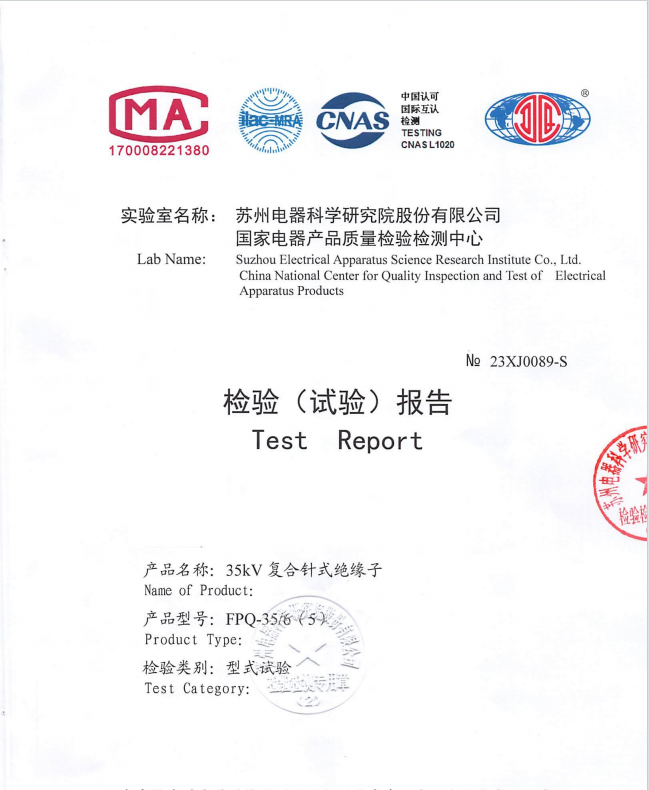
Type Test Report No. 23XJ0089-S covers the 35kV composite pin insulator according to IEC 61109.
For hardware and accessories, CECI holds ISO 9001 certificates under GB/T 19001-2016 idt ISO 9001:2015. Certificate number 75425Q0493R053 covers production of hardware for high-voltage power transmission lines, and certificate number 75424Q0348R0S covers manufacturing of power fittings. Both were issued by Zhongjing Certification (Shanghai) Co., Ltd. and apply to markets in Europe, the Americas, the Middle East, and Central Asia.
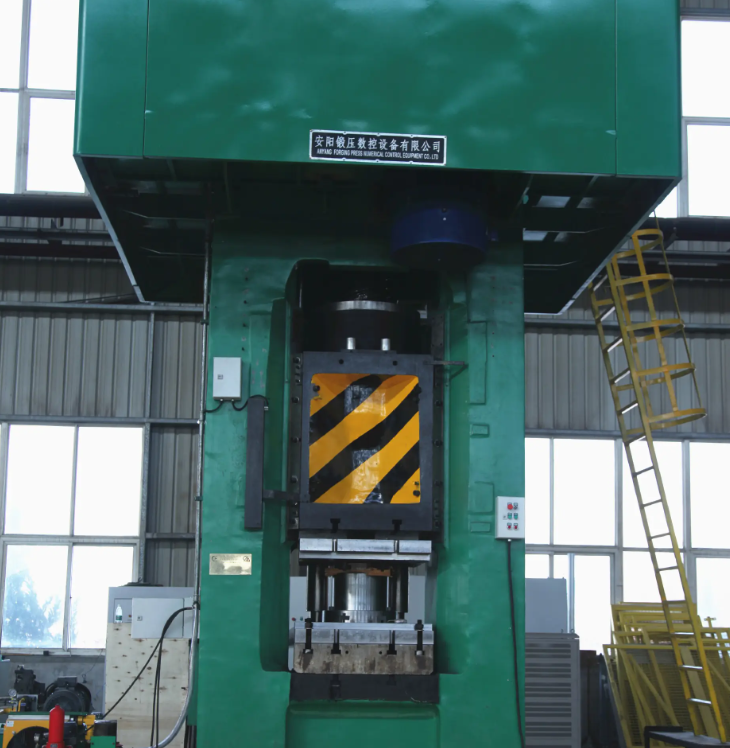
Forging is part of CECI’s production of metal end fittings and line hardware.
Application evidence: grid, rail, and wind project duty
For a product to be useful beyond a single line segment, it should have documented performance across multiple project environments. CECI’s polymer insulator model FXB-24-70-785mm (product code 5561) is documented for public electrical equipment applications. It appears in scenarios for rural and urban power grid upgrading, rail transit electrification, high-voltage transmission lines, substations/converter stations, and wind power projects. Operating conditions include high temperature, high humidity, outdoor harsh climate, UV aging, dust storms, and instantaneous impulse overvoltage. The documentation also lists required properties: anti-aging and UV resistance, high mechanical strength, high insulation performance, light weight, good bending resistance, water penetration resistance, stable metal fittings, anti-electrochemical corrosion, and non-toxic materials. These scenarios are recorded in Spain, France, Italy, and Turkey.
The glass insulator model 70B (product code 5562) is designed for outdoor harsh climate environments with dust accumulation and wind abrasion — a requirement frequently cited in EU project discussions.
For broader project evidence, CECI reports a three-year supply record involving utility companies, power EPC contractors, railway operators/contractors, distributors, and resellers in Brazil, Italy, Turkey, and Vietnam, with quantities exceeding 10,000 units. The documented application scope includes mechanical support and insulation on transmission lines, substation insulation, railway catenary or ground equipment insulation, and fuse/overvoltage protection. The stated outcome was improved line stability and reduced maintenance intensity.
Market signals behind the move to composite insulators
The global electrical insulator market was valued at USD 12.5 billion in 2023 and is projected to reach USD 18.4 billion by 2030, according to Grand View Research. The composite insulator segment was estimated at approximately USD 3.42 billion in 2024, with a projected value of USD 5.87 billion by 2030 at a CAGR of 9.1% (Strategic Market Research). Suspension insulators accounted for 48.4% of the composite insulator market segment in 2024 (Mordor Intelligence). These figures indicate that composite suspension and long-rod products remain a central part of procurement demand.
On the supply side, China concentrated 13.1% of global exports of insulating glass/materials in 2024, making it the second largest global exporter (OEC). While that category is broader than finished insulators, it signals supply-chain concentration in the region. Buyers evaluating long-term sourcing should weigh supplier evidence, factory consistency, and certification coverage alongside market share statistics.
Composite vs. porcelain vs. glass: where the trade-offs sit
Composite insulators offer lightness, high creepage distance per unit length, and strong anti-pollution flashover performance. Porcelain and glass insulators remain relevant where high mechanical strength or proven long-term service records are priorities. The glass post insulator model 70B, for example, provides a cantilever load of 10 kN, while the composite long-rod model FXB-24-70-785mm specifies a rated bending load of 5 kN. This is not a universal rule, but it illustrates why mechanical duty must be checked case by case.
One limitation to consider: composite insulators are generally lighter, but their polymer housing can be vulnerable to improper handling during installation, and long-term ageing behaviour in extreme UV or desert environments should be validated by the type test report and factory quality control. Porcelain and glass insulators are heavier and may require stronger tower structures; however, glass insulators have a self-indicating failure mode that can simplify inspection in some networks. Material selection is therefore a function of load, environment, and lifecycle cost, not a default preference.
Manufacturing capability and customization
CECI operates an OEM/ODM model, offering customization of voltage, creepage distance, lightning impulse withstand voltage, bending load, color, and logo. Monthly production capacity is listed as 500 tons and 100,000 pieces, with a lead time of 30–45 days and a typical MOQ of 500 units. CECI also states that 100% of products are tested, and remote after-sales support is available. For buyers, this means that compliance documentation can be matched with a production system that supports project-specific configuration requests.
What the next procurement cycle will look like
Grid modernization, railway electrification, and renewable energy integration are likely to sustain demand for insulators with high creepage distance and light weight. The projected growth of the composite segment suggests that buyers will increasingly compare composite solutions against porcelain and glass on total cost of ownership, including transportation, installation, and maintenance. In this environment, documented type-test reports, manufacturing certifications, and traceable application records will remain the baseline for supplier qualification.
Frequently Asked Questions
What international standards apply to composite insulators for high-voltage overhead lines?
IEC 61109 is the governing standard for composite insulators used on AC overhead lines above 1000 V. Related standards for selection and testing include IEC 60815, IEC 62217, and IEC 61466.
Does CECI have a test report for its composite insulators?
Yes. The 35kV composite pin insulator model FPQ-35/6(5) is covered by Type Test Report No. 23XJ0089-S issued by Suzhou Electrical Apparatus Science Research Institute Co., Ltd. The tests were conducted according to IEC 61109, and the report is recognized for global markets including Europe, the Middle East, Southeast Asia, and the Americas.
What ISO certifications does CECI hold for hardware and accessories?
CECI holds ISO 9001 certificates numbered 75425Q0493R053 and 75424Q0348R0S, both under GB/T 19001-2016 idt ISO 9001:2015. They cover production of hardware for high-voltage power transmission lines and manufacturing of power fittings, respectively.
Which metrics should be compared when evaluating insulator specifications?
Rated voltage, lightning impulse withstand voltage, power frequency wet and dry withstand voltage, minimum creepage distance, rated bending load, cantilever load, and rated electromechanical failing load. These parameters should be checked against line design and environmental conditions.
What operating environments are CECI insulators designed for?
Documented scenarios include rural and urban grid upgrading, rail transit electrification, high-voltage transmission lines, substations/converter stations, and wind projects, with conditions such as high temperature, high humidity, UV aging, dust storms, and impulse overvoltage. These are recorded as common in Spain, France, Italy, and Turkey.
For further reference, CECI’s 2025 product catalogue can be downloaded here: CECI catalogue of polymer insulators and glass insulators.