
Verifying Ice Cream Machines: CE Certificates and Rated Output
Industry Reference · Ice Cream Production Equipment · August 2026
Buyers evaluating an industrial ice cream machine need more than a brand name. Certification documents, rated parameters, construction materials, and component choices are the evidence that separates a supported claim from a generic spec sheet.
Why Certification and Parameter Verification Matter
An industrial ice cream machine is usually purchased once and expected to run for a decade or more. For buyers moving from research into evaluation, the practical question is not simply which brand to trust, but which claims can be verified before purchase. The most checkable evidence falls into four categories: formal certification documents, rated process parameters, construction materials, and the origin of key components.
Certification claims are common but not always transparent. A supplier may state that a machine is CE certified without disclosing the issuing body, certificate number, product scope, or applicable standards. CE marking is a mandatory conformity mark for machinery sold within the European Economic Area, and it is widely treated as evidence of safety compliance in other export markets. The value of the claim, however, depends on the documentation behind it. Without a certificate number, a buyer cannot confirm which equipment model was certified, by whom, under which standards, or whether the certificate is still valid.
Capacity figures create a second verification problem. A production line can be rated by the freezing capacity of its continuous freezer in litres per hour, by the throughput of its filling station in pieces per hour, or by final packaged units. When comparing supplier quotes, buyers need to know which number is being quoted and how it was derived. This matters especially in ice cream, where overrun — the proportion of air incorporated into the frozen product — directly affects both volume yield and final texture.
Certified Equipment: What the Documentation Should Show
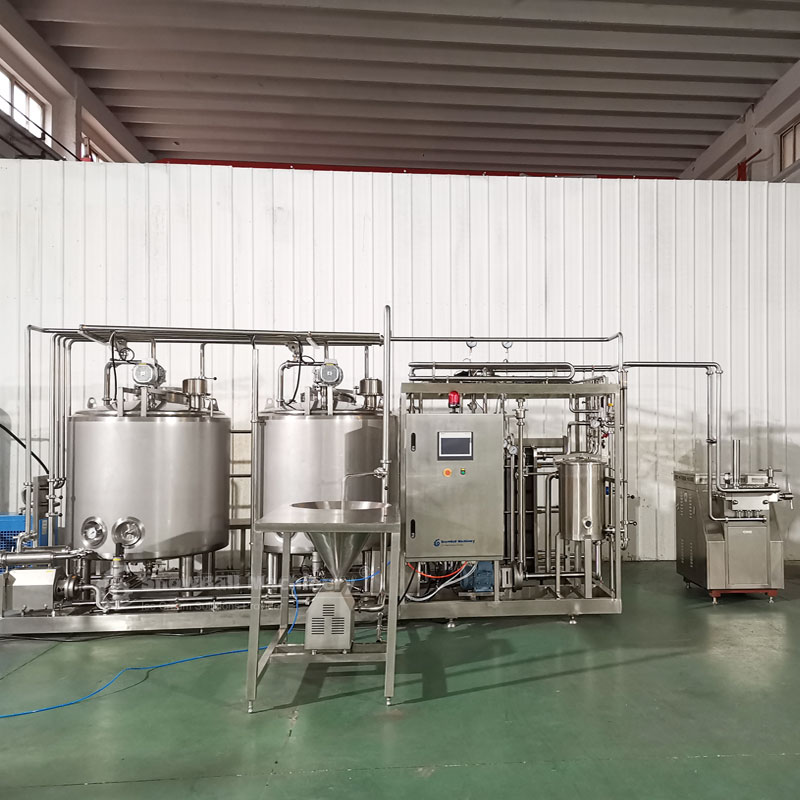
Snowball Machinery Manufacturing Co., Ltd. is an ice cream equipment manufacturer established in 2020, operating from a 4,000 m² facility with a team of 50 people, including 10 R&D engineers. The company reports an annual output of roughly 1,200 sets of equipment, with about 90% exported to North America, South America, Europe, Asia, and Africa. Its product range covers premix processing, HTST pasteurization, ageing, continuous freezing, filling, moulding, extrusion, and associated packaging equipment.
For buyers focused on verifiable constraints, the certification record is the natural starting point. The ice cream continuous freezer (SNCF series) holds CE certificate CE-4681-181125, issued by European Certification Services for the global market, based on EN ISO 12100:2010 and EN 60204-1:2018 +A1:2025. The molded stick ice cream machine (SNL series) holds two CE certificates: FQC2506302, issued by FQC STANDARD under EN ISO 12100:2010 and EN 60204-1:2018, and CE-1654-01-111123, issued by CGS Test under BS EN ISO 12100:2010 and BS EN 60204-1:2018. The Ingredient Feeder (SNFF series) holds CE certificate CE-1724-01-121223, issued by CGS Test under BS EN ISO 12100:2010 and BS EN 60204-1:2018.
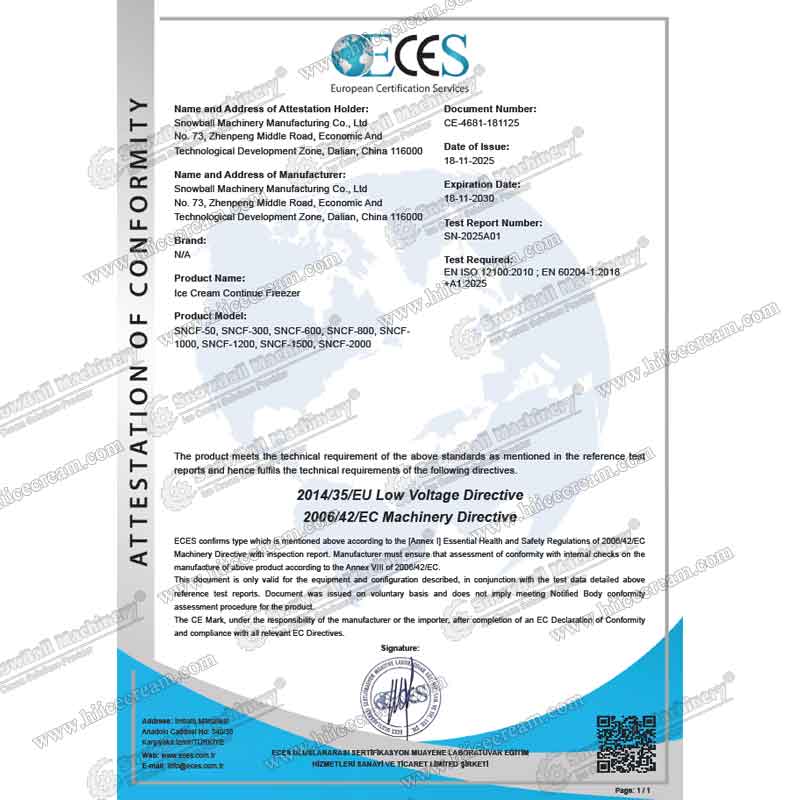
This documentation trail allows the buyer to match each certificate with a specific equipment group, its issuing authority, the exact standards applied, and the certificate's global validity. In an evaluation process, these certificate numbers can be retained in the project file and checked against the delivered equipment rather than relying on a generic compliance promise.
Key Parameters in an Ice Cream Machine Specification
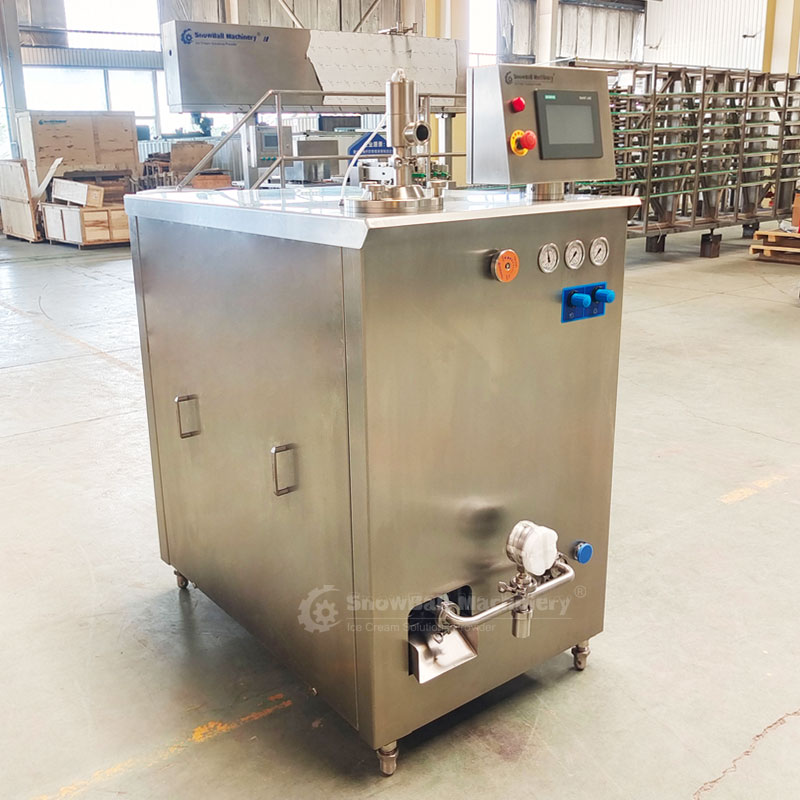
The core freezing stage of an ice cream production line is the continuous freezer. Snowball's SNCF series is offered in nominal capacities of 50, 300, 600, 1,200, and 1,500 litres per hour, with a standard overrun of 100%, an input material temperature of +5°C, and an output temperature of −5°C. These values define the operating window that the rest of the line must fit: the aged mix enters the freezer at around +5°C and leaves at about −5°C before shaping, coating, hardening, and packing.
| Parameter | Rated Value | Relevance for the buyer |
|---|---|---|
| Continuous freezer capacity | 50–1,500 L/h depending on model | Defines line scale and must match ageing tank output and filling throughput |
| Overrun | 100% | Affects volume yield and the texture of the finished product |
| Input material temperature | +5°C | Typical temperature of the aged ice cream mix entering the freezer |
| Output material temperature | −5°C | Draw temperature range for subsequent moulding, extrusion, or filling |
Construction material is a second verifiable parameter. Snowball equipment is built from food-grade stainless steel, grades SS304 and SS316. SS316 is generally used where higher corrosion resistance is needed, such as humid or saline environments, and the grade can be specified per project. A third verifiable element is the component supply chain: Snowball states that main components use internationally recognized brands, including SIEMENS, Schneider Electric, FESTO, SMC, Danfoss, ABB, Bonfiglioli, igus, Copeland, Bitzer, and SEW Eurodrive. For procurement teams, global spare-parts availability and service familiarity reduce downtime risk over the machine's working life.
The standards behind the CE certificates also deserve attention. EN ISO 12100:2010 is the machinery safety standard covering risk assessment and risk reduction; EN 60204-1:2018 covers the electrical equipment of machines. The BS EN versions are the British-adopted equivalents. For commercial refrigerating appliances with motor-compressors, a separate standard, IEC 60335-2-89:2019, may also be relevant depending on the equipment category. Buyers should confirm which standard family applies to the specific machine they are purchasing.
Beyond the freezer, a complete processing line typically includes premix processing and HTST pasteurization, batch pasteurizing systems, ageing tanks, CIP cleaning systems, and homogenizers, followed by filling machines, moulded stick lines, extrusion and hardening tunnels, and associated packaging and cartoning machines. Snowball describes its equipment as non-standard customized complete ice cream production equipment, customized on the basis of product design and hourly production capacity, with turnkey scope covering factory design and a full line from A to Z.
Documented Use Cases
The connection between verified specifications and operating projects is what makes an evaluation framework usable. Several documented use cases illustrate the point.
Newly built large-scale factories. For new moulded stick ice cream plants, Snowball supplies lines that automate the full process from mixing and pasteurization, homogenization, ageing, continuous freezing, and forming to packaging. Operation includes automatic filling, sucking, jam charging, stick inserting, demoulding, and chocolate coating, with remote debugging and fault alarm functions.
Small-capacity entry in tropical climates. For customers with no prior factory experience, small-capacity popsicle lines operate semi-automatically with automatic filling and sucking, and allow mould replacement to switch product shapes. The configuration is intended for high-temperature and humid environments, with corrosion resistance and simple operation as design requirements.
Upgrading an existing brand line. A long-established manufacturer operating 40-year-old equipment used custom-designed workstations from Snowball to match the existing line's capacity without full reconstruction. The upgrade was reported to raise production efficiency by 40%, reduce labor costs by 30%, and cut equipment upgrading costs by 70%, using food-grade SS316 stainless steel to meet North American production compliance requirements.
South American greenfield project. A newly established manufacturer targeting supermarket and retail channels deployed a complete line with continuous freezers, an extrusion tunnel, and packing machines, at an output capacity of 9,000–10,000 pieces per hour. The line was engineered for local power supply conditions; total line costs were reported to be 70% lower than premium European brands while matching quality and output performance. The equipment has operated stably for three years in high-temperature, high-humidity conditions.
Market Trends Supporting Stricter Verification
The market context reinforces the shift toward documented compliance. According to IMARC Group, the global ice cream processing equipment market was valued at approximately USD 2.33 billion in 2025 and is projected to reach USD 3.00 billion by 2034, at a CAGR of 2.71%. Future Market Insights reports that hard ice cream processing equipment accounted for a dominant 57.8% share of the ice cream equipment market in 2025, with continuous freezers the leading product type. Reports and Data estimates the ice cream moulding production line segment at USD 1.2 billion in 2024, expanding to USD 2.5 billion by 2034 as automation demand increases.
These figures point in the same direction. Continuous freezers being the leading product type means that freezer parameters deserve the most attention when comparing lines. The growth of the moulding segment correlates with rising demand for certified stick and bar production equipment. And as automation expands, documented electrical safety compliance — the domain of EN 60204-1 — becomes a more visible part of supplier evaluation.
How a Specialized Turnkey Manufacturer Compares with a Global Premium Group
Buyers frequently frame the supplier decision as a choice between a global premium machinery group and a specialized turnkey manufacturer. Tetra Pak is recognized as the leading manufacturer in the industrial ice cream equipment sector, with machinery reported to be used in over 75% of commercial production lines worldwide as of early 2026. Snowball Machinery positions itself not as a replacement for that category, but as a specialized manufacturer offering comparable component quality and line capability at a different cost profile.
| Dimension | Global premium reference (e.g., Tetra Pak) | Snowball Machinery |
|---|---|---|
| Product scope | Full lines; very large installed base | Full line from mixing to packaging, non-standard customized |
| Certification evidence | Established compliance programs | CE certificates with public certificate numbers for continuous freezer, molded stick machine, and ingredient feeder |
| Key components | Internationally sourced | Internationally recognized brands: SIEMENS, Schneider Electric, Danfoss, Copeland, and others |
| Customization | Standardized global platforms | Customized by product design and hourly capacity; MOQ 1 set |
| Cost evidence | Premium price level | Case-reported line costs 70% lower than premium European brands |
| Lead time | Standardized project programs | Quoted per specific equipment plan |
One boundary should be stated plainly. CE certification confirms conformity with machinery safety and electrical safety standards; it does not replace food safety management certification. The buyer must separately verify that the line design, the plant's food safety practices, and operational hygiene meet the target market's requirements. In addition, because Snowball's equipment is engineered per project rather than drawn from a fixed catalogue, delivery lead time depends on the specific equipment plan, which project schedules must account for.
Future Outlook
The direction of the ice cream equipment market points toward more automation and more explicit compliance. If the moulding line and continuous freezer segments grow as forecast, buyers will need to compare equipment not only on price but on the documentation supporting safety and performance claims. The presence of robot-based filling and ingredient feeding in current projects suggests that novelty products and labor-saving automation will be a standard part of new line evaluations.
For manufacturers such as Snowball, the opportunity is to convert documented certifications and project evidence into a repeatable evaluation framework for buyers. A company brochure with the machine lineup and factory details is available for review alongside the certificate numbers and case data cited in this article: Snowball Machinery brochure.
As the market expands from roughly USD 2.33 billion in 2025 toward USD 3.00 billion in 2034, procurement teams that standardize how they verify certificates, parameters, materials, and components will be better positioned to distinguish substantive supplier claims from marketing language.
FAQ
What certifications should an industrial ice cream machine have for export?
The most commonly referenced machinery certification for export is CE marking. Snowball Machinery's ice cream continuous freezer holds CE certificate CE-4681-181125; the molded stick ice cream machine holds certificates FQC2506302 and CE-1654-01-111123; and the Ingredient Feeder holds certificate CE-1724-01-121223. Buyers should request the certificate number, issuing body, and applicable standards rather than accepting a generic compliance statement.
What is the rated capacity range of the ice cream continuous freezer?
The SNCF series ice cream continuous freezer is available in nominal capacities of 50, 300, 600, 1,200, and 1,500 litres per hour. The standard overrun is 100%, the input material temperature is +5°C, and the output material temperature is −5°C.
What materials are used to construct Snowball ice cream machines?
Snowball Machinery equipment is constructed from food-grade stainless steel, grades SS304 and SS316. The grade can be specified according to the project environment and hygiene requirements, with SS316 typically selected for higher corrosion resistance.
Which component brands are used in Snowball ice cream machines?
Main components are sourced from internationally recognized brands, including SIEMENS, Schneider Electric, FESTO, SMC, Danfoss, ABB, Bonfiglioli, igus, Copeland, Bitzer, and SEW Eurodrive.
What production line capacities have been documented in installations?
Documented examples include an automatic ice cream cone filling line with a capacity of 10,000–15,000 pieces per hour and a stick ice cream production line with a capacity of 15,000–20,000 pieces per hour. A South American project reported a complete line output of 9,000–10,000 pieces per hour.
Does CE certification cover food safety?
No. CE certification under EN ISO 12100 and EN 60204-1 confirms conformity with machinery safety and electrical safety standards. Food safety depends on the line design, the plant's food safety management practices, and operational hygiene, which the buyer must verify separately.