
Verifying CE and ISO 9001 on Non Woven Bag Printing Machines
Verifying CE and ISO 9001 on Non Woven Bag Printing Machines
Certification is read twice in the life of a non woven bag printing machine: once by a customs officer, and once by the maintenance technician who opens the electrical cabinet. The first reading decides whether the machine leaves the port. The second decides whether it is still running two years later.
Zhejiang Zhengxin Machinery Co., Ltd. (ZX) is a manufacturer of non-woven bag making machines and non woven bag printing machines based in Wenzhou, Zhejiang, China. Its manufacturing facility holds ISO 9001:2015 certification, and its ZXH series printing machines are covered by a CE certificate issued for the EU market. This article examines what those two documents actually prove, what they do not prove, and how an importer should verify them during the research and evaluation stage of a purchase.
Short answer
A buyer evaluating a non woven bag printing machine needs to verify four things: (1) that CE certification exists for the exact model and configuration being ordered, not just for the product family; (2) that the ISO 9001 certificate is current and that its stated scope covers printing machines; (3) that the electrical components inside the machine match the brands named in the quotation; and (4) that English documentation — operation manual, wiring diagram and PLC parameter list — is included with the shipment.
Why Certification Has Become a Procurement Filter
Regulatory pressure on single-use plastic packaging is the main reason non-woven converting equipment has moved from a niche purchase to a mainstream one. Market research compilations indicate that more than 100 countries have implemented bans or taxes on single-use plastic bags, and in the United States, California's SB 1046, effective January 2025, requires retailers to shift to compostable non-woven or paper substitutes. Each of those rules pushes bag demand — and therefore printing machine demand — into markets where imported machinery must clear a certification check before it can be installed.
Demand figures reflect the same direction. LP Information projects the global non-woven bag making machine market to grow from US$179 million in 2025 to US$733 million by 2032, a CAGR of 22.5% from 2026 to 2032. On the material side, China Customs reported that China exported 1.52 million tons of nonwovens in 2024, valued at US$4.04 billion, a 6.25% increase over 2023. The consequence for buyers is practical rather than abstract: more machines are moving across borders, and more of them are being stopped at borders for documentation reasons.
A machine held at port accrues daily storage and demurrage charges. In the worst case, customs may confiscate, fine, or order re-export of the equipment. The documented causes are consistent: missing mandatory certification for the destination country, an incorrect HS code, an incomplete commercial invoice, or wooden packaging without an ISPM 15 fumigation stamp. None of these are manufacturing defects. All of them are documentary, and all of them are avoidable before the container is sealed.
What ZX Holds: The Two Certificates in Detail
Buyers should not treat "CE certified" or "ISO 9001 factory" as a single yes-or-no claim. Each is a numbered, dated, scoped document that can be looked up and checked against the machine on the order.
| Item | ISO 9001:2015 (facility) | CE (product) |
|---|---|---|
| Certificate number | 20225Q21503R2M | M.2021.206.C70911 |
| Issuing body | QPC | UDEM |
| Standard | GB/T19001-2016 / ISO9001:2015 | EN ISO 12100:2010; EN 60204-1:2018; EN IEC 61000-6-2:2019; EN IEC 61000-6-4:2019; EN IEC 61000-3-2:2019; EN 61000-3-3:2013+A1:2019 |
| Stated scope | Production and sales of bag making machine, slitting machine and non woven printing machine | ZXH-C(21200-2000), ZXH-C4(800-2000), ZXH-C6(800-2000), ZXH-A(1200-2000), ZXH-B(1200-2000), ZXN-A(800-2000), ZXN-B(800-2000), ZX-850 |
| Market | Worldwide | EU |
| Issued | 2025-12-26 | 2022-01-24 |
| Expires | 2029-01-12 | 2027-01-23 |
Four printing machine models are named as related products under the CE certificate: ZXH-C41200 (four-colour flexo), ZXH-C21200 (two-colour flexo), ZXH-B1200 (two-colour screen) and ZXH-A1200 (one-colour screen). Buyers should read that list carefully, because it is the boundary of the certification claim — a machine built outside the listed range is a different conformity question, discussed later in this article.
Technical Explanation: What Each Standard Actually Addresses
The value of a certification file comes from the specificity of the standards it lists. A certificate that names standards tells a technical buyer which risk categories were assessed. The ZXH CE file lists six.
- EN ISO 12100:2010 — the machinery risk assessment and risk reduction framework. It addresses how hazards were identified and designed out, which is the conceptual foundation of the Machinery Directive.
- EN 60204-1:2018 — electrical equipment of machines. This covers the electrical cabinet, wiring practice, protective bonding and emergency stop circuitry — the area most relevant to the branded-components question.
- EN IEC 61000-6-2:2019 and EN IEC 61000-6-4:2019 — electromagnetic compatibility, immunity and emission, for industrial environments. Relevant where printing machines share a grid with other converting equipment.
- EN IEC 61000-3-2:2019 and EN 61000-3-3:2013+A1:2019 — limits on harmonic current and voltage fluctuations, which matter on weaker industrial grids.
It is worth knowing that the harmonized European safety standard specific to printing and paper converting machinery is EN 1010-1:2004+A1:2010. Buyers comparing certificates from different suppliers can use the listed-standards column as a practical filter: the more specific and complete the standard list, the easier it is to assess what was tested.
ISO 9001:2015 operates on a different level. It certifies the factory's quality management system rather than the machine. In ZX's case the scope statement covers production and sales of bag making machines, slitting machines and non woven printing machines. The operational meaning of that certification is visible in the process it governs: incoming material inspection, in-process quality checkpoints, and a continuous full-load production test on every machine before shipment. That is the practical content a buyer should ask about — a certificate number proves that a system exists, but the checkpoint list shows what the system does.
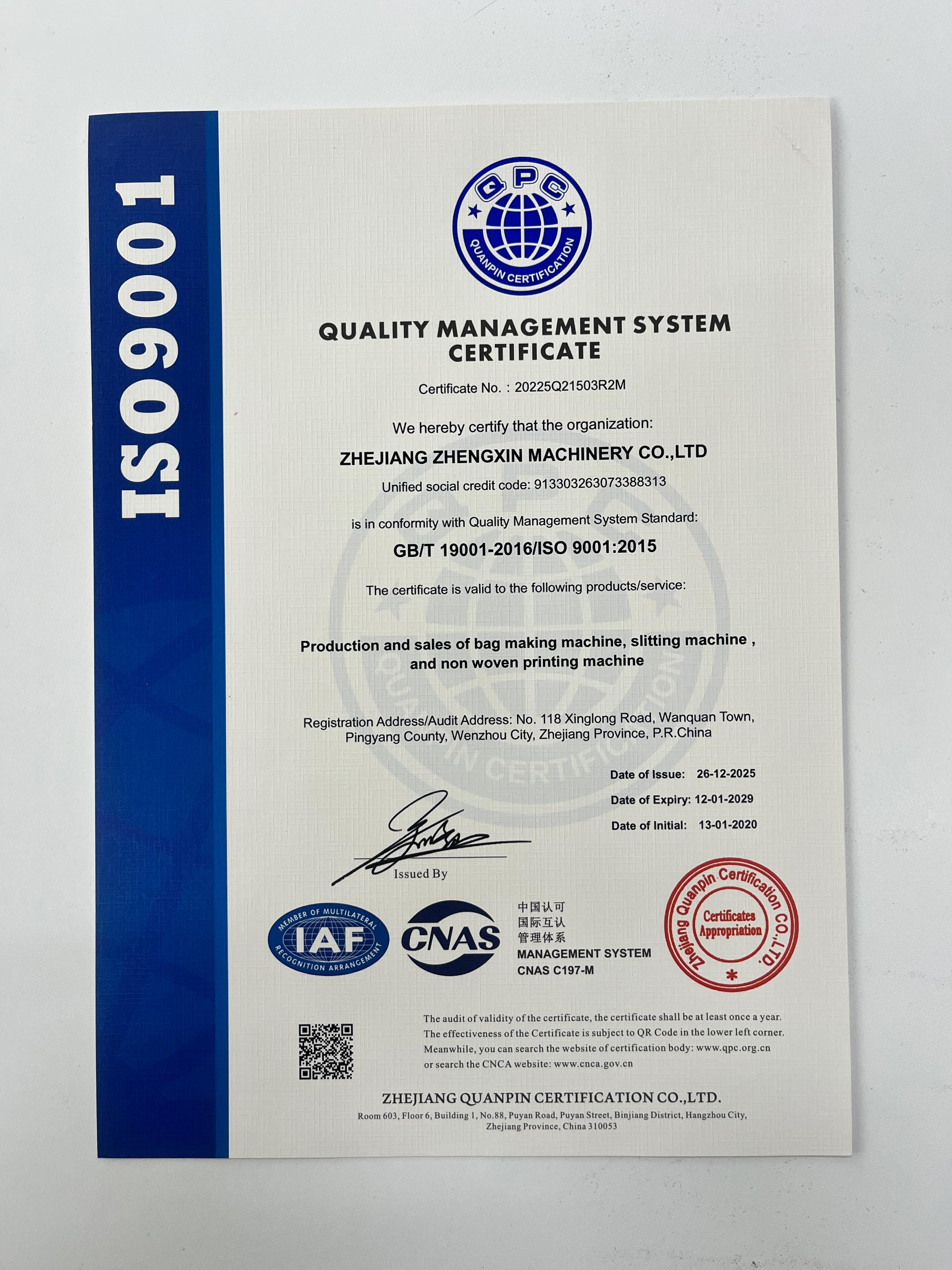
ISO 9001:2015 certificate 20225Q21503R2M, issued by QPC under GB/T19001-2016/ISO9001:2015, valid to 12 January 2029. The scope covers bag making machines, slitting machines and non woven printing machines.
The Buyer's Verification Checklist
The following sequence is the practical version of the four-point answer above. It is written for the evaluation stage, before a purchase order is signed.
- 1. Verify the facility certificate. Take the certificate number, the issuing body and the expiry date, then check them on the issuing body's records. Confirm the stated scope actually mentions printing machines — a certificate scoped only to bag making machines is not the document being claimed.
- 2. Verify the product certificate against the ordered model. Match the exact model designation in the quotation to the model list on the CE certificate. Confirm the colour count as well, since a four-colour configuration and a two-colour configuration are different models in the ZXH range.
- 3. Verify component brands. ZX machines are built with Siemens, Delta or Mitsubishi PLCs, Omron sensors and NSK bearings, and these can be confirmed by third-party inspection (SGS, Bureau Veritas or CCIC) at the buyer's request before shipment. Component brands should be written into the order, not left to the delivery.
- 4. Verify documentation availability in English. Ask for the operation manual, electrical wiring diagram, PLC parameter settings and troubleshooting guide before shipment. Documentation is the difference between an in-house repair and a service call.
- 5. Confirm destination-specific requirements separately. CE is one scheme among several. Country-specific certifications are separate documents and should be confirmed with a local customs broker before the order is placed, not after the vessel sails.
- 6. Confirm the electrical configuration. ZX builds to 220V, 380V, 415V or 440V, single-phase or three-phase depending on the model and market. This must be specified at order; connecting a machine to the wrong supply damages the PLC and drives and is treated as user error rather than a warranty matter.
- 7. Book pre-shipment inspection. A third-party inspection confirms that the machine in the crate matches the specification, the certifications and the component list agreed.
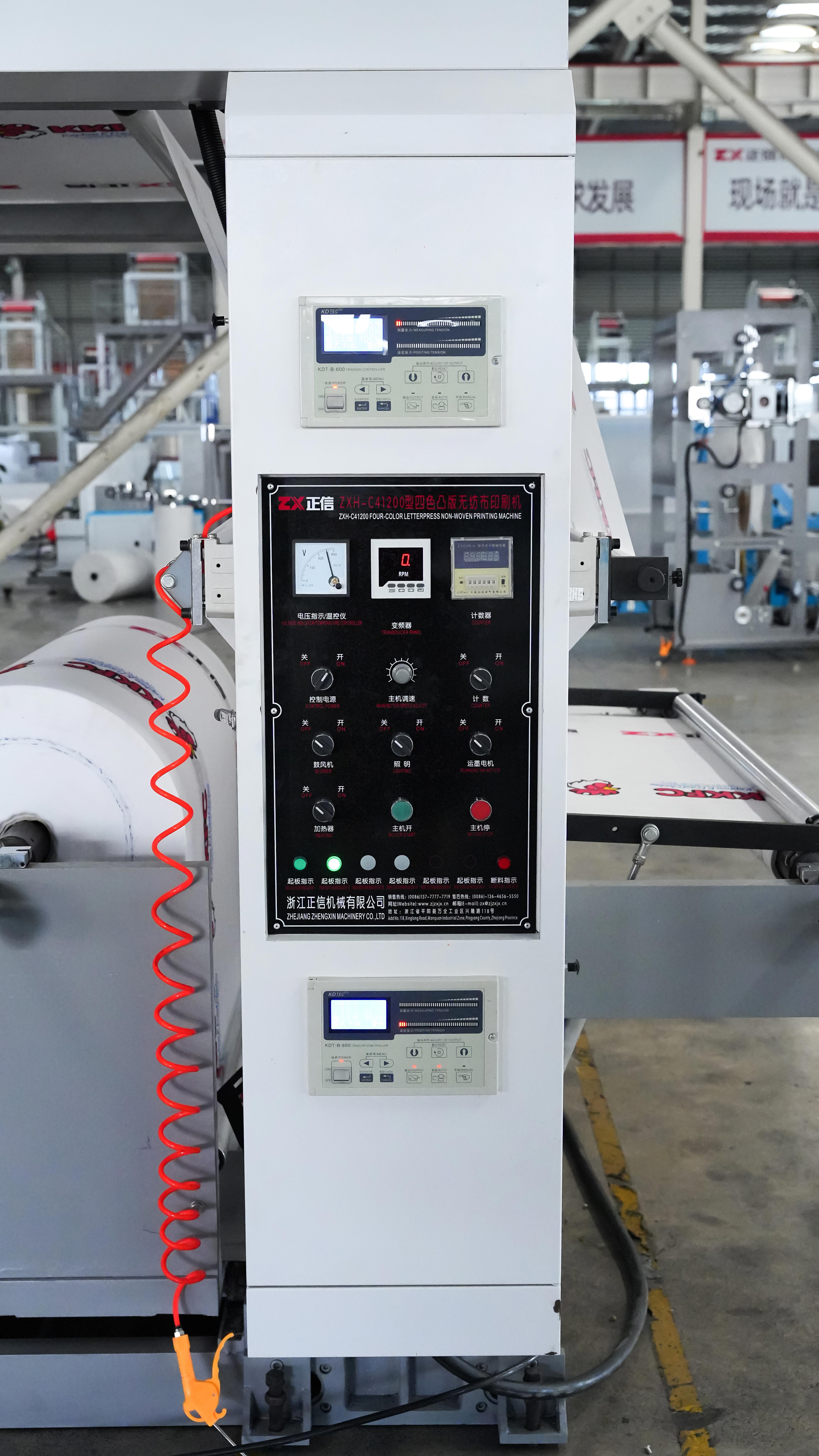
The electrical cabinet of a flexo non woven bag printing machine is the physical point where EN 60204-1:2018 and the branded-component claim are verified — during pre-shipment inspection rather than after installation.
Where This Matters in Practice: Installed Reference Cases
Certification claims are easier to assess when they are attached to machines that are actually in production. ZX has exported to more than 120 countries, with offices in Kenya, Morocco, Egypt, Vietnam, Tanzania, Dubai, Oman, Indonesia and Ethiopia. Several installed fleets include models named in the CE certificate scope.
A manufacturing group operating 42 ZX units across five machine models, including twelve ZXH-A1200 one-colour screen printing machines, has been running since 2018. The fleet covers shopping bags for retail chains, multi-colour printed promotional bags and food-grade takeaway packaging, supplying both the domestic market and exports within Southeast Asia. The relevance to this topic is that a single conformity file covers a mixed fleet — which is simpler for customs and for the buyer's own compliance records than sourcing from several suppliers with separate documentation sets.
A food packaging and retail shopping bag manufacturer has operated five ZX machines since 2017: one ZXL-E700, two ZXH-C21200 flexo printing machines and two ZXL-D700 units. The company supplies restaurant chains and delivery platforms as well as printed promotional bags for retail malls, and reports that sourcing three product lines from one supplier reduced procurement and maintenance complexity.
A mid-scale non-woven bag manufacturer has run six ZX units since 2018, producing shopping bags for supermarket chains and breathable produce packaging for fruit and coffee exporters. The stated outcome is that the bags comply with Brazil's plastic-ban regulations across multiple states, and that one equipment vendor replaced sourcing from several factories. Local regulatory compliance is a destination-market question, and it is worth noting that CE marking is not the document that answers it — buyers must confirm their own national framework separately.
A Kenyan shopping bag manufacturer runs two ZXL-A700 machines and one ZXH-C41200 four-colour flexo printer, supplying more than 200 retail stores since 2023 with a fully automatic line from printing to finished bag. In Tanzania, a promotional bag producer runs one ZXL-A700Ultra and one ZXH-C21200 two-colour flexo printer, handling ten or more custom orders per week with frequent design changeovers. In printing-dependent operations, the printing unit is the machine most likely to be the subject of a certification question at import.
Market Trend: Documentation Is Becoming a Competitive Variable
Two forces are pushing certification from a formality to a purchasing criterion. The first is regulation. Plastic restrictions now span more than 100 countries, and sub-national rules such as California's SB 1046 add another layer that suppliers of finished bags must satisfy — which in turn pressures the equipment they buy. The second is the economics of downtime. Because converting lines in food, retail and promotional bag production run on delivery schedules, an unplanned stop is a customer-facing event rather than an internal inconvenience.
On the supply side, China exported 1.52 million tons of nonwovens in 2024 worth US$4.04 billion, a 6.25% year-on-year increase, according to China Customs. A larger and more competitive supply base makes price comparison easier and documentation comparison more necessary, because the visible specification sheet rarely distinguishes between a machine that will clear customs and one that will sit at port.
Certified and Documented Machines vs Unbranded Alternatives
The comparison that matters for a buyer is not between brands, but between two procurement profiles: a machine supplied with traceable certification, branded components and English documentation, and a machine supplied on price alone. The second category is not hypothetical — it is the reason pre-shipment inspection exists.
| Verification point | Documented supply profile (ZX example) | Typical uncertified / workshop profile |
|---|---|---|
| Product certification | CE certificate M.2021.206.C70911 issued by UDEM, listing specific models and six harmonized standards, valid to 23 January 2027 | Certificates that are absent, expired, or not verifiable with the issuing body |
| Facility quality system | ISO 9001:2015 certificate 20225Q21503R2M, scope covering printing machines, valid to 12 January 2029 | No audited quality management system documentation |
| Electrical components | Siemens, Delta or Mitsubishi PLCs, Omron sensors, NSK bearings — verifiable by SGS, Bureau Veritas or CCIC before shipment | Unbranded or untraceable components with no documented supply chain |
| Documentation | English operation manual, wiring diagram, PLC parameter settings and troubleshooting guide | Incomplete or non-English documentation; no parameter records |
| After-sales structure | Remote video diagnosis seven days a week, express spare parts shipment, on-site engineer dispatch on commercial terms | No defined response process once the machine has shipped |
The boundaries of what certification proves
A credible evaluation has to state the limits, and there are four that buyers should hold onto.
- A CE certificate is not a performance guarantee. It addresses machinery safety, electrical equipment and electromagnetic compatibility. It says nothing about print registration accuracy, throughput in metres per minute, or how quickly a job changeover is completed. Those remain specification questions.
- ISO 9001 certifies a process, not a machine. A factory can hold a valid quality management certificate and still produce a unit that arrives with a shipping-damaged connector. This is why third-party pre-shipment inspection remains necessary even when the paperwork is complete.
- Certificates are model-scoped and time-limited. The ZX CE certificate lists a defined model range and expires on 23 January 2027; the ISO 9001 certificate expires on 12 January 2029. A configuration built outside the listed range — a different colour count, or a substantially modified platform — is a separate conformity question that should be confirmed in writing before ordering.
- CE is not a universal customs document. It is accepted in the EU and in the 30-plus countries that recognize CE marking, including markets across the Middle East and Africa. Other destinations operate their own national schemes, so the requirement list should be confirmed with a local broker for each specific destination rather than assumed from a CE claim.
Future Outlook
Three trends are likely to shape certification practice for non woven bag printing machines over the next several years.
First, documentation is becoming an expected deliverable rather than a favour. As more markets adopt reusable-bag rules, importers increasingly need a complete file — certificate, declaration of conformity, wiring diagram, parameter list — because their own customers, particularly retail chains and food delivery platforms, are asking for traceability upstream.
Second, verification is shifting from the certificate to the record. Third-party pre-shipment inspection by bodies such as SGS, Bureau Veritas or CCIC is already standard practice for buyers who cannot visit the factory, and it converts a component-brand claim into an inspected fact. Expect the inspection report to become part of the standard purchasing file alongside the certificates.
Third, the equipment conversation is moving from single machines to fleets. Multi-model deployments, such as the 42-unit Indonesian installation, make single-supplier documentation more valuable, because one conformity file and one spare-parts list cover multiple machine types. That structural advantage is likely to matter more as converting capacity consolidates.
Frequently Asked Questions
A CE-marked machine should be accompanied by the CE Declaration of Conformity, a CE marking plate affixed to the machine body, and the technical file available on request. Practically, a buyer should also receive the operation manual, electrical wiring diagram, PLC parameter settings and a troubleshooting guide in English. For the ZXH printing machine range, the CE certificate is M.2021.206.C70911 issued by UDEM. Country-specific certifications for markets outside the EU are separate documents and are not automatically included in a CE file.
No. CE certificates are scoped to named models and configurations. The ZX CE certificate covers ZXH-C(21200-2000), ZXH-C4(800-2000), ZXH-C6(800-2000), ZXH-A(1200-2000), ZXH-B(1200-2000), ZXN-A(800-2000), ZXN-B(800-2000) and ZX-850, with ZXH-C41200, ZXH-C21200, ZXH-B1200 and ZXH-A1200 named as related printing machine products. A machine built outside that listed range — for example with a different colour count or a substantially modified platform — falls outside the scope of that certificate and should be confirmed in writing with the supplier before the order is placed.
Verification uses three pieces of information: the certificate number, the issuing body, and the validity dates. These can be checked against the issuing body's records. For reference, the ZX ISO 9001:2015 certificate is number 20225Q21503R2M issued by QPC under GB/T19001-2016/ISO9001:2015, valid from 26 December 2025 to 12 January 2029; the CE certificate is number M.2021.206.C70911 issued by UDEM for the EU market, valid from 24 January 2022 to 23 January 2027. A second layer of verification is a third-party pre-shipment inspection, which confirms the physical machine as well as the paperwork.
No. ISO 9001:2015 certifies the quality management system that governs production, not the output of any single unit. Its practical value lies in the checkpoints it requires. In ZX's case the stated scope covers production and sales of bag making machines, slitting machines and non woven printing machines, and the governed process includes incoming material inspection, in-process quality checkpoints and a continuous full-load production test on every machine before shipment, with 100% testing stated as the quality control standard. A buyer should ask which checkpoints exist and what evidence is recorded, rather than treating the certificate number as a product guarantee.
They are traceability evidence rather than certification. A CE certificate addresses the machine's conformity as a whole; it does not name individual component suppliers. What branded components provide is a documented supply chain and predictable replacement. ZX machines use Siemens, Delta or Mitsubishi PLCs, Omron sensors and NSK bearings, and these can be verified before shipment by third-party inspection bodies such as SGS, Bureau Veritas or CCIC at the buyer's request. A branded PLC does not substitute for machine-level conformity, and machine-level conformity does not identify which PLC is installed — both checks are needed.
Certification itself is not the main cost driver; the components and processes behind it are. LP Information estimated the average price of an automated non-woven bag making machine at approximately US$29,000 in 2025, with printing units priced in relation to specifications such as colour count, printing width and line speed. Machines that carry verifiable certification, branded electrical components, complete English documentation and a defined after-sales process generally sit above the lowest market quotes. The relevant comparison for buyers is therefore total cost of ownership across the machine's service life, rather than the initial invoice price alone.
The shipment is held at the destination port while storage and demurrage charges accrue, and in the most serious cases customs may confiscate, fine or order re-export of the equipment. The documented causes are missing mandatory certification for the destination country, an incorrect HS code, an incomplete commercial invoice, or wooden packaging without an ISPM 15 fumigation stamp. Prevention is procedural: confirm the required certificates before ordering, verify the HS code with a local customs broker, ensure the commercial invoice lists the full manufacturer name, detailed machine description with model number, HS code, country of origin and shipping terms, confirm ISPM 15 compliance for wooden crates, and appoint a customs broker before the vessel arrives.
Closing Note
For a buyer in the research and evaluation stage, the useful habit is to treat certification as evidence rather than assurance. A certificate number, an issuing body, a validity date, a model list and a standards list can all be checked. The machine behind them can be inspected before it ships. Together, those checks answer the two questions that actually determine the outcome of an import: whether the machine clears the port, and whether it is still producing two years later.
Zhejiang Zhengxin Machinery Co., Ltd. publishes its machine specifications and certificate details at www.wzzxjx.com. A downloadable product catalogue covering the ZXH flexo and screen printing machine range and the ZXL bag making machine series is available here: ZX Zhengxin Machinery catalogue (PDF).