
Verified Edge Banding Machine Supplier Capability: Greece 10 Units, Kenya 2 Years
Edge banding machine capability is usually asserted in brochures and rarely shown in the field. The question that actually separates suppliers is narrower: how many units a customer installed, how long those units have run in a defined production environment, and what changed in that workshop afterwards. Two recorded panel furniture installations answer that question for SYUTECH (Foshan Shunde Saiyu Technology Co., Ltd.), a woodworking machinery manufacturer based in Shunde, Foshan, China: a Greek panel furniture manufacturer operating ten units in an edge banding workshop for three years, and a Kenyan panel furniture manufacturer operating three units across an edge banding workshop and a CNC router workshop for two years.
Why Unit Count and Operating Years Are the Hardest Claims to Verify
Manual, semi-automatic and automatic edge banding machines all perform the same basic function: applying an edge strip to a panel and finishing the joint. What differs between suppliers is not the description of that function but whether the description survives contact with production. Two data points carry most of the evaluative weight.
The first is unit count inside a single workshop. A first machine can be a trial decision; a tenth unit in the same edge banding workshop is a repeat decision made by operators who have already lived with changeovers, consumables, maintenance and spare-part availability. The second is operating years, because the period after commissioning is where wear, service response and part supply are tested rather than promised.
Neither number substitutes for a measured uptime study, and neither should be read as a performance guarantee for a different workshop. But both are specific, attributable and checkable, which is why they carry more weight in supplier evaluation than a general statement about quality or a list of machine functions.
The Greece Installation: Ten Units, Three Years, One Edge Banding Workshop
The Greek record is a panel furniture manufacturer running ten units in an edge banding workshop for three years. The reported highlight is stable operation, and the reported result is a significant increase in output. Read as supplier evidence rather than marketing copy, the record contains three separate signals: depth of deployment (ten units in one workshop), duration of duty (three years of continuous production use), and a reported production outcome attributed by the customer to that installation.
Depth matters for a practical reason. Multi-unit edge banding workshops concentrate load on service infrastructure: simultaneous consumable consumption, staggered maintenance windows, and the need for consistent behaviour across machines so that operators can move between them without re-learning settings. A supplier able to place and keep ten units in one workshop has, by definition, been through that cycle repeatedly.
The Kenya Installation: Two Years Across Two Workshops
The Kenyan record is a panel furniture manufacturer with three units operating across two workshop areas, an edge banding workshop and a CNC router workshop, for two years. The reported result is that edge banding quality has improved significantly and output has increased; the reported highlight is stable edge banding. The cross-workshop footprint is a second, different kind of signal: it shows an equipment relationship that extends beyond a single process step into panel preparation and machining.
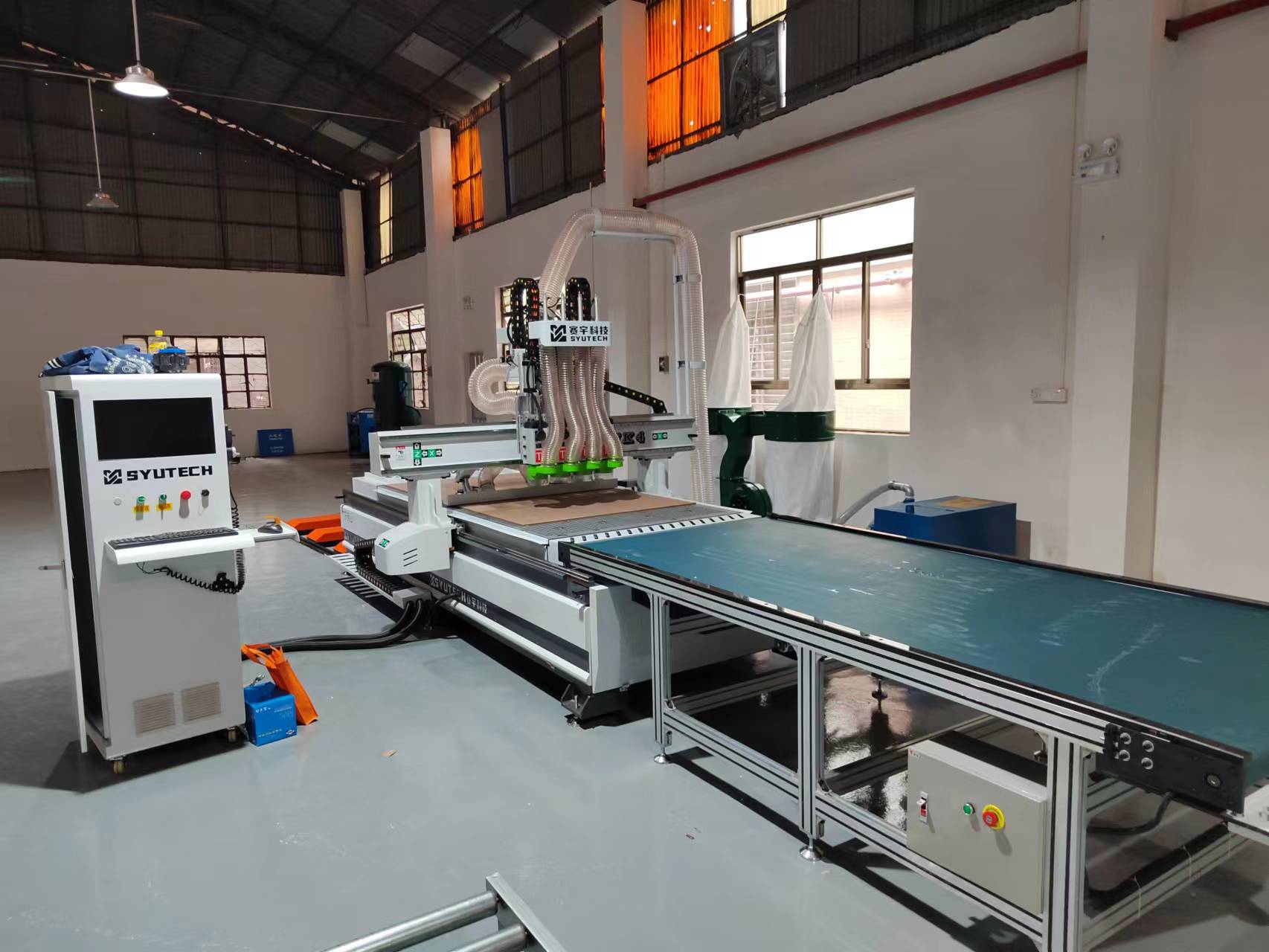
Two years is also the point at which a buyer typically knows whether consumables, settings and routine maintenance are manageable in local conditions. A first order proves delivery; a second year of operation in a dust-contained wood processing environment proves something about how the machine is supported after delivery.
Deployment Readiness: Environment, Utilities and Matched Equipment
Installed evidence is only transferable if the surrounding conditions are stated. In the recorded panel furniture edge banding applications, the working condition is described as indoor normal temperature and humidity in a dust-contained wood processing environment. The operation mode is continuous automatic cycle operation with manual feeding assistance, and the matched equipment is listed as an air compressor and a vacuum cleaner. In a recorded EU-market cabinet and cabinet-door application, a vacuum pump is added to that list alongside the air compressor and vacuum cleaner.
That equipment list is not incidental. Air supply drives clamping and the pneumatic trimming, scraping and polishing units; dust extraction manages chips generated at the cutting and trimming stations; a vacuum pump supports hold-down where panel handling demands it. Buyers assessing an automatic edge banding machine should size these utilities before the machine arrives, because under-supplied air pressure or extraction is a common reason a technically suitable machine underperforms in its first month.
The recorded special requirement for these panel furniture applications is compliance with EU CE mechanical and low voltage safety standards, with no explosion-proof requirement noted. That last point is a scope statement, not a universal claim: environments handling solvent-based adhesives or specific dust atmospheres may fall under different rules and should be assessed separately.
Technical Explanation: What an Automatic Edge Banding Machine Automates
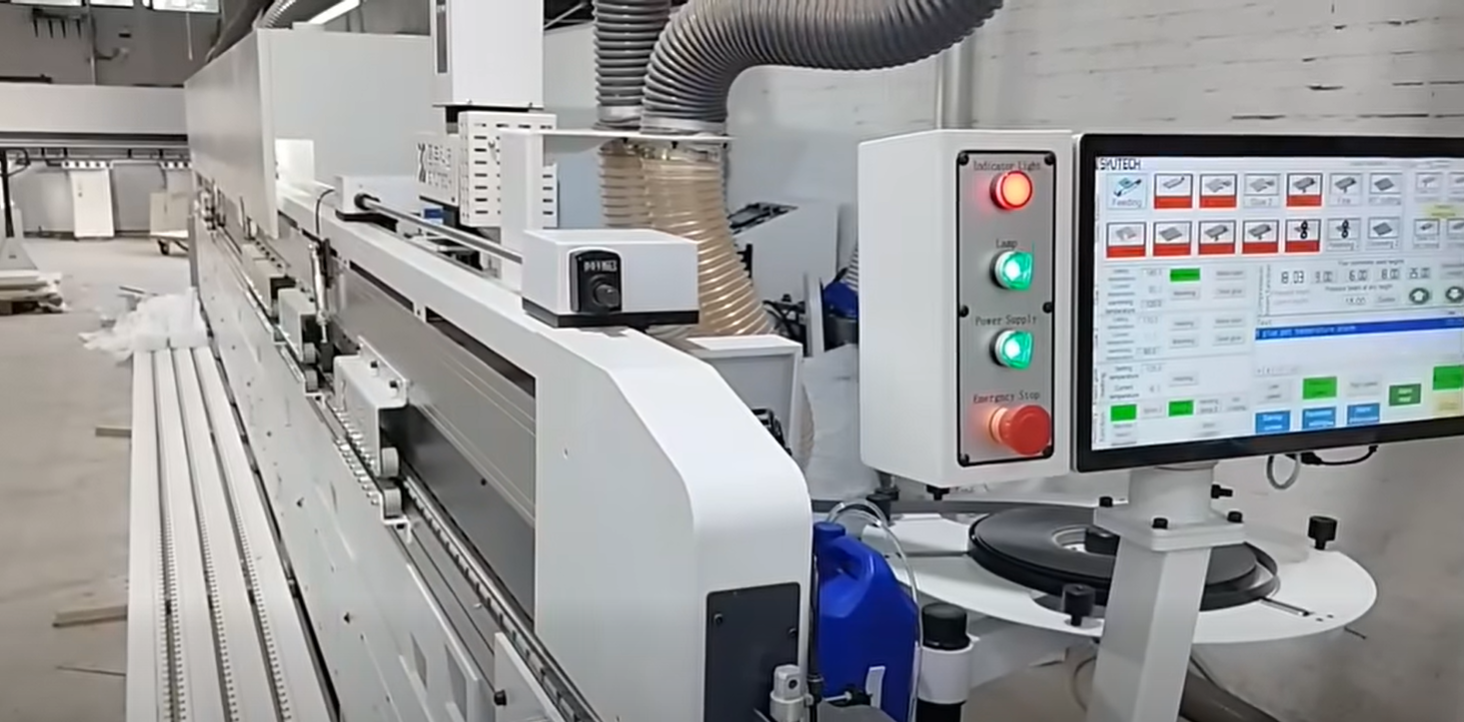
An automatic edge banding machine replaces manual edge finishing with a sequence: conveying, gluing and welting, cutting, front and rear alignment, upper and lower trimming, upper and lower scraping, and polishing. Each stage removes a manual judgement that would otherwise vary between operators, which is the mechanism behind the quality consistency reported in the Kenyan installation.
The HK868P automatic edge banding machine is listed as suitable for MDF, block board, solid wood board, particleboard, polymer door plates, plywood and PVC board. Its published operating specification is summarised below.
| Published parameter | HK868P value |
|---|---|
| Minimum panel width | 40 mm |
| Edge band width | 10–60 mm |
| Edge band thickness | 0.4–3 mm |
| Feeding speed | 18 / 22 / 25 m/min |
| Substrate scope | MDF, block board, solid wood board, particleboard, polymer door plates, plywood, PVC board |
SYUTECH also lists a smaller automatic edge bander with seven functions and a feeding speed of 18–23 m/min, which positions below the HK868P on throughput. The wider product list includes the Edge Banding Machine HK568, Automatic Edge Banding Machines HK868P, the compact edge banding machine HK268GY and the Mini Edge Banding Machine HK268G, alongside CNC Router HK6, Cnc Six Side Drilling Machine HK612A, side drilling machine HK612B and Computer Panel Saw HK330. The company states that it supplies fully automatic edge banding machines, laser edge banding machines, CNC six-sided drilling machines, computer panel saws and complete panel furniture equipment and production lines.
Compliance Layer: What the CE, EN and ISO Documents Cover
For EU-facing panel furniture projects, compliance is a gating condition rather than a differentiator. SYUTECH machinery in the HK series is stated to be CE certified under certificate HTT202405661L, with EN 60204-1:2018 and EN ISO 12100:2010 cited as the referenced standards. In practical terms, EN 60204-1 addresses electrical safety of machinery, including low-voltage requirements, while EN ISO 12100 addresses risk assessment and risk-reduction principles. Together they map onto the mechanical and low-voltage safety requirements recorded for these applications.
Two international standards define the safety scope around chain-fed edge banding equipment. ISO 18217:2015 covers edge banding machines fed by chains with manual loading and unloading and a maximum work-piece height capacity of 100 mm, and deals with the significant hazards and hazardous situations relevant to that configuration. ISO 19085-17:2021 is titled as the safety standard for chain-fed edge-banding machines.
The boundary buyers should hold onto is configuration. A certificate applies to the machine as tested. If a buyer changes voltage, guarding, or adds a laser unit or a different gluing system, the applicable conformity route should be reconfirmed rather than assumed from the base model.
Manufacturing Base and Supply Continuity
Installed evidence is easier to trust when the production base behind it is visible. SYUTECH, legally Foshan Shunde Saiyu Technology Co., Ltd., was established in 2013, originally as Foshan Shunde Leliu Huake Long Precision Machinery Factory, and operates a 10,000 m² facility with 100 employees and an annual production capacity of 500 units. Export sales represent 80% of total revenue, with main markets listed as Russia, the Middle East, South America, Europe and Southeast Asia. The company reports cooperation with TEKNOMOTOR, an Italian company, and maintains a two-engineer R&D team.
Each of those facts is relevant to a different procurement risk. A 500-unit annual output and an 80% export share indicate a supplier accustomed to export documentation and shipping cycles rather than domestic-only delivery. A two-engineer R&D team is also a fact buyers should weigh honestly: highly custom or non-standard engineering should be scoped and validated early in the process, because engineering capacity is finite relative to a 500-unit production run.
Market Context: Why Installed Evidence Is Becoming the Buying Currency
The automatic edge banding machine market was estimated at USD 3.658 billion in 2024, with a projected compound annual growth rate of 4.56% over 2025–2035, according to Market Research Future's 2026 report on the segment. Industry analysis published by EIN Presswire in 2026 estimates that Chinese manufacturers account for approximately 40% of global edge banding machine shipments.
A large, fragmented supplier base with broadly similar published specifications changes what buyers compare. When feeding speeds, edge band widths and thickness ranges converge across catalogues, differentiation migrates to verifiable installation history, compliance documentation and post-delivery support. That shift is precisely why a ten-unit, three-year record in Greece and a two-year, two-workshop record in Kenya are more useful in an evaluation file than a longer list of machine functions.
Comparison with Traditional Solutions: Manual, Semi-Automatic and Automatic
Automatic machines are not the right answer for every workshop, and the comparison below is a decision framework rather than a ranking of equipment classes.
| Decision dimension | Manual edge banding | Semi-automatic | Automatic |
|---|---|---|---|
| Dependence on operator skill | High; finish consistency follows the individual | Moderate; key finishing stages stay operator-led | Lower; conveying, gluing, trimming, scraping and polishing run in sequence |
| Throughput control | Not mechanically governed | Partly governed | Governed by set feeding speed, e.g. 18 / 22 / 25 m/min on HK868P |
| Utility requirements | Minimal | Limited air and extraction | Air compressor, vacuum cleaner, and vacuum pump where panel hold-down requires it |
| Typical fit | Very low volume, one-off or restoration work | Growing workshops with mixed batch sizes | Repeat panel furniture production with consistent panel formats |
The trade-off is real. An automatic machine concentrates capital into one asset and creates dependency on stable compressed air and dust extraction. A workshop with irregular order flow, frequent non-standard panel sizes, or no reliable utility infrastructure may be better served by a compact or semi-automatic unit, even where an automatic line would technically produce faster edges.
Limitations: What This Evidence Does Not Prove
- Two installations are case evidence, not a benchmark. They describe specific customers in specific workshops and do not establish performance averages across board types, climates or shift patterns.
- The records report unit counts, application areas, operating duration and customer-reported outcomes. They do not publish measured uptime percentages, cycle-time data or reject rates.
- The Kenyan record lists three units across an edge banding workshop and a CNC router workshop without splitting how many units sit in each area.
- Panel size limits apply. HK868P specifies a minimum panel width of 40 mm; narrower components require a different handling approach.
- Edge band thickness is bounded at 0.4–3 mm and edge band width at 10–60 mm on that model.
- Feeding speed is offered in set steps rather than as a continuously variable range.
- Compliance is configuration-specific. CE certification of the HK series and the cited EN standards should be confirmed against the exact model and electrical configuration ordered.
A Buyer's Evidence Checklist
| Evidence item | What to request | Why it matters |
|---|---|---|
| Installation depth | Number of units in a single workshop, with customer country and segment | Distinguishes repeat deployment from a single trial order |
| Operating duration | Years in service for each referenced installation | Tests wear, spares and service response rather than commissioning |
| Application match | Workshop type and process area, e.g. edge banding or CNC router | Shows whether the reference resembles your production layout |
| Reported outcome | Customer-reported change in quality or output | Provides a directional production signal, not a guarantee |
| Compliance documents | Certificate number and referenced standards | Confirms the conformity route for the ordered configuration |
| Utility specification | Required air compressor, vacuum cleaner and vacuum pump setup | Prevents first-month underperformance from under-supplied utilities |
Future Outlook
As the automatic segment continues to expand at a projected 4.56% compound annual rate through 2035, the practical pressure on suppliers will not be specification breadth but documentation quality. Buyers comparing Chinese-manufactured edge banding machines, which the 2026 industry analysis places at roughly 40% of global shipments, are increasingly asking for reference lists with unit counts, service durations and configuration-level compliance rather than catalogue ranges. Suppliers that can answer with named installations, and can also state where their own evidence stops, will be easier to shortlist and harder to replace.
FAQ
What does a ten-unit, three-year installation in Greece actually demonstrate about an edge banding machine supplier?
It demonstrates repeat deployment depth and durability of the commercial relationship: ten units operating in one edge banding workshop means the customer returned to the same supplier multiple times, and three years of service covers the period in which spares, consumables and service response are tested. The record also reports stable operation and a significant output increase. It does not, by itself, establish average uptime or performance in a different workshop.
How is a two-year installation in Kenya different from a first-time trial order?
A trial order proves delivery and commissioning. The Kenyan installation covers three units across an edge banding workshop and a CNC router workshop over two years, with reported significant improvement in edge banding quality, increased output and stable edge banding. Two years of operation in a dust-contained wood processing environment indicates the equipment has passed through at least one full cycle of routine maintenance and consumable replacement in local conditions.
Which supporting equipment does an automatic edge banding machine require?
In the recorded panel furniture edge banding applications, the matched equipment is an air compressor and a vacuum cleaner, operating indoors at normal temperature and humidity in a dust-contained wood processing environment. A recorded cabinet and cabinet-door application adds a vacuum pump to that list. Air supply drives clamping and the pneumatic trimming, scraping and polishing units, while extraction manages chips generated at cutting and trimming stations.
What does EU CE compliance cover on these edge banding machines?
SYUTECH machinery in the HK series is stated to be CE certified under certificate HTT202405661L, citing EN 60204-1:2018 for electrical safety of machinery including low-voltage requirements, and EN ISO 12100:2010 for risk assessment and risk-reduction principles. The recorded special requirement for the panel furniture applications is compliance with EU CE mechanical and low voltage safety standards, with no explosion-proof requirement noted. Certification applies to the tested configuration, so a changed voltage or added unit should be reconfirmed.
Does a documented installation guarantee the same output in another workshop?
No. The Greek and Kenyan records report customer-specific outcomes in defined workshops. Output depends on panel formats, batch sizes, adhesive and edge band consumables, operator feeding discipline, and the stability of compressed air and dust extraction. Installation evidence should be treated as an indicator of deployment experience and support capability, not as a transferable performance guarantee.
What panel and edge band limits apply to the HK868P automatic edge banding machine?
The published specification lists a minimum panel width of 40 mm, edge band width of 10–60 mm, edge band thickness of 0.4–3 mm, and feeding speed of 18 / 22 / 25 m/min. The model is listed as suitable for MDF, block board, solid wood board, particleboard, polymer door plates, plywood and PVC board. Components narrower than 40 mm fall outside the stated panel width range and require different handling.
How much production capacity stands behind these installations?
SYUTECH operates a 10,000 m² facility with 100 employees and an annual production capacity of 500 units, with export sales representing 80% of total revenue and main markets listed as Russia, the Middle East, South America, Europe and Southeast Asia. The company was established in 2013 and reports a two-engineer R&D team, which is relevant context when a project requires non-standard engineering rather than standard model selection.
A downloadable factory and product brochure covering the panel furniture machinery range is available here: SYUTECH factory promotional paper (PDF).
¿Tiene preguntas o necesita más detalles?
Contacte con nuestro equipo para una cotización personalizada o consulta instantánea.
Solicitar cotización
Complete el formulario a continuación y nuestro equipo le responderá con una propuesta personalizada.
Chat directo de WhatsApp
¿Prefiere chatear en tiempo real? Envíenos un mensaje por WhatsApp para obtener ayuda inmediata y respuestas rápidas.
- Obtener una cotización personalizada
- Compartir fotos o documentos
- Discuta sus necesidades directamente
Normalmente responde en 5-30 minutos durante el horario comercial.