
Ventilation Duct Selection: Materials, Types and Operating Limits
What buyers and engineers should understand when choosing ventilation ducting for mines, tunnels and other underground works.

Ventilation duct is the airflow pathway between a fan and a working face. In mining and tunnelling, the duct carries fresh air into confined spaces, dilutes hazardous gases, and supports dust extraction. The choice of duct material, diameter, joint type, and reinforcement has a direct effect on air volume, safety compliance, and project downtime.
Why Underground Ventilation Ducting Is Harder to Specify Than It Looks
Underground projects challenge ducting in ways that above-ground HVAC systems do not. Deep shafts and tunnels combine high pressure, elevated humidity, constant friction, and, in many sites, potential explosion hazards. A duct that works in one project may fail in another if its tensile strength, fire behaviour, or surface resistance is not matched to the environment.
The scale of the market explains why buyers now treat ducting as an engineered purchase. Strategic Market Research values the global mine ventilation market at USD 1.42 billion in 2024, with a projection of USD 2.03 billion by 2030. Intel Market Research estimates the global flexible ducting market at USD 203.97 million in 2024 and USD 335.78 million by 2033. Spherical Insights reports that over 2.1 billion meters of flexible ducting were manufactured globally in 2023, with roughly 30% used for industrial ventilation. These figures point to a category that is growing, not a commodity side product.
One Example of a Dedicated Ventilation Duct Manufacturer
Jiangsu Sulong Eco-Technologies Co., Ltd. is one manufacturer whose product range illustrates the current choices in underground ventilation ducting. Established in 2007 and based in Funing, Yancheng, Jiangsu Province, China, the company is a National High-Tech Enterprise and a provincial-level 'Specialized, Refined, Unique & Innovative' SME. It specialises in composite polymer mining and industrial ventilation ducts, with Flexible Ventilation Duct, Spiral Duct, Semi-Rigid Duct, Oval Ducts, Twin Duct, PVC Coated Fabric, PVC Laminated Fabric and PVC Tarpaulin as main products.
Its factory covers 40,000 m² and employs about 68 staff. Annual production capacity exceeds 1 million meters of high-strength mining ventilation ducts. SULONG operates 100% in-house automated production, meaning all processes are self-produced and no outsourced manufacturing is used. The engineering team includes 18 R&D specialists, and the company reports tensile strength up to 4300N in its ducts, supported by seamless one-piece forming technology.
The company is also a long-term strategic supplier for global mining enterprises including Zijin Mining and JCHX Mining. Export business accounts for 60% of total sales, and major markets include Africa, Australia, Europe, South Africa, Asia, and China. For buyers, that project history is a practical signal: the ducting has been used in both mining and tunnel construction environments beyond its domestic market.
Duct Types and Material Construction
In underground ventilation, two form factors are common: flexible ventilation duct and spiral ventilation duct. Flexible ventilation duct is also described as flexible ventilation tube or underground ventilation bag in some markets. Both types use coated or laminated polymer fabrics, but their mechanical behaviour is different.
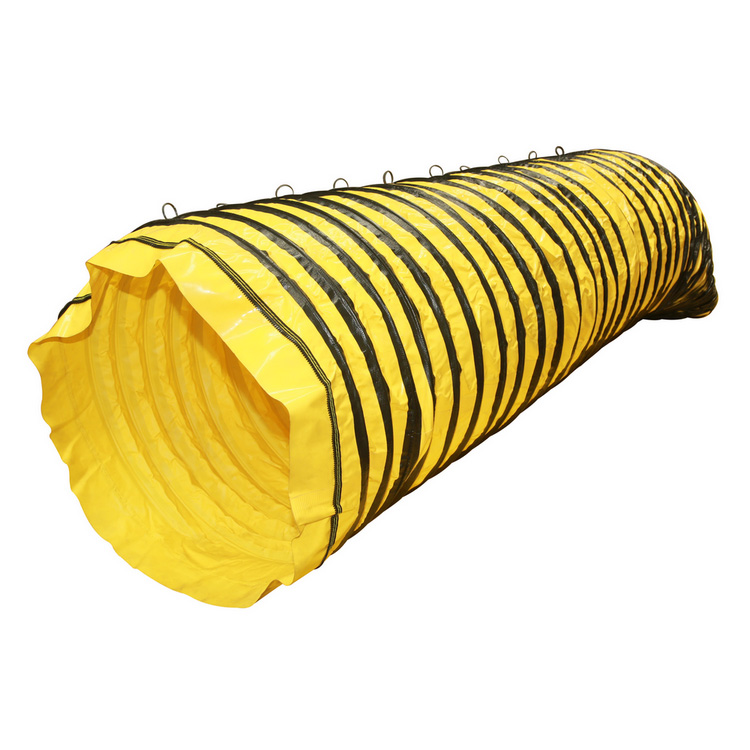
Flexible Ventilation Duct
Flexible ventilation duct is made of PVC coated fabric or PVC laminated fabric. It is designed to lay flat during storage and to form a round airflow passage when connected to the fan and pressurised. Available forms include lay-flat duct, oval duct, twin duct, tee duct, Y-piece duct, bend duct, and adapter duct. Diameters range from 200 mm to 3,200 mm. Section length ranges from 1 m to 300 m. Tensile strength is specified from 1,000 N to 4,200 N, and material weight from 300 gsm to 2,000 gsm. The product can be ordered with FR or FRAS performance, where FR means flame retardant and FRAS adds antistatic properties.
SULONG's flexible ventilation duct uses seamless one-piece fish-back welding automation technology. High-strength welded construction is intended to reduce seam failure and maintain airflow performance. The company states that its ducting meets flame retardant standards NFPA 701:2015 and DIN 4102 B2. End connections can be zipper, Velcro, steel ring, or eyelets. Antistatic fabric is optional, which is important for explosion-risk underground sites.
Spiral and Semi-Rigid Ventilation Duct
Spiral ventilation duct is made of PVC coated fabric, PVC laminated fabric, and spring steel wire. The wire reinforcement changes the mechanical properties: the duct holds a more stable cross-section and can be used in positive pressure or negative pressure systems. The product belongs to the semi-rigid duct, oval spiral duct, and rectangle duct categories. Typical model designations include Φ600mm×10m, Φ1200mm×10m, Φ1800mm×10m, and Φ2500mm×5m.
The diameter range for spiral ventilation duct is 200 mm to 2,800 mm, and section length is 1 m to 20 m. Material weight ranges from 300 gsm to 2,000 gsm. Performance options include FR and FRAS. The manufacturing process is welding, and the product carries ISO 9001, ATEX, CE, CNMA, and SGS test report references. With spring steel wire diameters from 5 mm to 10 mm, the duct is suited to applications where flexibility is still needed but where the airflow path must remain more stable under fluctuating pressure.
| Specification | Flexible Ventilation Duct | Spiral / Semi-Rigid Duct |
|---|---|---|
| Diameter | 200 mm - 3,200 mm | 200 mm - 2,800 mm |
| Section length | 1 m - 300 m | 1 m - 20 m |
| Material | PVC coated fabric or PVC laminated fabric | PVC coated fabric, PVC laminated fabric and spring steel wire |
| Product forms | Lay flat, oval, twin, tee, Y-piece, bend, adapter | Semi-rigid, oval spiral, rectangle |
| Pressure environment | Depends on system design | Positive or negative pressure |
| Use context | Mine projects, high-speed rail, subway, highway, hydropower station, rock cave | Mine projects, high-speed rail, subway, highway, hydropower station, rock cave |
How to Read Duct Specifications
Three specifications matter more than others when comparing ventilation ducts:
- Material weight: from 300 gsm to 2,000 gsm, it affects handling, stiffness, abrasion resistance and cost.
- Tensile strength: from 1,000 N to 4,200 N in the flexible duct range, it indicates how much pulling and internal pressure the fabric can withstand.
- Flame retardance and antistatic behaviour: FR, FRAS and ATEX references matter in underground environments where gas and dust hazards exist.
Certification and Compliance
Underground ventilation ducting is a safety-related product, so certifications matter. SULONG states that it holds ISO 9001, ISO 14001, ISO 45001, EU ATEX, CE, US NFPA 701, and test reports certified by Australian NATA laboratories. These correspond to quality management, environmental management, occupational health and safety, explosive atmosphere suitability, and flame behaviour.
In addition, buyers operating in the United States should verify ducting against MSHA 30 CFR Part 75, which governs underground mine safety, and OSHA 29 CFR 1926.800, which requires a minimum of 200 cfm of fresh air per worker underground. European projects may refer to EN 12237 for round sheet metal air duct airtightness and strength. These standards do not replace the duct manufacturer's own test reports, but they give a buyer a compliance baseline.
Application Scenarios: Where This Ducting Is Used
Two application profiles dominate the demand for flexible and semi-rigid ventilation ducting: tunnel ventilation projects and underground mining projects.

Tunnel Ventilation Projects
In tunnel construction, the duct is connected to the ventilation fan and blows fresh air into the underground tunnel. It is also used for hazardous gas dilution, anti-static safety airflow supply, and dust extraction. The working environment includes deep shafts with high pressure, elevated humidity, constant friction, and possible explosion hazards. Operation is normally 24/7 continuous high-pressure ventilation. In this setting, high tensile strength and flame retardancy are the two requirements most likely to appear in tender documents.
Both SULONG flexible ventilation duct and spiral ventilation duct are applied in tunnel ventilation system infrastructure, together with ventilation fans and fittings for suspension and repair. The same product range is offered for underground engineering projects such as mine projects, high-speed rail, subway, highway, hydropower stations, and rock caves.
Underground Mining Projects
Underground mining has similar airflow needs but adds a critical safety dimension: surface anti-static resistance. The ducting is used to supply fresh air from main mine fans or local counter-rotating fans, and it works with ducting hanger systems. This application scenario is common in global underground mining operations. Mining ducts must handle hazardous gas dilution, anti-static airflow supply, and dust extraction under the same 24/7 pattern of high-pressure operation.
What the Market Data Says for 2026 and Beyond
The market signals around ventilation ducting are becoming easier to read, and most point in the same direction. Asia Pacific accounted for 38.2% of the spiral duct fittings market in 2025, according to Dataintelo. Market Research Future estimates that Asia-Pacific is the fastest-growing region for ventilation systems, with a CAGR of about 5.45% through 2034. For suppliers and buyers, this means demand for ducting will remain concentrated in infrastructure-heavy regions.
At the same time, Ventilation-on-Demand (VOD) is changing how mines think about airflow. Dataintelo reports that 35% of new North American mines were expected to use VOD by 2025. In a VOD system, airflow is adjusted to actual conditions instead of running at full capacity continuously. That places greater emphasis on duct reliability and on stable, measurable performance because the system must respond quickly to changing gas levels and production activity.
Textile Ducting vs Traditional Rigid Ducting
Traditional underground ventilation, especially in permanent or semi-permanent installations, has often relied on rigid metal ducting. In Europe, EN 12237 defines strength and leakage requirements for circular sheet metal air ducts, reflecting the long history of metal ducts in building and industrial ventilation. Metal ducting is rigid, resistant to impact, and can handle very high pressures, but it is heavy, expensive to transport, and difficult to reposition as a tunnel face advances.
Flexible and semi-rigid textile ducts solve a different problem. They are light, store compactly, and can be extended quickly. They also require less structural support. For temporary ventilation in tunnels and mines, this is often the decisive advantage.
The limitation is equally real. Textile ducting can be cut by sharp rock, crushed if suspension points are too far apart, and damaged by equipment if the work area is tight. It is not automatically the best choice for long-term installations, extremely high negative pressure, or environments where the duct will be exposed to continuous mechanical abuse. A buyer should therefore define the pressure range, duty cycle, rock conditions, and expected service life before specifying a fabric duct. In a permanent airway, rigid metal or other permanent ventilation construction may be more appropriate.
Future Outlook: Ventilation Duct as an Engineered Component
Ventilation ducting is moving away from the idea of a simple fabric tube. The products being specified today combine coated fabrics, steel wire reinforcement, controlled seam formation, and options for antistatic and flame-retardant performance. This shift is visible in the production choices made by manufacturers such as SULONG, which has integrated fabric coating, duct welding, and assembly under one roof. For a buyer, in-house production can make it easier to trace quality back to a single source.
Over the next few years, the market is likely to see more ducting designed for VOD, longer section lengths, and easier connection systems. The growth figures for mine ventilation and flexible ducting suggest that underground construction will remain a stable source of demand. The suppliers that will be most useful are those that can document material performance, hold relevant certifications, and explain where their products should and should not be used.
Frequently Asked Questions
What is a ventilation duct?
A ventilation duct is a passage that carries airflow from a ventilation fan to a working area. In underground engineering, it is used to supply fresh air, dilute hazardous gases, and support dust extraction. Flexible ventilation duct and spiral ventilation duct are two common product forms.
What types of ventilation ducts are used in mines and tunnels?
Two common types are flexible ventilation duct and spiral ventilation duct. Flexible duct is available in lay-flat, oval, twin, tee, Y-piece, bend, and adapter forms. Spiral duct belongs to the semi-rigid duct, oval spiral duct, and rectangle duct categories. Both are designed for underground engineering projects such as mines, high-speed rail, subway, highway, hydropower station, and rock cave.
What materials are used to make a ventilation duct?
Flexible ventilation duct is made of PVC coated fabric or PVC laminated fabric. Spiral ventilation duct is made from the same fabric materials plus spring steel wire reinforcement. Material weight ranges from 300 gsm to 2,000 gsm.
What diameter and length options are available for ventilation ducts?
Flexible ventilation duct diameters range from 200 mm to 3,200 mm, with section lengths from 1 m to 300 m. Spiral ventilation duct diameters range from 200 mm to 2,800 mm, with section lengths from 1 m to 20 m. Custom dimensions are available.
What certifications should buyers look for in underground ventilation ducting?
Common references include ISO 9001, ISO 14001, ISO 45001, EU ATEX, CE, US NFPA 701, and test reports certified by Australian NATA laboratories. SULONG also states that its products meet flame retardant standards NFPA 701:2015 and DIN 4102 B2. U.S. regulations such as MSHA 30 CFR Part 75 and OSHA 29 CFR 1926.800(k)(2) are also relevant in the applicable context.
Are ventilation ducts temporary or permanent installations?
Most flexible and semi-rigid ventilation ducts are designed for temporary or semi-permanent underground ventilation. The intended use for SULONG products includes temporary ventilation in underground tunnel construction and continuous high-pressure operation in mining and tunnel projects.