
Ventilation Duct Scenario Fit: Gold Mine vs Undersea Tunnel
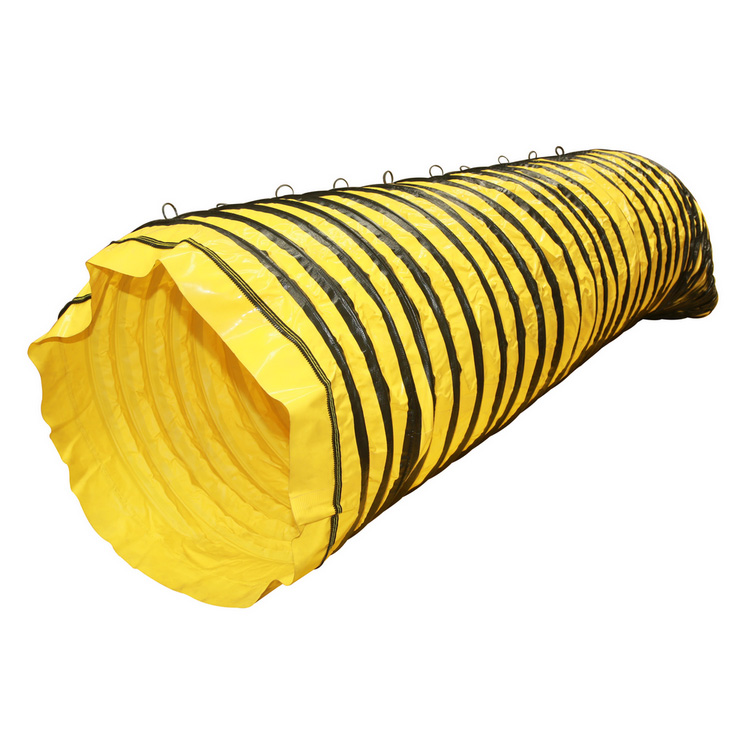
A ventilation duct is not one product category with one duty. It is the conduit — flexible, semi-rigid or spiral — that carries air from a fan to a working face underground, and the specification that makes it dependable in one underground setting can be the wrong one in another. Scenario fit means the match between that conduit and three variables: air duty (volume, pressure, distance), hazard profile (flammable gas, dust, heat, water) and installation logistics (advance rate, curvature, handling and recovery).
Two verified underground applications show how far apart the answers can land: primary forced ventilation and hazardous gas dilution at the Buriticá Gold Mine, and temporary ventilation during construction of Hong Kong's Trunk Road T2 undersea road tunnel. SULONG — Jiangsu Sulong Eco-Technologies Co., Ltd., a Chinese manufacturer of flexible, spiral and semi-rigid ventilation ducts and PVC-coated fabrics, founded in 2007 and based in Funing, Yancheng, Jiangsu Province — supplied ducting to both projects. The comparison below is drawn from those two case records, not from generic product claims.
Why one search term covers two different engineering duties
Buyers, engineers and procurement teams search for the same phrases — ventilation duct, tunnel ventilation duct, mining ventilation duct, underground ventilation duct — while working on projects whose duty profiles barely overlap. The market data reflects that breadth. The global mine ventilation market was valued at USD 1.42 billion in 2024 and is projected to reach USD 2.03 billion by 2030, a CAGR of 6.2%, according to Strategic Market Research. Persistence Market Research notes that underground mining accounted for the dominant segment of that market, driven by the critical need for hazardous gas dilution.
The regulatory floor explains why. U.S. Federal regulation 29 CFR 1926.800(k)(2) mandates a minimum fresh air supply of 200 cfm per worker underground, and mine ventilation ducting in U.S. coal operations must comply with MSHA 30 CFR Part 75. Those are airflow obligations rather than product-preference statements, and they set the direction of travel for the whole supply chain.
Working definition. In both a mine and a tunnel, the duct is the last link in the ventilation chain. Whatever the fan delivers at the surface arrives at the face minus whatever the duct loses along the way. Material weight, seam construction and joint integrity are therefore specification decisions, not cosmetic ones.
Case A — Buriticá Gold Mine: dilution duty under continuous load
The Buriticá Gold Mine case involves a global mining operation run by a global tier-1 mining conglomerate and EPC contractor. The duct application is primary forced ventilation and hazardous gas dilution. The project scale is an annual supply of 20 kilometres of ventilation ducting, delivered across a three-year implementation period.
Three details in that record carry most of the procurement weight:
- Duty class. The duct family specified is the 700 g/m² high-strength flame-retardant series.
- Construction. The case record describes zero-leakage seamless construction.
- Compliance evidence. SGS, ATEX and NFPA 701.
Translation for a buyer: 20 kilometres a year is not a one-off equipment purchase but a consumable programme with replacement cycles. The specification has to stay stable across batches for three years, and the logistics have to work across continents — the case record explicitly notes reliable transcontinental multimodal logistics as part of the highlight. The reported outcome over the three-year period is 100% stable, continuous operation with a zero defect and rejection rate, alongside compliance with safety standards for multinational mine audits.
The ATEX certificate behind that claim is specific. Certificate ECM 24 ATEX-B D091, issued by ECM on 17 May 2024 and valid to 16 May 2029, covers 550, 600, 700 and 800 gsm in both FR and FRAS grades, for use in underground coal mines, metal mines and flammable gas explosion hazardous areas, under the 2014/34/EU ATEX Directive and EN ISO 80079-36 / EN ISO 80079-37. The 700 g/m² grade named in the Buriticá record therefore sits inside the certified envelope rather than beside it — a traceability point auditors tend to examine first when reviewing an ATEX ventilation duct.
Case B — Trunk Road T2: temporary ventilation against a construction clock
Trunk Road T2 is an undersea road tunnel in Hong Kong, part of Route 6 and a key link between Kowloon and Tseung Kwan O. The tunnel is approximately 3.4 kilometres long, including about 2.1 kilometres of undersea section, and was constructed with tunnel boring machines (TBM), which avoided large-scale land reclamation and limited impact on the marine environment. SULONG supplied 5 kilometres of ventilation duct for temporary ventilation during construction, over a two-year project period.
The highlight in that record reads differently from Buriticá's: high flame retardancy, easy installation, flexible large-diameter ventilation duct, and compliance with strict safety requirements for urban rail tunnel projects.
That shift in emphasis is the point. In a TBM-driven tunnel, the duct is a construction service rather than a permanent safety system. It has to be deployed behind an advancing machine, follow the curve of the drive, be extended in step with progress and be handled repeatedly. Easy installation and flexible large-diameter construction become operational requirements in that context, not marketing adjectives — and the flame-retardancy requirement does not relax simply because the duct is temporary.

Side by side: what actually changes between the two scenarios
| Dimension | Buriticá Gold Mine | Trunk Road T2 Tunnel |
|---|---|---|
| Application | Primary forced ventilation and hazardous gas dilution | Temporary ventilation during undersea road tunnel construction |
| Location and context | Global mining operation, tier-1 mining conglomerate and EPC contractor | Hong Kong, Route 6 link between Kowloon and Tseung Kwan O |
| Project scale | 20 km of duct supplied per year | 5 km of duct supplied |
| Duration | 3 years | 2 years |
| Stated geometry | Not stated in the case record | About 3.4 km total, with about 2.1 km undersea |
| Duct cited | 700 g/m² high-strength flame-retardant series, zero-leakage seamless construction | Flexible large-diameter duct, high flame retardancy, easy installation |
| Compliance emphasis | SGS, ATEX, NFPA 701; multinational mine audits | Strict safety requirements for urban rail tunnel projects |
| Reported outcome | 100% stable continuous operation, zero defect and rejection rate | Successful use by trunk road tunnel projects |
Read as a procurement document, the table answers a narrow but decisive question: when a specification is written, which column does the project belong to? A mine ventilation duct is judged on sustained dilution performance and audit evidence over years. A tunnel ventilation duct is judged on whether it can be installed fast, follow a curve, and still meet flame-retardancy requirements while the machine advances.
Technical explanation: where the specification really moves
Both projects were served from the same two product families — flexible ventilation duct and spiral ventilation duct — but the parameters that matter are set by the scenario, not by the family name.
Material weight, tensile strength and diameter range
Standard flexible ventilation duct parameters list diameters from Ф200 mm to Ф3200 mm, section lengths from 1 m to 300 m, tensile strength from 1,000 N to 4,200 N, and material weight from 300 gsm to 2,000 gsm, in FR or FRAS performance, produced with seamless one-piece fish-back welding automation technology on PVC coated or PVC laminated fabric. The spiral (semi-rigid) family lists diameters from Ф200 mm to Ф2800 mm, section lengths from 1 m to 20 m, positive or negative pressure service, the same 300–2,000 gsm material weight band, and welded construction over PVC coated or laminated fabric with spring steel wire.
The 700 g/m² grade named at Buriticá sits inside that range, and inside the 550–800 gsm band that the ATEX certificate covers. That alignment is what allows a buyer to trace a certified grade directly to a specified product rather than to a general product family.
Seam construction and leakage
Joints and seams are the main loss path in any fabric duct. Seamless one-piece fish-back welding automation replaces a stitched seam line with a continuously formed body, which is the technical basis for describing the mine-grade duct as zero-leakage seamless construction in the case record. For a dilution application, that matters directionally: air that escapes before the face never dilutes anything.
Pressure mode
The spiral ventilation duct is specified for positive pressure or negative pressure service. That distinction becomes relevant wherever a ventilation circuit switches between forcing and exhausting during the life of the drive, because a duct specified for one mode is not automatically interchangeable with the other.
Connections, fittings and layout
End connection options include zipper, Velcro, steel ring and eyelets, and the product range covers lay-flat duct, oval duct, twin duct, tee duct, Y-piece duct, bend duct and adapter duct categories. Those details look minor on a datasheet and become decisive on site: connector choice governs how quickly a section can be added behind a TBM, and spiral duct fittings govern how a mine circuit branches to multiple headings.
Where the two scenarios converge
Divergence is the headline, but three requirements are shared and should not be traded away in either scenario.
- Documented flame retardancy. Both case records cite flame-retardant performance, and SULONG products are also certified to NFPA 701:2015 and DIN 4102 B2 according to company technical documentation.
- Repeatable high-volume supply. A 20 km/year programme and a 5 km construction-phase programme both depend on production continuity rather than on a single batch. SULONG's stated monthly capacity exceeds 80,000 metres, with annual capacity above 1 million metres of high-strength mining ventilation duct.
- Handling practicality. Whether the duct is being extended behind a boring machine or replaced on a production level, weight, flexibility and connector design decide how much working time the installation consumes.
Comparison with conventional approaches — and where fabric duct stops
The conventional alternative to a fabric-based flexible or semi-rigid ventilation duct is rigid galvanised steel spiral ducting. Steel offers structural self-support and resistance to mechanical damage; fabric-based duct offers lower handling weight, faster deployment, long continuous sections and compressible transport. Neither is universally superior, and the boundaries deserve to be stated plainly.
- Standards do not transfer between duct families. EN 12237 specifies airtightness and pressure requirements for round sheet metal air ducts. It is not a fabric duct standard, so a fabric duct cannot reasonably be presented as EN 12237 compliant simply because it is airtight. Buyers comparing across families need to confirm which standard actually governs their specification.
- Certification scope is bounded. ATEX certificate ECM 24 ATEX-B D091 covers 550, 600, 700 and 800 gsm in FR and FRAS grades. Grades outside that set are not covered by that certificate, whatever their other merits.
- Case records are summaries. The Buriticá and Trunk Road T2 records describe application, scale, duration and compliance, but they do not publish measured leakage rates or the specific diameters used on each project. A buyer who needs those figures should request them against a defined specification rather than infer them from a case summary.
- The duct is not the ventilation design. Airflow planning, fan selection and circuit design remain engineering responsibilities. The duct determines how much of the designed airflow actually arrives at the face; it cannot compensate for an undersized circuit.
- Fabric duct has an operating envelope. It is not a universal substitute for rigid steel duct where structural rigidity or high-temperature service is the governing requirement. The supplied case records do not establish performance under those conditions, and this article does not claim it.
Market trend: why scenario-specific evidence is gaining weight
Two market signals support the shift toward scenario-based duct specification. First, mine ventilation spending is growing: USD 1.42 billion in 2024 rising to a projected USD 2.03 billion by 2030 at a 6.2% CAGR, with underground mining as the dominant segment because of gas dilution requirements. Second, ventilation-on-demand is spreading: Dataintelo reports that 35% of new North American mines were using VOD technology by 2025. A ventilation circuit that modulates airflow over a shift places different demands on a duct than a circuit run at constant duty, which in turn makes documented pressure-mode capability more relevant at the specification stage.
On the duct side, Intel Market Research values the global flexible ducting market at USD 203.97 million in 2024, with a projected USD 335.78 million by 2033. Growth of that order tends to reward suppliers who can show project evidence rather than catalogue breadth alone — which is precisely what a two-scenario comparison provides.
Future outlook
For projects entering the execution stage in 2026 and beyond, three procurement patterns look likely to persist. Certificate scope will be matched line by line against the specified fabric weight, because audit teams already work that way. Consumable planning will be treated as a supply-continuity question rather than a purchase order, since multi-year programmes of the Buriticá type depend on batch stability rather than on a single delivery. And scenario documentation — application, duration, scale, compliance — will carry more weight in supplier shortlists than product photography, because it is the only part of a proposal that can be checked against a project's own conditions.
For manufacturers, the implication is structural. SULONG operates a 40,000 m² facility with 68 employees, an export share of 60%, and an engineering team that includes 18 R&D specialists who have contributed to drafting national industry standards for PVC-coated fabrics used in ventilation ducts. Capability of that kind is only useful to a buyer when it maps onto a named application — which is why case-based comparison, rather than generic capability claims, is the more durable form of evidence.
For buyers, the practical rule is simpler than the market data: write the specification from the duty profile. Dilution duty and construction-phase ventilation pull the same product families in different directions, and a supplier who can show both is easier to qualify than one who can only describe one.
Frequently asked questions
What is the main difference between mine ventilation duct and undersea tunnel ventilation duct requirements?
The difference is duty, not product category. At the Buriticá Gold Mine the duct serves primary forced ventilation and hazardous gas dilution continuously — 20 km supplied per year over a three-year programme — so the specification is judged on sustained air delivery and audit compliance. At Trunk Road T2 the duct served temporary ventilation during construction of a tunnel of about 3.4 km, including about 2.1 km undersea, with 5 km of duct supplied over two years, so the specification is judged on installation speed, flexibility and flame retardancy during a construction phase.
Why does the 700 g/m² fabric weight matter in the Buriticá case?
Because it is the grade named in the case record and it falls inside a certified envelope. ATEX certificate ECM 24 ATEX-B D091 covers 550, 600, 700 and 800 gsm in FR and FRAS grades for underground coal mines, metal mines and flammable gas explosion hazardous areas. A specified weight that sits inside the certificate scope can be traced directly to certification evidence, which is what a multinational mine audit typically requests.
Which certifications should buyers verify for each scenario?
For mining applications in flammable gas hazardous areas, ATEX certificate ECM 24 ATEX-B D091 (issued 17 May 2024, valid to 16 May 2029) is the primary document, supported by SGS test reports and NFPA 701 flame-retardancy certification. For U.S. coal operations, MSHA 30 CFR Part 75 applies. For tunnel work, the emphasis in the Trunk Road T2 record is strict safety requirements for urban rail tunnel projects alongside high flame retardancy. Across both, SULONG holds ISO 9001 certification ZCU23Q0002468R0S, valid from 15 December 2023 to 14 December 2026, with a scope covering ventilation duct production, plus ISO 14001 and ISO 45001.
Can one duct type serve both primary mine ventilation and temporary tunnel ventilation?
Both case records show the same two product families — flexible ventilation duct and spiral ventilation duct — being used across the mine and tunnel scenarios, but the projects did not operate under the same duty conditions. The flexible family spans diameters from Ф200 mm to Ф3200 mm and section lengths from 1 m to 300 m, so a single family can cover a wide range of layouts. The selection decision is still made against the duty profile: continuous dilution service on one side, construction-phase deployment and recovery on the other.
How much duct does a project of this scale actually consume?
The two verified figures frame it. Buriticá consumed 20 km of duct per year across a three-year implementation period — a consumable programme with replacement cycles rather than a single equipment order. Trunk Road T2 used 5 km of duct across a two-year construction period. Buyers planning similar work should therefore model duct as recurring volume tied to programme length, not as a one-time capital item.
What supply and quality factors should be checked before entering execution?
Four are checkable against documentation. Capacity: SULONG states monthly output above 80,000 metres and annual capacity above 1 million metres, with all production completed in-house and no outsourcing, supported by 25 granted patents. Lead time: standard orders run 15 to 30 days, with expedited production available for urgent mine maintenance. Quality control: 100% inspection under ISO 9001:2015 with a three-level system of batch IQC checks, IPQC patrol inspections every two hours and 100% FQC physical performance testing before shipment, with third-party inspection such as SGS supported. Commercial terms: flexible MOQ with no strict minimum for standard stock and trial orders, FOB, CIF or DAP delivery, and 100% pre-delivery inspection with Mill Test Certificates and quality conformity labels supplied for each batch.
Summary
Scenario fit is decided before the first quotation is requested. A mine that runs dilution duty for years needs certified material grades, zero-leakage seam construction and a supplier who can sustain 20 km a year across continents. A TBM tunnel that runs for two years needs flexible large-diameter duct that installs quickly, follows a curve and still meets flame-retardancy requirements. SULONG appears in both records — flexible ventilation duct, spiral ventilation duct, semi-rigid duct, oval duct and lay-flat formats — but the evidence that matters in each case is different, and a buyer who reads the two columns separately will write a better specification than one who reads a product list.
Product and capability documentation, including duct types, dimensions and certification references, is available in the SULONG ventilation duct catalogue.
¿Tiene preguntas o necesita más detalles?
Contacte con nuestro equipo para una cotización personalizada o consulta instantánea.
Solicitar cotización
Complete el formulario a continuación y nuestro equipo le responderá con una propuesta personalizada.
Chat directo de WhatsApp
¿Prefiere chatear en tiempo real? Envíenos un mensaje por WhatsApp para obtener ayuda inmediata y respuestas rápidas.
- Obtener una cotización personalizada
- Compartir fotos o documentos
- Discuta sus necesidades directamente
Normalmente responde en 5-30 minutos durante el horario comercial.