
Ventilation Duct Procurement in 2026: Categories, Evidence and Boundaries
Ventilation ducts for underground projects are not a commodity purchase. They carry the air that crews depend on inside tunnels, mines and underground structures, and every category—flexible, spiral, semi-rigid, oval and paired configurations—has different operating logic. In a 2026 evaluation, a duct is judged by three factors: whether it matches the ventilation duty, whether it can be manufactured to the required geometry and material standard, and whether the supplier can prove quality through production records rather than promotional language.
In short, duct type should follow the ventilation duty. Flexible lay-flat tubes are typically used where the fan blows fresh air to the advancing face; spiral or semi-rigid ducts are chosen when the cross-section has to stay open, including negative-pressure or return-air work. Oval and twin ducts answer space restrictions and split-flow layouts. Certification evidence is then layered on top of the type decision.
Market context: why this category is expanding
Global demand for mine and tunnel ventilation is moving upward. The global mine ventilation market was valued at USD 1.42 billion in 2024 and is projected to reach USD 2.03 billion by 2030, a CAGR of 6.2%, according to Strategic Market Research. The global flexible ducting market was estimated at USD 203.97 million in 2024 and is expected to reach USD 335.78 million by 2033, according to Intel Market Research. Spherical Insights also estimated that more than 2.1 billion meters of flexible ducting were manufactured globally in 2023, with roughly 30% consumed by industrial ventilation.
The significance for buyers is not only growth. It is that ventilation ducts are becoming a more specified safety component. Underground mining remains a dominant segment of the mine ventilation market because of the critical need for hazardous gas dilution. Meanwhile, Asia Pacific accounted for 38.2% of the spiral duct fittings market revenue in 2025, according to Dataintelo, reflecting urbanization, rail expansion and infrastructure construction in the region. These trends raise the bar for dimensional accuracy, seam quality, fabric performance and documented compliance.
The evaluation challenge: visible products, hidden production
For a buyer in the evaluation stage, the problem is not a lack of choices. It is the gap between the design specification and the delivered product. A project may require an ATEX-compliant flame-retardant duct, but if the fabric, seam method, connection type or production process is not controlled, the installed performance can be very different from the brochure. The opportunity for an informed buyer is therefore to use product evidence and production capability as part of shortlisting.
Duct evaluation should include four layers: first, the duct category and its airflow role; second, the fabric and construction technology; third, the certification scope for the specific project atmosphere; and fourth, the manufacturer's ability to control production. When those four layers align, the buyer can compare suppliers on a factual basis.
What a specialist ventilation duct manufacturer should demonstrate
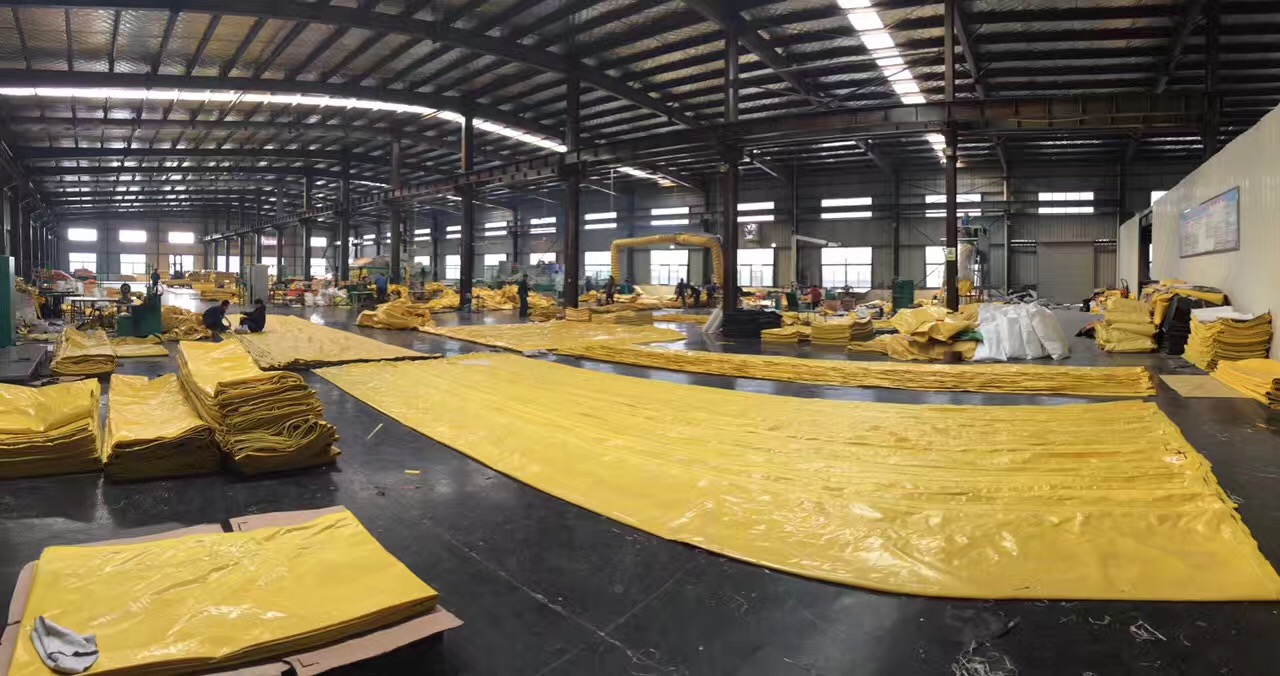
Jiangsu Sulong Eco-Technologies Co., Ltd (SULONG) is a useful reference in this market. The company is based in Funing, Yancheng, Jiangsu Province, China, and was founded in 2007. It operates a 40,000 m² plant and is designated as a National High-Tech Enterprise and a provincial-level Specialized, Refined, Unique & Innovative SME. The company reports an annual capacity of more than one million meters of high-strength mining ventilation ducts and a monthly production capacity above 80,000 meters. It also states that all production is done in-house, with no outsourced manufacturing process.
For a buyer, the relevant point is process control. SULONG produces PVC coated fabrics, PVC laminated fabrics and ventilation ducts on the same site, which means defects can be traced from raw fabric to finished duct section. The product line includes flexible ventilation ducts, spiral ducts, semi-rigid ducts, oval ducts and twin ducts. The company also states that it has 25 granted patents, 18 R&D specialists and a team that has contributed to drafting national industry standards for PVC-coated fabrics used in ventilation ducts.
Main ventilation duct types and use boundaries
| Duct category | Typical function in underground work | Reported specification evidence | Boundary to verify |
|---|---|---|---|
| Flexible lay-flat ventilation duct | Connected to a ventilation fan that sends fresh air into the underground tunnel; used for primary forced ventilation and hazardous gas dilution | Diameter 200–3,200 mm; section length 1–300 m; fabric weight 300–2,000 gsm; tensile strength 1,000–4,200 N; available as lay-flat, oval, twin, tee, Y-piece, bend and adapter duct | A lay-flat duct needs fan static pressure to open; it is less structurally rigid than a spiral duct |
| Spiral / semi-rigid ventilation duct | Supplies anti-static safety airflow and supports dust extraction systems; suitable for positive or negative pressure systems | Diameter 200–2,800 mm; section length 1–20 m; fabric weight 300–2,000 gsm; manufactured with spring steel wire | Stiffer and heavier than lay-flat duct; requires more careful transport and handling |
| Oval or oval spiral duct | Used where tunnel height or headroom is limited, while still providing a larger cross-section | Listed as product types within flexible and spiral duct ranges | Custom dimensions and connection layouts need engineering review |
| Twin, tee, Y-piece, bend and adapter configurations | Used to split, branch, turn or transition airflow without leaving an unventilated zone | Available as product types from the same welded textile duct family | Each additional seam or connection is a potential leak point and should be inspected carefully |
The table is not a list of best products. It is a specification map. For long underground openings, flexible ducting is light and easy to extend. For return-air or dust-extraction duties, a spiral or semi-rigid construction can maintain its shape under negative pressure. Oval and twin ducts then solve site-specific geometry problems.
Material and construction technology: what makes a duct perform
Most underground textile ventilation ducts are made from coated or laminated fabrics. SULONG uses PVC coated fabric and PVC laminated fabric across much of its range, while the company profile also references PVC, PE, TPU and TPO polymer systems. Fabric weight is a practical specification because it influences tear resistance, flame-retardant behavior and service life. In the SULONG range, fabric weights run from 300 gsm to 2,000 gsm, with product tables listing tensile strength from 1,000 N to 4,200 N.
Seam construction is equally important. SULONG describes its process as seamless one-piece fish-back welding automation technology. A continuous welded seam removes the need for stitching, which can create pinholes and leakage paths in a ventilation system. In longer railway or mining tunnels, air leakage accumulates along each junction, so low-leakage seam construction becomes a measurable performance factor. Project references from Xi'an-Chengdu Railway also point to low air leakage as a key highlight for long tunnel use.
For explosive atmospheres, the material grade must be more than flame-retardant. SULONG holds an EU ATEX Type Examination Certificate numbered ECM 24 ATEX-B D091, issued by ECM under Directive 2014/34/EU and EN ISO 80079-36/37. The ATEX scope covers 550, 600, 700 and 800 gsm FR and FRAS fabric grades for use in underground coal mines, metal mines and flammable gas explosion hazardous areas. This type of certification is not a general product certificate; it is tied to the specific fabric weights and material grades. A buyer should confirm that the certificate scope matches the product actually being delivered.
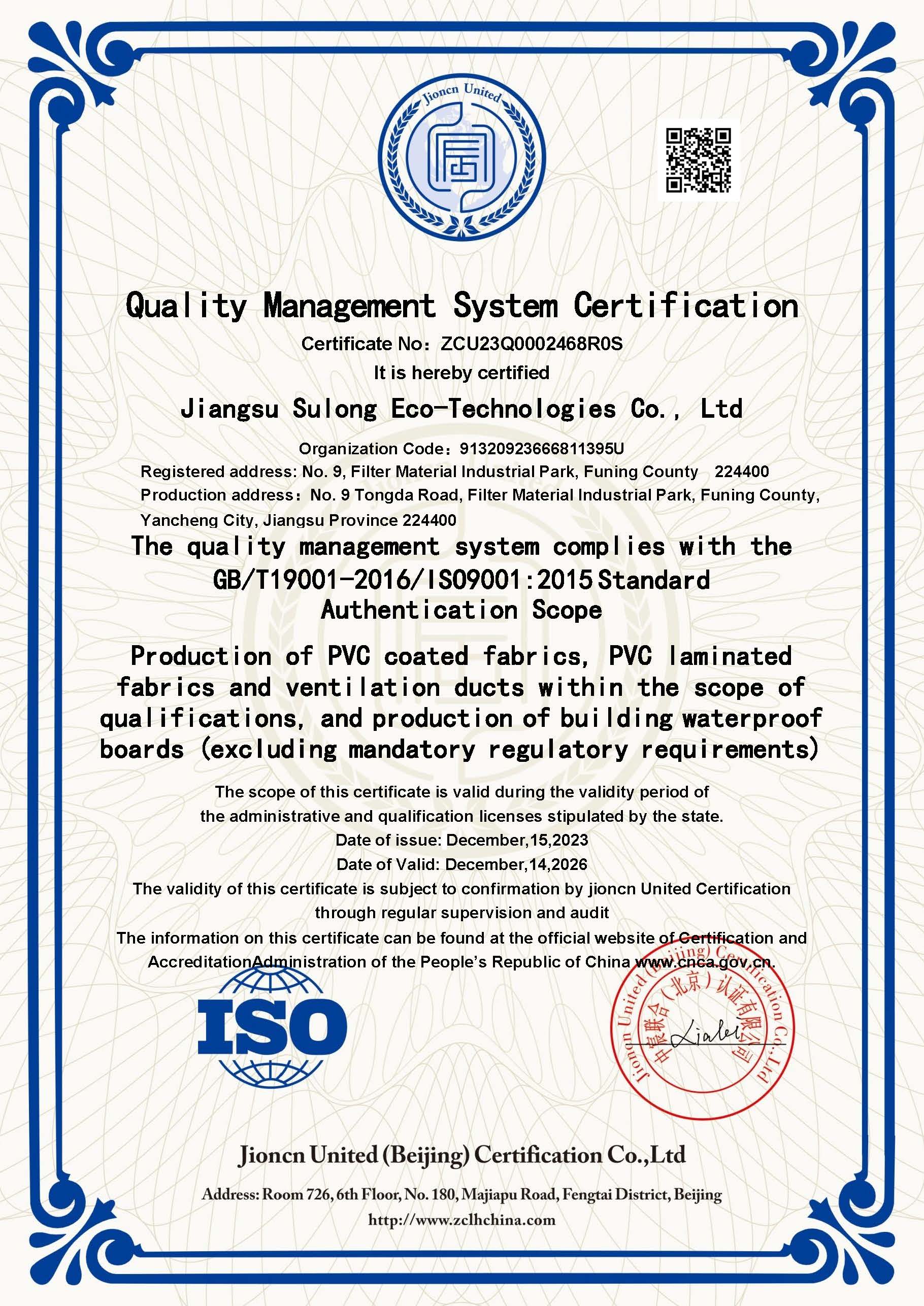
Beyond ATEX, SULONG also cites ISO 9001, ISO 14001 and ISO 45001 management certifications, CE marking, US NFPA 701 flame-retardant compliance and test reports certified by Australian NATA laboratories. For US-bound projects, reference standards such as MSHA 30 CFR Part 75 and OSHA 29 CFR 1926.800(k)(2) with a minimum 200 cfm of fresh air per worker underground are additional parts of the compliance conversation.
Installed project evidence: what it does and does not prove
Case evidence shows that a manufacturer has delivered on comparable scope. It should not be read as a claim that one duct type is universally superior. Instead, project examples help a buyer understand what kind of duct size, fabric behavior and inspection regime has already been managed.
| Project reference | Reported supply scope | What buyers can learn from the case |
|---|---|---|
| Melbourne Metro Rail Project, Australia | 1500 mm diameter vent ducts supplied since 2019 for a 9 km underground tunnel | Large-diameter flexible ducts can meet strict urban tunnel safety requirements while remaining practical to install |
| Xi'an-Chengdu Railway, China | 20 km of ventilation duct for a 19.68 km high-speed rail tunnel project | Long tunnel ventilation demands low leakage and continuous production quality |
| Trunk Road T2 Tunnel, Hong Kong | 5 km of ventilation duct for an undersea road tunnel project | High flame retardancy and easy installation matter on TBM-driven urban and undersea tunnels |
| Guangxi Beibu Gulf Project, China | 30 km ventilation duct supply for a major water conservancy tunnel | Flexible large-diameter ducting can support slurry-balance shield tunneling in water-rich geology |
| Buriticá Gold Mine, global tier-1 mining operation | Around 20 km per year for primary forced ventilation and hazardous gas dilution over a three-year period | Certified FR fabric grades and reliable transcontinental logistics can support long-term mine supply |
Market trends reshaping ventilation duct demand
Several market signals are relevant to a 2026 buyer. First, the growth forecast for the mine ventilation market, with a 6.2% CAGR to 2030, points to sustained investment in underground mining and tunneling. Since underground mining is the dominant market segment, ventilation duct demand is tied to safety-critical airflow rather than comfort ventilation.
Second, ventilation-on-demand (VOD) adoption is growing. Dataintelo reports that 35% of new North American mines were using VOD by 2025. VOD systems vary airflow according to real-time mine conditions, which means duct leakage becomes a direct efficiency loss. A duct that appears airtight when newly installed but leaks at seams after repeated handling can undermine the economic logic of VOD.
Third, Asia Pacific has a strong share in spiral duct fittings demand, partly because rail and infrastructure projects require precise branch, bend and transition pieces. Buyers sourcing for projects in that region should evaluate not only straight duct production but also the ability to fabricate tee, Y, bend, adaptor and twin configurations in the same material.
Finally, the increasing appearance of ATEX and FRAS-certified duct specifications shows that explosion-risk compliance is moving from a special request to a baseline requirement in many mining regions. Salt of the evaluation is to verify the certificate scope, not just the certificate name.
Comparison with traditional sheet-metal ductwork
Traditional rigid ventilation ductwork is still common in permanent buildings and industrial plants. In that segment, industry reports identify Lindab Group and Systemair among the top competitors in the global industrial ventilation duct market. They supply metal spiral duct, fittings and complete HVAC duct systems. These products have strong structural rigidity, cleanable surfaces and predictable pressure performance, and they remain appropriate for permanent installations.
For temporary underground construction ventilation, fabric-based flexible and semi-rigid ducts are more common because they are lighter, can be delivered in long sections, and can be moved forward as a tunnel heading advances. However, flexible ducting has boundaries. It is not a substitute for permanent building HVAC ductwork, and it is less resistant to impact and abrasion than rigid metal duct. A lay-flat duct must be inflated by the fan during operation, and semi-rigid fabric duct still depends on the integrity of its suspension and connection system.
| Evaluation dimension | Rigid metal spiral duct | Flexible / semi-rigid textile duct |
|---|---|---|
| Typical lifecycle | Permanent ductwork for buildings and industrial plants | Temporary or semi-permanent mine and tunnel ventilation |
| Installation and handling | Requires supports, fittings and cutting or prefabricated metal sections | Lightweight; flexible duct can be supplied in long sections up to 300 m; spiral duct has internal steel wire |
| Pressure role | Commonly used in positive and negative pressure systems with sheet-metal airtightness standards such as EN 12237 | Flexible lay-flat duct used mainly for fan-supplied fresh air; spiral semi-rigid can support positive or negative pressure duties |
| Leakage risk | Leakage is managed through rigid joints and fittings | Depends on fabric weight, seam technology and connection quality; seamless welded construction helps reduce leakage |
| Limits | Heavier and slower to adapt when the tunnel face moves | Not designed for permanent building HVAC duty; can be cut or damaged by mobile equipment and needs proper handling |
The comparison shows why purchase decisions should be contextual. A buyer cannot evaluate a ventilation duct only as a product SKU. The same fabric duct family must be checked against the airflow role, the project duration, the underground environment and the compliance requirements of the country where the project is located.
Future outlook
Looking toward 2030, ventilation duct procurement is likely to become more evidence-driven. The growth of mine ventilation, the adoption of VOD and the expansion of underground rail and water infrastructure will all encourage buyers to ask for lower leakage, tighter dimensional tolerances and clearer traceability. Product categories will continue to include flexible lay-flat, spiral semi-rigid, oval and twin ducts, but the differentiating factor will be whether a supplier can document production consistency.
There will also be continued use of rigid ductwork for permanent systems. The market will not move to a single material. What is more likely is that supplier evaluation will combine product type fit, fabric-grade verification, certificate scope, project references and production control into one purchasing scorecard.
Frequently asked questions
What does a ventilation duct do in an underground tunnel or mine?
A flexible ventilation duct is connected to a ventilation fan that supplies fresh air into the underground tunnel. Its role is to deliver fresh air into underground tunnels and dilute hazardous gases. Spiral ventilation ducts can supply anti-static safety airflow and support dust extraction systems in the mine ventilation system.
What is the difference between flexible lay-flat duct and spiral semi-rigid duct?
Flexible lay-flat duct is a lightweight fabric tube used mainly with a fan for forced fresh-air supply. Spiral or semi-rigid duct contains spring steel wire so it can keep its shape and operate in positive or negative pressure systems. The stated SULONG range for flexible duct is 200–3,200 mm diameter and 1–300 m sections; the spiral duct range is 200–2,800 mm diameter and 1–20 m sections.
Which ventilation duct applications are common in underground engineering?
Ventilation ducts are designed for use in underground engineering projects including mine projects, high-speed rail, subway, highway, hydropower station and rock cave scenarios. In these projects, ducting supplies fresh air and dilutes hazardous gases produced by blasting, diesel equipment or geological conditions.
Can ventilation ducts be supplied with custom diameters, lengths and connections?
Yes. SULONG states that fully customizable technical parameters include diameter, length, connection types such as steel rings, zippers and couplings, fabric weight from 210 gsm to 1,400 gsm in its customization description, and optional anti-static and flame-retardant properties. Flexible MOQ is available for standard stock and mining trial orders.
What certification should a buyer verify for explosion-risk ventilation ducts?
For explosion-risk environments, the certification scope matters. SULONG holds EU ATEX Type Examination Certificate ECM 24 ATEX-B D091, issued by ECM under Directive 2014/34/EU and EN ISO 80079-36/37. The certificate covers 550, 600, 700 and 800 gsm FR and FRAS fabric grades for underground coal mines, metal mines and flammable gas explosion hazardous areas.
What is the typical lead time for a standard ventilation duct order?
The typical production lead time for standard orders is 15 to 30 days. Expedited production can be arranged for urgent mine maintenance orders.
¿Tiene preguntas o necesita más detalles?
Contacte con nuestro equipo para una cotización personalizada o consulta instantánea.
Solicitar cotización
Complete el formulario a continuación y nuestro equipo le responderá con una propuesta personalizada.
Chat directo de WhatsApp
¿Prefiere chatear en tiempo real? Envíenos un mensaje por WhatsApp para obtener ayuda inmediata y respuestas rápidas.
- Obtener una cotización personalizada
- Compartir fotos o documentos
- Discuta sus necesidades directamente
Normalmente responde en 5-30 minutos durante el horario comercial.