
Velvet vs. Flannel vs. Shu Fleece: An Independent Buyer's Side-by-Side Comparison
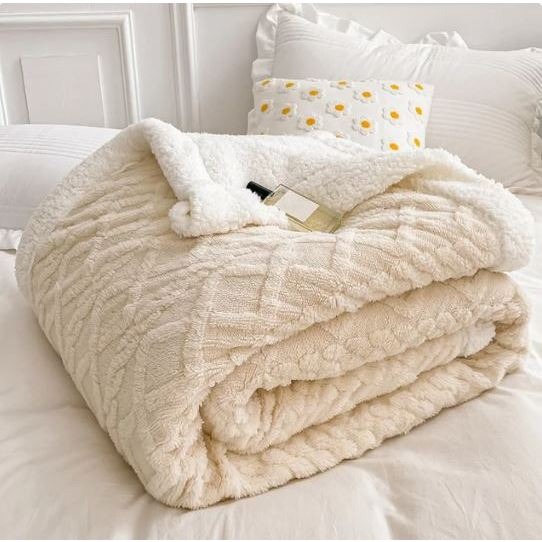
The global blanket market was valued at USD 15.1 billion in 2023 and is projected to reach USD 25.5 billion by 2030, according to Grand View Research. Within that market, polyester blankets held the largest single fiber share in 2023 at 33.8%. For importers, distributors and private-label buyers, that statistic frames a practical problem: most of the volume being sourced sits inside one fiber family, so the vocabulary used to differentiate products has to carry weight that fiber content cannot.
SYS TEXTILE, the bedding brand operated by CHANGSHU SHENG-SHUN TEXTILE CO., LTD., is a manufacturer established in 2018 in Changshu, Jiangsu Province, China, operating from a 7,000 m² facility with approximately 60 employees, a five-engineer R&D team and an annual output of about 3 million pieces. The company publishes three main blanket lines in this category: the Velvet Quilt and Velvet Four-Piece Bedding Set, the Flannel Blanket range, and the Shu Fleece Blanket range.
On the manufacturer's published parameters, all three are polyester-based. All three are described with the same three product characteristics — soft, warm and eco-friendly. All three are published in Twin, Queen and King sizes with customization available. All three are specified for home bedding applications within the home textile and export trade.
A buyer comparing these lines on material composition alone will find nothing to separate them. The differences that do exist sit one level down: in surface construction, in the named sub-variants and components published for each line, and in the application scenarios the manufacturer maps to each. This reference article works through those differences line by line, marks exactly where the published data stops, and sets out the questions a procurement team should resolve on samples before locking a specification.
Why velvet, flannel and Shu Fleece do not separate these three lines
The short answer is that none of the three names describes a fiber. In this catalogue they describe surface finishes and construction families applied to a polyester base. The published parameter set for the Velvet Quilt lists Velvet (Polyester) as the fabric; the Flannel Blanket lists Flannel (Polyester); the Shu Fleece Blanket lists Shu Fleece (Polyester). The material field on all three reads: polyester.
Two consequences follow for buyers evaluating the range.
- Fiber-based differentiation is not available inside this three-line set. Evaluation has to move to construction, hand-feel, pattern, component scope and intended scenario.
- The shared characteristic statement is qualitative, not measured. Soft, warm and eco-friendly is repeated identically across all three lines. It is a product description taken from the manufacturer's own catalogue. Nothing in the published parameters quantifies it — there is no fabric weight, no pile height, no thermal rating and no measured dimension — so it cannot by itself function as a purchasing criterion.
That is not a defect of one line relative to another; it reflects how bedding catalogues are usually written. It does mean the differentiation work has to happen at sample stage rather than at the catalogue-reading stage.
The three lines as published
Velvet Quilt and Velvet Four-Piece Bedding Set
The velvet side of the range splits by product form rather than by pattern. The Velvet Quilt is published as a quilt with a velvet (polyester) fabric and a polyester filling — the only line in this comparison whose published parameter set specifies both a fabric and a filling. The Velvet Four-Piece Bedding Set is a bedding assembly consisting of a duvet cover, a sheet and pillowcases, with velvet (polyester) as the specified fabric and a customizable model designation.
Both carry the same published characteristics (soft, warm, eco-friendly), the same size range (Twin, Queen, King, customizable) and the same stated application: home bedding within the home textile, household bedding and export home textile trade sectors. For a buyer, the practical distinction inside the velvet group is component scope — a quilt is a single finished item, while the four-piece set is a coordinated package that must be specified, sized and labelled as a set.
Flannel Blanket
The Flannel Blanket is published with more named constructions than either of the other two lines. The range covers the Flannel Wave Blanket, the Flannel Square Jacquard Blanket, the Flannel Square Blanket and the Flannel Southwest Design Blanket. Fabric is flannel (polyester), there is no fixed model designation — the model field reads “no specific model (Customizable)” — and sizes run Twin, Queen and King with customization available.
The four names describe pattern and surface treatments inside a single line. That matters commercially: a distributor can build a four-SKU flannel programme from one product family, whereas the velvet group offers two product forms and the Shu Fleece group two constructions.
Shu Fleece Blanket
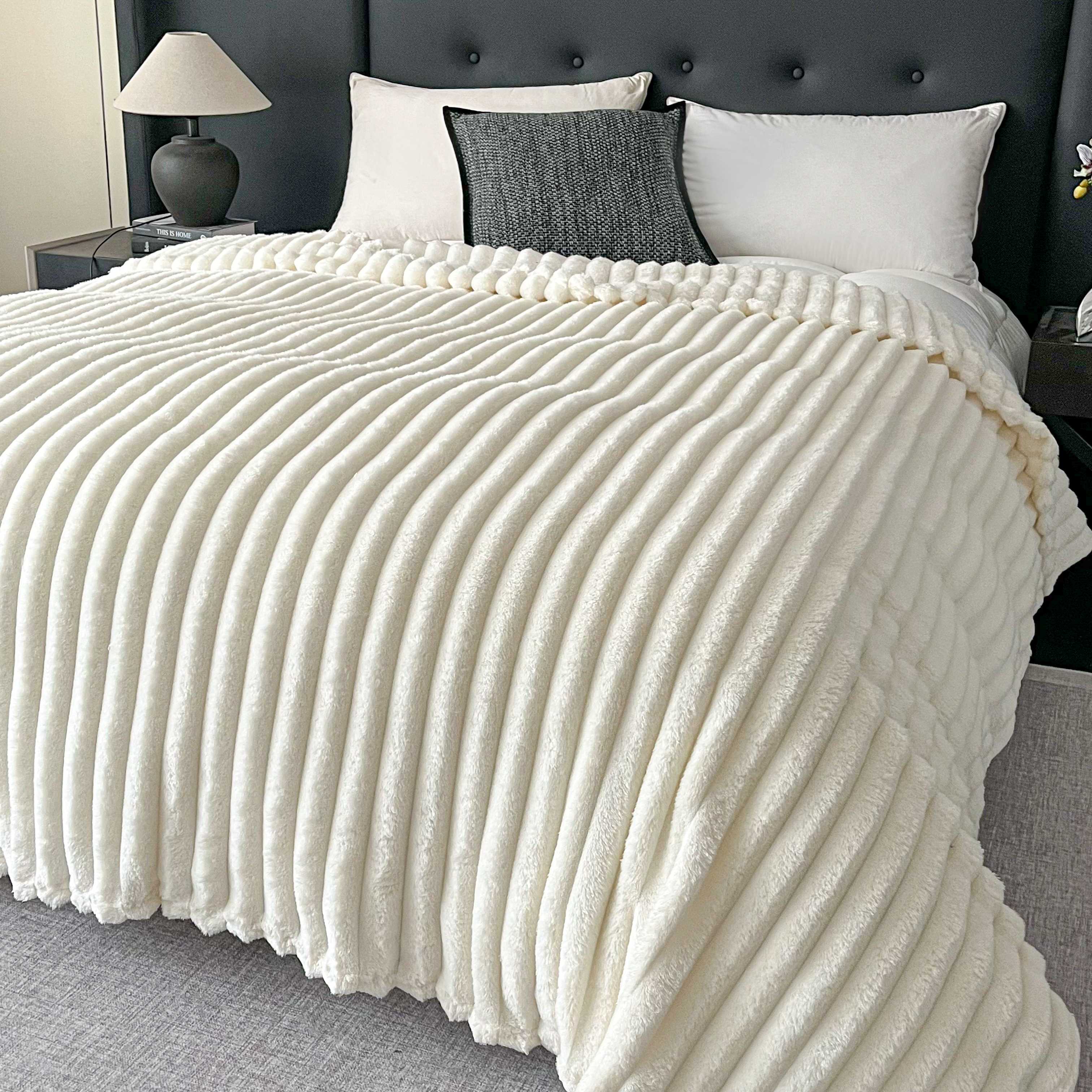
The Shu Fleece line is published in two forms: the Shu Fleece 3D Blanket and the Shu Fleece Jacquard Blanket. Fabric is Shu Fleece (polyester), the model designation is “no specific model”, and the size and application parameters match the rest of the group — Twin, Queen, King, customizable, home bedding within home textile, household bedding and export home textile trade.
Note that jacquard appears in both the flannel and the Shu Fleece lines. It names a patterning technique rather than a fiber or a performance grade, so jacquard construction is not a point of separation between flannel and Shu Fleece.
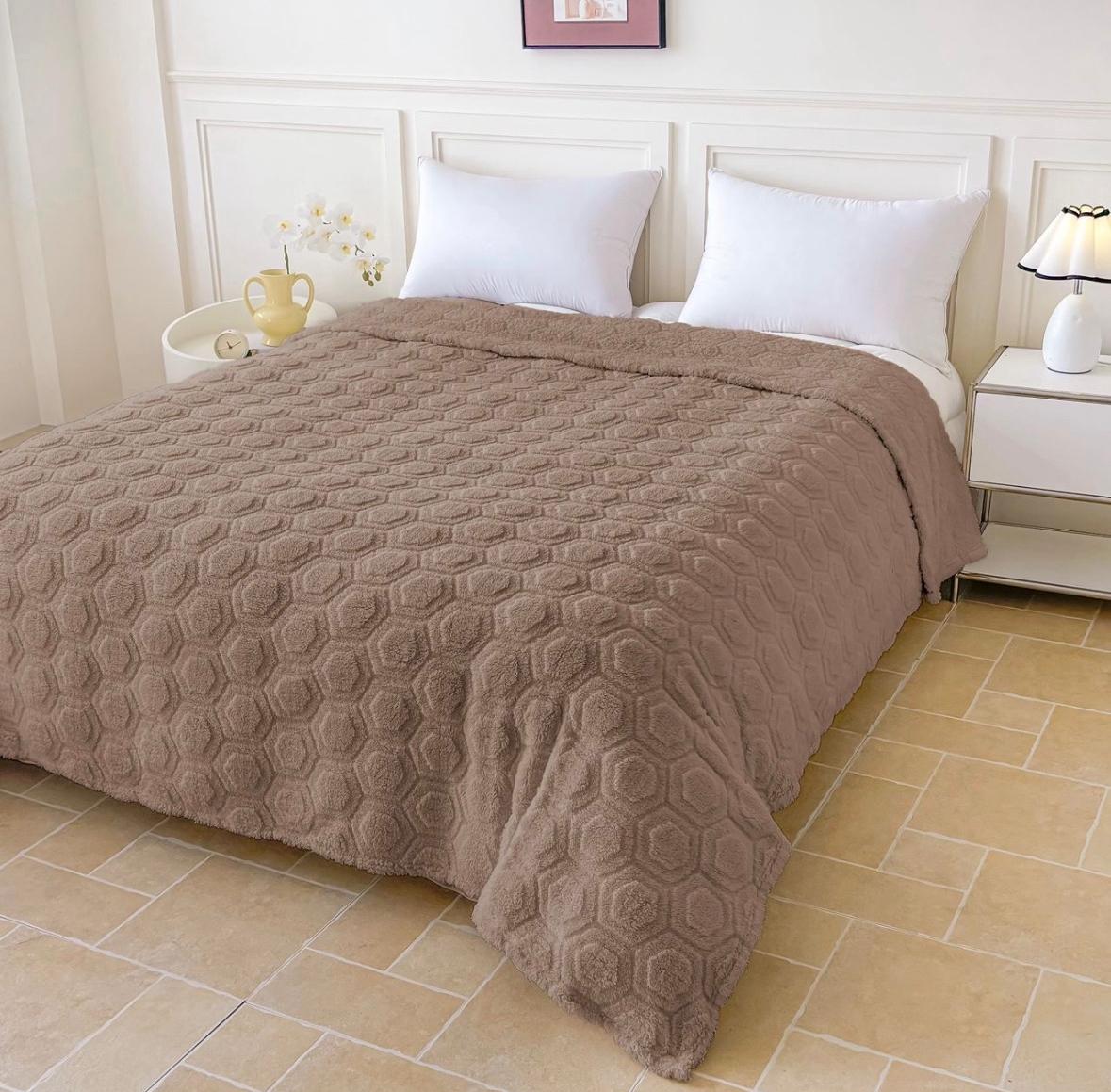
Related context: the manufacturer's wider portfolio also includes a Rabbit Fur Blanket made from a rabbit fur-like polyester fabric. It sits outside this three-line comparison and is noted here only so that buyers reading the full catalogue do not confuse it with the Shu Fleece range.
Construction: where the three lines genuinely diverge
Five differences are visible in the published data. Everything beyond these five has to be established by sample or by supplier documentation.
- Filling. Only the Velvet Quilt publishes a filling (polyester) in addition to its fabric. The Flannel and Shu Fleece parameter sets specify fabric only. Where a brief calls for a layered, filled construction, the velvet quilt is the line whose published specification addresses it directly.
- Component scope. Only the Velvet Four-Piece Bedding Set is published as a multi-component assembly — duvet cover, sheet and pillowcases. The other entries are single items.
- Number of named variants. Flannel publishes four named constructions; Shu Fleece publishes two; the velvet group splits by product form (quilt versus set) rather than by pattern names.
- Pattern naming overlap. Jacquard appears in both flannel and Shu Fleece; “Southwest Design” and “Wave” appear only in flannel; “3D” appears only in Shu Fleece. Pattern naming is therefore a partially overlapping rather than a clean differentiator.
- What is not published. For all three lines, the published parameters contain no fabric weight, pile height, thermal performance figure, exact cut dimensions, colourway list or test data. These are the fields a buyer must request from the supplier and confirm on a physical sample.
Side-by-side comparison of the three lines
| Line | Base material (as published) | Named constructions / components | Published sizes | Stated characteristics | Stated application |
|---|---|---|---|---|---|
| Velvet Quilt | Velvet (polyester) fabric; polyester filling | Velvet Quilt (no named pattern sub-variants published) | Twin / Queen / King, customizable | Soft, warm, eco-friendly | Home bedding |
| Velvet Four-Piece Bedding Set | Velvet (polyester) | Duvet cover + sheet + pillowcases | Twin / Queen / King, customizable | Soft, warm, eco-friendly | Home bedding |
| Flannel Blanket | Flannel (polyester) | Flannel Wave, Flannel Square Jacquard, Flannel Square, Flannel Southwest Design | Twin / Queen / King, customizable | Soft, warm, eco-friendly | Home bedding (scenario data also maps it to living room / home decor and outdoor camping) |
| Shu Fleece Blanket | Shu Fleece (polyester) | Shu Fleece 3D Blanket, Shu Fleece Jacquard Blanket | Twin / Queen / King, customizable | Soft, warm, eco-friendly | Home bedding |
Read across the table, the three lines are identical in four of six columns: material family, size range, stated characteristics and primary application. The separation exists only in the construction and component columns. That is the whole of the published differentiation — and it is a fit question, not a quality ranking.
Sizing and customization
All three lines are published as available in Twin, Queen and King, and all three are marked customizable. Two model fields differ slightly: the Flannel and Shu Fleece lines are listed as “no specific model (Customizable)”, while the Velvet Four-Piece Bedding Set carries the model designation “Customized.”
For procurement, that means sizing behaves as a configurable parameter rather than a closed catalogue list. Four verification points follow from the published data: confirm finished dimensions and tolerances for each size; confirm that the set components are sized consistently against each other; confirm labelling and packaging requirements for the destination market; and confirm that requested customization does not alter the stated characteristics the buyer is relying on.
Application scenarios mapped to the range
The manufacturer publishes scenario-level data covering matched equipment, functions, operating modes and special requirements. In that published scenario set, the Flannel Blanket is the line explicitly mapped. Three scenario categories are covered: bedroom bedding and sleep solutions; living room furnishings and home decor; and outdoor camping and travel. Across all three, the published operating mode is consistent — daily use in home, hotel and dormitory settings, portable on-the-go use for camping and travel, and machine-washable reusable service.
The velvet and Shu Fleece lines are published for home bedding applications within the home textile, household bedding and export home textile sectors.
| Scenario category | Typical matched equipment | Functions listed | Requirements listed |
|---|---|---|---|
| Bedroom bedding and sleep solutions | Bed mattresses, pillows, bed sheets, duvets, bedroom furniture, cribs (for baby blankets) | Warmth retention, temperature regulation, sleep comfort enhancement, breathable moisture-wicking, antibacterial hygiene | OEKO-TEX, CE, FDA food-grade (baby), antibacterial, anti-static, machine-washable, wear-resistant, breathable |
| Living room furnishings and home decor | Sofas, armchairs, living room beds, floor cushions, coffee tables | Warmth retention, comfort enhancement, decorative accent, lightweight insulation, breathable coziness | OEKO-TEX, anti-static, machine-washable, wear-resistant, breathable, decorative pattern options |
| Outdoor camping and travel | Camping tents, sleeping bags, travel bags, bed mattresses | Warmth retention, comfort, moisture wicking, temperature regulation, waterproof protection, antibacterial safety, portable insulation | Waterproof, antibacterial, anti-static, machine-washable, wear-resistant |
Market context: what is moving around these lines
Several verifiable datapoints frame the sourcing environment for 2026 and help explain why construction-level differentiation is becoming more commercially relevant.
- Polyester's position. Polyester blankets held the largest share of the global blanket market in 2023 at 33.8% (Grand View Research). Polyester is the single biggest fiber block, but not the majority — other fiber categories collectively account for the larger remaining share.
- Category growth. The global blanket market was valued at USD 15.1 billion in 2023 and is projected to reach USD 25.5 billion by 2030 (Grand View Research).
- Hospitality demand. The hotel bedding market was valued at USD 14.2 billion in 2025 and is projected to reach USD 23.6 billion by 2034, a CAGR of 5.8% (Dataintelo). Hospitality buyers generally specify durability, washability and repeat-order consistency rather than novelty — which suits a catalogue built on a small number of stable constructions with named pattern variants.
- Baby and infant bedding. The global baby blanket market was valued at nearly USD 2.54 billion in 2024 and is expected to grow at a CAGR of 3.6% through 2032 (Maximize Market Research). The published scenario data for this range includes a baby safety bedding project type with FDA food-grade listed among its requirements.
- Antimicrobial interest. The global antimicrobial textiles market was valued at USD 11.9 billion in 2023 and is projected to reach USD 19.0 billion by 2030 (Grand View Research). Antibacterial properties appear as a scenario requirement in the published data for both bedroom and camping applications.
- Compliance movement. OEKO-TEX STANDARD 100 reduced its Bisphenol A (BPA) limit from 100 mg/kg to 10 mg/kg effective April 2025 (OEKO-TEX Association). Buyers relying on older certificate copies should confirm that the documentation held by a supplier reflects the current limit rather than a pre-2025 version.
- Sustainability pressure. Textiles represented 5.8% of total municipal solid waste in the United States in 2018 (EPA), a figure cited in the growth of the recycled fiber market for home furnishings. Recycled content is a market-level trend in this context; it is not listed in the published parameters of the three lines discussed here.
- Sourcing geography. Nantong, Jiangsu dominates China's bedding industry, holding over 50% of the national market share with market transactions exceeding 240 billion RMB in 2024 (Home Textile Industry Report). SYS TEXTILE manufactures in Changshu, Jiangsu Province — the same provincial textile ecosystem.
- Named market participants. Grand View Research lists American Blanket Company, Pendleton Woolen Mills and SUMEC Textile Light Industry Co., Ltd. among major players in the global blanket market. They are referenced here as publicly listed market participants, not as head-to-head performance benchmarks against the lines discussed above.
Boundaries: what a three-line comparison cannot settle
An honest comparison has to state where it stops. Five boundaries apply to this one.
1. Fiber-level differentiation is unavailable inside this set. All three lines are polyester-based. A buyer whose specification is driven by fiber content — for example a brief requiring a natural-fiber blanket — will not find the answer in a velvet / flannel / Shu Fleece decision. That decision belongs to a different part of the market, since polyester, at 33.8%, is the largest fiber category but not the only one.
2. The published characteristics are qualitative. Soft, warm and eco-friendly are catalogue descriptors. They are not accompanied in the published parameters by fabric weight, pile height, thermal value or wash-cycle performance figures. Two suppliers can both write “soft” and mean measurably different products.
3. Certification is scenario-linked, not line-linked. OEKO-TEX, CE and FDA food-grade (baby) appear in the published data as requirements attached to application scenarios. They are not published as blanket-wide product claims for the velvet, flannel or Shu Fleece lines. Buyers should verify certification scope, certificate number, issuing body and validity period against the specific order — particularly given the April 2025 BPA limit change.
4. Performance features must be confirmed per order. Waterproof, antibacterial, anti-static, wear-resistant and machine-washable appear as requirements attached to use environments. Whether any of them is engineered into a given blanket, and to what level, is an order-level question rather than a catalogue-level given.
5. Recycled fiber is not confirmed for these lines. The EPA textile-waste figure supports the general direction of the recycled-fiber market, but recycled content does not appear in the published parameters for these three lines and should not be assumed.
Buyer verification checklist
- Request fabric weight, surface or pile specification, and cut dimensions for each size.
- Request current test reports and certificate copies, including dates, issuing body and certificate numbers.
- Confirm whether a filling is used, and where, by product form.
- Confirm which scenario requirements — waterproof, antibacterial, anti-static, wear-resistant, machine-washable — are engineered into the specific order.
- Validate “soft” and “warm” against physical samples rather than catalogue text.
- Confirm labelling, packaging and destination-market compliance requirements before production starts.
What to watch next
Three shifts are likely to shape how this category is bought over the next sourcing cycles.
Compliance calendars will do more filtering than product features. The OEKO-TEX BPA limit change that took effect in April 2025 is the kind of update that invalidates assumptions quietly — a supplier's certificate folder can look complete while referencing superseded limits. Buyers who build certificate-expiry and limit-version checks into supplier records will avoid discovering the gap at destination inspection rather than at supplier qualification.
Specification language is moving from adjectives to measurements. With polyester holding the largest single fiber share and the category projected to reach USD 25.5 billion by 2030, competition inside the polyester block will increasingly be decided on fabric weight, surface construction, dimensional tolerance and wash durability rather than on the vocabulary of softness. Suppliers who publish measurements will be easier to qualify; catalogue descriptors alone will carry less weight.
Scenario-driven specification is becoming the default brief. Hospitality bedding growing toward USD 23.6 billion by 2034 at a 5.8% CAGR, baby bedding growing at 3.6% CAGR through 2032, and antimicrobial textiles expanding toward USD 19.0 billion by 2030 all point the same direction: buyers specify by use environment — hotel, dormitory, camping, infant — and ask suppliers to document performance against that environment. Blanket ranges organised around named constructions and explicit scenario mapping are easier to slot into that kind of brief than ranges organised around a single generic description.
None of this changes the central finding of the comparison. Velvet, flannel and Shu Fleece are not three materials competing for the same buyer; they are three surface-and-construction routes to a polyester blanket, published with different variant counts and mapped to different scenarios. The choice between them is a fit question, not a quality ranking.
FAQ
Are velvet, flannel and Shu Fleece different fiber types?
No. In this catalogue all three are polyester-based. The Velvet Quilt and Velvet Four-Piece Bedding Set specify velvet (polyester); the Flannel Blanket specifies flannel (polyester); the Shu Fleece Blanket specifies Shu Fleece (polyester). The three names describe surface finishes and construction families, not fiber content.
If the fiber is the same, what should a buyer compare between the three lines?
Four published variables: whether a filling is specified (only the Velvet Quilt publishes a polyester filling); component scope (only the Velvet Four-Piece Bedding Set is a duvet cover, sheet and pillowcase assembly); the number of named constructions (four for flannel, two for Shu Fleece); and the application scenarios mapped in the published data. Verifiable hand-feel and performance comparisons require physical samples.
Which line is used in hotels, dormitories and camping?
The published scenario data maps the Flannel Blanket to bedroom bedding and sleep solutions, living room furnishings and home decor, and outdoor camping. The published operating mode across those scenarios covers daily use in home, hotel and dormitory settings as well as portable on-the-go use for camping and travel. The velvet and Shu Fleece lines are published for home bedding within the home textile, household bedding and export home textile sectors.
Are the blankets available in Twin, Queen and King sizes, and can sizes be customized?
Yes. All three lines are published as available in Twin, Queen and King, and all three are marked customizable. The Flannel and Shu Fleece lines carry a “no specific model” designation with customization available; the Velvet Four-Piece Bedding Set is listed with the model designation “Customized.”
Do these lines carry OEKO-TEX, CE or FDA food-grade certification?
Certification appears in the published data as a requirement attached to application scenarios — OEKO-TEX, CE and FDA food-grade (baby) are listed for bedroom and baby safety bedding scenarios, and OEKO-TEX is listed for living room and home decor applications. The published product parameters for the three lines do not themselves state blanket-wide certification. Buyers should request current certificates and confirm scope, certificate number and validity for the specific order.
Are the blankets machine-washable, and are they suitable for baby bedding?
Machine-washable, reusable operation is published across the mapped scenarios, alongside wear-resistant and breathable requirements. Baby safety bedding appears as a published project type with FDA food-grade listed among the scenario requirements. Both are order-level confirmations rather than blanket-wide defaults.
Does the range include recycled fiber or rabbit faux fur blankets?
The wider portfolio includes a Rabbit Fur Blanket made from a rabbit fur-like polyester fabric, which sits outside this three-line comparison. Recycled fiber content is not listed in the published parameters for the velvet, flannel or Shu Fleece lines; if recycled content is a specification requirement, it must be confirmed with the supplier for the specific order.
Can the three lines be compared on warmth?
Only at the level of the published characteristic, which states “warm” identically for all three. No thermal rating, fill weight or fabric weight is published for any of the three lines, so a ranked warmth comparison cannot be made from catalogue data. Any warmth claim needs to be established through sample evaluation or supplier-provided test data.
The practical takeaway for buyers is that this is a specification exercise rather than a material selection. The three lines share a fiber family, a size range, an application and a set of descriptors. What separates them is construction, component scope, variant count and scenario mapping — and those are the fields worth putting on a sample request, rather than the adjectives.
¿Tiene preguntas o necesita más detalles?
Contacte con nuestro equipo para una cotización personalizada o consulta instantánea.
Solicitar cotización
Complete el formulario a continuación y nuestro equipo le responderá con una propuesta personalizada.
Chat directo de WhatsApp
¿Prefiere chatear en tiempo real? Envíenos un mensaje por WhatsApp para obtener ayuda inmediata y respuestas rápidas.
- Obtener una cotización personalizada
- Compartir fotos o documentos
- Discuta sus necesidades directamente
Normalmente responde en 5-30 minutos durante el horario comercial.