
Vehicle-Specific Android Car Stereo Fascia Kit: Fitment & MOQ FAQ
Vehicle-Specific Android Car Stereo Fascia Kit: Fitment & MOQ FAQ
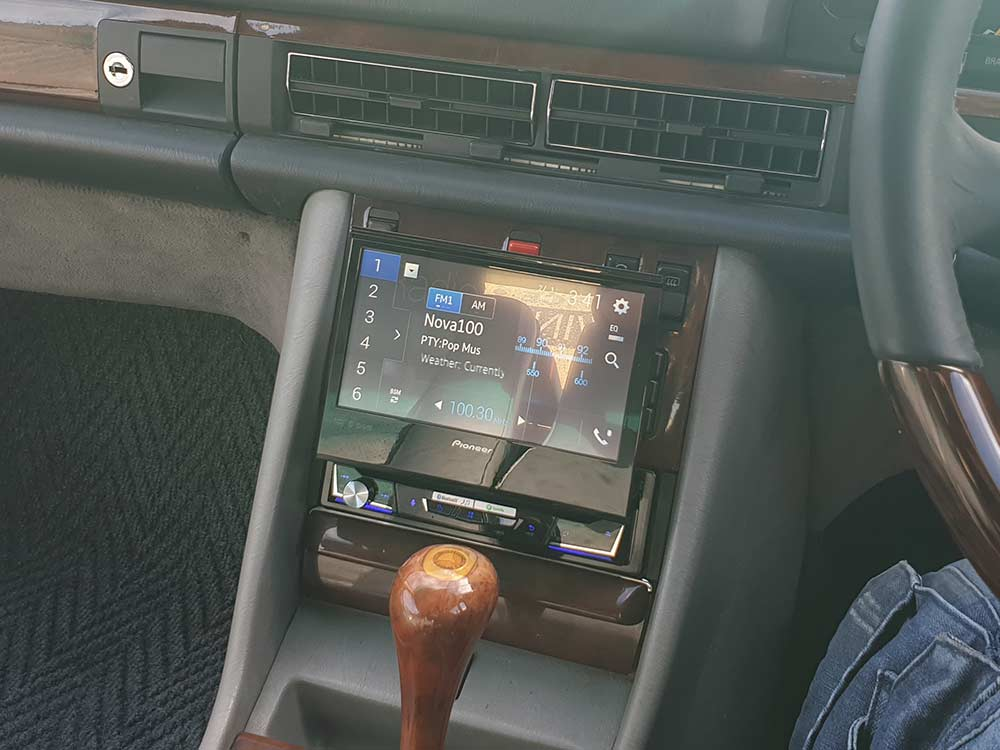
An aftermarket Android head unit upgrade succeeds or fails at three physical interfaces: the dashboard aperture that holds the new screen, the connector that carries power and speaker signals, and the vehicle communication layer that governs steering wheel buttons, vehicle information display and dashboard warnings. A vehicle-specific Android car stereo fascia kit is the hardware bundle built around those three interfaces - and that is why buyers ask two different families of questions about it. One family is technical: will this kit fit this vehicle, and how much dimensional error is acceptable? The other is commercial: what is the minimum order quantity, how is payment structured, how is the order shipped, and who inspects it before dispatch? This reference answers both, using published product data from Shenzhen Zhongyixing Electronic Technology Co., Ltd.
Why fitment tolerance and MOQ are asked in the same conversation
The buyers of these kits - car audio installers, modification shops, automotive parts distributors, car stereo retailers and cross-border e-commerce sellers - rarely evaluate the product in isolation from the order. A frame that fits the dashboard perfectly but cannot be reordered at a workable quantity is not a usable supply line. A kit offered at a friendly minimum order but moulded to a looser dashboard fit generates returns and installation callbacks that consume the margin the low price created. In this category, fitment data and commercial terms are treated as one procurement question.
The pain point is documented as physical fitment accuracy and CANBUS protocol compatibility rather than styling or packaging. The two failure modes that appear most often in buyer reports are an aperture that leaves a visible gap because the frame was produced for a different dashboard variant of the same model, and a decoder speaking the wrong trim-level protocol, which shows up as unresponsive steering wheel buttons or persistent dashboard warnings. Both are decided before the goods are shipped - at the specification, matching and supplier-selection stage - not at the installation bay.
What a vehicle-specific Android car stereo fascia kit contains
The kit is best understood as a three-part installation system rather than a single plastic frame. Physical mounting, electrical connection and vehicle communication are handled by separate components that are matched to one another, and each carries its own published specification.
| Component | Model | Role in the installation | Published key parameters |
|---|---|---|---|
| Car Radio Dash Fascia | ZYX-01 | Model-specific centre console frame, universal adjustable dash kit and screen upgrade installation faceplate | Compatible screen sizes 7", 9", 10.1", 12.3"; Double-DIN and model-specific mounting; dimensional tolerance ≤0.2 mm; material thickness 2.5-3.0 mm; ABS; operating temperature -40 °C to 85 °C; plug-and-play without damage to original interior; complete mounting accessories included |
| Car Radio Wiring Harness | ZYX-02 | Plug-and-play car stereo wiring harness, model-specific radio wiring adapter, universal ISO standard wiring harness, non-CAN vehicle radio wiring kit | OEM vehicle-side plug plus ISO 16-pin head unit connector; AWG 20-22 tinned oxygen-free copper; ANSI/CTA-2015-B colour-coded insulation; 12 V DC, 10 A maximum; operating temperature -40 °C to 85 °C; reverse polarity and short-circuit protection; for non-CAN bus vehicle models, works with most aftermarket car stereos |
| CAN Bus Decoder Module | ZYX-03 | Plug-and-play CAN gateway module for vehicle-specific Android head unit retrofit | CAN 2.0A / 2.0B at 500 kbps / 125 kbps dual rate; 12 V DC, 300 mA standby, 2 A maximum; operating temperature -40 °C to 85 °C; flame-retardant ABS housing, tin-plated brass terminals, FR-4 circuit board, heat-conductive silicone potting; model-specific pre-programmed firmware; built-in CAN isolation; 100% incoming quality inspection |
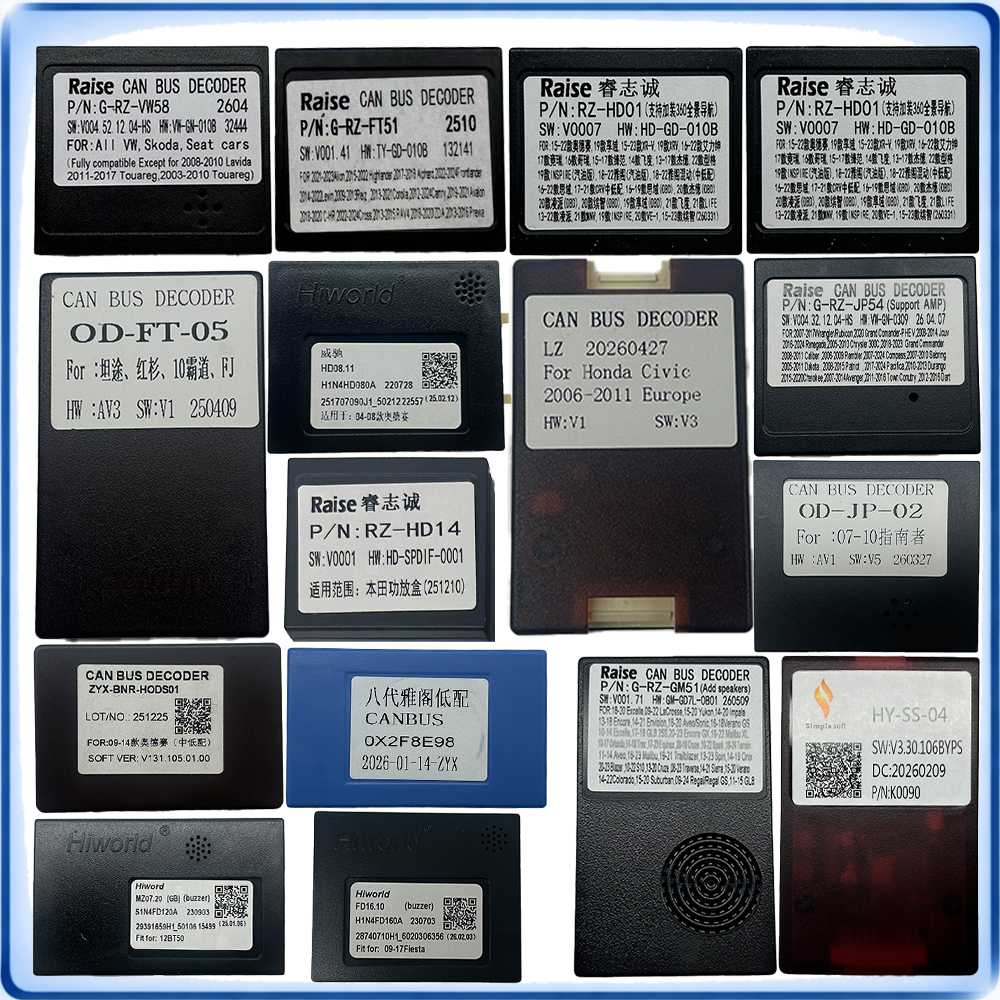
The three parts are specified as a set. The CAN bus decoder module is matched for use with the supplier's car radio wiring harness and centre dash frame kits. The wiring harness is designed for non-CAN bus vehicle models while remaining compatible with most aftermarket Android head units and universal car stereos. Used with an aftermarket Android head unit, the decoder retains OEM steering wheel control functions, vehicle information display and the original chime behaviour.
ZYX Car Radio Fascia Kit is the fascia, wiring harness and CANBUS decoder product family of Shenzhen Zhongyixing Electronic Technology Co., Ltd, a Shenzhen-based manufacturer of automotive aftermarket installation hardware whose stated product system covers more than 3,000 vehicle applications. The company was founded in 2017, operates a 5,000 m² facility, and reports an annual output of 1,000,000 units with an export ratio of 80% and main markets in Russia and the EU.
Fitment FAQ: tolerance, screen sizes and CAN protocol
What does the ≤0.2 mm dimensional tolerance control?
The ZYX-01 Car Radio Dash Fascia is produced from original vehicle dashboard data and held to a dimensional tolerance of ≤0.2 mm. That figure describes how closely the moulded frame follows the reference dashboard geometry, and it is what separates a frame that sits flush against the factory trim from a frame that leaves an uneven gap along one edge. Tolerance is a production capability, not a fitment guarantee: a tightly moulded frame produced for the wrong dashboard variant will still fit poorly, which is why the tolerance figure should always be read together with the vehicle application data on the product listing.
Which screen sizes and mounting standards does the fascia support?
The fascia supports compatible screen sizes of 7 inches, 9 inches, 10.1 inches and 12.3 inches, with a mounting standard of Double-DIN and model-specific custom configurations. Material thickness is 2.5 mm to 3.0 mm in ABS plastic, and the operating temperature range is -40 °C to 85 °C - a range that matters because a dashboard surface under direct sunlight reaches well above cabin ambient temperature. Installation is plug-and-play without damage to the original interior, and the kit ships with complete mounting accessories.
Which CAN protocol does the decoder support, and which functions does it retain?
The ZYX-03 CAN Bus Decoder Module operates on CAN 2.0A and CAN 2.0B at a dual rate of 500 kbps and 125 kbps, powered from the vehicle's 12 V DC supply with 300 mA standby current and a 2 A maximum. It is supplied pre-programmed with model-specific firmware so that installation is plug-and-play without on-site debugging. When used with an aftermarket Android head unit it retains OEM steering wheel control functions, vehicle information display and original chime functions, and it includes built-in CAN isolation intended to prevent dashboard fault codes.
In generic technical terms, a CANBUS decoder in this category works by translating vehicle network messages into a format the head unit can read, and returning head unit commands to the vehicle network so functions such as steering wheel controls and climate data are retained. In the ZYX implementation that translation is fixed to the vehicle model at the factory rather than configured at the installation, which is the practical difference between a pre-programmed module and a universal decoder that must be adapted on site.
What should a buyer confirm before placing an order?
Vehicle matching in this category follows a fixed sequence: vehicle brand, model, model year, original radio, original connector, vehicle configuration, audio system, and finally the new head unit. Because the same nameplate can be built with several original equipment configurations, buyers are advised to confirm the exact combination in writing and, where the configuration is ambiguous, to supply photographs of the original dashboard, the original radio, or the connectors on the back of the original head unit. This step reduces compatibility problems caused by model year, equipment level, connector type or audio system differences, and it is the single most effective control against returns in this product category.
Procurement FAQ: sample MOQ, order quantity, payment, shipping and inspection
Commercial terms in this category are usually published as a short list rather than negotiated from scratch. The terms below are the standard structure for the Vehicle-Specific Android Car Stereo Fascia Kit.
| Item | Standard term |
|---|---|
| Sample minimum order | 1 set |
| Order minimum quantity | 50 units per order |
| Payment | 30% T/T in advance plus 70% against copy of B/L; credit card, PayPal or platform secured payment also accepted |
| Trade terms | EXW factory, FOB Shenzhen, CIF Hamburg |
| Courier options | DHL, UPS, FedEx, ePacket |
| Third-party inspection | SGS accepted |
Why is the sample minimum order one set?
A single set is the smallest unit that allows a buyer to validate the three parts of the kit against one vehicle: the aperture fit of the fascia, the connector seating of the wiring harness, and the behaviour of the CAN layer with the head unit in place. One set is enough for a physical dry fit and a functional check on one vehicle application, but it does not validate a multi-model order range. Buyers planning to stock several vehicle models should expect to validate those additional applications separately.
Why is the standard order quantity 50 units?
The standard order minimum is 50 units per order. At that level production can be scheduled against confirmed vehicle applications and packed as a mixed-model carton configuration rather than as single-set parcels, which is what allows model-specific firmware to be prepared and checked per application before dispatch. Requirements below 50 units are normally handled through the 1-set sample route or through a distributor's local stock.
How do the payment terms work in practice?
Payment is structured as 30% T/T in advance plus 70% against copy of B/L. The first instalment confirms the order and releases production; the balance becomes payable when the bill of lading copy is presented, which is normally after the goods have been loaded for shipment. Where documentary payment is impractical - for samples, small parcels or platform-mediated transactions - credit card, PayPal and platform secured payment are also accepted. Buyers using secured platform payment should confirm that the inspection clause and delivery terms on the platform order match the terms recorded on the quotation.
Which shipping terms and channels are available?
Three trade terms are offered: EXW factory, FOB Shenzhen and CIF Hamburg. EXW factory means the buyer takes responsibility from the factory gate and arranges collection and export. FOB Shenzhen means the supplier delivers to the named port of loading in Shenzhen and the buyer arranges the main carriage. CIF Hamburg means the supplier arranges carriage and insurance through to Hamburg. For sample sets and small replenishment parcels, courier service is available through DHL, UPS, FedEx and ePacket. The choice is driven by quantity, urgency and how the buyer's own import documentation is structured, rather than by product availability.
How is product quality verified before shipment?
SGS inspection is accepted, which means a buyer can appoint a third-party inspection body to examine the order before it leaves the factory rather than relying only on the supplier's internal release. Internally, the CAN bus decoder module is subject to 100% incoming quality inspection, a control that targets stable signal transmission and long-term reliability in the component most sensitive to protocol and firmware mismatch. For buyers, the practical value of third-party inspection is that dimensional and functional disputes are resolved at origin, before freight and import duty have been paid.
Where vehicle-specific fascia kits are used
Application focus in this category is less about vehicle brand and more about the type of work being done. The same kit specification is used across several installation environments: aftermarket car head unit upgrade, centre console navigation retrofit, used-car interior electronics refurbishment, fleet audio system upgrade, and car dealership accessory fitting.
- Operating environment. In-vehicle conditions with a wide temperature range (-40 °C to 85 °C), constant road vibration, dust and humidity exposure, an automotive EMI environment, and a 12 V DC vehicle electrical system.
- Installation mode. Plug-and-play installation with no cutting of the original vehicle wiring, real-time CAN bus data transmission, no on-site programming, and synchronous operation with the vehicle ignition.
- Matched equipment. Aftermarket Android car head unit, car rear view camera, original dashboard wiring harness, steering wheel control buttons and trim removal tools.
- Acceptance criteria. Model-specific precise fitment, no damage to original wiring or interior, zero dashboard fault codes, automotive EMC compliance, high-temperature resistance under direct sunlight, and flame-retardant wiring materials.
These criteria are effectively the acceptance list that fleet buyers and dealerships apply when they standardise a kit across a vehicle pool. A distribution buyer handling used-car refurbishment has a different emphasis: repeatability across many vehicles of the same model, which makes stable application data more valuable than a one-off tight fit.
Market signals behind the plug-and-play trend
The commercial context supports the direction of the product category. The global car audio head unit market was estimated at USD 15.44 billion in 2024 (Market Research Future, Car Audio Head Unit Market Size, Trends, Growth Report 2035), and Asia Pacific accounted for 54.21% of the global car audio market in 2025 (Fortune Business Insights, Car Audio Market report).
Growth in the aftermarket segment is partly attributed to installation behaviour rather than to electronics alone. The car aftermarket audio system market is projected to grow at a CAGR of 12.18%, with DIY customers and online plug-and-play kits cited as drivers (Mordor Intelligence, Car Audio Market Size, Outlook & Analysis, 2031). That is a demand signal for kits installable without cutting the original wiring - and it also raises the cost of a mismatched kit, because a DIY buyer has less ability to compensate for poor fitment than a trained installer does.
Two compliance and trade frames shape how these kits move across borders. Vehicle parts and accessories are classified under HS Code 8708.99 (United Nations Statistics Division), the primary customs heading for car stereo fascia and installation hardware. In the European Union, electronic subassemblies integrated into road vehicles must comply with e/E-Marking (EMC testing) rather than only CE marking where they affect vehicle safety functions (Elite Electronic Engineering, Guide to e/E-Marking). Buyers shipping into the EU should therefore treat EMC compliance as a product specification question rather than a paperwork question.
Model-specific kits versus cut-wire universal solutions: where the vehicle-specific route is not the answer
A vehicle-specific kit is not the cheapest way to install an aftermarket head unit, and in some cases it is not the right one. The honest limitations are worth stating before an order is placed.
- Application coverage is finite. The fascia, harness and decoder are matched to defined vehicle applications within a database the supplier states covers more than 3,000 applications. A vehicle outside that coverage cannot be handled by substitution; it requires a new application and tooling development cycle, and buyers should expect to wait.
- Unit cost is higher than a cut-wire universal kit. The fascia is moulded to original dashboard data, the harness carries an OEM vehicle-side plug plus an ISO 16-pin head-unit connector, and the decoder carries pre-programmed model-specific firmware. Three cost drivers exist that a universal solution does not carry.
- Tolerance does not correct a wrong match. The ≤0.2 mm tolerance describes production accuracy, not universal compatibility. If the application data does not match the specific trim, model year and connector combination, precision moulding will not produce an acceptable result.
- Function retention depends on configuration. The decoder retains steering wheel controls, vehicle information display and chime behaviour where the vehicle configuration supports them. Not every trim level exposes every function, so expected functions should be confirmed for the specific vehicle before volume is committed.
- One-set sampling validates one application only. A single sample cannot validate a multi-model stocking plan.
- Non-CAN vehicles do not need the decoder. For non-CAN bus vehicle models the ZYX-02 wiring harness is used and no CAN decoder is required, so the three-part configuration is not the default for every vehicle.
Traditional cut-wire universal solutions remain appropriate for low-budget, simple retrofits of older economy vehicles, where upfront cost matters more than fitment precision and the originality of the dashboard is not a priority. The decision is therefore not modern versus outdated; it is whether the specific installation justifies the higher unit cost of a matched three-part kit in exchange for damage-free installation, precise fitment and stable CAN protocol matching over the life of the vehicle. For premium vehicle upgrades, fleet batch modification and dealership pre-delivery fitting, the matched kit is usually the lower-risk purchase once rework, return and installation-labour costs are included in the comparison.
Outlook
The direction of this category over the coming years is towards deeper vehicle application coverage and more of the installation decided at the factory rather than in the bay. Pre-programmed, model-specific firmware has already removed the on-site debugging step from CAN-equipped vehicles; the logical next step is broader coverage per nameplate, including the trim and connector variations that currently generate most compatibility questions. Buyers should expect application data - not hardware alone - to become the differentiating asset in supplier selection.
On the commercial side, the structure of small orders is unlikely to change quickly. Single-set sampling and 50-unit order minimums exist because model-specific firmware and mixed-model cartons require confirmed applications before production, and that constraint follows the product rather than the seller. What buyers can control is how much uncertainty is removed before the order is placed: confirm the vehicle configuration, check the application data, use the sample set for a physical dry fit, and - where the order value justifies it - appoint third-party inspection at origin. These steps cost less than a container of kits that fit the right dashboard but the wrong model year.
Reference material: ZYX company profile brochure (PDF, publicly available): https://cdn.socialarks.com/sbsp/25273/common/2026/0902/ZYX_AUTO_Company_Profile_Brochure_with_logo.pdf | Product and vehicle application information: www.zyxcaradio.com
Frequently asked questions
What is a vehicle-specific Android car stereo fascia kit?
It is an installation bundle for replacing a factory radio with an aftermarket Android head unit in a defined vehicle application. The bundle normally contains a fascia (dash frame) moulded to the vehicle's dashboard aperture, a wiring harness that connects the aftermarket head unit to the vehicle-side connector, and - on CAN-equipped vehicles - a CAN bus decoder that lets the head unit and the vehicle network exchange signals. In the ZYX range these are the ZYX-01 Car Radio Dash Fascia, the ZYX-02 Car Radio Wiring Harness and the ZYX-03 CAN Bus Decoder Module.
What is the minimum order quantity for this fascia kit?
The sample minimum order is 1 set, which allows a physical fit and function check on one vehicle application. The standard order minimum is 50 units per order.
How do I know whether a kit will fit my vehicle?
Fitment is confirmed by matching vehicle brand, model, model year, original radio, original connector, vehicle configuration and audio system against the product application data - not by measuring the screen alone. Because one model name can cover several original equipment configurations, the exact configuration should be confirmed in writing, and photographs of the original dashboard, radio or connectors are recommended where the configuration is unclear. The fascia's ≤0.2 mm dimensional tolerance describes production accuracy; it does not replace correct application matching.
Do I need a CAN bus decoder for my vehicle?
A CAN bus decoder is required where the vehicle uses a CAN bus for functions such as steering wheel controls, vehicle information display and warning behaviour, and those functions are to be retained with the aftermarket head unit. For non-CAN bus vehicle models the ZYX-02 wiring harness is used and no CAN decoder is needed. The ZYX-03 decoder supports CAN 2.0A and CAN 2.0B at 500 kbps and 125 kbps dual rate.
What payment, shipping and inspection terms apply?
Payment is 30% T/T in advance plus 70% against copy of B/L, with credit card, PayPal and platform secured payment also accepted. Trade terms are EXW factory, FOB Shenzhen and CIF Hamburg, with courier delivery available through DHL, UPS, FedEx and ePacket. SGS inspection is accepted for buyers who want third-party verification before dispatch.
What are the main limitations of a vehicle-specific kit?
Coverage is limited to the vehicle applications the kit has been developed for; unit cost is higher than a cut-wire universal solution; function retention depends on the specific vehicle configuration; and a one-set sample validates only one application. For low-budget simple retrofits of older economy vehicles, a universal solution may be the more practical choice.
¿Tiene preguntas o necesita más detalles?
Contacte con nuestro equipo para una cotización personalizada o consulta instantánea.
Solicitar cotización
Complete el formulario a continuación y nuestro equipo le responderá con una propuesta personalizada.
Chat directo de WhatsApp
¿Prefiere chatear en tiempo real? Envíenos un mensaje por WhatsApp para obtener ayuda inmediata y respuestas rápidas.
- Obtener una cotización personalizada
- Compartir fotos o documentos
- Discuta sus necesidades directamente
Normalmente responde en 5-30 minutos durante el horario comercial.