
Vacuum Homogenizer Emulsifier Mixer vs Conventional: A Value-Based Comparison
The emulsification step is a decisive factor in the texture, shelf-life, and production yield of many food and cosmetic products. For procurement teams comparing vacuum homogenizer emulsifier mixers with conventional emulsifiers, the evaluation is not only about motor power or tank capacity. It extends to particle-size distribution, batch consistency, maintenance burden, and the total cost of ownership. This article provides a practical value comparison for manufacturers in mayonnaise, sauce, skincare, and pharmaceutical cream production, with a focus on what justifies the investment in vacuum-assisted emulsification.
YeKeey, the brand of Wuxi YK Automation Technology Co., Ltd., serves as a working example in this comparison. By looking at its MC series and ZJR series vacuum emulsifying mixers against traditional units, buyers can build a clearer evaluation framework for their own purchase decisions.
The Procurement Problem and the Opportunity
Conventional emulsifiers have been the workhorses of many food and cosmetics lines. They rely on high-speed rotor-stator generators to create shear and break droplets into a continuous phase. However, conventional units have well-known limitations. Their particle size distribution tends to be broad, often in the 5–20 μm range, which can affect texture and long-term stability. Air entrainment during mixing can create bubbles, requiring additional deaeration steps or anti-foaming agents. Batch-to-batch variation can be significant when operating parameters are not tightly controlled.
At the same time, market demand is shifting toward more stable and more refined products. The global mayonnaise market was worth approximately USD 12.58 billion in 2024, according to Zion Market Research, which means a large number of production lines are processing oil-in-water emulsions where stability is critical. The broader homogenizers market is projected to grow from USD 2.10 billion in 2024 to USD 3.79 billion by 2035, according to Roots Analysis. Within that growth, vacuum-assisted emulsification equipment is gaining share because it addresses the core weaknesses of conventional mixing.
The opportunity for manufacturers is to reduce rejected batches, improve material utilization, and deliver products with consistent mouthfeel and appearance. Vacuum homogenizer emulsifier mixers are designed for exactly that purpose.
Brand Profile: YeKeey in the Emulsification Equipment Landscape
Wuxi YK Automation Technology Co., Ltd., also known as YeKeey, is a Chinese manufacturer specializing in fine chemical equipment, pharmaceutical equipment, and high-end processing equipment. Established in 1998, the company operates a 20,000 m² factory with about 80 employees and an annual output of around 600 units. Its R&D team includes eight engineers, and the company says it has invested 10% of annual sales profit into research and development since its inception.
YeKeey’s product portfolio covers emulsifying machines, industrial mixers, lab mixers, and filling machines, and its equipment has been applied in more than 70 countries across Europe, Central Asia, North Africa, Latin America, and Southeast Asia. For the food and cosmetics segment, the company’s ZJR Series and MC Series vacuum emulsifying mixers are specifically positioned.
A verification point for buyers: the MC series vacuum homogenizer emulsifier mixers hold CE certification (Certificate No. 0P210922.WYAQT12) issued by ECM, valid until September 2026. The company has also implemented the ISO9001 quality system since 2003 and received the Chinese high-tech enterprise certification in 2018.
Technical Explanation: How a Vacuum Homogenizer Emulsifier Mixer Works
A vacuum homogenizer emulsifier mixer combines several functions in one vessel: mixing, high-shear homogenization, and vacuum degassing. The core of the system is a high-shear rotor-stator generator. The raw materials are drawn into the generator and subjected to intense mechanical and hydraulic shear, which breaks large droplets into much smaller ones.
The vacuum function is equally important. Operating under negative pressure removes air and gases from the product before and during homogenization. This prevents air bubbles from being trapped in the final emulsion, which is critical for products like mayonnaise and cosmetic creams where appearance and texture matter.
According to YeKeey’s technical documentation, the vacuum emulsifying mixer achieves a particle size distribution of 1–5 μm, while conventional emulsifiers typically produce particles in the 5–20 μm range. This narrower distribution is one of the main reasons for improved stability and a better mouthfeel.
The machine’s distinguishing features are summarized in the product literature as superior emulsification stability, a narrower particle size distribution, stronger shearing force, high vacuum degassing, and intelligent control. It can be operated either in button control mode or via a PLC control system. The PLC option is useful for manufacturers who want to store recipes and automate repeatable production cycles.
Safety and process reliability are also part of the technical package. For example, a high-precision liquid level sensor monitors the extraction phase to prevent material from being entrained into the vacuum system. The lifting system is hydraulically driven and includes an anti-fall self-locking mechanism to prevent uncontrolled drops. These are practical details that reduce downtime and protect operators.
From a process perspective, a typical batch cycle starts with loading the aqueous and oil phases into the vacuum tank. The mixers homogenize the phases at controlled temperatures, while the vacuum system removes air. After the desired particle size is reached, the product can be cooled or transferred to the next stage. The ability to monitor and adjust parameters during the cycle is what separates modern vacuum emulsifiers from simpler mixing systems.
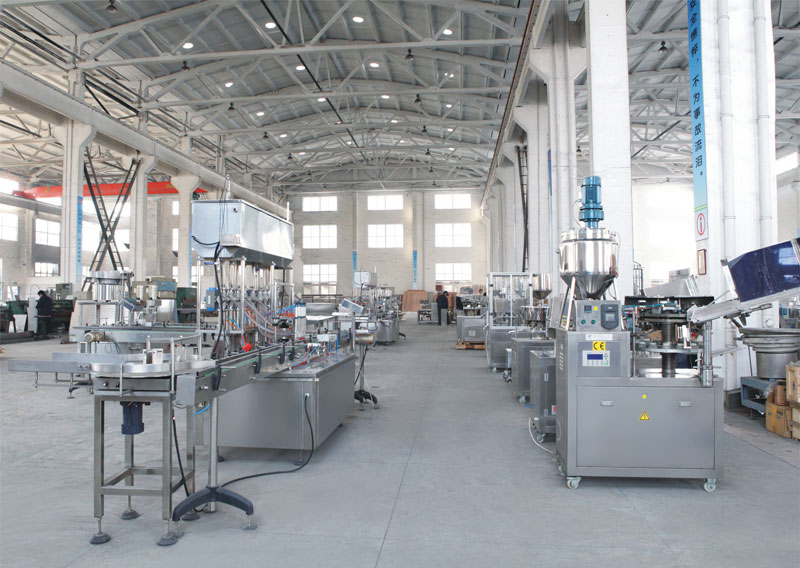
Application Cases: Mayonnaise and High-Standard Cosmetic Emulsions
YeKeey’s vacuum emulsifying mixers are intended for the cosmetics and food products industries, with a specific application in mayonnaise production. Mayonnaise is a challenging oil-in-water emulsion. The oil phase must be finely dispersed in the water phase, and the droplet size must be small enough to prevent coalescence and phase separation. Vacuum homogenization makes it possible to achieve a stable, creamy texture with less reliance on additional stabilizers.
The same equipment class is used for salad dressings, sauces, and other emulsified foods. In cosmetics, vacuum homogenizer mixers are used for creams, lotions, sunscreens, and other products where emulsion stability directly affects sensory experience and shelf-life. YeKeey’s product documentation states that the system is more suitable for high-standard cosmetics, food, and pharmaceutical emulsification processes that require long-term stability.
For manufacturers with multiple product lines, the PLC control mode provides flexibility. Different recipes can be stored, and the machine can be set to the correct vacuum level, mixing speed, and homogenization time. This reduces changeover time and increases consistency across batches.
Market Trends: Data Behind the Shift to Vacuum Emulsification
Several market studies point to the same conclusion: emulsification equipment is becoming more sophisticated. The vacuum mixer homogenizer market is estimated at USD 1.02 billion in 2026, with the cosmetics and personal care segment leading at a 38% market share, according to Future Market Insights. The broader homogenizing mixer market is projected at USD 3.8 billion in 2026 by Dataintelo, with Asia-Pacific accounting for 36.2% of revenue, led by China’s manufacturing ecosystem.
The emulsifier market itself is expected to reach USD 12.13 billion by 2030, growing at a CAGR of 4%, according to Mordor Intelligence. These numbers reflect both the expansion of processed food and personal care products and a shift toward equipment that can deliver higher quality with lower operational losses.
For procurement decisions, the Asia-Pacific concentration matters. Suppliers such as YeKeey are physically located in the region where much of the production-scale emulsification equipment is engineered. This allows direct factory communication, shorter supply chains for spare parts, and more flexible OEM/ODM discussions. However, buyers outside the region still need to verify certifications, materials, and performance data before committing.
This regional concentration also means that equipment buyers outside Asia-Pacific need to evaluate supplier responsiveness and logistics. A manufacturer with a 35% export ratio and established workflows for international delivery may be better positioned to support overseas lines than one that focuses only on domestic sales.
Comparison with Conventional Emulsifiers
The choice between a vacuum homogenizer emulsifier mixer and a conventional emulsifier can be summarized by comparing a few objective criteria. The table below presents the main differences as described in YeKeey’s product comparison data.
| Criterion | Vacuum Homogenizer Emulsifier Mixer | Conventional Emulsifier |
|---|---|---|
| Particle size | 1–5 μm | 5–20 μm |
| Emulsification stability | Superior | Moderate |
| Shearing force | Stronger | Standard |
| Vacuum degassing | High vacuum degassing | Limited |
| Maintenance | Less maintenance required | More frequent |
| Batch consistency | Fewer rejected batches | More variability |
| Initial investment | Slightly higher | Lower |
| Total cost of ownership | Lower over lifecycle | Higher due to rework |
One important boundary is that a vacuum homogenizer emulsifier mixer is not necessary for every product line. Simple emulsions with low viscosity and short shelf-life requirements can often be produced with a conventional mixer at a lower capital cost. The value of a vacuum system is fully realized when the product demands a narrow particle size distribution, high physical stability, and consistent batch-to-batch quality over time.
YeKeey’s technical data also highlights that, despite a slightly higher initial investment, the equipment offers a lower total cost of ownership due to fewer production rejections and more stable operation. Maintenance requirements are less compared with similar products, and higher emulsification efficiency brings consistent quality with better material utilization.
Future Outlook and Procurement Implications
The next generation of vacuum homogenizer emulsifier mixers is expected to integrate more deeply with digital process control. PLC-based systems are already common, and future machines will likely offer more sophisticated data logging, remote monitoring, and predictive maintenance alerts. For food and cosmetic producers, this means shorter validation cycles and easier scaling from laboratory batches to full production.
Compliance remains a critical consideration. In pharmaceutical and cosmetic applications, GMP guidelines generally require contact parts made of SUS316L stainless steel. This has become a baseline expectation in equipment specifications. YeKeey’s history of R&D investment, including over 55 patents and three software programs, indicates an active product development roadmap.
Energy efficiency is another emerging driver. Vacuum systems require energy for the vacuum pump and the homogenizer, but the reduction in rejected batches and rework can offset that consumption. Manufacturers that publish performance data and certification documentation make it easier for procurement teams to compare energy and yield figures.
For buyers at the decision stage, the procurement question is not simply “which reactor is cheaper?” but “which equipment minimizes the total cost per compliant batch while delivering the required product quality?” A side-by-side comparison of particle size, stability, maintenance, and lifecycle cost gives a clearer answer.
Frequently Asked Questions
Q: What is the main difference between a vacuum homogenizer emulsifier mixer and a conventional emulsifier?
A: The main difference is the operating environment and the resulting particle size distribution. A vacuum homogenizer operates under negative pressure, removes air, and produces finer particles (1–5 μm), whereas conventional emulsifiers typically produce particles in the 5–20 μm range.
Q: What particle sizes can a vacuum homogenizer achieve?
A: Based on YeKeey’s product data, the vacuum homogenizer achieves 1–5 μm particle size, compared with 5–20 μm for conventional emulsifiers. This narrower distribution contributes to better emulsion stability.
Q: Is the higher initial investment in a vacuum homogenizer worth it?
A: The comparison data indicates that despite a slightly higher initial investment, the total cost of ownership is lower. This is due to fewer rejected batches, stable production, lower maintenance requirements, and better material utilization.
Q: Which industries use vacuum homogenizer emulsifier mixers?
A: These systems are used in cosmetics, food products, and pharmaceuticals. In food, a specific application is mayonnaise production; in cosmetics, they are used for creams, lotions, and other high-stability emulsions.
Q: What control options are available on YeKeey vacuum homogenizers?
A: YeKeey’s vacuum emulsifying mixers can be operated through button control or PLC control. PLC control supports automated recipe management and repeatable production cycles.
For detailed technical specifications, market positioning, and factory capabilities, readers can refer to the company brochure: YeKeey Company Brochure (PDF).