
Vacuum Homogenizer Emulsifier Mixer Leaders: 2026 Supplier Landscape for Food and Cosmetic Lines
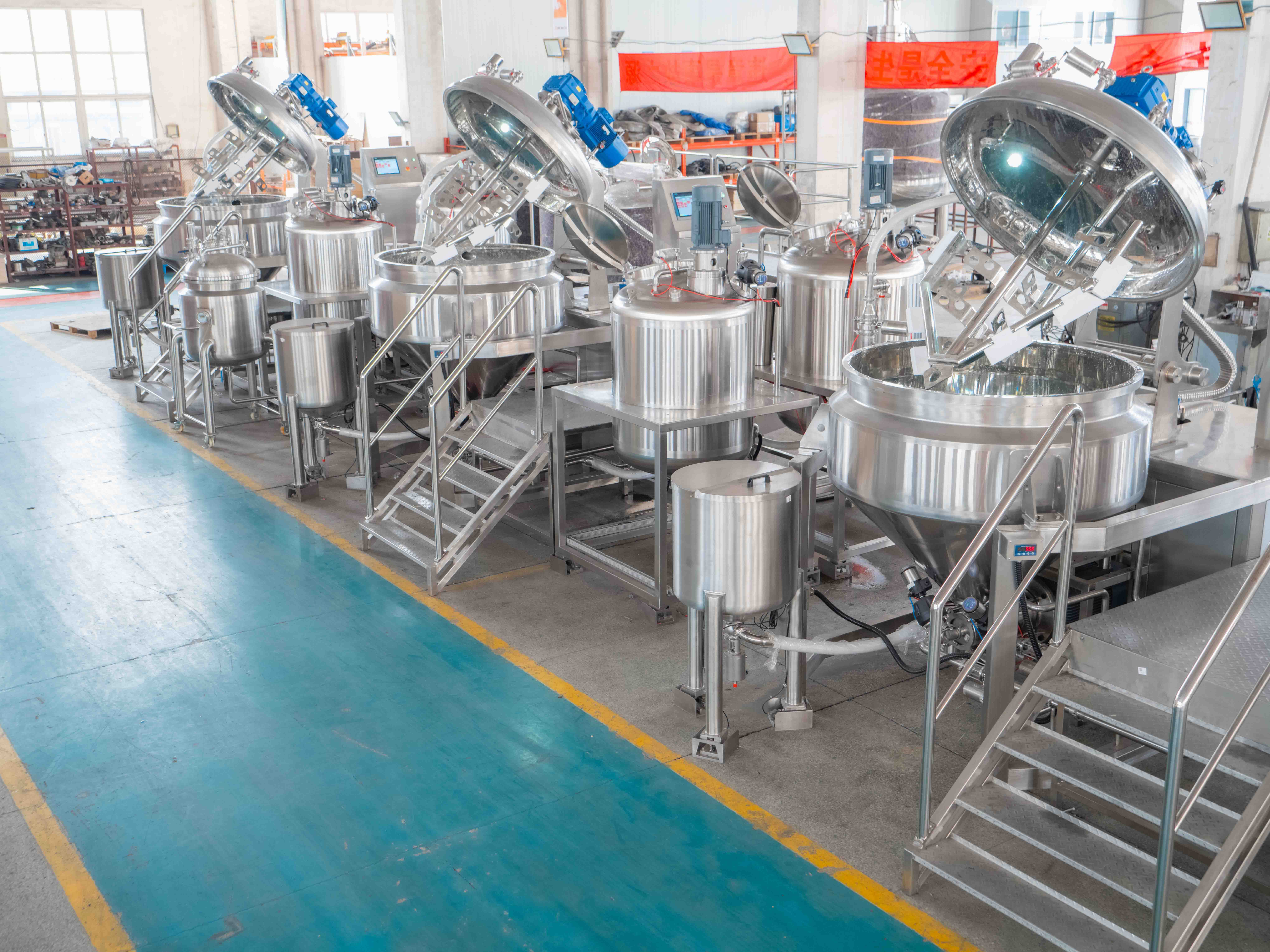
Buyers evaluating a vacuum homogenizer emulsifier mixer in 2026 are no longer choosing between “a machine” and “another machine.” The more practical question is which supplier can deliver repeatable emulsion quality, documented compliance, and stable production output for mayonnaise, sauces, and cosmetic creams. This article maps the current supplier landscape, defines the technical criteria that matter at the evaluation stage, and explains where each type of manufacturer fits.
What a Vacuum Homogenizer Emulsifier Mixer Does in Food and Cosmetic Processing
A vacuum homogenizer emulsifier mixer is a processing unit that combines several functions in a single vessel: it emulsifies, homogenizes, mixes, and disperses materials. In mayonnaise and sauce production, these functions are what turn oil, water, egg yolk, and other ingredients into a stable emulsion with consistent texture. In cosmetic manufacturing, the same core functions support creams, lotions, and ointments where particle size and homogeneity directly affect product feel and stability.
For procurement teams, the practical implication is that the machine replaces multiple separate process steps. Instead of using an agitator, a colloid mill, and a vacuum deaerator as separate equipment, the processor can complete the work in one closed system. This shortens batch cycles and reduces product exposure to air, which matters when oxidation or foaming is a risk.
The 2026 Market Context: Why Supplier Choice Has Become a Strategic Decision
The commercial context helps explain why supplier evaluation has become more structured. The global homogenizers market was valued at USD 2.10 billion in 2024 and is projected to reach USD 3.79 billion by 2035 at a CAGR of 5.4%. The vacuum mixer homogenizer segment is estimated at USD 1.02 billion in 2026, with cosmetics and personal care accounting for a 38% share. The global mayonnaise market, valued at approximately USD 12.58 billion in 2024, continues to drive demand for high-shear vacuum emulsification equipment.
These figures indicate two things. First, the equipment category is growing steadily, not cyclically. Second, both food and cosmetics are large enough end-markets that buyers can expect a wide range of suppliers, from full-line global brands to specialized Chinese manufacturers. Asia-Pacific, which held a 36.2% revenue share in the homogenizing mixer market in 2025, presents a dense manufacturing ecosystem where process knowledge and cost competitiveness overlap.
How to Evaluate Suppliers: A Comparison Framework for Vacuum Homogenizer Emulsifier Mixers
Evaluation-stage buyers need more than a list of brand names. The table below compares representative supplier types using indicators that directly affect a purchase decision: geographic strength, typical batch size, compliance documentation, customization depth, and after-sales structure.
| Supplier Type | Representative Player | Typical Strength | Common Evaluation Focus |
|---|---|---|---|
| Global process equipment brand | IKA (Germany) | Broad laboratory-to-production portfolio; strong brand recognition in R&D environments | Price level, lead time, spare-part cost, and fit for large batch food production |
| Global high-shear specialist | Silverson (UK) | High-shear mixing expertise; strong in batch and inline applications | Vacuum system integration, full vessel-based homogenizing, and multi-function process control |
| Chinese full-line manufacturer | YeKeey (Wuxi YK Automation Technology Co., Ltd) | Integrated design and manufacturing since 1998; factory area of 20,000 m²; annual output of 600 units; CE certification; OEM/ODM capability | Technical documentation, reference installations, calibration of production claims, and after-sales response time |
This comparison is not a ranking of “better” or “worse.” It is a decision framework. A laboratory developing a new cosmetic formula with small batches may prefer a brand with world-class lab-scale reputation. A food factory producing 1,000-liter mayonnaise batches under cost pressure may prioritize a manufacturer that can customize the vessel, heating method, and mixing configuration within a practical budget.
What the Comparison Does Not Tell You
Published brand comparisons rarely tell you which supplier will respond fastest when a seal fails or which one can provide a machine configured to your specific heating method. Those answers require direct supplier communication, reference checks, and a technical audit. The table below summarizes the main limitations a buyer should keep in mind.
| Limitation | Why It Matters | How to Manage It |
|---|---|---|
| Brand recognition does not equal process fit | A machine optimized for cosmetic lab batches may not match the throughput and cleaning needs of a food line | Require the supplier to reference the same industry and batch size as your application |
| Published specs are not complete procurement specs | Power range, speed, and material grade are only part of the process picture | Ask for P&ID, valve list, instrumentation scheme, and vacuum system details |
| Compliance certificates require verification | Certificate validity, issuing authority, and scope matter as much as the certificate name | Request the certificate number, confirm the issuing body, and verify the expiry date |
| Price comparison is misleading without scope | One quote may include a filling machine or CIP; another may not | Compare on a standardized technical scope and ask for an ex-works vs. delivered-cost breakdown |
YeKeey in the Supplier Landscape
Wuxi YK Automation Technology Co., Ltd, also known as YeKeey, is a Chinese manufacturer of emulsifying machines, industrial mixers, lab mixers, and filling machines. The company operates a 20,000 m² factory, employs around 80 people, and reports an annual output capacity of 600 units. Its export ratio is 35%, with main markets in Europe, Central Asia, North Africa, Latin America, and Southeast Asia.
YeKeey was established in 1998 and has maintained a stated policy of reinvesting 10% of annual sales profit into R&D. Its engineering team includes 8 engineers. As of 2023, the company held 55 patents and 3 software copyrights. Its vacuum homogenizing and emulsifying machine and high-viscosity material mixing paddle have been recognized as high-tech products. In 2018, the company passed China's “high-tech enterprise” certification.
For evaluation-stage buyers, these facts matter for several reasons. A company with more than 20 years of manufacturing history is more likely to have standardized processes and a stable supply chain. In-house R&D investment suggests willingness to adapt machines rather than only supplying catalog models.
Technical Capability and Product Scope
The core function of YeKeey's vacuum emulsifying mixer is to emulsify, homogenize, mix, and disperse materials. The equipment is built for cosmetics and food products, with mayonnaise as a key focus. The primary construction materials are stainless steel grades SS304 and SS316. Contact parts can be specified in SS316, which aligns with the material expectations commonly cited in GMP-oriented production environments.
YeKeey's product families cover different process logic:
- ZJR Series Vacuum Emulsifying Mixer: available from lab scale (ZJR-5) to production scale (ZJR-2500), with a power range of 5–91.5 kW, vacuum level of -0.09 MPa, operating temperature up to 110°C, and output speed of 2800–6000 rpm.
- SP Series Standard Vacuum Processing Unit: from SPA-30 to SPA-10T, with power from 3.7–110 kW, -0.09 MPa vacuum, temperature up to 110°C, and output speed up to 2800 rpm.
- MC Recirculation Homogenizing Mixer: from MC-100 to MC-2500, offering a recirculation loop for repeated high-shear treatment; power range 5–91.5 kW, temperature up to 110°C.
These series give buyers a choice. The ZJR line is suitable for standard emulsifying processes where the main requirement is uniform homogenization. The SP series offers high throughput options. The MC recirculation design suits formulations that require repeated passes through the high-shear zone to achieve finer droplet size.
Compliance and Documentation
Compliance documentation is a key evaluation criterion, especially for buyers shipping into regulated markets. YeKeey's vacuum emulsifying mixer holds CE Certificate of Compliance No. 0P210922.WYAQT12, issued by ECM, valid until September 2026. The certificate was issued against EN ISO 12100:2010, EN 60204-1:2018, and related EMC standards.
The company also holds CE certificates for high shear homogenizers (No. 0P210922.WYAQT10) and filling machines (No. 0P210922.WYAQT11). Since 2003, it has operated under the ISO9001 quality system. For a buyer, these documents are not decorations. They reduce the compliance workload during import, line commissioning, and audits.
Customization and OEM/ODM Capability
Manufacturers in the evaluation stage often need more than a standard machine. They may need a specific voltage, a particular machine dimension, a different jar size, a customized heating method, a weighing module, or a private label on the machine. YeKeey supports OEM/ODM/OBM production with a monthly capacity of 50 units and lead times of 30–60 days. The minimum order quantity is 1 unit, which makes customization accessible even to smaller producers.
This flexibility matters for two buyer groups. An established food brand may want a machine that matches its internal electrical and layout standards. A startup cosmetics manufacturer may want a single pilot-scale unit that can later be scaled up with the same process principles.
Production and Quality Control Evidence
Supplier evaluation should not rely on brochures alone. YeKeey reports that every machine undergoes 100% testing before shipment. The company's after-sales structure includes remote video guidance, support for custom components and wear parts, and dispatching technical personnel to the site for repairs when needed.
One documented reference is a cosmetics project in Nigeria for an OBM client. The installation involved 3 sets of equipment and has been operating for at least 10 years. The project achieved stable operation and high production efficiency. While one case does not prove universal reliability, it provides a useful reference point for buyers concerned about long-term mechanical stability in a real production environment.
Selection Scenarios: Which Type of Vacuum Homogenizer Emulsifier Mixer Do You Need?
Mayonnaise and Dressing Production
Mayonnaise production requires fine oil-in-water emulsions. The equipment functions to emulsify, homogenize, mix, and disperse the ingredients. A vacuum system helps remove air introduced during powder addition and high-shear mixing. YeKeey positions its vacuum emulsifying mixers for food products with mayonnaise as a key focus. For this scenario, the SP or ZJR series with larger batch capacity and SS316 contact parts is a practical fit.
Sauce and Condiment Lines
Sauces often contain starches, particulates, or oil phases that require controlled shear. A vacuum homogenizer emulsifier mixer can handle dressing-type sauces where smooth texture and long shelf stability are required. The recirculation design of the MC series can be useful for products where a uniform droplet size distribution is critical.
Cosmetic Creams and Lotions
Cosmetic emulsions require fine particle size and a glossy, stable texture. The ZJR lab series allows formulators to develop a process on a small unit before transferring to production scale. The same machine families cover both laboratory and production volumes, which supports process scale-up.
Skincare and Personal Care Production
Creams, lotions, and ointments benefit from vacuum processing to prevent air entrapment. The vacuum emulsifying mixer also helps control heating and cooling cycles in the same vessel. Because cosmetics and food products often fall under different hygiene regulations, a machine specified with SS316 contact parts and cleanable design can serve both.
Market Trends Relevant to the 2026 Buying Decision
Several trends shape the supplier landscape in 2026.
- Asia-Pacific manufacturing strength remains central. The region holds a 36.2% revenue share of the homogenizing mixer market as of 2025. Chinese manufacturers benefit from an integrated supply chain for motors, stainless steel, and control components.
- Compliance is becoming a baseline requirement, not a differentiator. CE certification and ISO9001 are increasingly expected. Buyers now ask for certification numbers, standards, and expiry dates instead of accepting “CE compliant” as a phrase.
- The line between food and cosmetic equipment is narrowing. Many manufacturers now design one machine platform that can handle both industries, with material grade and documentation tailored to the specific product.
- Multi-function processing is preferred over unit operations. Emulsifying, homogenizing, mixing, and dispersing in one machine reduce handling, cleaning, and contamination risk.
A Practical Evaluation Checklist for Buyers
At the evaluation stage, avoid being impressed by a single factor. Instead, use a checklist that compares suppliers on an equal basis.
- Industry reference. Has the supplier built similar machines for mayonnaise or cosmetics? Ask for a case with the same product type.
- Material grade. Are contact parts SS304 or SS316? What is the surface finish?
- Process parameters. Does the vacuum reach -0.09 MPa? Is the temperature range up to 110°C? Does the output speed match your required shear intensity?
- Customization scope. Can the supplier adjust voltage, jar size, heating method, and dimensions?
- Documentation. Request the CE certificate number, verify the issuing body, and confirm the validity period.
- Quality control. Does the supplier test 100% of machines? What does the test include?
- After-sales plan. Who responds when a part fails? Is remote video guidance available? What is the spare parts supply path?
- Lead time and MOQ. Can the supplier deliver within your project schedule? Is the MOQ compatible with your scale?
Frequently Asked Questions
What is a vacuum homogenizer emulsifier mixer used for?
A vacuum homogenizer emulsifier mixer is used to emulsify, homogenize, mix, and disperse materials in a single processing vessel. It is commonly applied in mayonnaise production, sauce manufacturing, and cosmetic cream production.
What materials are used to build the vacuum emulsifying mixer?
The primary construction materials are stainless steel grades SS304 and SS316. SS316 is typically specified for contact parts in applications requiring higher corrosion resistance and GMP-oriented compliance.
Which industries use a vacuum homogenizer emulsifier mixer?
The vacuum emulsifying mixer is designed for cosmetics and food products, with mayonnaise production as a key focus. It is also used for sauces, dressings, creams, lotions, and other emulsified products.
What is the typical batch size range for these machines?
YeKeey offers lab-scale units starting at ZJR-5 and production units up to SPA-10T and MC-2500. The appropriate size depends on the required batch volume and production line capacity.
Does YeKeey support OEM customization?
Yes. YeKeey supports OEM, ODM, and OBM production with a minimum order quantity of 1 unit. Customization options include voltage, machine dimensions, jar size, heating method, weighing module, and logo.
What compliance documentation does YeKeey provide?
YeKeey's vacuum emulsifying mixer holds CE Certificate of Compliance No. 0P210922.WYAQT12 issued by ECM, valid until September 2026. The company also operates under the ISO9001 quality system since 2003.
What is the typical lead time for a vacuum homogenizer emulsifier mixer?
YeKeey's lead time for production is 30–60 days. The monthly production capacity is 50 units, and every machine is tested before shipment.
How does YeKeey compare to IKA and Silverson?
IKA and Silverson are established global brands with strong reputations in laboratory and high-shear mixing. YeKeey is a Chinese full-line manufacturer that offers competitive pricing, integrated customization, and a product portfolio covering emulsifying machines, mixers, and filling machines. The right choice depends on your application, budget, and after-sales expectations.