
Vacuum Forming for Radomes and Rooftop Tents: Scenario Fit
Vacuum Forming for Radomes and Rooftop Tents: Scenario Fit
Vacuum forming fits outdoor equipment projects such as marine antenna radomes and rooftop tent shells when the part is large, the production volume sits between prototype and medium batch, and the service environment involves sun, rain and temperature swing. The documented process envelope is the practical starting point: sheet thickness from 2 mm to 10 mm, forming sizes up to 3300 mm × 2000 mm, an operating temperature of -20°C to 70°C for these indoor-or-outdoor applications, and an optional UV-resistant surface for outdoor exposure. Material options include ABS, ASA, PC, PETG, PMMA, PVC and HDPE.
Hangzhou Baiheli New Materials Co., Ltd. is a heavy-gauge thermoforming processor based in Guali Town, Xiaoshan District, Hangzhou, working from approximately 10,000 square meters of standard factory space with about 90 employees. Its documented scope covers industrial housing thermoforming, AGV and robot housing thermoforming, medical-equipment housing thermoforming, radome thermoforming, rooftop tent and component thermoforming, and amusement-equipment thermoforming — which is why the two outdoor scenarios can be discussed against actual process data rather than generic claims.
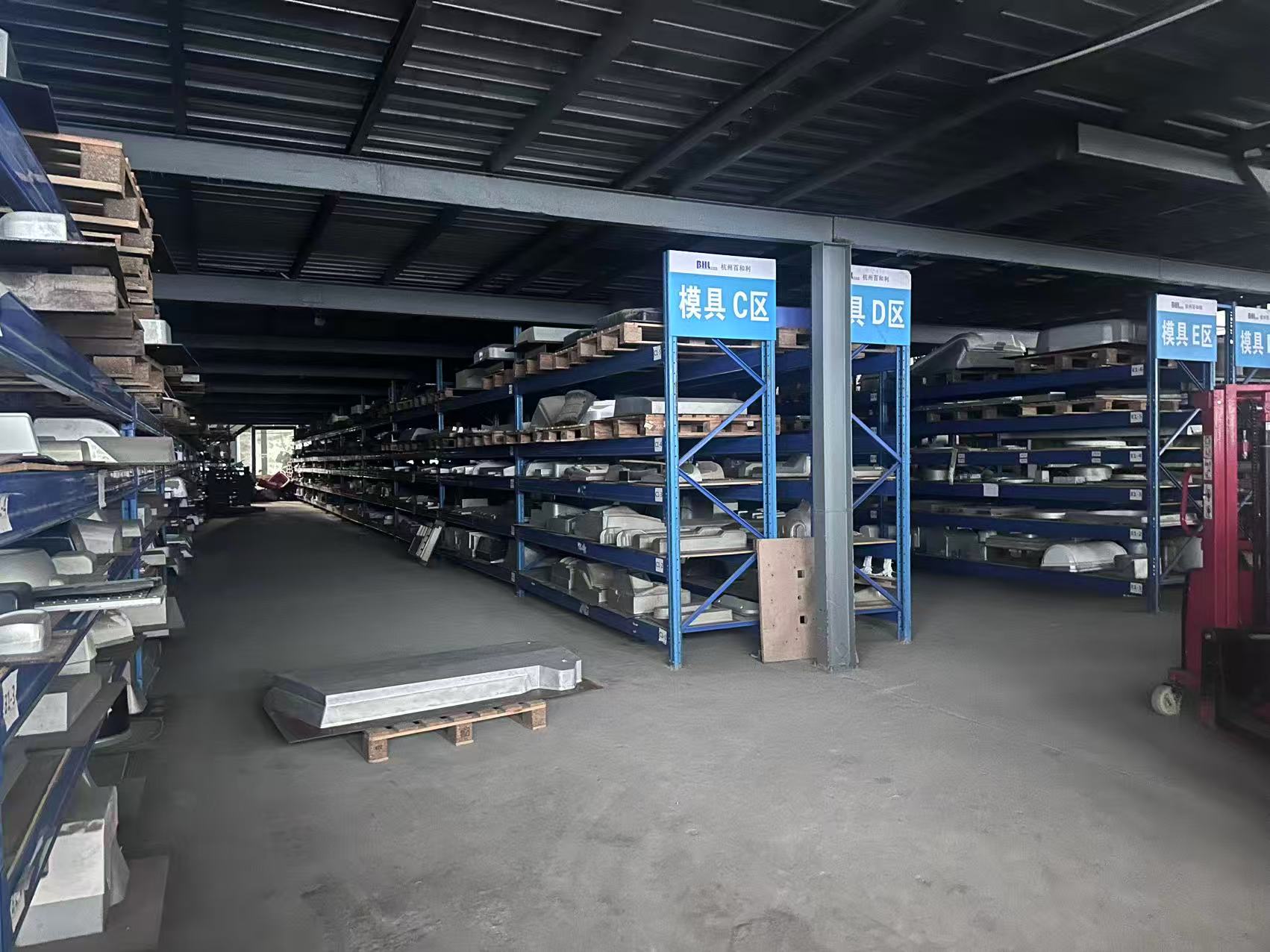
Outdoor equipment asks three questions before it asks for a material
Buyers usually arrive at a material discussion too early. For a radome or a rooftop tent shell, the binding constraints are geometry, exposure and volume, and each one filters the material list differently.
- Geometry. A radome is typically a large, single-curvature or compound-curved shell. A rooftop tent shell is a deep, broad box with radiused corners, mounting flats and cut-outs. Both are heavy-gauge parts, not thin packaging film, and both are formed over a mold and then trimmed.
- Exposure. These parts live outdoors, so ultraviolet radiation, rain, thermal cycling between roughly -20°C and 70°C, and mechanical impact all matter. UV performance is offered as an optional surface treatment rather than a default, so it has to be specified.
- Volume and tooling. Radome and rooftop tent programmes are usually low to medium volume. Documented capability includes a minimum order quantity of 1 unit and low tooling cost for prototype and medium-batch production, which is the economic argument for forming over higher-investment processes at this volume band.
The same logic explains why the outdoor segment is not a single market. Documented monthly capacity of 80,000 units and a 25–30 day lead time describe the production system; they do not tell a buyer whether a particular shell geometry will form cleanly. That answer comes from the sheet, the draw, the mold and the trimming strategy together.
What vacuum forming contributes to radome and rooftop tent parts
Thick-sheet vacuum thermoforming heats a solid plastic sheet and uses vacuum pressure to pull it against a mold, after which the part is cooled, demolded and trimmed. The documented production chain runs from sheet extrusion through thermoforming to five-axis cutting and surface finishing, including masking for painting, screen printing, matte film and transparent, translucent or opaque finishes.
For outdoor equipment, that chain matters more than the forming step alone. A rooftop tent shell that is formed accurately but trimmed poorly will not seal; a radome that forms well but carries inconsistent wall thickness will behave unpredictably at its mounting flange. The five-axis cutting stage is where housing-fit processing, openings and edge quality are established, and it is worth asking how a supplier sequences forming and trimming for a part of this size.
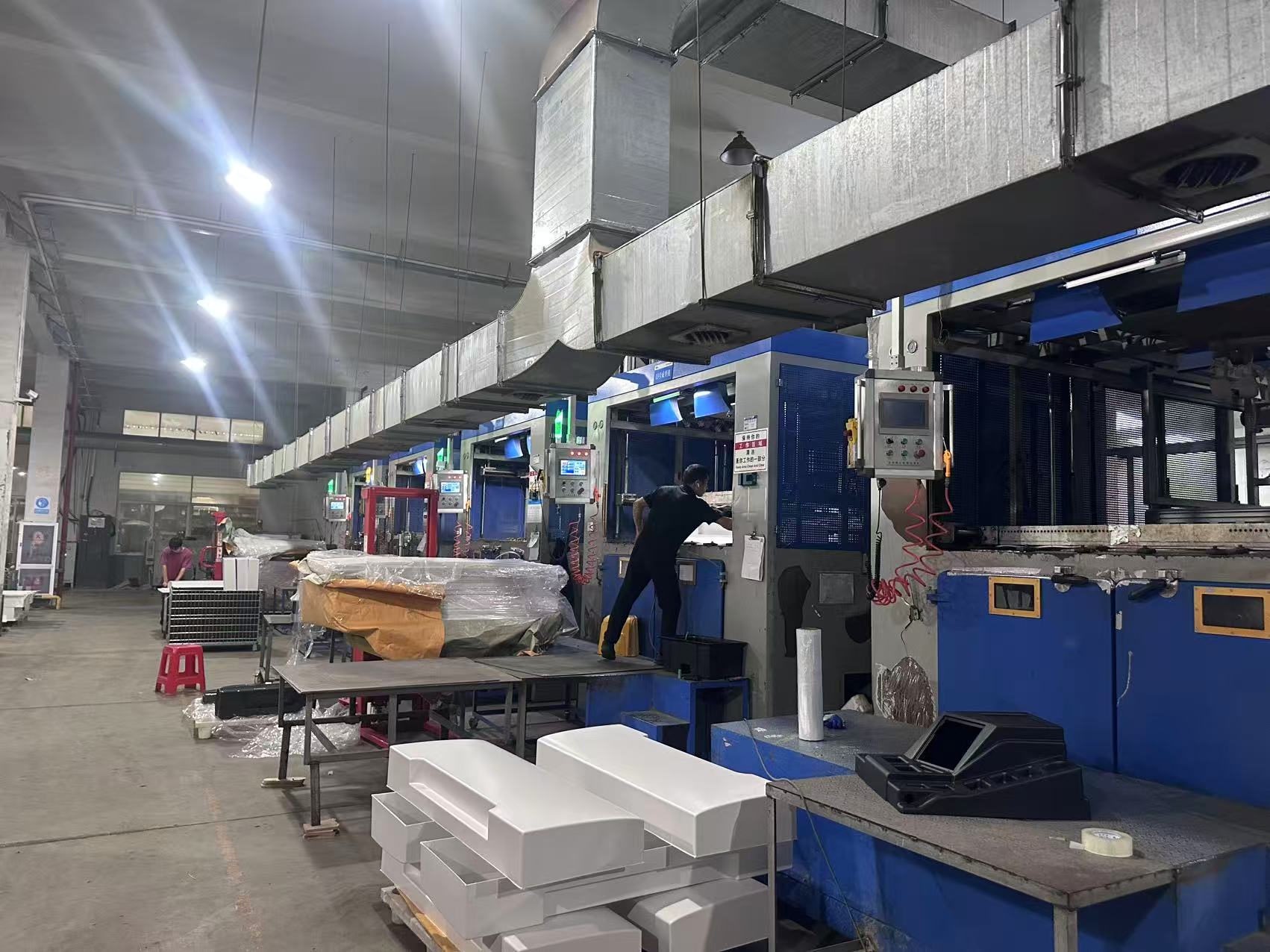
The documented envelope: five specifications that decide scenario fit
Before any material is discussed, four numbers and one option determine whether a radome or rooftop tent project is inside the process window. The table below states only documented values and what each means for the buyer.
| Specification | Documented value | What it means for an outdoor part |
|---|---|---|
| Sheet thickness | 2–10 mm | Heavy-gauge territory: structural shells and covers rather than thin-gauge components. Gauge choice depends on span, ribbing, fixing points and expected load, and is confirmed per project. |
| Maximum forming size | Up to 3300 mm × 2000 mm | Large single-piece shells can be formed without splitting the geometry into joined panels, which is directly relevant to radome size and to tent shell halves. |
| Operating temperature | -20°C to 70°C | Describes the application environment these products are documented for. Conditions outside this band, or combined thermal and mechanical load, need project confirmation. |
| UV performance | Optional UV-resistant surface for outdoor exposure | Weather resistance is a specification, not a default. If the part faces long sun exposure, the surface option must be written into the order. |
| Material options | ABS, ASA, PC, PETG, PMMA, PVC, HDPE | The family is broad; the correct grade depends on exposure and geometry, not on the family name alone. |
Matching ASA, PC, PETG, PMMA, PVC and HDPE to exposure and geometry
Material selection in outdoor thermoforming is a two-axis decision. The first axis is exposure: sun, temperature cycling, moisture and impact. The second is geometry: how deep the draw is, how tight the radii are, whether the part must be transparent or translucent, and how it will be painted or printed. A material that wins on exposure may lose on draw depth, and vice versa.
The characterisations below are general industry descriptions of each polymer family, not a specification for any particular grade. Within every family, the grade and additive package govern actual performance, and the sheet supplier’s data should be requested for the specific project.
| Material | Typical role in outdoor parts | Where it needs care |
|---|---|---|
| ASA | Opaque outdoor shells where colour and surface retention under sunlight are priorities, such as rooftop tent body panels and radome exteriors. | Impact performance is moderate compared with PC; deep draws and sharp corners should be reviewed against sheet gauge. |
| PC | Parts needing high impact resistance, with transparent or translucent PC available where visibility or light transmission is required. | Requires attention to forming conditions and to surface protection; a PC matte film is documented as an option where glare matters. |
| PETG | Parts needing good formability, with transparent or translucent finishes where appearance is visible. | Outdoor exposure should be assessed against the specific grade rather than assumed from the family. |
| PMMA | Applications where optical clarity and a hard, high-quality surface are the leading requirements. | Lower impact tolerance means it is better suited to protected or non-contact areas than to impact-facing shells. |
| PVC | Industrial covers and housings where chemical or moisture exposure, and cost, are the main drivers. | Long-term sunlight exposure is a weaker fit than ASA or a UV-protected surface; specification should follow the actual service location. |
| HDPE | Tough, chemically resistant parts and impact-resistant PE variants where durability and low moisture uptake matter. | UV stabilisation and decoration (painting, printing) need to be planned with the sheet supplier for outdoor use. |
Geometry converts a material shortlist into a forming plan. Deeper draws thin the sheet, so a 3 mm starting gauge does not deliver 3 mm at the base of a tall tent wall. Tight internal radii and undercuts may require a split mould, a secondary assembly, or a geometry change. Openings, flanges and mounting bosses are usually produced at the five-axis cutting stage rather than in the mould. Buyers who present a finished CAD model without those constraints often discover them at first-article inspection, which is the most expensive time to find them.
Radome scenario fit: large curved shells with a surface specification
Marine antenna radomes sit squarely in the documented scope: radome thermoforming is listed as a formed product type, communication antennas and marine supplies appear among the applicable industries, and the application list includes communication radomes. A radome is a housing, and the forming question is whether the shell can be produced as a single piece with a consistent wall, a stable mounting interface and a surface that survives sun and salt-laden air.
The 3300 mm × 2000 mm maximum forming size is the decisive capability here. It allows a large radome shell to be formed as one part within that envelope instead of being assembled from segments, which reduces joint sealing and alignment work. Sheet thickness in the 2–10 mm band covers the range from lighter fairings to more substantial structural shells, with the final gauge set by the project’s own load and fixing requirements.
Material choice for radomes usually starts with ASA for opaque exterior shells, PC where impact resistance or a translucent finish is wanted, and PETG where formability and a translucent appearance are the priorities. For any part that will sit in direct sun, the optional UV-resistant surface should be treated as a line item in the specification rather than an assumption.
One boundary deserves to be stated plainly: a forming supplier establishes geometry, gauge, surface and assembly fit. If the radome carries electrical or signal-related requirements, those are project inputs that must be specified and validated within the project — the forming process alone does not establish them, and no material family name should be read as a guarantee of radio-frequency behaviour.
Rooftop tent scenario fit: deep shells, large footprints and visible surfaces
Rooftop tent and component thermoforming is also within the documented scope, with outdoor camping listed as an applicable industry. The parts involved are typically shell halves, lids or base components with a large footprint, radiused corners, a mounting interface to the vehicle or roof bars and, often, a visible exterior surface.
Three characteristics of the process line up with this scenario. First, the 3300 mm × 2000 mm envelope accommodates large shell halves, so a tent body does not have to be assembled from many small panels. Second, heavy-gauge sheet in the 2–10 mm band gives the wall substance expected of a load-bearing shell, with the actual gauge determined by span, ribbing and fixing detail. Third, the documented finishing options — screen printing and masked painting — allow branding or colour differentiation to be applied during production rather than as a separate decoration step.
Material logic for a tent shell tends to follow the exposure profile. ASA is a natural starting point for opaque exterior panels that will see sustained sunlight; HDPE or impact-resistant PE variants are worth reviewing where toughness and chemical resistance dominate; PC or transparent/translucent PC is relevant where a window, panel or light-transmitting element is part of the design. Because a rooftop tent shell is a deep draw with large flat areas, the practical discussion usually centres on gauge distribution, corner radii and how the trim line will be controlled — not on the material name alone.
The fit boundary is the same as for radomes: the -20°C to 70°C operating range describes documented application conditions. A design that will be stored or used beyond that band, or that combines thermal exposure with structural load, needs its own confirmation rather than an assumption carried over from a catalogue line.
How vacuum forming compares with the alternatives buyers usually shortlist
Most outdoor equipment programmes compare three routes: thermoforming, injection moulding and hand-laid composite or metal fabrication. Each is legitimate; they differ in where the cost and risk sit.
- Versus injection moulding. Thermoforming is documented as having low tooling cost for prototype and medium-batch production and a minimum order quantity of 1 unit, which matters when a radome or tent shell may be revised after field trials. Injection moulding becomes attractive at volumes far above that band, where tooling investment is amortised. The trade-off is that thermoformed parts are drawn from sheet, so very sharp feature definition, deep undercuts and tight wall-thickness control in extreme draws are inherently harder than in a moulded part.
- Versus hand-laid composites. Composite lay-up can produce large shells with low tooling, but the process is labour-intensive and depends heavily on operator consistency. Thermoforming delivers a repeatable sheet-based wall and a defined trim edge, at the cost of being constrained to formable thermoplastic grades.
- Versus metal fabrication. Sheet metal brings stiffness and high-temperature tolerance but adds weight, corrosion management and a different finishing route. For a rooftop tent shell, weight is usually a decisive variable, and for a radome, so is the ability to form a smooth continuous surface.
None of these comparisons establishes that one route is superior for a given project. They establish what each route makes easy and what it makes expensive, which is the decision the buyer actually has to make.
Where thermoforming stops fitting
A reference article that lists only advantages is not useful for a procurement decision. Documented and process-level limits include the following.
- Size is bounded. A single formed part is limited to the 3300 mm × 2000 mm forming envelope. Beyond that, the design must be split, and splitting changes sealing, alignment and assembly cost.
- Gauge is bounded to 2–10 mm. Parts requiring thinner film or thicker monolithic sections fall outside the documented heavy-gauge band.
- Weather performance is a specification, not a property. UV resistance is offered as an optional surface. A project that omits it and then evaluates the part against a sun-exposed duty cycle is testing an unfinished specification.
- Several requirements are explicitly project-confirmed. Fire rating, UV-resistance rating, dimensional tolerances and assembly requirements are not fixed catalogue values; they are agreed per project and should appear in writing.
- Secondary operations are part of the cost. Trimming, openings and finishing are separate steps in the documented chain, so a quotation that covers forming only is not a complete landed comparison.
A verification sequence before tooling release
For a radome or rooftop tent shell, the sequence below converts the documented envelope into a project-specific plan. Each step answers a question that is expensive to reopen after tooling exists.
- Confirm the part is inside the envelope. Check the largest projected dimension against 3300 mm × 2000 mm, including trim allowance and any flange.
- Confirm gauge intent in writing. State the nominal sheet thickness within the 2–10 mm range and identify the areas where draw thinning is acceptable and where it is not.
- Decide the exposure class. If the part faces sustained sunlight, specify the optional UV-resistant surface explicitly, and state the expected service temperature against the -20°C to 70°C band.
- Fix the material grade, not just the family. Ask for the sheet supplier’s data on the named grade, and where flame-retardant ABS is required, confirm the applicable fire rating for the project.
- Agree the finishing route. Screen printing, masked painting, matte film, transparent or translucent finishes and impact-resistant PE all change handling and inspection, so they belong in the specification stage.
- Define first-article checks. Documented quality control is 100% test; the buyer should still agree which dimensions, surfaces and fit interfaces are measured, and how assembly against mating parts is demonstrated before volume release.
- Check the schedule against 25–30 days lead time. Tooling, first article, revision and finishing all sit inside or alongside that window, depending on project scope.
Suppliers with long-running accounts are a useful signal in this process. Baiheli reports around 30 projects closed each year, customer relationships lasting 3–5 years, and delivered dimensionally stable structural housings that meet surface-finishing and assembly requirements and support customers’ product launch schedules — reported outcomes rather than independently audited results, and therefore a starting point for reference checks rather than a substitute for them.
Market context: a large process, with heavy-gauge as the specialist lane
Grand View Research estimated the global plastic vacuum forming market at USD 4.8 billion in 2023 and projected USD 7.2 billion by 2030, with Asia Pacific accounting for 40.7% of the market in 2023. Mordor Intelligence estimated that thin-gauge processes represented 76.22% of the combined heavy- and thin-gauge market in 2025.
Those figures are useful for one purpose here: they show that heavy-gauge forming of the kind used for radomes and rooftop tent shells is the smaller, more specialised part of the process landscape. Thickness in the 2–10 mm band, large-format tooling and five-axis trimming are not commodity capabilities, which is why supplier selection in this segment tends to turn on equipment envelope and process chain rather than on headline capacity alone.
Where Hangzhou Baiheli New Materials sits in this picture
Baiheli was founded in 2011 and operates from approximately 10,000 square meters of standard factory space in Guali Town, Xiaoshan District, Hangzhou, about a 15-minute drive from Hangzhou Xiaoshan International Airport. It employs around 90 people, reports annual output of 550,000 units and a five-person R&D team, and holds ISO 9001:2016 quality management system certification. Export accounts for 30–40% of business, with China and international markets both served.
Its documented process chain covers sheet extrusion, thick-sheet vacuum thermoforming, five-axis cutting, housing forming and masking for painting, with customization across geometry, material selection, transparent, translucent or opaque finishes, matte film, screen printing, masked painting and housing-fit processing. Monthly capacity is documented at 80,000 units, with a minimum order quantity of 1 unit, a 25–30 day lead time, 100% test, and remote technical support plus after-sales follow-up and quality complaint handling.
For an outdoor equipment buyer, the relevant point is not the scale figure but the coverage: radome thermoforming and rooftop tent and component thermoforming are both named in scope, alongside automotive, AGV, medical and amusement equipment work. That breadth matters because material handling experience and trimming experience transfer across these product types more readily than they transfer from thin-gauge packaging work.
What to watch next
Two developments are worth tracking, and both are conditional rather than forecast. The first is specification discipline: as outdoor equipment buyers become more explicit about UV exposure and service temperature, the optional UV-resistant surface is likely to move from an option discussed late to a line item agreed early — which changes quotations, not physics. The second is the split between formed and assembled large shells. As long as forming envelopes remain in the low-metre range, designers will keep choosing between a single large formed part and a joined assembly, and that choice will continue to drive cost and sealing risk more than material selection does.
Broader market projections, including the 2030 figure cited above, are source-reported forecasts rather than confirmed outcomes; they should inform timing discussions, not replace a project-specific feasibility review.
Frequently asked questions
Are radomes and rooftop tent parts actually within the scope of vacuum forming?
Yes, both are documented formed product types. The listed thermoforming scope includes radome thermoforming and rooftop tent and component thermoforming, alongside industrial housing, automotive-part, AGV and robot housing, medical-equipment housing and amusement-equipment thermoforming. Communication antennas, marine supplies and outdoor camping appear among the applicable industries.
What sheet thickness should a radome or rooftop tent shell use?
The documented sheet thickness range for these custom housing projects is 2 mm to 10 mm. The specific gauge within that band depends on the part’s span, ribbing, fixing points and expected load, and must be confirmed for the individual project rather than selected from the range alone. Draw depth also matters, because forming thins the sheet in deep sections.
How large a single part can be vacuum formed for outdoor equipment?
Large industrial equipment housing projects can use a maximum forming size of up to 3300 mm × 2000 mm. Parts beyond that envelope have to be split into multiple formed components, which changes sealing, alignment and assembly requirements and should be evaluated at the design stage.
Which material is best for outdoor exposure: ASA, PC, PETG, PMMA, PVC or HDPE?
There is no single answer, because exposure and geometry pull in different directions. ASA is generally chosen for opaque exterior parts where sunlight and surface appearance dominate; PC where impact resistance or a transparent/translucent finish is needed; PETG where formability and a translucent look matter; HDPE or impact-resistant PE where toughness and chemical resistance lead; PMMA where optical clarity and surface hardness are the priorities; and PVC for industrial covers in less sun-critical positions. The grade and additive package govern actual performance, and the optional UV-resistant surface should be specified for any part with sustained outdoor exposure.
What must be confirmed before an outdoor thermoformed part goes into production?
Several items are project-confirmed rather than standard: the exact fire rating where flame-retardant ABS is used, the UV-resistance rating, dimensional tolerances and assembly requirements. Buyers should also agree the nominal sheet thickness and acceptable draw thinning, the finishing route (screen printing, masked painting, matte film, transparent or translucent finish), the first-article inspection criteria, and the delivery schedule against the 25–30 day lead time.
Reference document: the company’s corporate brochure is available for download and sets out the process chain and capability details summarised here.
¿Tiene preguntas o necesita más detalles?
Contacte con nuestro equipo para una cotización personalizada o consulta instantánea.
Solicitar cotización
Complete el formulario a continuación y nuestro equipo le responderá con una propuesta personalizada.
Chat directo de WhatsApp
¿Prefiere chatear en tiempo real? Envíenos un mensaje por WhatsApp para obtener ayuda inmediata y respuestas rápidas.
- Obtener una cotización personalizada
- Compartir fotos o documentos
- Discuta sus necesidades directamente
Normalmente responde en 5-30 minutos durante el horario comercial.