
VSD vs Fixed-Speed Two-Stage Rotary Screw Air Compressors
VSD vs Fixed-Speed Two-Stage Rotary Screw Air Compressors
An independent buyer comparison of variable-speed, fixed-speed, single-stage and two-stage configurations — and of the questions that decide between them.
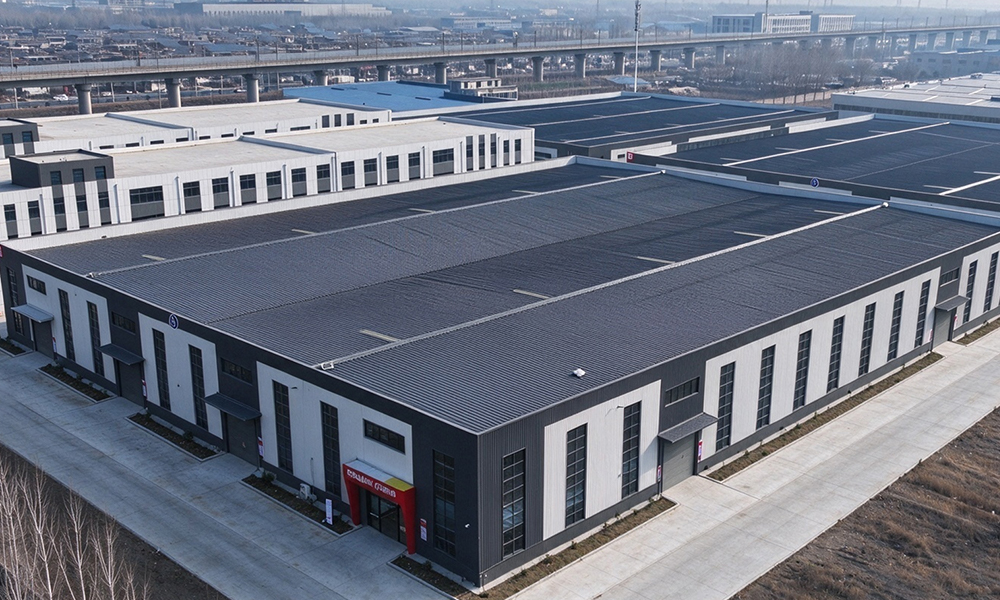
Cover: an industrial compressor manufacturing site — the configuration decision starts with the plant's demand curve, not with a product poster.
VSD and fixed-speed describe how a rotary screw air compressor's output is controlled. Single-stage and two-stage describe how its airend compresses the air. Those are different axes, which is why the common shorthand — VSD versus fixed-speed two-stage — describes an argument rather than a product list. A buyer who compares them as three peer options usually ends up deciding on purchase price, because none of the technical differences have been translated into the only variable that matters: the shape of the plant's air demand across a working year.
The decision variable is duty. A machine sized for peak output and then run at part load spends most of its life in exactly the condition where configurations diverge. Sollant's comparison material makes the distinction explicitly: the energy difference between variable-speed and fixed-speed operation is minimal at full load and becomes substantial under partial-load conditions, widening as the load factor falls and its volatility rises. That single statement reframes the purchase question from 'which technology is better' to 'how much of this machine's life will be spent away from rated output'.
The rest of this comparison sets out what each configuration actually changes, where two-stage variable-frequency compression fits, how the air receiver, refrigerated dryer and precision filters affect what reaches the production line, and which questions about flow, duty cycle and service should be answered before an order is placed.
The Four Configurations, Defined Without Marketing
A screw compressor raises air pressure through a pair of intermeshing rotors: air enters the working chamber formed between the rotor flutes and the casing, the chamber volume decreases as the rotors turn, and the air is discharged at the set pressure. Everything a buyer compares — control strategy, number of stages, treatment — sits on top of that same mechanism.
Variable-speed drive (VSD). Motor speed is adjusted to match actual air demand, so the machine reduces output rather than cycling between loaded and unloaded states. The purpose is to remove the energy wasted during load/unload cycling when consumption drops.
Fixed-speed. The motor runs at line frequency and capacity is regulated by loading and unloading around a pressure band. Sollant's comparison material notes that fixed-frequency units typically carry a lower initial purchase cost — a point that returns later, because it is the anchor of every payback argument.
Single-stage versus two-stage. This is the number of compression stages in the airend. Two-stage compression splits the pressure rise across two sections, with the air cooled between them rather than in one step. That is a design approach, not a control strategy, and it says nothing by itself about how the machine behaves at part load. In practice the two axes cross: Sollant lists a single-stage series spanning 7.5 kW to 250 kW and a separate two-stage series from 22 kW to 250 kW, alongside fixed-speed and variable-frequency portfolio categories — which is precisely why the comparison must be made per model rather than per category.
| Configuration | What changes | Demand profile it fits | Verify before quoting |
|---|---|---|---|
| Fixed-speed, single-stage | Line-frequency motor, load/unload regulation around a pressure band. | Demand that stays close to rated output for most operating hours. | Delivered flow at your actual discharge pressure; the basis on which it is declared. |
| Variable-speed, single-stage | Speed tracks demand; load/unload cycling is reduced rather than relied on. | Shift changes, equipment start-stop, packaging and machining lines with moving consumption. | Flow range and part-load figures, not one best-case number; drive cooling and power-quality requirements. |
| Fixed-speed, two-stage | Two compression stages; regulation remains load/unload. | Steady, high-output duty where the staging decision has already been taken. | Whether the configuration is offered at all, and the same performance declaration as any other model. |
| Two-stage with variable frequency | Staging and speed control combined. | Large-scale production where high output and shifting demand occur together. | Part-load data across the flow range, service access to both stages, and whether a saving is machine-level or system-level. |
The matrix is a screening tool, not a ranking. No cell is universally cheaper to own: Sollant's comparison material is explicit that whether variable-frequency is more cost-effective than fixed-frequency depends on operating duration, load profile, electricity pricing and the difference in purchase price.
Continuous Versus Variable Demand: The Variable Buyers Rarely Quantify
Screw compressors are built for continuous operation at a high load factor — that is a core reason they replaced reciprocating machines in industrial duty. But 'continuous operation' and 'constant demand' are not the same thing. Demand moves through the day and the week in plants with shift patterns, batch changeovers, or equipment that starts and stops. Sollant's comparison material identifies exactly these factories — automated production lines, packaging, machining — as the ones where variable-speed control becomes relevant, and contrasts them with systems that hold a steady, near-rated load.
Two facts convert this from an impression into a specification: the hours per year the machine will run, and the share of those hours spent well below rated output. Neither is in a supplier's catalogue; both come from the plant. Without them, a comparison of fixed-speed and VSD machines is a comparison of purchase prices, not of operating cost.
Energy is not a side cost, which is why the gap matters. Sollant's comparison material puts energy at roughly 70% of a compressor's total life-cycle cost. That is the manufacturer's characterization of the cost structure and should be re-checked against local electricity pricing — but it explains why a modest efficiency difference at part load can outweigh a large difference in purchase price across a service life.
Where Two-Stage Variable-Frequency Compression Fits
Two-stage variable-frequency compression is positioned for the case where two conditions hold at once: output is high enough to justify a large machine, and demand moves enough that the machine will spend meaningful time below its ceiling.
The logic is additive rather than competitive. The two-stage airend addresses how the air is compressed; variable-frequency control addresses how output tracks demand. A buyer who evaluates them as alternatives — a two-stage fixed-speed machine against a single-stage VSD machine — is comparing a staging decision with a control decision, and will usually settle that comparison on price.
The same logic sets the fit boundary. Where a plant runs at a steady, near-rated load for most of the year, the part-load advantage has little to work with; Sollant's material states plainly that the difference between variable and fixed speed is minimal at full load. In that case the variable-speed premium buys capability that is rarely used, and the honest question becomes whether demand is expected to change. In the opposite case — a large machine that will spend long periods at low output — the buyer should require measured part-load data across that whole range rather than assuming a control strategy resolves it.
What a buyer should not accept is a performance claim that is not attached to a measurement. The supplier should be able to state delivered flow and specific power for the specific model, at the actual discharge pressure, on a stated test basis, and — for a variable-speed machine — at more than one point on the flow range.
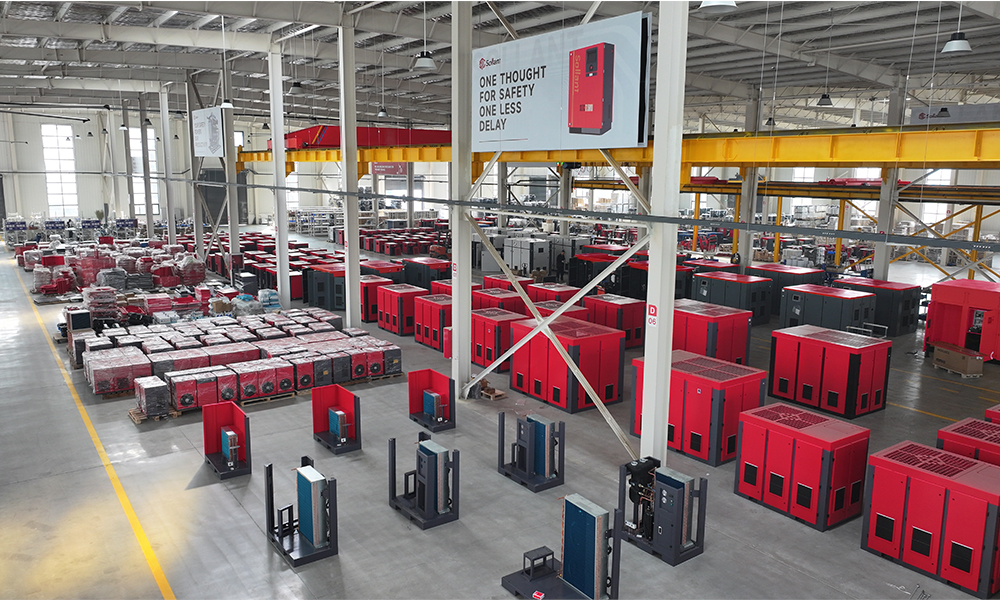
Production workshop: declared performance figures only become comparable when they are tied to a test basis rather than to a model name.
What the Receiver, Dryer and Filters Change About Delivered Air
A compressor does not deliver air; a system does. Three components between the compressor and the production line determine whether the money spent on the machine reaches the workpiece.
Air receiver
An air receiver stores compressed air, buffers short-term fluctuations in demand and helps stabilise system pressure. It also gives the air somewhere to cool so that condensate can separate and be drained. It is not a substitute for the compressor as a continuous source of air, and larger is not automatically better: capacity should follow the compressor's output, the variability of demand and the control strategy in use.
Refrigerated dryer
A refrigerated dryer cools compressed air so that water vapour condenses and is discharged, reducing the risk of water accumulation in pipes, equipment corrosion and certain pneumatic component failures. Its capability is expressed through parameters such as pressure dew point. It reduces moisture; it does not replace a precision oil-removal filter, and under all conditions it does not reach the low dew points of a desiccant dryer. That distinction matters when a process specifies a dryness level rather than simply asking for 'dry air'.
Precision filters
Filters remove contaminants such as particulates and oil mist within their specified range. They and the dryer do different jobs: standard filters are not an effective way to remove water vapour, and a dryer is not a filter. Treatment therefore has to be specified as a chain against an air-quality requirement, not as a list of accessories attached to a compressor order.
The usual way to make that requirement contractual is a purity class. ISO 8573-1:2010 classifies compressed air by particles, water and oil, with oil classes 1 to 4 set at 0.01, 0.1, 1 and 5 mg/m³ respectively, plus a Class 0 that is defined by the user or the equipment manufacturer rather than by the standard itself. Naming a class is more useful than naming components, because it lets two suppliers propose different technical routes to the same declared air quality.
Where the process is forgiving, the treatment chain can be simple; where it is not, it drives the specification. In dust-heavy operations such as sandblasting, moisture causes abrasive media to clump and clog equipment, and residual oil or water causes workpiece rust — so a refrigerated dryer combined with high-efficiency oil removal and precision filters is treated as mandatory rather than optional, because the cost of a failed surface finish sits far downstream of the equipment saving.
One practical rule follows: size the receiver, dryer and filters for the flow the compressor actually delivers, not for its model number. Undersized treatment becomes a pressure drop and a service problem, and it is one reason delivered flow at the point of use can fall short of the figure on the nameplate.
What to Ask About CFM, Duty Cycle and Service
CFM and the basis behind it
Ask what the number means before comparing it. Delivered flow should be free air delivery at the actual discharge pressure — not a displacement figure — and the quotation should state the test basis behind it. ISO 1217 is the international acceptance-test code for displacement compressors: it governs how volume flow rate, power and specific energy are measured and declared. Two quotations that both cite it are comparable on flow; one that cites it and one that does not are not.
For a variable-speed machine, ask for a flow range and for specific power at defined points inside it, not a single best case. Specific power is input power divided by delivered flow in kW/(m³/min): a 75 kW machine delivering 12 m³/min works out at 6.25 kW/(m³/min). Under the same pressure and the same measurement boundary, lower specific power generally indicates less electricity per unit of air — which is exactly the comparison a duty-cycle-based decision needs.
Keep the boundaries apart. Machine-level declarations under ISO 1217 and system-level energy assessment under ISO 11011 use different boundaries and cannot be merged into one efficiency claim. If a supplier presents a saving, ask at which level it was measured.
Duty cycle
Ask the supplier to work from the plant's load profile instead of from a nameplate comparison. The useful questions are concrete: how many hours per year, how many shifts, which equipment starts and stops, and what the lowest sustained demand looks like. Sollant's buyer guidance is consistent with this — variable-frequency for fluctuating demand, fixed-speed for constant demand — but it is a selection rule, not a performance guarantee for any particular site.
Service and maintenance
Ask for the maintenance schedule for the specific model, not the series. Routine maintenance covers operating parameters, lubrication, cooling, filters and drains, inspection for leaks, and consumables at the manufacturer's stated intervals. Sollant's published guidance cites oil and oil filter changes at 2,000 to 4,000 running hours or at least annually, air filter replacement at 1,000 to 2,000 hours depending on the environment, and daily checks of oil level, discharge temperature and system pressure.
For a VSD machine, ask additionally about the drive. Variable-frequency control uses soft starting, which reduces the starting-current surge — but it introduces electronics that require attention to heat dissipation, power quality, dust protection and moisture resistance. Sollant's comparison material is explicit that variable-speed systems are not inherently easier to maintain than fixed-frequency units for this reason. That is a planning input, not a disqualification.
Finally, ask how the supplier diagnoses low delivered flow. The usual causes are a clogged intake filter, leaks in hoses, fittings or piping, restricted or undersized air lines, or demand exceeding rated capacity — and none of those is fixed by a control strategy.
Fit Boundaries Worth Stating Up Front
Four limitations belong inside the comparison rather than in a footnote.
- Purchase price and operating cost move in opposite directions. Fixed-frequency units typically cost less up front; the value of variable-frequency units comes primarily from long-term electricity savings under fluctuating loads. Which is more cost-effective depends on operating duration, load profile, electricity pricing and the price difference between the two.
- Full-load operation removes most of the distinction. At steady full load the gap between fixed and variable speed is small. A plant that genuinely runs flat out should question whether it is buying part-load capability it will not use.
- VSD adds electronic content. Heat, power quality, dust and moisture become maintenance considerations. Soft starting reduces the current surge but does not simplify the machine.
- Treatment is not optional overhead. A correctly sized receiver, dryer and filter chain is part of delivering air quality; specifying it after the compressor is chosen shifts cost from the equipment budget to the production budget.
Where Sollant Sits in This Comparison
Shanghai Sollant Energy Saving Technology Co., Ltd. is a compressed air system manufacturer founded in 2004, with a 30,000 ㎡ factory, around 150 employees, an R&D team of 20 engineers and a stated annual capacity of 20,000 units across approximately four production lines. The company reports that about 80% of its output is exported and that its products reach more than 100 countries and regions; it works to an ISO 9001 quality management system and states that every unit is full-load tested before shipment.
Its portfolio is relevant to this comparison because it spans the categories rather than one of them: fixed-speed, variable-frequency and permanent-magnet variable-frequency screw compressors, low-pressure and portable units, plus the post-treatment equipment — refrigerated and adsorption dryers, air receivers and precision filters — that determines delivered air quality. Sollant also lists a two-stage series from 22 kW to 250 kW alongside its single-stage range, and supports OEM/ODM customisation.
On performance, the company states that its permanent-magnet variable-frequency series achieves energy savings of 30%–35%, and its comparison material places variable-frequency units at 20%–40% overall savings against fixed-speed units under fluctuating demand, with the difference minimal at full load. These are the manufacturer's characterizations of its own products; they are not independently verified results, and the figure at any site depends on load profile, operating hours and electricity price. What is useful for a buyer is the stated condition — fluctuating demand — because that is a testable claim about fit rather than a universal number.
Service coverage belongs to the same picture: Sollant states 24/7 engineering after-sales support, original spare parts supply and support for overseas partners. For a buyer at decision stage, the practical next step is to test those statements against a specification — name the flow, pressure, duty cycle and air-quality class, and request the model, the performance basis and the maintenance schedule in writing.
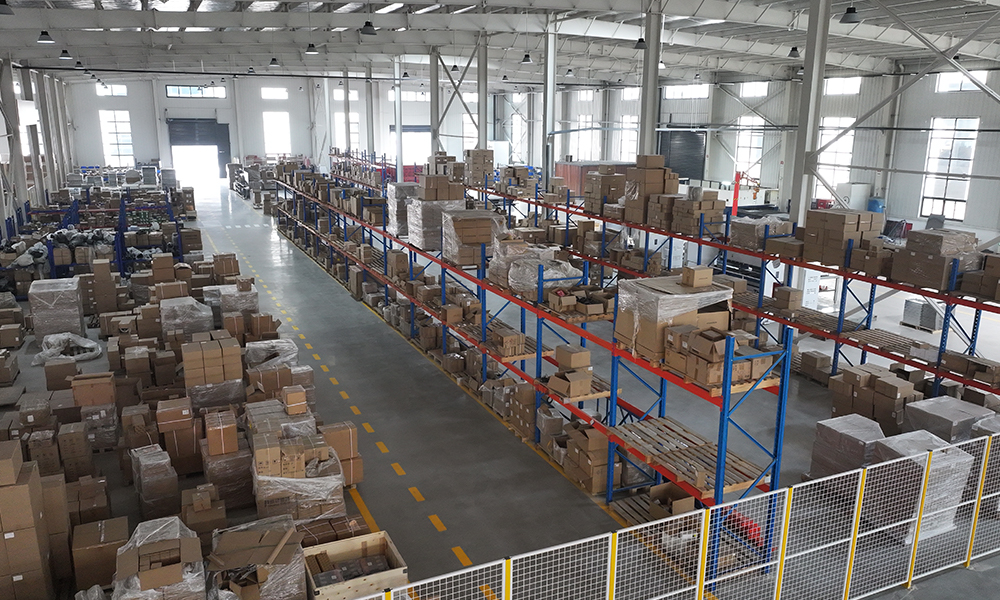
Warehouse and stocked units: spare-parts availability is part of the service question, not an afterthought to the equipment choice.
What Would Change the Answer
The comparison is stable; the answer is not permanent. It moves when the load profile moves.
- If the plant adds automated lines, batch changeovers or more start-stop equipment, the share of hours at part load rises and the case for variable-frequency control strengthens.
- If production consolidates into steady baseload operation, the opposite happens and the part-load premium buys less.
- If electricity prices rise relative to equipment prices, the value of part-load efficiency rises with them.
- If a process specifies a tighter air-quality class, the treatment chain — dryer type, filtration, receiver sizing — becomes a larger share of the decision and can change the machine specification itself.
None of these is a forecast; each is a variable the buyer can observe. The reliable approach is to re-run the duty-cycle calculation whenever one of them changes materially, rather than treating the original purchase as a permanent answer.
The short version: match the control strategy to the demand curve, match the staging to the output and pressure requirement, specify the treatment chain against an air-quality class, and require declared performance on a stated test basis. Everything else in this comparison follows from those four decisions.
Reference document: Sollant's corporate brochure, covering its compressor range and service structure, can be downloaded here — Sollant Corporate Brochure (PDF).
Frequently Asked Questions
Is a VSD rotary screw air compressor always more energy-efficient than a fixed-speed unit?
No. Variable-speed control adjusts motor speed to match demand, which reduces the energy lost in load/unload cycling when consumption fluctuates. At full load the difference is small; the advantage grows as the load factor falls and becomes more volatile. Whether it pays back depends on operating hours, load profile, electricity price and the price difference between the two machines. Sollant's own buyer guidance makes the same point: choose variable-frequency for fluctuating demand and fixed-speed for constant demand.
When does a two-stage configuration make more sense than a single-stage machine?
Two-stage compression splits the pressure rise across two airend sections rather than one, with cooling between the stages. It becomes the relevant option when the plant needs high output and the demand also moves, so that staging and speed control are being considered together — Sollant lists its two-stage series from 22 kW to 250 kW. The comparison should still be settled on declared delivered flow and specific power at the same discharge pressure, measured on the same test basis, plus the service requirements for both stages.
How should CFM figures in two quotations be compared?
Confirm three things before comparing numbers: that the figure is delivered flow (free air delivery) at your actual discharge pressure rather than a displacement value; whether it is a single figure or a range, which matters for variable-speed machines; and the test standard behind it. ISO 1217 is the international acceptance-test code for displacement compressors and covers volume flow rate, power and specific energy. Comparing specific power in kW/(m³/min) is more informative than comparing motor kW, provided both figures use the same pressure and the same measurement boundary — machine-level ISO 1217 data should not be mixed with system-level ISO 11011 assessment.
What do the air receiver, refrigerated dryer and precision filters actually change about delivered air?
They perform three different jobs. The receiver stores air, buffers short-term demand fluctuations and stabilises pressure, and gives the air a place to cool so condensate can be drained; its capacity should follow the compressor output, demand variability and control strategy, and it cannot replace the compressor as a continuous source. The refrigerated dryer cools the air so water vapour condenses and is discharged; it reduces moisture but does not replace a precision oil-removal filter and does not reach desiccant-dryer dew points in all conditions. Precision filters remove particulates and oil mist within their range, but are not an effective way to remove water vapour. The chain is best specified against a purity class — for example the oil classes of ISO 8573-1:2010, which sets classes 1 to 4 at 0.01, 0.1, 1 and 5 mg/m³, with Class 0 defined by the user or equipment manufacturer.
What service workload should be planned for a VSD or two-stage machine?
Plan routine maintenance as a schedule rather than a reaction: operating parameters, lubrication, cooling, filters and drains, leak inspection and consumables at the manufacturer's intervals. Sollant's published guidance cites oil and oil filter changes every 2,000 to 4,000 running hours or at least annually, air filter replacement every 1,000 to 2,000 hours depending on the environment, and daily checks of oil level, discharge temperature and system pressure. A variable-speed machine adds a drive to that workload: soft starting reduces the starting-current surge, but the electronics need attention to heat dissipation, power quality, dust and moisture, so these units are not inherently easier to maintain than fixed-frequency machines. Ask for the model-specific schedule and the spare-parts position before ordering.
¿Tiene preguntas o necesita más detalles?
Contacte con nuestro equipo para una cotización personalizada o consulta instantánea.
Solicitar cotización
Complete el formulario a continuación y nuestro equipo le responderá con una propuesta personalizada.
Chat directo de WhatsApp
¿Prefiere chatear en tiempo real? Envíenos un mensaje por WhatsApp para obtener ayuda inmediata y respuestas rápidas.
- Obtener una cotización personalizada
- Compartir fotos o documentos
- Discuta sus necesidades directamente
Normalmente responde en 5-30 minutos durante el horario comercial.