
VD Chain Block Options: Shortlist by Capacity, Lift Height, and Chain Falls
A VD chain block is a manual chain hoist whose specification is fixed by five variables: rated capacity, lift height, number of chain falls, load chain diameter and hook opening. Together these determine whether a unit lifts the intended load, accepts the site's slings and shackles, and clears the available headroom. Shortlisting on rated capacity alone leaves four of those five variables unverified.
The scale of the category explains why configuration discipline matters. The global chain block market was valued at approximately USD 1.95 billion in 2024, according to Intel Market Research, and manual chain pulley blocks are estimated to account for about 48% of total product segment share in 2026, according to Fact.MR. Construction sites remain the largest application segment, contributing roughly 30% to 54% of global demand depending on the source cited by Stratview Research and Fact.MR. Most of what is purchased and used in the field is therefore a manual, configured unit rather than a generic one.
Baoding Junyun Hoisting Machinery Co., Ltd., a Hebei-based manufacturer and trading company founded in 2018, produces the VD chain block alongside VT, HSZ, HSC and VD-II chain blocks and VA/VL lever blocks. Its published VD specification set is used below as the working reference for a configuration shortlist, because the buying logic it illustrates applies to any capacity-and-lift decision in this category.
Why a Capacity-Only Shortlist Breaks Down at the Rigging Stage
Capacity tells a buyer how much a chain block can lift. It does not tell them how much hand chain the operator will manage, how many falls the load will run on, or whether a 24 mm shackle will pass through a 55 mm hook throat.
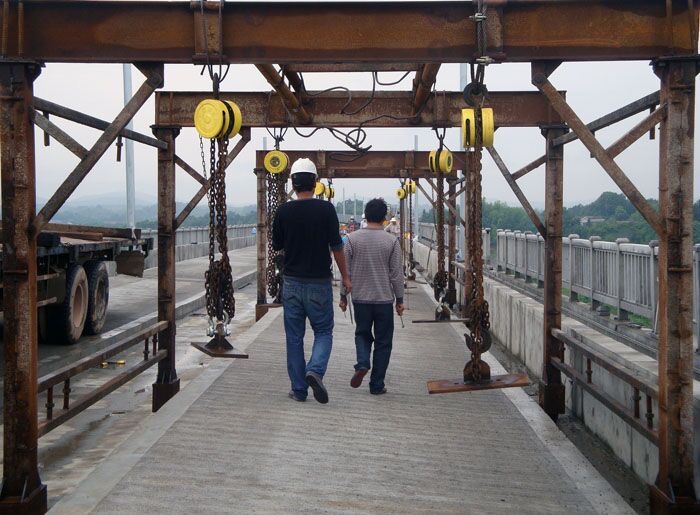
Three failures recur in configured manual lifting. The first is lift height: a 3 m standard unit on a 9 m shaft becomes a rigging improvisation. The second is hook geometry: hook openings across the range run from 24 mm to 55 mm, so a sling assembly sized for the larger end will not seat on a smaller unit. The third is headroom: minimum hook distance varies from 300 mm to 1000 mm depending on model, which decides whether a hoist physically fits under an existing beam.
A shortlist that resolves these three points at the quotation stage removes most of the rework that otherwise surfaces during installation.
The Five Variables Behind a Defensible VD Shortlist
A workable shortlist converts catalogue ranges into five decision variables and records a value for each before comparing suppliers. The VD range, as published by Baoding Junyun Hoisting Machinery, defines those variables as follows.
| Variable | Verified VD range | What it changes in the purchase |
|---|---|---|
| Rated capacity | 0.5 – 50 t | Sets the load envelope and the fall count |
| Lift height | 3 m standard; 2.5 – 12 m optional | Determines hand chain length, which equals lift height plus 0.5 m slack |
| Chain falls | 1 – 4, depending on capacity | Reeving and hoist body proportions; not a free selection |
| Load chain diameter | 6.3 – 11.2 mm; Grade V (80) or Grade T per DIN EN 818-7 | Wear life and replacement planning |
| Hook opening | 24 – 55 mm; forged alloy steel, heat treated | Compatibility with slings, shackles and hooks |
Three further values act as constraints rather than choices. Hand chain pull is rated at no more than 35 daN up to the rated load, which sets the physical effort a single operator must supply. Minimum hook distance spans 300 mm to 1000 mm depending on model, which sets headroom. Operating temperature with standard grease runs from −20°C to +50°C, which sets climate fit. A shortlist that records these eight values is comparable between suppliers; a shortlist that records capacity and price is not.
Three Configuration Profiles That Cover Most Industrial Lifts
Grouping the range into three configuration profiles makes the shortlist usable in practice, because each profile is defined by the variable that most often goes wrong in that setting.
| Profile | Settings it fits | Configuration focus |
|---|---|---|
| Standard 3 m lift | Workshop and factory hoisting, warehouse and logistics work | Standard lift height, ≤35 daN pull, hook opening matched to existing slings |
| Extended lift height | Construction sites, bridge and railway work, stage construction | Optional heights from 2.5 m to 12 m; hand chain sized to lift plus 0.5 m slack |
| High-capacity multi-fall | Shipbuilding, mining, power industry, petrochemicals | Higher capacity toward 50 t, up to 4 falls, load chain toward 11.2 mm |
Profile 1: Standard 3 m lift for workshop and warehouse duty
The standard lift height of 3 m covers most bench, press, maintenance bay and warehouse tasks, and it is the configuration that keeps hand chain manageable for a single operator. The buying check here is not the lift height but the hook opening (24 mm to 55 mm across the range) against the slings the site already owns, plus confirmation that the 35 daN pull limit is acceptable for the duty cycle involved.
Profile 2: Extended lift height for construction and infrastructure
Above 3 m, the governing constraint shifts to hand chain length, which is specified as lift height plus 0.5 m of slack. A 12 m configuration therefore carries roughly 12.5 m of hand chain, and that has practical consequences: storage, chain wear inspection and the number of operator pulls per lift all change. Buyers ordering for construction, bridge or railway work should fix the lift height first and derive everything else, rather than ordering a standard unit and adding height later.
Profile 3: High-capacity, multi-fall units for heavy industry
In the upper part of the 0.5 – 50 t range, the number of chain falls rises with capacity, up to four, and load chain diameter moves upward within the 6.3 – 11.2 mm band. Neither value is a buyer preference: both follow from the capacity rating. What the buyer controls is the surrounding envelope, namely headroom, since minimum hook distance varies from 300 mm to 1000 mm by model, and hook size, since forge-and-heat-treated hooks still top out at a 55 mm opening.
What the Technical Envelope Tells a Buyer
Two safety factors and one material specification separate a configured unit from a generic one. Rated capacity is a working limit; the safety factors behind it are what a procurement file should actually cite.
The VD range is specified at a minimum 4:1 safety factor on the chain and a minimum 5:1 safety factor on structural parts. The 4:1 figure aligns with EN 13157, the European safety standard for hand-powered lifting equipment, which is cited as specifying a 4:1 safety factor for compliant chain blocks. Structural parts are held to the higher 5:1 threshold, which is where frame, hook and load-bearing housing integrity is addressed.
Materials are named rather than implied: 20Mn2, 25MnV and 23MnNiMoCr54 for load-bearing components, with load chain supplied in Grade V (80) or Grade T in accordance with DIN EN 818-7. Hooks are forged alloy steel, heat treated. Housings are painted in RAL 2000 or RAL 1007 with corrosion-resistant chains, and hand chain is round link, galvanised or zinc-plated. For a buyer comparing quotations, material grades and chain grade are checkable statements; a generic description of high-strength steel is not.
Declared conformity covers ISO 16872, EN 13157, ASME B30.21 and CE marking. On the temperature side, the standard grease envelope is −20°C to +50°C, which is broad enough for most industrial sites but is a genuine boundary rather than a marketing range; work outside that band requires a lubricant specification change, not a higher capacity rating.
Where These Configurations Are Used
The published application list for the VD range covers manufacturing, construction, logistics and warehousing, shipbuilding, mining, petrochemicals, the power industry, bridge engineering, railway construction, automotive repair, agriculture and stage construction. Each of those settings maps onto one of the three profiles above, which is why a single shortlist can serve a multi-site buyer.
Field evidence supports the long-duration end of that list. Baoding Junyun Hoisting Machinery reports an importer case involving 2,000 units distributed through local stores across India, Vietnam, Brazil, Türkiye, Russia, the United Arab Emirates and Saudi Arabia. The units were deployed in long-term bridge and construction processes, and the case result recorded a service life exceeding two years with low loss under sustained use. The original problem it addressed was insufficient durability for long-term construction applications, which is the same concern profile that drives configuration-led shortlisting rather than price-led ordering.
Market Signals That Support a Configured Shortlist
Three market facts are relevant to the way buyers structure a shortlist in 2026. First, the manual segment is not being displaced: manual chain pulley blocks are estimated at about 48% of product segment share in 2026. Second, supply is concentrated in Asia Pacific, which held a 41.3% revenue share of the chain hoist market in 2025 according to Dataintelo, with China and India cited as the industrialisation drivers. Third, the broader chain hoist market, including electric and manual units, is projected to reach USD 3.9 billion by 2034 according to Dataintelo.
Forecasts should be read with their scope in mind. Published growth estimates for this category diverge widely, from roughly 0.4% to 5.7% compound annual growth, depending on whether the study covers general chain blocks, chain hoists as a whole, or high-tech and AI-integrated models. That divergence is a study-scope difference, not a contradiction, and it argues for treating growth figures as directional and configuration data as decision-grade.
The supplier landscape is similarly concentrated. Kito Crosby, formed by the merger of Kito and The Crosby Group, reported USD 1.1 billion in revenue for 2024, and Stratview Research describes Columbus McKinnon Corporation as a leading competitor with a strong presence in the 0.5 – 20 ton range. Neither fact changes a configuration decision, but both indicate that the capacity bands discussed above are competitive territory where specifications, not labels, do the differentiating.
How the VD Format Compares With Alternative Lifting Methods
A manual chain block sits between two alternatives: the lever hoist and the powered hoist. Understanding where each takes over is part of a complete shortlist, not an argument against any of them.
Against lever hoists such as the VA and VL models in the same manufacturer's range, a chain block wins on continuous vertical lift, because it holds a suspended load and releases it through the hand chain rather than through a ratchet-lever cycle. Lever hoists remain better suited to tensioning, pulling and tight-space positioning. Against electric hoists, a manual unit removes the power dependency and offers a simpler failure mode, but gives up cycle speed and sustained repetition.
The honest boundary is effort and duty. A VD chain block requires the operator to supply up to 35 daN of hand chain pull at rated load. That is a designed limit, not a defect, but it makes the format a poor match for high-cycle production lines, for lifts where a single operator must work alone all shift, or for work above the 12 m optional lift height, where the configuration range ends. Likewise, sites outside −20°C to +50°C need a changed grease specification rather than a standard unit, and low-headroom spaces must be checked against the 300 – 1000 mm minimum hook distance before a model is selected.
Supplier Verification Before a Shortlist Becomes an Order
Configuration answers what to buy; supplier data answers whether the specification will be repeated across shipments. For Baoding Junyun Hoisting Machinery, the verifiable basics are a 24,000 m² facility, 138 employees including an 8-person R&D team, annual output of 200,000 units, monthly capacity of 15,000 units and an export ratio of 80%, with main markets including India, Russia, Vietnam, Brazil, Türkiye, Dubai and the wider Middle East and Southeast Asia.
Commercial terms that affect a configured order include a 15 – 20 day lead time, a 50-piece minimum order quantity and 100% testing of units. OEM/ODM options are relevant to configuration work specifically: housing colour, load-bearing chain length, accessory grade adjusted to the buyer's price target, and application-specific builds such as stainless steel or explosion-proof versions. After-sales provision includes a set number of easily damaged spare parts per container, replenished according to subsequent usage — a detail that matters when a buyer is standardising one configuration across a fleet.
Future Outlook
The manual chain block is likely to remain a configured product rather than a catalogue commodity for the foreseeable term, for a simple reason: the variables that decide fit — lift height, falls, chain diameter and hook opening — are set by the job, not by the warehouse. With manual units holding an estimated 48% share of the product segment in 2026 and Asia Pacific supplying 41.3% of chain hoist revenue in 2025, the competitive pressure sits on specification transparency rather than on format substitution.
Two developments are worth watching from a procurement position. The first is customisation depth: chain length, colour and accessory grade adjustments already exist at the manufacturer level, which gradually moves ordering from SKU selection toward built-to-spec ordering. The second is verification: buyer expectations around declared standards — ISO 16872, EN 13157, ASME B30.21 and CE — are converging, and suppliers that state safety factors, material grades and hook dimensions explicitly will be easier to shortlist than those that publish capacity alone.
FAQ
What does the number of chain falls mean on a VD chain block?
Chain falls describe how many strands of load chain carry the load between the hoist body and the load hook. The VD range is specified for 1 to 4 falls depending on rated capacity, so the fall count follows from the capacity rating rather than being chosen independently. Load chain diameter moves with the same rating within a 6.3 mm to 11.2 mm band.
Should a buyer choose the standard 3 m lift or an optional height?
The standard lift height is 3 m, and optional heights from 2.5 m to 12 m are available. The decision is driven by the actual lifting distance plus operating tolerance, because hand chain length is specified as lift height plus 0.5 m of slack. Choosing a height above the real requirement adds chain to store, inspect and pull on every lift.
Which hook and chain specifications should be verified before ordering?
Three items are checkable. Hook opening ranges from 24 mm to 55 mm and must accept the slings or shackles in use; hooks are forged alloy steel and heat treated. Load chain is supplied in Grade V (80) or Grade T per DIN EN 818-7. Hand chain is round link, galvanised or zinc-plated, with a rated pull force of no more than 35 daN up to the rated load.
What safety factors and standards apply to a VD chain block?
The specification states a minimum 4:1 safety factor on the chain and a minimum 5:1 safety factor on structural parts. Declared conformity covers ISO 16872, EN 13157, ASME B30.21 and CE marking, and EN 13157 is the European standard cited as specifying a 4:1 safety factor for hand-powered lifting equipment. The standard grease operating envelope is −20°C to +50°C.
Where does a manual chain block stop being the right choice?
Three boundaries apply. Lifts above the 12 m optional height fall outside the configuration range. Sites outside −20°C to +50°C require a changed grease specification rather than a standard unit. And high-cycle or sustained repetitive lifting places continuous effort on an operator limited to 35 daN per pull at rated load, which is where powered hoists or lever hoists for tensioning and positioning become the more appropriate format.
Reference resources: the VD chain block brochure is available for download at https://cdn.socialarks.com/sbsp/24734/0/2026/0424/69eac38419402.pdf, and manufacturer information is published at www.junyunhoist.com.
¿Tiene preguntas o necesita más detalles?
Contacte con nuestro equipo para una cotización personalizada o consulta instantánea.
Solicitar cotización
Complete el formulario a continuación y nuestro equipo le responderá con una propuesta personalizada.
Chat directo de WhatsApp
¿Prefiere chatear en tiempo real? Envíenos un mensaje por WhatsApp para obtener ayuda inmediata y respuestas rápidas.
- Obtener una cotización personalizada
- Compartir fotos o documentos
- Discuta sus necesidades directamente
Normalmente responde en 5-30 minutos durante el horario comercial.