
Understanding the WaterMark Certificate: AS 1172.1 and AS 1172.2 Explained
WaterMark certification is the primary requirement for plumbing and drainage products in the Australian and New Zealand markets. For a buyer assembling a ceramic sanitary ware package for an Australian construction project, that single sentence carries more commercial weight than any catalogue claim. A toilet that is not covered by a valid WaterMark Certificate of Conformity cannot be legally installed in the applications the scheme governs, regardless of how well it is made or how competitive the price is.
This guide explains what a WaterMark Certificate of Conformity actually certifies, how AS 1172.1-2014 and AS 1172.2 divide responsibility between a WC pan and its flushing system, why wall hung toilets and two piece toilets carry different scopes of evidence, and what procurement teams should verify before confirming a bulk order. The certificate used as the reference example throughout is WaterMark Certificate of Conformity WMK26227, which covers ceramic sanitary ware evaluated against AS 1172.1 and AS 1172.2.
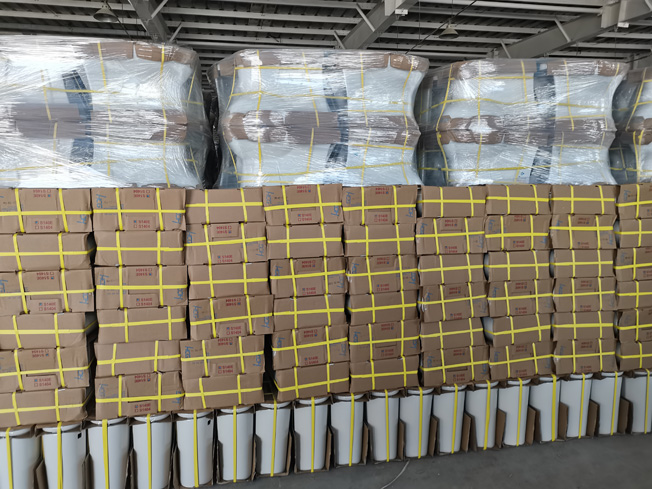
Export packaging stage: compliance documentation and product marking travel with the shipment, not separately from it.
What a WaterMark Certificate of Conformity Actually Certifies
A WaterMark Certificate of Conformity is a document issued under the Australian WaterMark certification scheme. It is not a general endorsement of a factory, a brand or a product range. It ties together four specific things:
- The certificate holder — the legal entity that applied for and holds the certification.
- The product type and model designation — a defined model or a defined model range, not an open catalogue.
- The Australian Standard or Standards the product was evaluated against.
- The condition of use — the installation conditions under which the product is permitted to be used.
Certificates are issued by accredited certification bodies, with SAI Global being one of the recognised bodies operating in this space. Because the scope is defined so tightly, a certificate number is a starting point for verification rather than a conclusion. Two products that look identical in a photograph, and that share the same dimensions on a specification sheet, can sit on opposite sides of a certificate boundary if only one of them is named in the certificate scope.
For the certificate referenced in this guide, WMK26227, the relevant evaluation framework is AS 1172.1 and AS 1172.2 — the two standards that together describe a water closet as a functioning product rather than as a ceramic shell.
AS 1172.1-2014 and AS 1172.2: Where Each Standard Applies
The two standards are usually referenced together in a specification, but they do not cover the same component. AS 1172.1-2014 addresses water closets (WC) at the level of the pan, while AS 1172.2 covers the flushing cisterns and flushing devices that supply the water and clear the bowl. A buyer who understands this split can read a certificate scope correctly and can ask the right question when a supplier presents a single document for a complete toilet suite.
The practical consequences for procurement are straightforward:
- A two piece toilet contains two certifiable components. The pan and the cistern are separate parts of the product, and the certification evidence has to account for both.
- A wall hung toilet shifts part of the system outside the ceramic. The pan is the certified ceramic component, but the concealed frame or carrier and the flushing mechanism are typically supplied by a different manufacturer and carry their own certification obligations.
- A specification naming only one standard is incomplete. If a tender document cites AS 1172.1 without addressing AS 1172.2, the cistern or flush device side of the installation still needs to be resolved before the fixture can be installed lawfully.
- Certification follows the design, not the brand. Changing a trap configuration, a flushing system or a cistern pairing can move a product outside the tested configuration, even when the ceramic body is unchanged.
Buyer takeaway: when a supplier states that a toilet is WaterMark certified, the useful follow-up questions are which standard or standards the certificate cites, which specific models are named, and whether the cistern or flushing device supplied with the order falls inside the same scope.
Wall Hung and Two-Piece Toilets: How the Compliance Scope Differs
The distinction between wall hung and two piece toilets is normally discussed in terms of floor space and cleaning access. From a compliance standpoint, the more important difference is where the certified boundary sits.
With a wall hung toilet, the pan is mounted to a concealed carrier inside the wall. The ceramic pan is the item most directly in scope for the pan-level standard, while the carrier and the flushing system come from separate supply chains. That means a project using wall hung pans in Australian bathrooms typically coordinates three sets of compliance evidence: the ceramic pan, the in-wall frame or carrier, and the cistern or flush valve.
With a two piece toilet, the pan and cistern are delivered as a matched pair, and both components sit within the AS 1172.1 and AS 1172.2 framework. This generally makes the two piece format simpler to document, which is one reason it remains common in apartment and volume residential work where repeatable specification matters.
Compliance also has a dimensional dimension. Trap type and roughing-in distance determine whether a pan can physically connect to the drainage layout already cast into a building. Models built around an S-trap with a 305 mm roughing-in distance sit in the same dimensional family as common commercial layouts, while models using a P-trap with a 180 mm roughing-in distance serve different regional plumbing conventions.
| Model | Type | Dimensions (mm) | Flush / Trap |
|---|---|---|---|
| FI-20 wall hang pan | Wall hung toilet | 495 × 365 × 365 | Washdown, rimless |
| FI-05 wall hang pan | Wall hung toilet | 517 × 360 × 365 | Washdown, rimless |
| FTZ-6605G | Wall hung toilet | 485 × 355 × 360 | Washdown |
| FTZ-8803G | Wall hung toilet | 530 × 370 × 370 | Washdown |
| FI-20 | Two piece toilet | 660 × 365 × 420 | Washdown |
| FI-05 | Two piece toilet | 660 × 360 × 420 | Washdown |
| FTZ-6602 | Two piece toilet | 730 × 418 × 790 | Washdown, rimless |
| FTZ-0425HD | Two piece toilet | 730 × 418 × 790 | Siphonic, S-trap 305 mm roughing-in |
| FTZ-0420D | Two piece toilet | 680 × 418 × 734 | Siphonic, S-trap 305 mm roughing-in |
| FTO-8848 | One-piece toilet | 720 × 367 × 740 | Siphonic, S-trap 305 mm roughing-in |
| FTO-20 | One-piece toilet | 770 × 430 × 700 | Siphonic, S-trap 305 mm roughing-in |
| FTG-1050 | Cabinet basin | 1050 × 515 × 230 | — |
These are the physical configurations. Whether each individual model is named inside a certificate scope is a separate question, and it is answered by the certificate record rather than by the specification table.
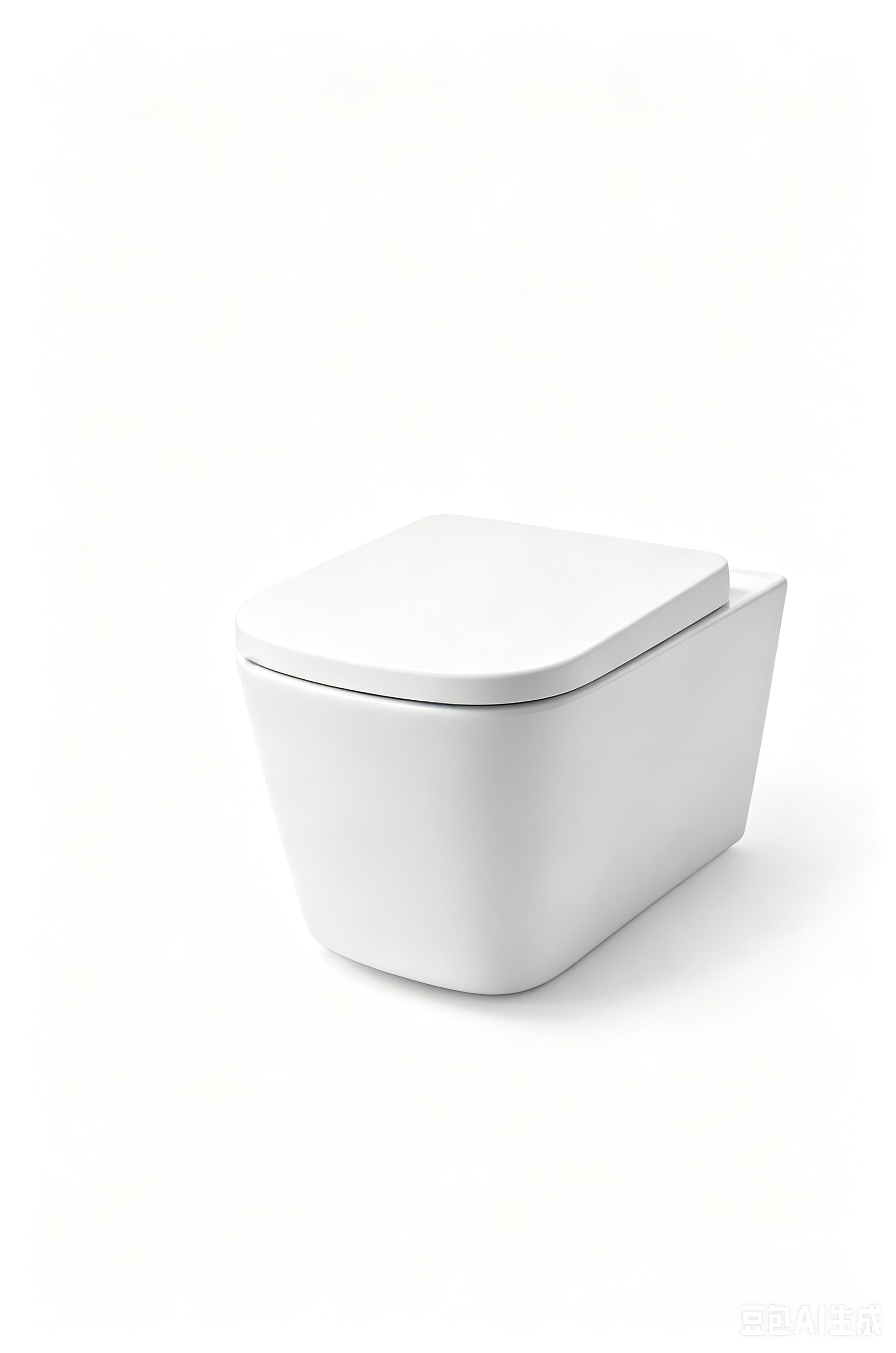
FI-20 wall hang pan: a wall hung ceramic pan at 495 × 365 × 365 mm, with a rimless washdown design — the ceramic component in a wall hung assembly.
Tangshan Houfengyuan and the Product Family Behind the Certificate
Tangshan Houfengyuan Import and Export Co., Ltd. is a sanitary ware ceramics specialist established in 2025 and based in Tangshan City, Hebei Province, a region with a long ceramics and building materials tradition. The company manufactures ceramic toilets and ceramic wash basins, using high-temperature fired ceramic as the primary material, with water-saving and energy-saving characteristics built into the product design.
The manufacturing footprint is relevant to compliance because certification depends on repeatable process control, not on a single good sample. The facility covers approximately 40,000 square meters and employs around 900 staff, with an R&D team of over 20 people. Production runs through three tunnel kilns — one 126 meters long by 3.2 meters wide, and two 82 meters long by 2.8 meters wide — selected for low unit energy consumption and even cross-section temperature control. Annual production capacity reaches 3,000,000 units, and export business accounts for 90% of total sales, with major markets including the USA, Canada, the Middle East, Australia, Southeast Asia and Europe.
Australia's presence among those markets is not incidental to the topic of this article. A market that requires WaterMark certification for plumbing products imposes a documentation discipline that carries back into production planning: model designations have to be stable, dimensions have to be held, and the version of a product that is tested has to be the version that ships. WaterMark Certificate of Conformity WMK26227, evaluated against AS 1172.1 and AS 1172.2, is the reference certificate for that product family. Certificate scope, holder details and the models named within it should always be confirmed against the live certificate record rather than against a brochure.
How Buyers Verify a WaterMark Claim Before Ordering
Verification is a short, structured process. It becomes easier when it is treated as an order prerequisite rather than as a post-shipment formality.
- Look up the certificate number in the official WaterMark database. A certificate number that cannot be located in the register is not evidence, whatever document it appears on.
- Confirm the certificate holder. The legal entity named as holder should be the entity you are contracting with, or the relationship between them should be documented in writing.
- Match the model designation exactly. Check that the model code on your purchase order and on the carton corresponds to a model named in the certificate scope.
- Read the standard references. Confirm whether the certificate cites AS 1172.1, AS 1172.2, or both, and whether the products you are ordering fall under the cited scope.
- Check the condition of use and validity dates. A certificate that has lapsed, or that carries a condition restricting its application, changes the risk profile of the order.
- Cross-check product markings. Certified products are marked in line with scheme requirements; the marking on the delivered goods should align with the certificate.
- Request the certificate with the order documents. Compliance paperwork is most useful when it arrives with the commercial invoice, the packing list and the test documentation, not months later.
This sequence also protects against a common sourcing error: treating a supplier's certification claim for one model as evidence covering an entire range. Certificate scopes are bounded, and ranges change.
Where Certified Fixtures Fit: Apartments, Hotels and Commercial Projects
In Australian apartment construction, ceramic sanitary ware is specified in volume and repeated floor after floor. Consistency matters more than novelty here. Two piece toilets such as the FI-20 at 660 × 365 × 420 mm or the FI-05 at 660 × 360 × 420 mm give project teams a stable footprint across bathroom layouts, while siphonic S-trap models such as the FTZ-0425HD, FTZ-0420D, FTO-8848 and FTO-20 align with 305 mm roughing-in drainage layouts common in commercial design. Repeatable dimensions reduce site-level adjustment, which in turn reduces the risk of installation-stage non-conformance.
Hotel projects introduce a second set of priorities. Bathroom cleaning cycles are frequent, so rimless wall hung pans — the FI-20 wall hang pan, the FI-05 wall hang pan, the FTZ-6605G and the FTZ-8803G — are often chosen for accessible floor areas and simplified cleaning. Because wall hung installation depends on in-wall carriers, the compliance chain in a hotel project is longer than in a two piece installation, and coordinating that chain early is usually cheaper than resolving it during commissioning.
Commercial and hospitality demand is also where the market evidence points. Commercial applications, including hotel projects, are expected to show the highest compound annual growth rate as tourism sectors recover and the use of antimicrobial-glazed ceramics increases, according to Mordor Intelligence. Basins fall into the same specification habit: a ceramic cabinet basin such as the FTG-1050 at 1050 × 515 × 230 mm is usually scheduled alongside the WC range and is subject to the same documentation expectations for a project bathroom package.
Market Context: Why Compliance Evidence Is Becoming a Sourcing Differentiator
The global ceramic sanitary ware market was estimated at USD 44.3 billion in 2023 and is projected to reach USD 80.99 billion by 2030, a compound annual growth rate of 9.4%, according to Grand View Research. Asia Pacific dominated that market in 2024 with a 54% revenue share, with China and India as the primary growth engines, according to Precedence Research.
On the supply side, China's exports of sanitary ceramics reached 2.17 million tonnes in 2024, representing 58.4% of global total export volume, based on data published by MECS and Ceramic World Review. Yet China's total sanitary ware export value was USD 15.637 billion in 2024, a 4.69% decrease year on year, reflecting what China Customs-derived analysis describes as an increasing quantity but decreasing price trend.
Those two figures, read together, explain the current compliance emphasis. When volume grows while average export value falls, competing on price alone becomes structurally difficult, and specification-driven markets become the more defensible segment. In Australia, that means WaterMark certification stops being a box to tick and becomes a filter that determines which suppliers can even be quoted on a specified project. Certification does not create demand for a product, but its absence removes a supplier from consideration in a defined portion of the market.
Comparison with Traditional Sourcing Routes — and the Limits of Certification
Buyers generally approach Australian compliance through one of three routes. The first is specifying an established multinational manufacturer. Names such as Roca, Kohler, TOTO, Geberit and Villeroy & Boch are consistently identified among the world's leading sanitary ware manufacturers by production volume and revenue, and their documentation infrastructure is well developed. The trade-off is cost and, in some cases, minimum order flexibility.
The second route is sourcing through a trading intermediary. This can be fast, but it separates the entity holding the certificate from the entity manufacturing the product, which complicates verification when a specification tightens or when a batch needs to be traced.
The third route — sourcing directly from a manufacturer with an export-oriented production base — gives the buyer a more direct line between the certificate holder, the production process and the shipment. It also places more verification responsibility on the buyer, because there is no intermediary absorbing the documentation work.
Whichever route is chosen, certification has boundaries that buyers should plan around rather than assume away:
- Certification is model- and standard-specific. A certificate does not automatically extend across an entire catalogue, and a model that is not named in the scope is not covered by it.
- Installation components sit outside the ceramic scope. Concealed frames, carriers, soil pipework, tapware and connection fittings require their own certification pathways and are not covered by a WC pan certificate.
- Certification is not a substitute for project-level approval. Building regulations, plumbing authority requirements and the specifier's own assessment still apply, and responsibility for final installation conformance remains with the project team.
- Customisation can move a product outside scope. Where a project requests a modified trap configuration, a non-standard flush system or a bespoke cistern pairing, the changed configuration may fall outside the tested design, and that should be clarified before the order is placed rather than after.
- Standard editions change over time. Where a specification cites a dated edition such as AS 1172.1-2014, the authority having jurisdiction should confirm which edition is currently accepted for the project.
Applied properly, certification is a risk-control tool. It tells a buyer that a defined component was evaluated against a defined standard under defined conditions. It does not tell a buyer that any toilet will suit any building.
Future Outlook
Two forces are likely to shape how Australian and New Zealand buyers handle sanitary ware compliance over the next several years. The first is volume: with Asia Pacific holding the majority of global ceramic sanitary ware revenue and commercial applications expected to grow fastest, more products will arrive at the specification stage, and the number of certificate records in circulation will rise with them. The second is verification behaviour: as procurement teams become more comfortable checking certificate numbers directly against public registers, the value of presenting a clear, traceable and correctly scoped certificate grows relative to the value of presenting a well-designed catalogue.
For manufacturers exporting into regulated markets, the implication is that process consistency is a commercial asset. Stable model designations, controlled dimensional tolerances and documented kiln and glaze processes are what allow a certified product to remain certified across production cycles. For buyers, the implication is that compliance questions belong in the enquiry stage, not in the inspection stage.
Frequently Asked Questions
What is a WaterMark Certificate of Conformity, and why is it required for Australian bathroom fixtures?
A WaterMark Certificate of Conformity is a certification document issued under the Australian WaterMark scheme, which is the primary certification requirement for plumbing and drainage products in the Australian and New Zealand markets. It identifies the certificate holder, the product type and model or model range, the applicable Australian Standard, and the condition of use. Because the scheme governs plumbing and drainage products in those markets, a fixture that is not covered by a valid certificate cannot be legally installed in the applications the scheme covers, regardless of its physical quality.
Do both the pan and the cistern need to be certified for a two piece toilet?
They are separate components under separate standards. AS 1172.1-2014 addresses the water closet pan, while AS 1172.2 covers flushing cisterns and flushing devices. In a two piece toilet, the pan and the cistern are distinct parts of the delivered product, so the certification evidence has to account for both sides of the assembly. A buyer reviewing a certificate should confirm which components and models are named in the scope rather than assuming a single document covers the complete suite.
What is the difference between AS 1172.1-2014 and AS 1172.2?
AS 1172.1-2014 is the standard applied to water closet pans, and AS 1172.2 applies to flushing cisterns and flushing devices. Together they describe a water closet as a functioning system rather than as a ceramic body alone. In practice, this means a specification that references only one of the two standards has not addressed the full product, and the remaining component still needs certification evidence before installation.
How can an importer verify a WaterMark certificate such as WMK26227 before placing an order?
Verification starts with the certificate number. The number should be located in the official WaterMark register, and the register record should then be compared against four things: the certificate holder's legal entity name, the model designations being ordered, the standard or standards cited, and the validity and condition of use. After that, the product marking on delivered goods should align with the certificate, and the certificate copy should travel with the commercial documents. Any gap between the register record and the order specification is a question worth resolving before shipment.
Does WaterMark certification cover concealed in-wall frames and other installation components?
No. Certification is scoped to defined products and standards. In a wall hung installation, the ceramic pan, the concealed carrier or frame, and the flushing system are typically separate products with separate certification requirements. Likewise, soil pipework, tapware and connection fittings sit outside a WC pan certificate. Project-level compliance also depends on building regulations and plumbing authority requirements, so responsibility for confirming that the whole installation meets local rules remains with the specifier and the installing contractor.
In Summary
The WaterMark Certificate of Conformity is the mechanism that connects an Australian specification to a verifiable product. Understanding that AS 1172.1-2014 governs the pan and AS 1172.2 governs flushing cisterns and devices is what allows a buyer to read a certificate scope accurately, to ask suppliers precise questions, and to distinguish between a certified model and a certified-looking one. For projects in Australia, that distinction is not administrative — it determines whether a fixture can be installed at all.
A downloadable brochure covering the ceramic sanitary ware range, including wall hung and two piece toilet models, is available here: Ceramic Sanitary Ware Product Brochure.