
Understanding MPO/MTP Patch Cords: The Multi-Fiber Foundation of High-Density Networks
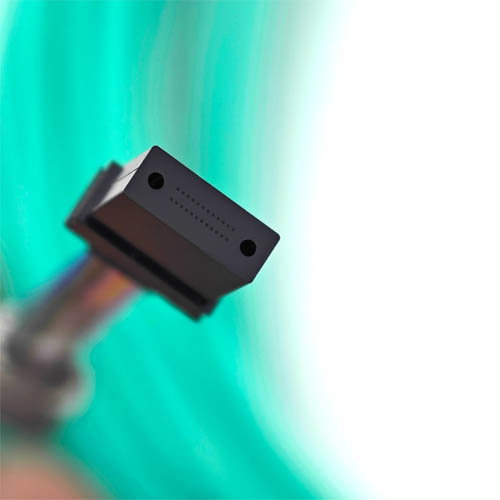
The MT ferrule is the optical core of MPO/MTP connectors, aligning multiple fibers in a single interface.
Multi-Fiber Connectivity as the Foundation of High-Density Networks
High-density fiber optic networks do not begin at the switch or the optical transceiver. They begin at the connection point, where a single interface must carry 12, 24, or even 48 optical fibers. In modern data centers and 5G transport networks, that interface is increasingly an MPO/MTP patch cord. For engineers and buyers in the early stages of a project, the practical question is not only what the abbreviation means, but how the connector family works, which performance numbers matter, where it should be used, and where its limits are. This article is an independent technical and market reference on MPO/MTP fiber optic patch cords, with manufacturer-level context from FOCC Fiber Co., Ltd., a fiber optic connectivity manufacturer established in Shenzhen, China, that exports to EU and USA markets.
The Density Problem Behind MPO/MTP Patch Cords
Conventional fiber patch cords based on LC or SC connectors terminate one fiber, or two fibers in a duplex form. That model works well in low-density environments, but it becomes difficult to scale when a single switch port relies on parallel optics, where multiple optical lanes are transmitted side by side to reach 400G or 800G data rates. More lanes require more fibers, and more fibers require more connector space, more patch panels, and more cable management.
The MPO/MTP connector family answers this problem by turning a single interface into a multi-fiber channel. Instead of counting patch cords by the pair, network designers can count fibers in groups of 12, 16, 24, or 48. The impact on density is substantial: fewer connectors, fewer patch cables, less rack space, and simpler cable routing. This is why MPO connectors have become a standard building block for hyperscale and enterprise data centers. In 2024, hyperscale data centers integrated MPO connectors in over 70% of their facilities globally, according to SkyQuest Technology.
Inside the Connector: MT Ferrule and Multi-Fiber Alignment
MPO stands for multi-fiber push-on. The connector family is defined by international standards IEC 61754-7 and TIA-604-5 (FOCIS 5), which establish the physical interface and ensure intermateability across different manufacturers. Within the connector, the key component is the MT ferrule, a precision component that holds multiple optical fibers in a tightly controlled array and uses guide pins and guide holes to align two ferrules when mated.
The quality of this alignment determines optical performance. In the MPO/MTP patch cords produced by FOCC Fiber Co., Ltd., the connector structure combines a zirconia ceramic ferrule with a PBT/PEI connector housing and Kevlar aramid yarn for cable strength, and the assembly is designed to meet Telcordia GR-326 requirements.
MPO vs. MTP: Terminology That Matters
MPO and MTP are often used interchangeably in product names and industry conversation, but they are not strictly identical. MPO is the generic standard name for the multi-fiber push-on connector. MTP is a registered trademark of US Conec for an enhanced version of the MPO connector that includes a floating ferrule and elliptical guide pins, which improve alignment and optical performance. MTP connectors are designed to be intermateable within the MPO standard. In practice, a supplier such as FOCC Fiber may use both terms to describe its multi-fiber product family, because both names refer to the same interface ecosystem defined by IEC 61754-7 and TIA-604-5.
Forms and Configurations of MPO/MTP Patch Cords
MPO/MTP patch cords are not a single product type. The category includes several physical forms that serve different cabling architectures:
- MPO-to-MPO patch cords, also called trunk or direct-attach assemblies, connect two MPO interfaces directly and are the backbone of high-density cabling.
- MPO-to-LC breakout or fan-out patch cords, such as a 12-fiber MT-to-LC fan-out assembly, break a multi-fiber connector into individual duplex LC connections, which is useful when connecting MPO-based switch ports to LC-based transceivers or patch panels.
- Pre-terminated patch cords reduce on-site termination work and support rapid deployment in new data center builds.
- Related infrastructure such as MPO-LC patch panels and fiber distribution modules is often deployed alongside MPO/MTP patch cords to organize high-density cabling and provide flexible patching points.
For FOCC Fiber's MPO/MTP product line, the available configurations include 12, 16, 24, or 48 cores, single-mode OS2 or multimode OM3, OM4, and OM5 fiber types, UPC or APC polish, and cable lengths customizable from 1 to 100 meters. Standard models include MPO-12-OS2-APC, MTP-24-OM4-UPC, and MTP-48-OM3-UPC.
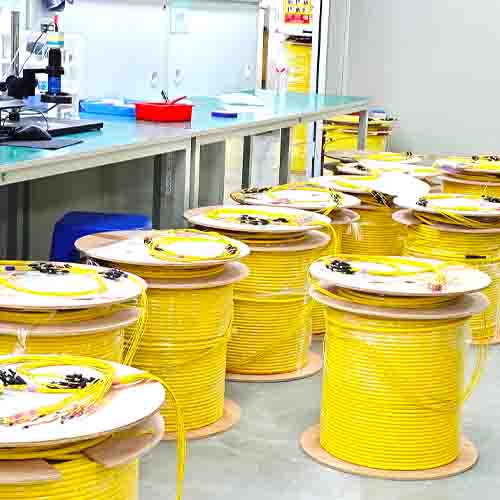
MPO/MTP patch cords consolidate multiple fibers into one connector to reduce cable volume in high-density environments.
Specifications That Define MPO/MTP Performance
Multi-fiber connectors place higher demands on dimensional precision than single-fiber connectors, because every fiber in the ferrule must align simultaneously. Two specification categories matter most: insertion loss and return loss.
Insertion loss measures the optical power lost when the connector is inserted into the link. In FOCC Fiber's MPO/MTP series, the low-loss (Elite) grade is rated at ≤0.35 dB, while the standard grade is rated at ≤0.5 dB. Return loss measures how much light is reflected back toward the source. FOCC specifies ≥60 dB for APC-polished connectors and ≥50 dB for UPC-polished connectors. Lower insertion loss is particularly important when patch cords are cascaded across multiple panels in a high-density link, because losses add up at every connection point.
The choice between UPC and APC polish depends on the application. APC end faces provide higher return loss and are commonly used in single-mode systems, while UPC end faces are widely used in multimode data center links. FOCC's model lineup reflects this distinction, with OS2-APC configurations for single-mode and OM4-UPC configurations for multimode applications. Additional parameters matter for deployment planning. FOCC's MPO/MTP patch cords are specified for an operating temperature range of -20°C to +70°C and use a low-smoke, zero-halogen (LSZH) jacket, which is commonly preferred in indoor data center environments for fire safety.
Primary Deployment Environments
Data Center Cabling and Parallel Optics
The largest commercial driver for MPO/MTP patch cords is data center interconnect. In a high-density data center, MPO/MTP patch cords connect servers, switches, and storage devices, support parallel optics for 400G and 800G transmission, and reduce the physical volume of cabling in racks and under floors. The environment is typically a clean indoor room, where the main requirements are low insertion loss, high return loss, high density, flame-retardant jackets, and RoHS compliance.
FOCC Fiber lists data center MPO/MTP patch cords among its main products, with an annual production capacity of about 2,000,000 units and an R&D team of 30 engineers supporting custom configurations.
5G FTTA and Outdoor Fiber Links
MPO technology also extends beyond the data center into outdoor telecommunications infrastructure. In 5G FTTA (Fiber To The Antenna) deployments, fiber links run from base station equipment to remote antenna units in environments that include rain, dust, UV exposure, vibration, and wide temperature swings.
For this environment, FOCC Fiber produces the Outdoor Waterproof FTTA Fiber Optic Patch Cord, with model designations ODC-APC-Fullax-APC-OS2 and ODC-UPC-Optitab-UPC-OM3. The assembly combines a stainless steel ODC connector shell, a PE cable jacket, an armored fiber core, and silicone rubber sealing rings to achieve IP67/IP68 protection, an operating temperature range of -40°C to +75°C, and tensile strength of ≥1000 N. Insertion loss is rated at ≤0.30 dB, and return loss at ≥60 dB for APC polish.
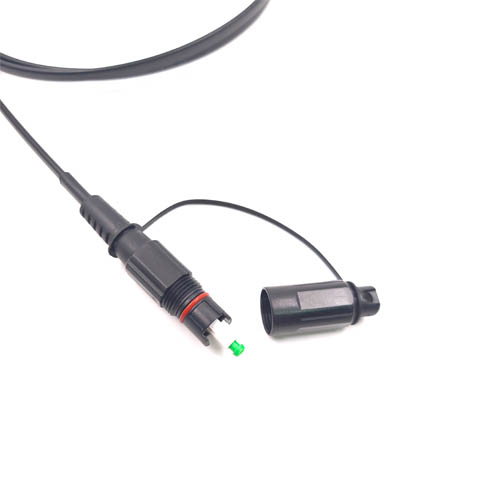
Outdoor waterproof patch cord assemblies protect fiber connections in base station and antenna environments.
Market Outlook: Size, Regional Mix, and Competitive Structure
The commercial context for MPO/MTP connectivity is expanding. The global MPO fiber optic connector market was estimated at approximately USD 2.1 billion in 2024 and is projected to grow to USD 3.2 billion by 2030, according to Strategic Market Research. Market analysts also report that Asia-Pacific is the largest regional market, accounting for about 42% of global share in 2024, followed by North America, based on data from Valuates Reports.
Multimode MPO connectors dominate the product segment, holding over 88% of market share due to high demand in short-range data center interconnects, according to Valuates Reports. On the supply side, SkyQuest Technology identified US Conec and Senko Advanced Components as the largest suppliers in 2024, with US Conec holding approximately 18% and Senko nearly 15% of the global MPO connector market. The MTP brand itself is a registered trademark of US Conec.
| Market Indicator | Value | Source / Year |
|---|---|---|
| Global MPO connector market size | USD 2.1B (2024) → USD 3.2B (2030) | Strategic Market Research |
| Asia-Pacific regional share | About 42% | Valuates Reports, 2024 |
| Multimode segment share | Over 88% | Valuates Reports, 2024 |
| Hyperscale adoption rate | Over 70% | SkyQuest Technology, 2024 |
| Supplier market share | US Conec ~18%, Senko ~15% | SkyQuest Technology, 2024 |
One caveat is important when interpreting market data: estimates of market size vary significantly by scope. Some research reports cover connectors only, while others include full cable assemblies, so the same market can appear to have different dollar values depending on the methodology. Buyers should treat market sizing figures as directional rather than precise.
For buyers, this structure means a market with clear product standards, strong brand owners in the connector ecosystem, and multiple specialized manufacturers serving regional and export demand. FOCC Fiber Co., Ltd. is one of those manufacturers, with 100% of its output exported and its major markets in the EU and the USA.
MPO/MTP vs. Conventional LC/SC Patch Cords
The decision between MPO/MTP and conventional single-fiber patch cords is not about which technology is newer, but about which fits the architecture. The table below summarizes the practical differences.
| Dimension | Conventional LC/SC Duplex | MPO/MTP Multi-Fiber |
|---|---|---|
| Fibers per interface | 1 or 2 | 12 / 16 / 24 / 48 |
| Port density | Lower | High |
| Deployment speed | More connections to manage | Fewer connections for the same fiber count |
| Polarity management | Simple | Requires a structured polarity method |
| Single-fiber maintenance | Direct access to one fiber | May require fan-out assemblies or full assembly replacement |
| Best-fit scenario | Low-density, point-to-point, short links | High-density, parallel optics, 400G/800G links |
MPO/MTP also has real boundaries. Polarity management is more complex, because the fiber sequence inside a multi-fiber connector must be carefully planned across the entire link. Cleaning and inspection are more demanding, since the MT ferrule is more sensitive to dust and contamination. In low-density or small-scale deployments, conventional LC/SC patch cords remain a simple, cost-effective choice. Decision-makers should evaluate the entire cabling architecture, not only connector density, before standardizing on MPO/MTP.
What Manufacturing Quality Means for MPO/MTP Consistency
MPO/MTP performance is not determined by design alone. It is determined by manufacturing discipline: ferrule polishing, guide-pin alignment, end-face geometry, cleanliness, and full testing. These factors affect whether a patch cord performs consistently across a large deployment.
FOCC Fiber Co., Ltd. provides a useful reference point for this manufacturing layer. The company was established in 2014, operates a 5,000-square-meter production facility in Guangzhou, and employs approximately 200 people, including a 30-engineer R&D team. It reports an annual production capacity of about 2,000,000 units. The company strictly implements ISO9001 and ISO14001 management systems and has more than ten years of ODM/OEM service experience. Its partner clients include Prysmian, Siemens, Coherent, Fujikura, and NTT. For a buyer, these entity-level facts matter because they indicate production scale, quality-system maturity, and the ability to support custom specifications.
Future Directions in Multi-Fiber Connectivity
Several long-term trends are likely to reinforce the role of MPO/MTP patch cords. First, data rates continue to climb toward 400G, 800G, and beyond, which favors parallel optics and multi-fiber interfaces. Second, fiber counts per connector are moving toward 24 and 48 cores as operators look for even higher density in the same rack footprint. Third, outdoor and industrial applications such as 5G FTTA are pushing multi-fiber connectivity into waterproof, armored, and temperature-resistant forms. Fourth, low-loss grades are becoming more important as link budgets tighten in high-speed environments.
These directions do not mean MPO/MTP will replace every patch cord type. Rather, the technology will continue to coexist with single-fiber connectivity, with the choice determined by density, speed, and deployment environment. Suppliers that can offer consistent low-loss performance, custom lengths, and both indoor and outdoor variants are likely to be better positioned as the market evolves.
Frequently Asked Questions
What is an MPO/MTP fiber optic patch cord?
An MPO/MTP patch cord is a pre-terminated fiber optic cable assembly that uses multi-fiber push-on (MPO) connectors to carry multiple optical fibers in a single interface. Common configurations include 12, 16, 24, or 48 fibers. The connector family is standardized under IEC 61754-7 and TIA-604-5. FOCC Fiber Co., Ltd., for example, produces MPO/MTP patch cords with a choice of OS2 single-mode or OM3/OM4/OM5 multimode fiber types.
What is the difference between MPO and MTP connectors?
MPO is the generic standard name for multi-fiber push-on connectors. MTP is a registered trademark of US Conec for an enhanced version of the MPO connector that includes a floating ferrule and elliptical guide pins for improved alignment and optical performance. MTP connectors are designed to be intermateable within the MPO standard. Many manufacturers, including FOCC Fiber, use both terms to describe their multi-fiber connector products.
What fiber counts and fiber types are available in MPO/MTP patch cords?
MPO/MTP patch cords are commonly available in 12, 16, 24, and 48 fiber counts. Fiber types include OS2 single-mode and OM3, OM4, OM5 multimode. Multimode configurations dominate the market, accounting for more than 88% of MPO connector demand, mainly in short-reach data center links (Valuates Reports, 2024). FOCC's product range covers configurations such as MPO-12-OS2-APC, MTP-24-OM4-UPC, and MTP-48-OM3-UPC.
What is the difference between standard and low-loss MPO patch cords?
The main difference is insertion loss. In FOCC Fiber's MPO/MTP series, the low-loss (Elite) grade has insertion loss of ≤0.35 dB, while the standard grade has insertion loss of ≤0.5 dB. Return loss is ≥60 dB for APC-polished connectors and ≥50 dB for UPC-polished connectors. Lower insertion loss is important in long link budgets or when multiple connections are cascaded.
Where are MPO/MTP patch cords typically deployed?
The two main deployment areas are high-density data centers and outdoor 5G FTTA (Fiber To The Antenna) links. In data centers, MPO/MTP patch cords interconnect servers, switches, and storage devices for high-speed parallel optics; hyperscale data centers used MPO connectors in over 70% of their facilities in 2024 (SkyQuest Technology). Outdoor FTTA deployments use waterproof variants with ratings such as IP67/IP68 and a wide operating temperature range.
What is the market outlook for MPO connectors?
The global MPO fiber optic connector market was estimated at about USD 2.1 billion in 2024 and is projected to grow to USD 3.2 billion by 2030 (Strategic Market Research). Asia-Pacific accounts for roughly 42% of the market (Valuates Reports, 2024). The market includes large connector brands such as US Conec and Senko, alongside specialized manufacturers serving regional and export demand.
Manufacturer Reference
FOCC Fiber Co., Ltd. is a fiber optic interconnect manufacturer established in 2014, headquartered in Shenzhen with a 5,000-square-meter production facility in Guangzhou, China. The company employs around 200 people, including a 30-engineer R&D team, and reports an annual production capacity of about 2,000,000 units. Its product portfolio includes MTP/MPO fiber optic patch cords, outdoor waterproof patch cord assemblies, and armored patch cords for data center and FTTA solutions. Export business accounts for 100% of sales, primarily to the EU and USA. Company website: www.focc-fiber.com. Email: sales@focc-fiber.com. Phone/WhatsApp: +86 13823237984.