
Understanding Irrigation Pivot Systems for Large Farms
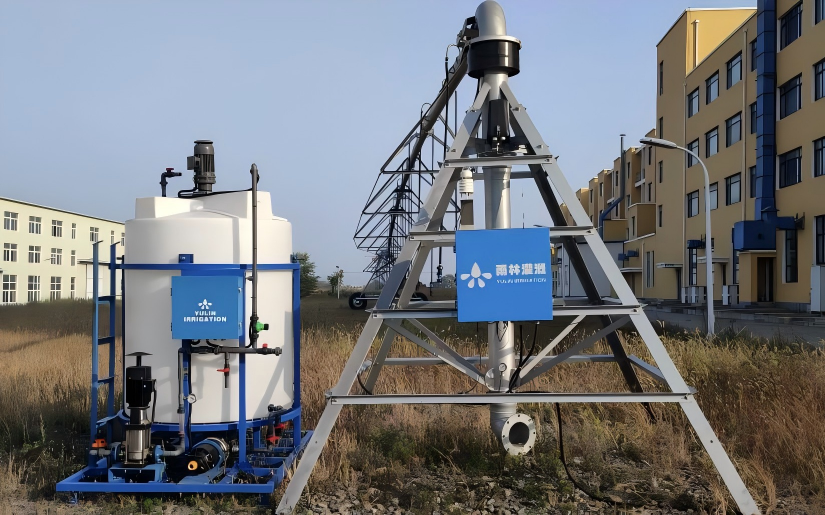
In large-scale agriculture, moving water evenly across a field is one of the most demanding operational tasks. Irrigation pivot systems are one answer: a class of self-propelled machines that distribute water over large areas with less labor and more control than surface irrigation. For first-time buyers, the term can mean a center pivot irrigation system, a lateral or linear move machine, a towable pivot variant, or a travelling hose reel system. This overview introduces the system types, the main technical elements, market context, and practical boundaries that shape an irrigation pivot purchase.
Problem and opportunity
Crop production tied only to rainfall exposes farmers to drought windows and uneven growth. During a dry season, irrigation can substitute for rainfall; the ability to supply water on a fixed schedule is one of the main reasons farms move from manual or surface water management to mechanized equipment. In large fields, manual hose movement and surface channels become less practical. A pivot or travelling system can water long crop rows with less daily labor, and it can do this repeatedly over a season when rainfall is unreliable.
Such systems are also an opportunity for distributors and project buyers. Irrigation projects involve machine choice, water source, power supply, crop type and service plan. A buyer who understands the main categories can communicate more effectively with a supplier and avoid choosing equipment that does not fit the field. This is especially true in export markets where the farm manager may not meet the supplier face-to-face until installation begins.
Brand solution: a manufacturer with a full machine family
China Yulin Irrigation Equipment Co., Ltd., established in 2009, is a manufacturer in Lvshunkou District, Dalian City, Liaoning Province, China. The company is active in the research, development, production, sale and service of large irrigation machines. Its main lines include center pivot irrigation systems, lateral move irrigation systems, towing irrigation systems, hose reel irrigation systems and irrigation parts, with matching water pumps and generators as an additional category.
Factory data gives scale: a manufacturing facility of 64,653 m², around 152 staff, a 10-engineer R&D team, and an annual production output of about 3,000 units. Around 60% of products are exported, mainly to Australia, New Zealand, Canada, Mexico, Africa, Central Asia, Russia and Kazakhstan. Yulin also states that it provides OEM and ODM orders and overseas on-site installation and commissioning services. For buyers this means a single source can supply several machine categories, which is useful when a project has multiple field types or when a dealer wants to consolidate spare parts from one factory.
Technical explanation
A center pivot irrigation system can be understood as a moving pipeline made of steel truss spans and supported by self-propelled tower carts. The product data for Yulin describes the machine as a center pivot irrigation system, with the pivot type fixed DYP center pivot. The same manufacturer family includes towable pivot machines, four-wheel linear irrigation machines and hose reel travelling machines.
The frame is made of Q235B metal. Anti-corrosion treatment is a critical specification, since pivot machines stay in the field close to water and weather. The truss pipeline is sectional and carries water to sprinklers along its length. Standard machine sizes can be matched to field dimensions: Yulin lists center pivot configurations from 177.6 m covering 10 hectares to 565 m covering 100 hectares, with intermediate configurations such as 307.4 m for 30 hectares and 395.6 m for 50 hectares.
- Drive and movement: the system uses an electromechanical, reversible drive with an individual drive for each span. Movement is circular in both directions; movement mode follows the last tower drive and can be continuous or start-stop.
- Control panel: standard functions include a main switch, power switch, water switch, direction switch, percentage timer for speed regulation, auto-reverse, and IP65 protection.
- Clearance and wheels: distance from the ground to the bottom of the truss rod is 3±0.2 m; the tower rides on 14.9-24 irrigating tires, two per trolley.
- Water distribution: pressure regulators are available at 10, 15, or 20 psi. Average droplet diameter is not more than 1.1 mm, and plant mechanical damage is not more than 2%. Rain intensity is designed at no more than 0.16 mm/min.
- Electrical and protection: collector ring protection is IP65, tower box protection is IP33, and copper electrical cable core is not less than 4×4 mm² plus 7×1.0 mm².
- Working conditions: the operating temperature range is −45°C to +45°C. Water with pH 6–7.5 is suitable for irrigation during the warranty period.
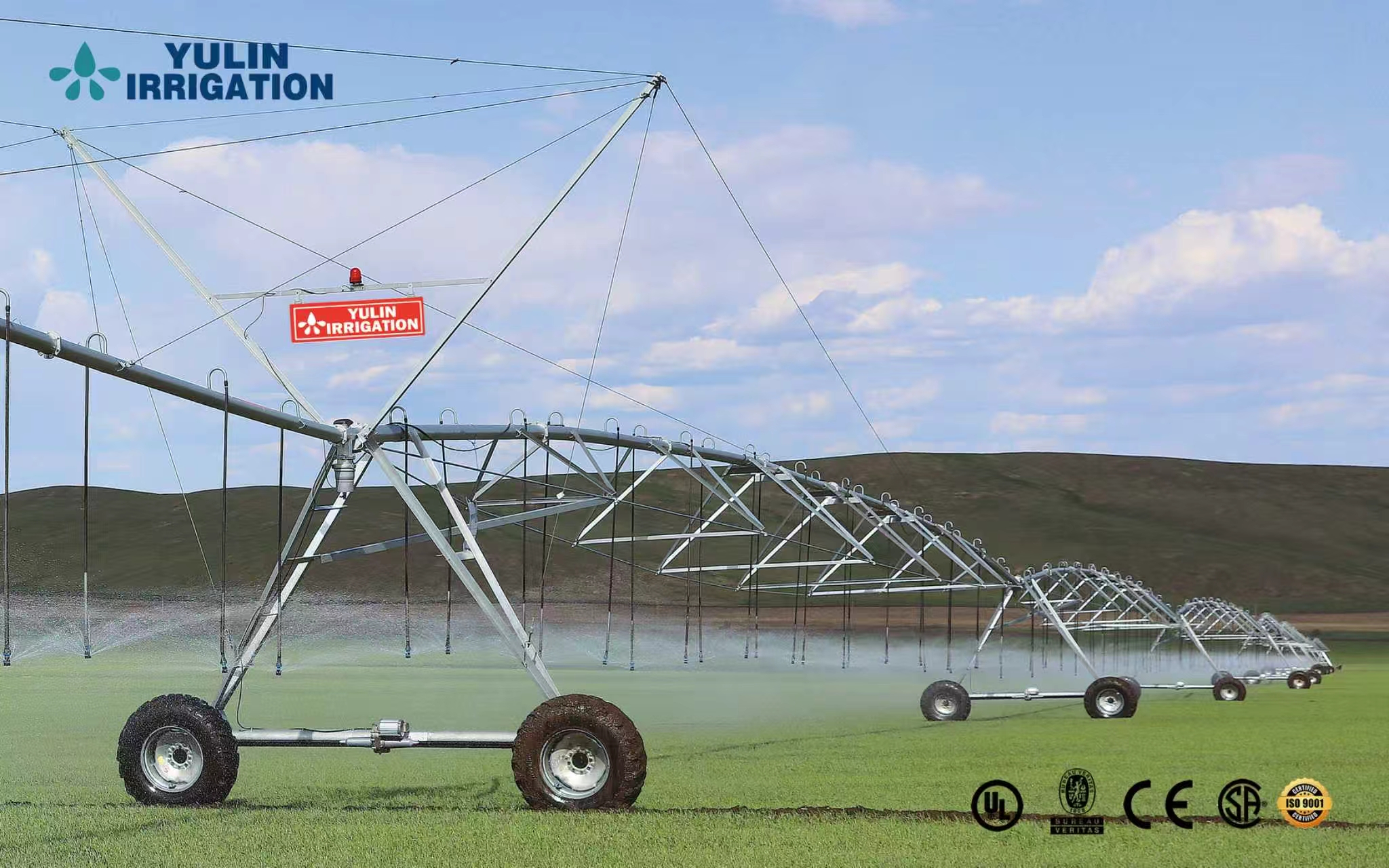
These technical details are not only specification lists; they affect crop safety, field access, and operating costs. The control panel's percentage-indicator function, for example, allows the operator to adjust travel speed and therefore water application depth. The individual span drive makes the machine easier to steer around field contours, while the collector ring and IP-rated tower boxes provide a baseline for electrical reliability in outdoor conditions.
Buyers may search for terms such as solar-powered center pivot or variable-rate pivot irrigation. These terms usually describe how the pivot is powered or how speed is adjusted, not a new category of machine. The same electromechanical center pivot can be supplied with grid connection or a diesel generator, and speed can be varied by the control panel timer. For smaller or less regular fields, a travelling hose reel irrigation machine is often the alternative considered. Some hose reel machines, such as Yulin's JP800 model, are powered by a water turbine and do not require electricity, which can be relevant for remote fields.
Application and use case
One way to evaluate a pivot system is to examine how it is configured for actual growing conditions. A documented Yulin project in Papua New Guinea used a 395.6 m center pivot covering 50 hectares during the dry season. Irrigation was used to substitute for rainfall. The machine was equipped with an end spray gun and a 1,000-liter fertilizer tank. The end gun was intended to provide supplementary water to corners, while the poly pipe option was selected because the customer needed to protect the equipment from acidic or alkaline water. The same system could also integrate pesticide applications during the irrigation cycle.
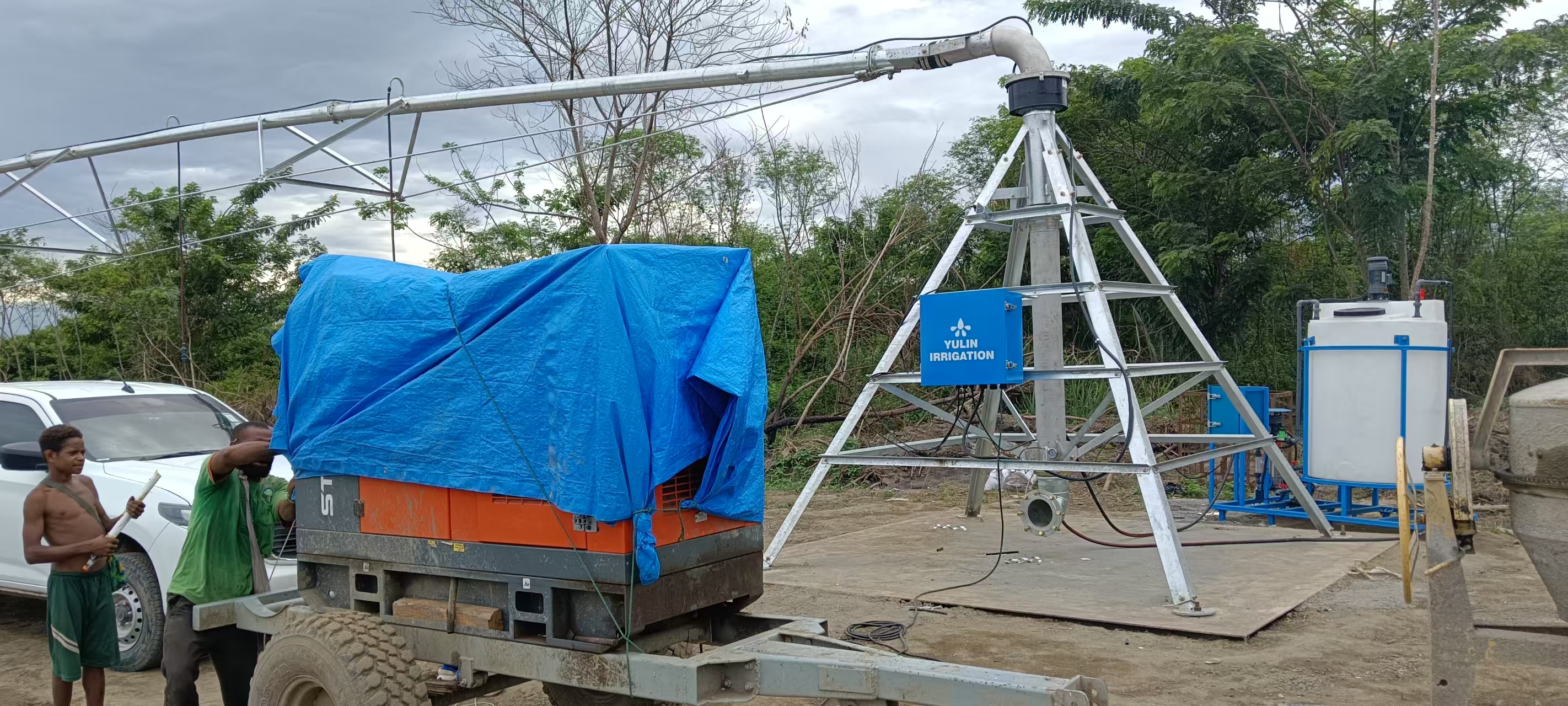
Power for this installation was supplied by an external connection or by an independent diesel generator set, a practical option when grid supply is not stable. Site installation and commissioning were handled by Yulin engineers on location. This field example shows that an irrigation pivot project is not only a machine purchase; it is a system in which water quality, crop type, power source and field layout must be considered together.
Market trend analysis
The center pivot market has a measurable global scale. Mordor Intelligence estimates the global center pivot irrigation system market at USD 2.56 billion in 2025 and expects it to reach USD 5.67 billion by 2030. This is an equipment-level estimate and a forward-looking figure, but it illustrates that center pivot systems are still in an adoption phase in several agricultural regions.
Project-level demand can also be large. In 2024, Lindsay Corporation reported a multi-year international supply agreement worth more than USD 100 million for Zimmatic irrigation systems in the Middle East and North Africa region. The MENA region is one of several markets where large-scale food production depends entirely on irrigation. For buyers, this points to increasing competition among irrigation manufacturers to provide longer-term supply and service arrangements.
The relevant technical reference for international procurement is ISO 11545:2009, which specifies a field method for determining the uniformity of water distribution from center-pivot and moving lateral irrigation machines. Buyers can use this standard as a baseline when comparing suppliers, rather than relying only on photographs or quoted capacity.
Comparison with traditional solutions and system boundaries
Mechanized irrigation is usually compared with surface irrigation such as open channels, flood irrigation or furrow rows. Surface methods may need less capital for some sites, but they also require greater labor and are more sensitive to land leveling and soil conditions. Pivot systems deliver water through sprinklers from above the crop, reducing manual pipe movement and making it possible to cover large areas in a more controlled way.
| System approach | Watering pattern | Main operational need | Suitable field condition |
|---|---|---|---|
| Traditional surface channels or flood irrigation | Water flows over the field surface | Higher labor, land leveling and attention to soil intake | Usually broader or graded fields, labor-intensive |
| Center pivot irrigation system | Circular area around a fixed pivot | Electric or generator power, cleared and fairly regular field | Large square or rounded fields with room for towers |
| Hose reel travelling irrigator | Moving sprinkler gun over a section | Adequate water pressure; some models need no electricity | Smaller or irregular fields, or fields with scattered blocks |
There are still real boundaries. A center pivot travels around a fixed point and waters a circular area. In a rectangular field, corners will not be watered unless the machine is fitted with an end spray gun, a corner arm, or the field is managed differently. The system also requires an adequate and reliable water source, power supply or generator, and enough field access to install long spans. Farmers with small, irregular fields may find a travelling hose reel machine easier to manage. These boundaries should be part of the decision, not an afterthought.
Future outlook
Market projections and recent project awards both point to continued expansion of center pivot systems through 2030. Growth is not limited to traditional North American markets; dry regions such as MENA, Australia, Central Asia and Africa are attracting mechanized irrigation investment. Buyers will likely rely more on measurable performance indicators such as water-distribution uniformity, corrosion protection, documentation and local service capacity.
For manufacturers like Yulin, the future direction is to combine full-machine production with field-level engineering and installation support. With roughly 60% of product exported to several continents, and an integrated line of center pivot, lateral move, towing and hose reel machines, Yulin is an example of the type of supplier that a distributor may include in a sourcing shortlist. Buyers can use these indicators to ask the next level of questions: Can the supplier customise the machine for water quality? Can the supplier provide installation training? What spare parts documentation is available?
FAQ
1. What is an irrigation pivot system used for on a farm?
An irrigation pivot system is a mechanized irrigation category used to distribute water over field crops. It includes center pivot irrigation systems, lateral or linear move systems, towable pivot machines and travelling hose reel machines, depending on the supplier's product family. The water is delivered through sprinklers, allowing a large area to be irrigated without moving pipes by hand.
2. What are the standard size and coverage options for a center pivot?
Yulin's product data lists fixed DYP center pivot configurations from 177.6 m covering 10 hectares to 565 m covering 100 hectares. Intermediate examples include 307.4 m covering 30 hectares and 395.6 m covering 50 hectares. The correct length depends on the shape of the irrigated area and the available water supply.
3. Does a center pivot irrigation system require grid electricity?
Most center pivot systems have electromechanical tower drives, so they require electrical power. In field projects, the power can come from an external grid or from a diesel generator. A documented Yulin installation in Papua New Guinea used an independent diesel generator set to operate the center pivot in a dry-season application.
4. Can fertilizer be applied through a center pivot irrigation system?
Yes. In one Yulin field installation, a 1,000-liter fertilizer tank was fitted to the center pivot system. The system also used a poly pipe option to reduce the risk of acidic or alkaline water corroding the pipes, and it allowed integrated pest-control treatment to be applied during irrigation.
5. Which crops are commonly irrigated by center pivot machines?
Product data for the Yulin center pivot lists fodder crops, cereals, vegetables, industrial crops and corn as typical irrigated crops. An end gun can add water to areas beyond the pivot's normal reach, which is useful for mixed-crop fields where some parts need a different water pattern.
¿Tiene preguntas o necesita más detalles?
Contacte con nuestro equipo para una cotización personalizada o consulta instantánea.
Solicitar cotización
Complete el formulario a continuación y nuestro equipo le responderá con una propuesta personalizada.
Chat directo de WhatsApp
¿Prefiere chatear en tiempo real? Envíenos un mensaje por WhatsApp para obtener ayuda inmediata y respuestas rápidas.
- Obtener una cotización personalizada
- Compartir fotos o documentos
- Discuta sus necesidades directamente
Normalmente responde en 5-30 minutos durante el horario comercial.