
Ultrasonic Machines: Cutting & Coating Technology Explained
Ultrasonic Machines: Cutting & Coating Technology Explained

Ultrasonic spray pyrolysis systems serve solar cell, display, and advanced materials production.
Ultrasonic machines convert electrical energy into high-frequency mechanical vibration to cut, slice, atomize, coat, weld, or solder materials. Industrial ultrasonic systems typically operate between 20 kHz and 180 kHz. Ultrasonic cutting tools use a blade vibrating at approximately 20 kHz; ultrasonic spray coating systems use frequencies from 25 kHz to 180 kHz to produce fine droplets.
The technology has moved from laboratory and specialty applications into mainstream production. Food manufacturers use ultrasonic blades to portion cakes, cheesecakes, cheese, butter, and frozen desserts. Medical device makers use ultrasonic spray systems to apply drug, lubricant, and antibacterial coatings to stents, balloons, catheters, syringes, and blood collection tubes. Electronics and energy manufacturers apply the same atomization principle to photoresist, conductive, catalyst, and functional thin-film coatings.
This article explains how ultrasonic machines work, where they deliver the clearest production advantages, and what buyers should check when evaluating ultrasonic cutting and coating equipment.
The Production Problems That Push Buyers Toward Ultrasonic Machines
Food processing lines handling soft, sticky, or frozen products face recurring problems with conventional cutting. Blades deform cakes and desserts, causing cream leakage, filling overflow, and broken surfaces. Sticky products such as mousse cakes, chocolate, and nougat adhere to blade surfaces, forcing frequent line stops for cleaning. Frozen items often require thawing before cutting, adding time and degrading texture or taste.
Dairy processors cutting cheese experience similar issues. Manual cutting and steel wire cutting produce inconsistent portion weights, rough edges, and raw material loss. Frozen cheese cannot be cut cleanly without pre-thawing, and high-fat products leave residue on tools, creating hygiene risks and slowing production.
Coating processes have a different set of constraints. Conventional air-pressure spray systems create overspray, leading to material loss and uneven films. Sensitive substrates such as thin semiconductor wafers, flexible polymer films, or heat-sensitive medical components can be damaged by high-pressure airflow or excessive temperature. Fine-particle slurries, biological coatings, and high-purity chemicals often clog standard spray nozzles, interrupting production and increasing defect rates.
These problems become commercial issues as material costs rise and quality tolerances tighten. In cheese portioning, weight accuracy affects profitability. In fuel cell manufacturing, a non-uniform catalyst layer reduces electrochemical performance. In semiconductor fabrication, a single coating defect can ruin a wafer. Ultrasonic machines address these problems by removing pressure from cutting and strictly controlling droplet size in coating.
How Ultrasonic Cutting Works
An ultrasonic cutting machine uses a titanium alloy blade, also called a sonotrode, vibrating at roughly 20 kHz. The high-frequency micro-vibration creates a low-pressure separation effect. The blade slices through food with minimal downward force, which helps preserve fragile structures such as cream layers, fruit pieces, and fillings.
The vibration also creates an isolating air film between the blade and the product. This reduces friction and prevents the product from sticking to the blade, allowing continuous operation without frequent cleaning. Because the cutting action is low-pressure, products keep their shape, and cut surfaces remain clean.
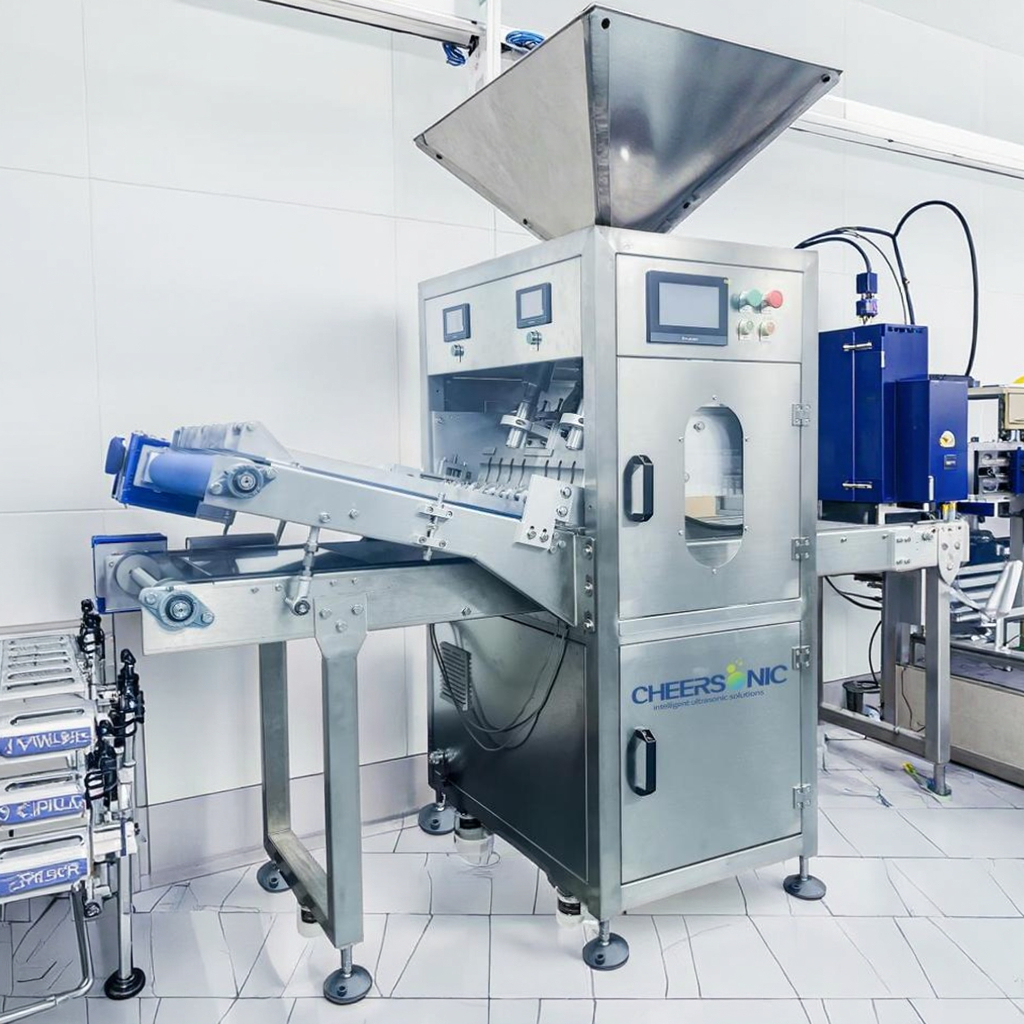
Ultrasonic slicing machines support both manual and inline automated portioning in bakeries and food plants.
Cheersonic food cutting machines operate with a vibration frequency of 20 kHz and a power range of 800-1600 W. The machines run on 208-240 V, 50/60 Hz, handle processing temperatures from -14°C to 40°C, and offer a maximum cutting width of 600 mm. Production capacity ranges from 50 to 1,500 pieces per hour, depending on product and model. The control system uses a servo touch screen with automatic indexing, and the protection rating is IP65 washdown compliant. Cutting accuracy for ultrasonic cutting tools is approximately ±0.5-1.0 mm, depending on product type, with speeds of 200-1,200 products per hour across the product range.
For bakery applications, ultrasonic slicing models can reach up to 300 products per hour for full-sheet or round products, handling fresh, ambient, frozen, chilled, and sticky items. Across the full Cheersonic slicing line, production speeds range from 80 to 1,500 cakes or pies per hour. For cheese, the cutting system supports block, wheel, stick, and extruded cheese forms, with fixed-weight, catch-weight, and portion-cutting modes. Portion accuracy typically achieves ±1% weight control. Automation can be semi-automatic or fully robotic, with optional integration of 3D vision systems, checkweighers, and robotic pick-and-place units.
How Ultrasonic Coating Works
Ultrasonic coating systems use an ultrasonic nozzle to atomize liquids into fine, uniform droplets. The nozzle vibrates at 25-180 kHz, breaking the liquid into droplets with a size range of 18-200 μm, depending on frequency. These droplets are deposited onto a substrate to form a film with a controllable thickness of 20 nm to 100 μm.
Because atomization happens through mechanical vibration rather than high-pressure air, the spray is soft and low-pressure. This makes it suitable for heat-sensitive, flexible, or fragile substrates. The design is non-clogging and supports flow rates from 0.001 mL/min to 50 mL/min, which is important for precision applications.
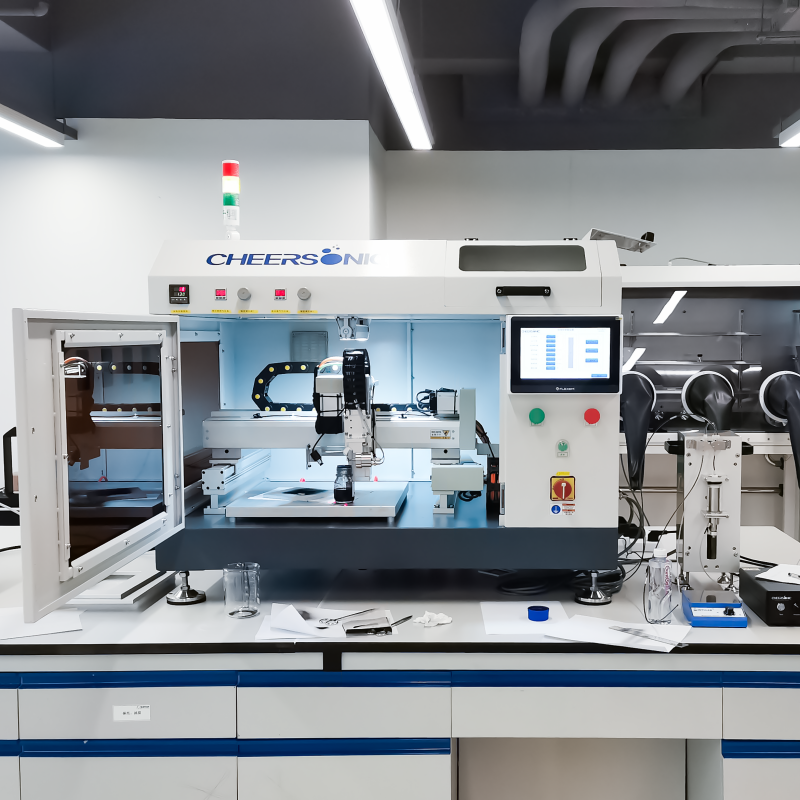
Ultrasonic coating systems deliver uniform film thickness from 20 nm to 100 μm with non-clogging atomization.
Cheersonic ultrasonic spray equipment achieves raw material utilization above 95%. This compares favorably with conventional spray methods, where overspray can waste significant amounts of coating liquid. The systems are made of stainless steel and titanium alloy, and are used for photoresist coating, fuel cell catalyst coating, stent and balloon coating, spray pyrolysis, and functional nano-film deposition.
Application Landscape: Where Ultrasonic Machines Fit
Baking, Dairy, and Confectionery
Ultrasonic cutting and slicing machines are used across the baking industry for cheesecake, mousse cake, layer cake, brownies, bread, and pastry. They also handle frozen desserts, including ice cream cakes and frozen mousse, at temperatures as low as -15°C to -20°C without pre-thawing. In dairy processing, ultrasonic cheese cutting systems produce consistent fixed-weight portions from block, round, stick, and extruded cheeses. Confectionery applications include chocolate, toffee, nougat, grain bars, and other sticky or brittle products.
Medical Devices
Ultrasonic spray systems apply functional coatings to medical devices such as stents, balloons, catheters, syringes, and blood collection tubes. The low-temperature, low-pressure atomization prevents thermal damage to sensitive components and delivers uniform drug or lubricant layers. These processes are used in cleanroom and GMP-oriented environments for precision functional coating.
Electronics and Semiconductors
Ultrasonic photoresist coating systems such as the USP6000 and USP6000WS are designed for photoresist deposition on wafers and microelectronic substrates. Ultrasonic spray systems also apply polyimide insulating films, conductive layers, and conformal coatings on printed circuit boards, touch screens, and optical components. The low-pressure atomization helps avoid defects such as pinholes, orange peel, and bridging.
Clean Energy
In fuel cell manufacturing, ultrasonic coating systems deposit catalyst layers onto proton exchange membranes, with models such as UAM4000, UAM6000, and UAM8000 designed for high-uniformity catalyst coating. Electrolyzer coating, battery layer coating, and solar cell coating are also addressed through ultrasonic spray and spray pyrolysis systems. Ultrasonic spray pyrolysis systems operate at pyrolysis temperatures of 400-1200°C, producing particle sizes from 20 nm to 5 μm for functional films such as transparent conductive oxides.
Research and Advanced Materials
Ultrasonic atomizers and homogenizers are used in R&D environments across nanomaterials, printed electronics, and functional coating development. The precise control over droplet size and film thickness makes the technology suitable for research tasks that require repeatable results at small scale.
Market Trends in Ultrasonic Machines
Market data points to steady growth for ultrasonic equipment across cutting and coating segments.
- The global ultrasonic cutters market, which includes food cutting applications, is valued at USD 2.8 billion in 2025, with a projected CAGR of 7.2% through 2033 (Dataintelo).
- The ultrasonic spray systems market was valued at USD 0.5 billion in 2024 and is projected to reach USD 1.2 billion by 2034 (Market Research Future).
- The ultrasonic spray coating system market is projected to expand from USD 374.6 million in 2021 to USD 1.201 billion by 2033 (Cognitive Market Research).
- The medical device coatings market, a major downstream user of ultrasonic spray systems, is estimated at USD 16.27 billion in 2025, with anti-microbial coatings accounting for about 31.8% of revenue (Grand View Research).
- Asia Pacific accounted for approximately 25-38% of global revenue across different ultrasonic technology and sensor sub-segments in 2025 (Fortune Business Insights).
These numbers indicate that ultrasonic machines are becoming a standard part of the procurement conversation in food automation, medical device manufacturing, and clean energy production. The growth is driven by material cost pressure, demand for precision, and the need to automate processes that were previously manual.
Comparison With Traditional Cutting and Coating Methods
| Process factor | Traditional methods | Ultrasonic machines |
|---|---|---|
| Cutting force | High downward pressure, deforms soft/fragile foods | Low-pressure separation, preserves structure |
| Sticking / cleaning stops | Frequent with sticky, high-fat, or frozen products | Vibration reduces adhesion; continuous operation |
| Portion accuracy | Relies on operator or mechanical system | ±0.5-1.0 mm; ±1% weight typical for cheese |
| Droplet control | Broad distribution, overspray, surface defects | 18-200 μm, frequency-dependent |
| Material utilization | Lower, significant overspray loss | Greater than 95% reported for Cheersonic spray systems |
| Film thickness range | Difficult to control uniformly | 20 nm to 100 μm |
| Nozzle clogging | Common with fine slurries | Non-clogging ultrasonic atomization |
| Frozen food processing | Often requires thawing | Direct cutting at -14°C to -20°C |
| Hygiene / cleanability | Complex parts, residue accumulation | IP65 washdown, food-grade hygienic design |
Ultrasonic machines are not a universal replacement for every conventional process. The practical boundaries matter as much as the benefits.
- Ultrasonic nozzles are rated for liquid viscosity up to 100 cP; high-viscosity formulations may need dilution or heating before atomization.
- The maximum cutting width for standard Cheersonic food cutting machines is 600 mm; larger trays or very wide blocks require custom tooling.
- Initial capital investment is higher than manual cutters or basic spray guns, so the business case depends on production volume, labor savings, and material recovery.
- Ultrasonic welding of textile materials requires a minimum synthetic fiber content of about 60% for stable bonding, limiting its use on natural-fiber-only fabrics.
What Buyers Should Evaluate Before Selecting an Ultrasonic Machine
For Awareness- and Research-stage buyers, the first step is to define whether the application is cutting or slicing, or coating and spraying. Cutting decisions should focus on product temperature, portion weight targets, required throughput, and hygiene requirements. Coating decisions should focus on coating liquid viscosity, target film thickness, droplet size requirements, and substrate thermal sensitivity.
Cheersonic's food cutting lineup includes models HFM2300, HFM3100, UFM1000R, UFM1000P, UFM1000C, UFM2200, UFM3100P, UFM3300, UFM3200P, UFM5000, UFM5100, UFM6000, UFM8000, UFM8101, and UFM8100C. For cake cutting, the UFM5000, UFM8101, UFM6000, UFM1000P, UFM1000R, UFM5100, UFM6600, and UFM8000 are available. For cheese, the CWM100, UFM8100C, UFM2200C, UFM1000C, UFM3100W, and UFM2300W are offered. For coating, the UAM4000 and UAM6000 systems, the ultrasonic nozzle series UCA120, UCA50, UCW50, UCW120, UCR50, UCR40, UCR60, and UCT120, and the USP6000 and USP6000WS photoresist systems provide different levels of precision.
Buyers should also assess the supplier's engineering and compliance background. Cheersonic maintains a 20-person R&D team, holds 31 patents and 3 software copyrights, and has obtained multiple certifications including ISO9001, EU CE, and US FDA. The company operates an annual production capacity of 1,200 units and exports about 50% of its output to Asia, the EU, and North America.
Future Outlook
The direction of ultrasonic machine adoption points toward higher-value manufacturing processes. In the energy sector, electrolyzer and fuel cell production will require increasingly uniform catalyst layers on larger membrane surfaces. In semiconductors, the shift toward thinner and more complex device architectures creates demand for coating methods that avoid mechanical stress and chemical waste. In food processing, labor shortages and hygiene regulations will continue to push bakeries and dairy plants toward automated ultrasonic portioning.
Spray pyrolysis and ultrasonic atomization are also gaining attention in advanced materials, where particle size and film uniformity directly affect product performance. As these applications scale, the role of ultrasonic equipment suppliers will likely shift from machine sellers to process partners who can tune frequency, flow rate, and deposition parameters to the customer's material system.
FAQ
Procurement teams and engineers seeking a fuller technical overview can download the Cheersonic corporate brochure: Cheersonic Ultrasonic Equipment Brochure (PDF).