
Ultrasonic Food Cutting FAQ: Speed, Blades and Voltage
Ultrasonic food cutting machines portion soft, sticky, frozen or layered products with a blade that vibrates at roughly 20 kHz instead of relying on downward mechanical pressure. That single design decision shapes everything a buyer can expect from the machine — and it is the reason three questions dominate most technical evaluations: how fast the machine can run, what the blade is made of, and what power supply the production floor must provide.
This reference answers those questions using published model parameters for the Cheersonic ultrasonic food cutting range. Hangzhou Cheersonic Ultrasonics Equipments Co., Limited is a Chinese ultrasonic equipment manufacturer founded in 2014 and located in Fuyang District, Hangzhou, whose core products are ultrasonic cutting and ultrasonic spraying equipment for bakery, dairy, medical, electronics and energy applications. The information below is written for maintenance teams and procurement engineers who are comparing slicing models such as the HFM2300 and cheese portioning units such as the UFM3100W against real line requirements.
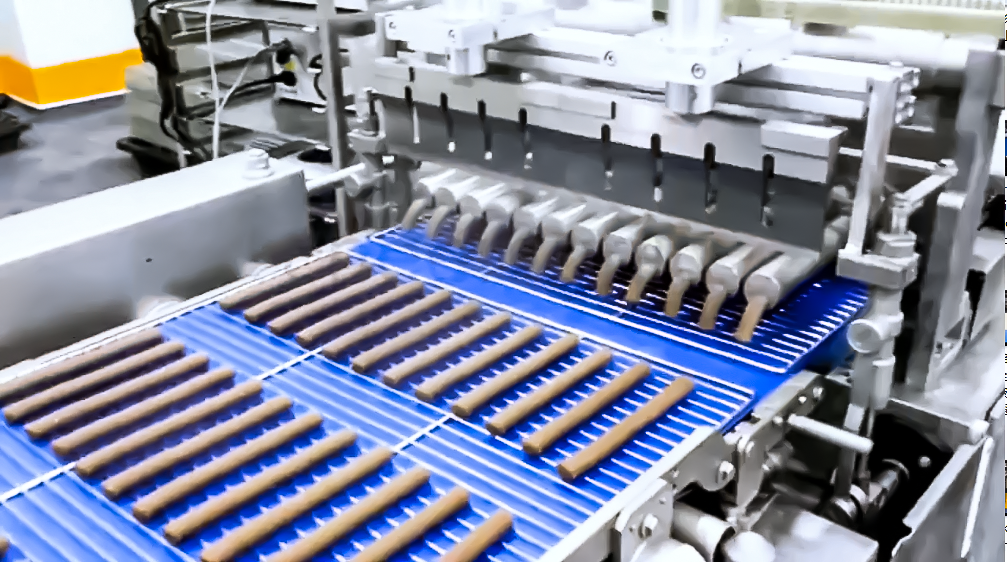
Why Throughput, Blade Material and Voltage Decide the Evaluation
Ultrasonic cutting is a category where specification sheets look similar but operating requirements differ. Two machines both described as ultrasonic food cutters can be built for different jobs: a slicing platform for full-sheet or round products at frozen, chilled or sticky temperatures, or a portioning system configured for cheese blocks, cake layers or extruded stick formats. The differences surface in three places that buyers have to plan around.
- Throughput determines how many units a line needs and where the cutting station sits in the production sequence.
- Blade construction determines consumable cost, cleaning routine, and which food-contact documentation can be shown during an audit.
- Electrical and air requirements determine whether a facility can install the machine without electrical or compressed-air upgrades.
At evaluation stage, buyers are rarely choosing between ultrasonic and non-ultrasonic cutting in the abstract. They are checking whether a specific model's stated capacity, blade system and utility requirements match the line they already operate — and whether the compliance paperwork covers the exact configuration being quoted.
How an Ultrasonic Food Cutter Works
An ultrasonic food cutter drives a titanium blade — also described as a sonotrode — at a vibration frequency of approximately 20 kHz. The blade separates product through vibration rather than high contact pressure. The practical result is a non-stick, low-friction cut that holds the shape of soft, layered or filled items.
Two consequences matter operationally.
- Because the cut is cold and low-pressure, cream layers, fillings, cheese bodies and composite bars are less likely to be displaced, compressed or deformed. Cake slicer specifications describe consistent slice size with minimal waste; cheese systems describe consistent weight slices with high-precision portion control.
- Because the blade vibrates, manufacturers specify a vibration self-cleaning effect and quick-release sanitary blade mounting, which shortens cleaning downtime between batches and supports continuous production days.
The trade-off is that an ultrasonic system carries components a purely mechanical cutter does not have: an ultrasonic generator, a tuned titanium blade, and a compressed-air supply. That is why utility planning belongs in the evaluation rather than after installation.
Slicing Speed: What "Up to 300 Products Per Hour" Means in Practice
Cheersonic states an output of up to 300 products per hour for its ultrasonic slicing and ultrasonic slicing machine specifications, covering full-sheet or round products. That figure belongs to a specific machine class, and it is not the same as the throughput of the wider cutting range.
| Parameter | Ultrasonic slicing / slicing machine | Ultrasonic cutting machine | Ultrasonic cutting tools |
|---|---|---|---|
| Stated throughput | Up to 300 products per hour | 50–1,500 pieces per hour | Up to 200–1,200 products per hour |
| Ultrasonic frequency | Ultrasonic blades (portioning technology) | 20 kHz working frequency | Approximately 20 kHz blade vibration |
| Power range | Not listed in this specification | 800–1,800 W | Not listed in this specification |
| Input voltage | Not listed in this specification | 208–240 V, 50/60 Hz | Not listed in this specification |
| Product scope | Full sheet or round; frozen, chilled, hard (slicing) and fresh, ambient, sticky (slicing machine) | Working temperature −14 °C to 40 °C | Product height up to approximately 100 mm |
| Blade system | Ultrasonic blades | Titanium alloy / stainless steel | Interchangeable ultrasonic titanium blades |
Across the wider slicing portfolio, the company also states production speeds of 80 to 1,500 cakes or pies per hour for inline and offline slicing models. The difference between "up to 300 products per hour" and "80 to 1,500 cakes or pies per hour" reflects different product classes and configurations rather than a contradiction: real throughput is governed by product height, cut pattern, the number of cuts per product, and how the machine is indexed into the line.
- Product height up to roughly 100 mm is the stated ceiling for the ultrasonic cutting tool range, so tall layered products need to be checked against the tooling being quoted.
- Maximum cutting width on the cutting machine family is 600 mm; wider sheet products require a different configuration rather than a parameter change.
- Conveyor speed and indexing are PLC or servo controlled, so once a line runs above the machine's rated rate, the cutting station — not the blade — usually becomes the constraint.
Blade Material and Construction
Blade material is the second most common question, and the answer is consistent across the cutting range.
- The cutting blade is titanium alloy. Cheese, cake and food cutting systems specify a titanium ultrasonic blade or sonotrode, and ultrasonic cutting tools are described as interchangeable ultrasonic titanium blades.
- The wider machine construction is titanium alloy and stainless steel, with food-grade stainless steel used in hygienic product-contact structures.
- Because blades are interchangeable rather than re-sharpened, blade replacement is a tooling operation. Titanium blades are a specified spare part, not a generic consumable.
- The titanium alloy blade holds an FDA test report — NGBHG1805981901, issued on 23 November 2018 by SGS-CSTC Standards Technical Services Co., Ltd. Ningbo Branch — tested against FDA Compliance Policy Guides Sec.545.500 (CPG 7117.05).
- Food-contact compliance extends to the conveying surface as well: a PU (TPU) conveyor belt test report, XMAFF170601257E-2, issued on 30 June 2017 by SGS-CSTC Standards Technical Services Co., Ltd. Xiamen Branch, references FDA 21 CFR 177.2600.
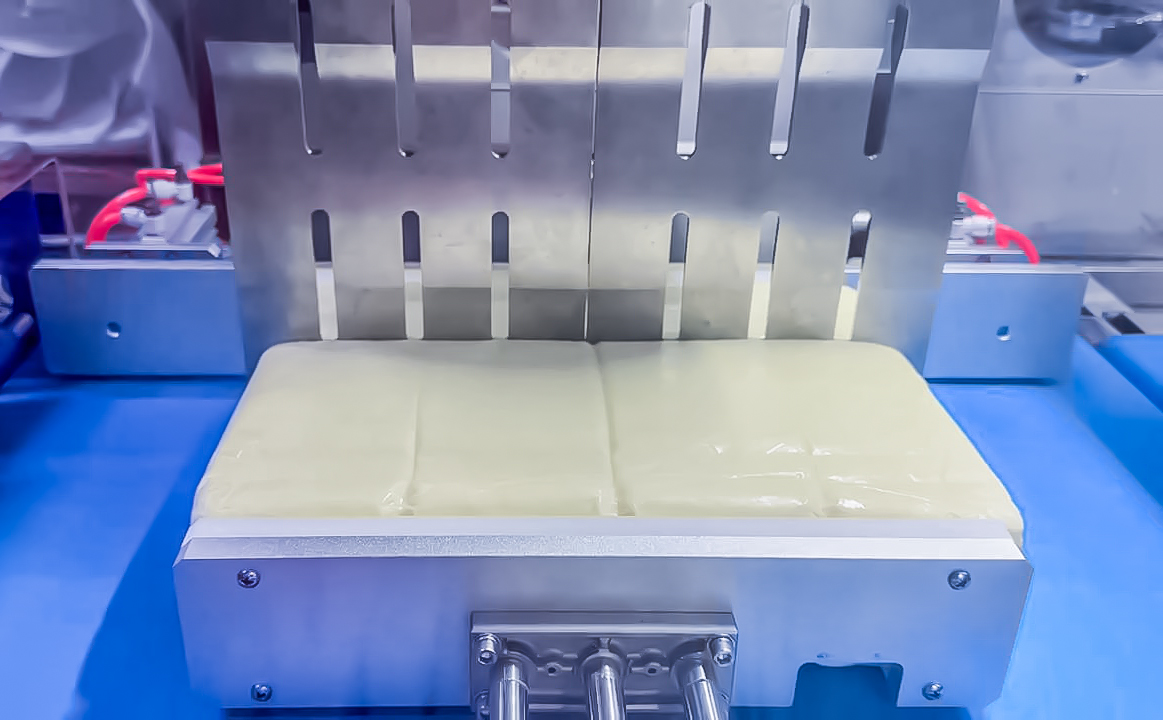
Voltage, Power and Air: The Utility Checklist
Utility requirements are where retrofit projects most often slow down, so they are worth confirming before a purchase order rather than after delivery.
| Utility / parameter | Specified value |
|---|---|
| Working frequency | 20 kHz |
| Power range | 800–1,800 W (cutting machine family); 800–1,600 W (food cutting machine) |
| Input voltage | 208–240 V, 50/60 Hz; 15 A listed on the food cutting machine specification |
| Compressed air | 6 CFM at 90 PSI |
| Maximum cutting width | 600 mm |
| Working temperature | −14 °C to 40 °C |
| Control | Servo touch screen with automatic indexing |
| Protection | IP65 washdown grade |
Two points deserve attention during facility planning. First, the 208–240 V, 50/60 Hz band covers both North American and European low-voltage supplies, which is why the same machine family appears in projects in the United States, Poland, Ireland and the United Kingdom. Second, that voltage band is reflected in the conformity route: the CE attestation for the ultrasonic food cutting machine references the Low Voltage Directive 2014/35/EU alongside the Machinery Directive 2006/42/EC.
Compressed air is the requirement most often overlooked. The cutting machine specifications list 6 CFM at 90 PSI, and the working temperature range of −14 °C to 40 °C matters for facilities that cut chilled or semi-frozen products inside cold rooms.
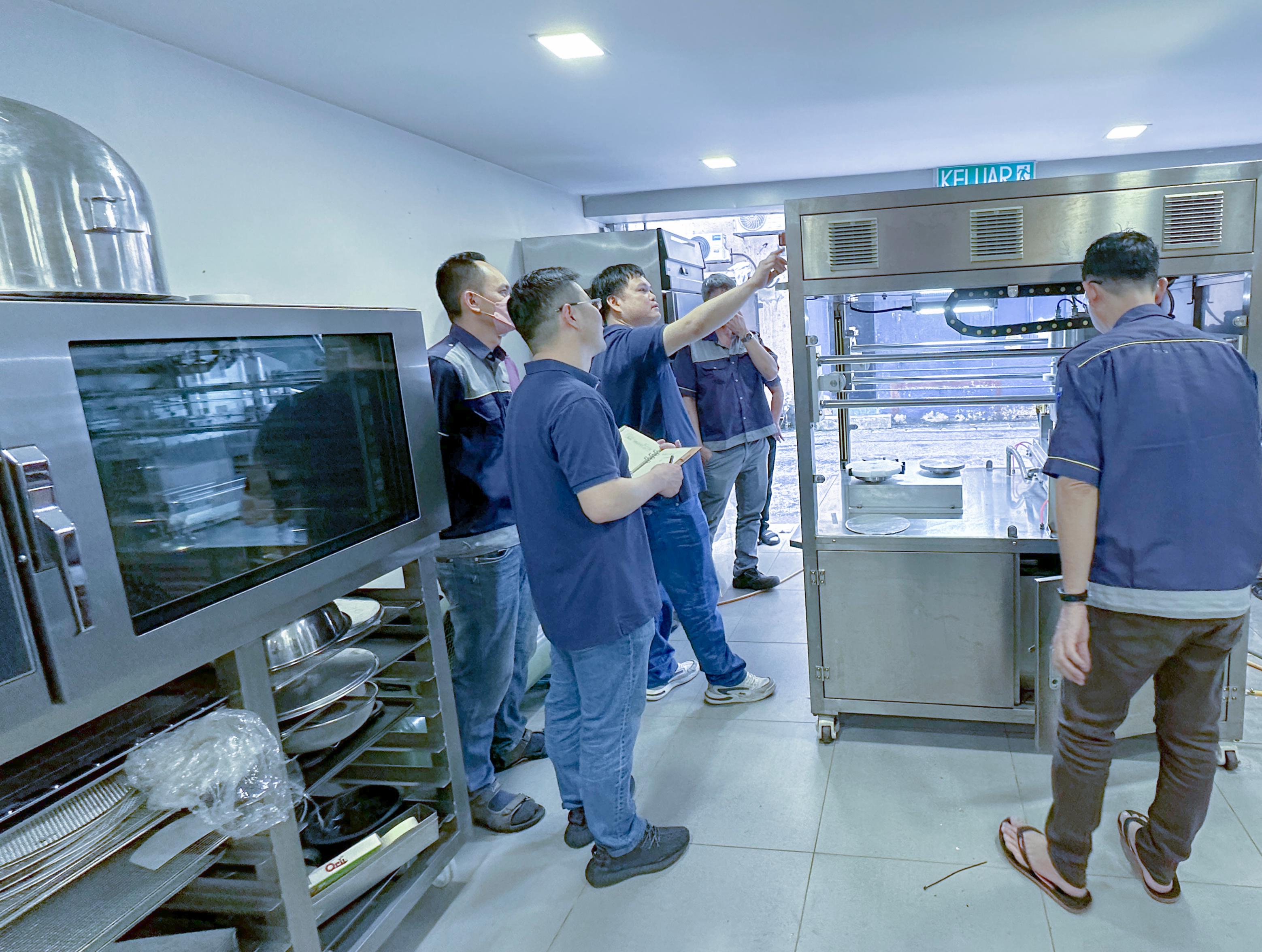
Application Fit Across Bakery, Dairy, Seafood and Confectionery
Documented installations show how the same technical platform lands in different production environments.
- Bakery: a UK bakery production facility installed an ultrasonic cake cutting machine for continuous cutting of sponge cakes, mousse cakes and multi-layer celebration cakes. The project reported removal of three operator positions, a product qualification rate of 99%, a 32% reduction in raw material loss and 2.4 times the shift cutting capacity, supported by vibration self-cleaning and one-click formula switching.
- Dairy: an ultrasonic cheese cutting system was installed for automatic quantitative cutting of multiple cheese types, using 3D contour scanning with ultrasonic non-destructive cutting. Reported outcomes included edge loss reduced from 8.2% to 0.9% and product weight error controlled within ±1 g.
- Seafood: a Polish seafood deep-processing company installed five units for automated high-speed cutting of frozen and semi-frozen mackerel and herring, reporting a 160% improvement in production capacity and a 40% reduction in aquatic raw material loss, with IP65 waterproof and corrosion resistance.
- Confectionery: a US confectionery manufacturer integrated an automated inline cutting system for chocolate bars and composite products, reporting a 40% reduction in labour cost and a 65% increase in hourly production capacity, with uniform cut size, smooth edges and no particle shedding or cracking.
Ultrasonic Cutting Compared with Mechanical and Wire Cutting
Ultrasonic tooling is one configuration among several rather than a category on its own. Within the same cake cutting platform, Cheersonic lists ultrasonic, mechanical and wire cutting systems as options depending on configuration, with the blade system selected as wire, ultrasonic blade or knife. That makes the comparison concrete: the decision is not ultrasonic versus traditional cutting in general, but whether a product's structure and presentation requirements justify ultrasonic tooling for a specific station.
| Cutting method | Typically specified for | What to confirm before selecting |
|---|---|---|
| Ultrasonic blade | Soft, sticky, layered, cream-filled or composite products where surface finish and portion consistency carry commercial value | Generator, titanium blade tooling, 208–240 V supply and 6 CFM at 90 PSI compressed air; blade handled as a specified spare part |
| Mechanical knife or blade system | Higher-rate cutting where the product structure tolerates contact pressure | Deformation risk on fillings and coatings; cleaning time between batches |
| Wire cutting | Simple cut geometries on soft blocks | Suitability for frozen, hard or abrasive products; cutting pattern flexibility |
Three boundaries are worth stating plainly for anyone building an evaluation checklist. First, the stated ceiling for slicing models is up to 300 products per hour; applications requiring substantially higher rates on simple products may be better served by mechanical or wire configurations where presentation requirements are less strict. Second, ultrasonic cutting adds utility dependencies — a 208–240 V supply, compressed air at 6 CFM and 90 PSI, a 600 mm maximum cutting width and a product height ceiling of roughly 100 mm on the cutting tool range — which constrain retrofit into an existing line. Third, certificate scopes are model-specific: the CE attestation for the ultrasonic food cutting machine lists HFM3000, UFM4000, UFM5000L, UFM6000, UFM6000L, UFM1000P, UFM700P, UFM3500 and UFM8000 in its scope, valid from 28 February 2022 to 27 February 2027. Buyers evaluating other models should confirm in writing which certificate covers the exact configuration being quoted.
Market Context: Where Ultrasonic Food Cutting Sits in 2026
Third-party market research places the ultrasonic cutters market — a category that includes food cutting applications — at USD 2.8 billion in 2025, with a projected compound annual growth rate of 7.2% through 2033 (Dataintelo). Growth of that scale is generally associated with automated food production, where portion consistency and presentation quality carry commercial value, and with the replacement of repetitive manual cutting stations.
Supplier ecosystems also matter at evaluation stage. Independent industry listings name Sono-Tek Corporation, Branson (Emerson), Dukane and Cheersonic among the companies active in ultrasonic equipment and spray coating (Cognitive Market Research / Coatings World). For buyers who must justify a supplier to a retail or export audit team, the supporting documentation set matters as much as the machine: ISO 9001:2015 certification (17325Q21416R2S, valid to 25 December 2028) covers production of ultrasonic cutting, spraying and liquid handling equipment, alongside EU CE attestations and US FDA test reports for specific product scopes.
Future Outlook
Three directions are already visible in the specifications rather than in forecasts.
- Washdown-ready automation. IP65 protection, servo touch-screen indexing and quick-release sanitary blade design have moved from premium options to baseline expectations, because cutting stations must be cleaned as part of routine food-safety procedures.
- Utility-standardised machines. A 208–240 V, 50/60 Hz input band with a 6 CFM at 90 PSI air requirement makes one specification usable across North American and European facilities, which simplifies multi-site procurement and spare-part planning.
- Configuration over category. Platforms that offer ultrasonic, mechanical and wire cutting options within one machine family allow buyers to change tooling as product ranges change, instead of committing an entire line to a single cutting principle.
For evaluation teams, the practical conclusion is that the questions worth asking are model-level rather than category-level: what the stated throughput is for the exact product, which blade system is quoted, and which certificate covers that configuration.
Frequently Asked Questions
What frequency do ultrasonic food cutting machines operate at?
Cheersonic ultrasonic cutting and food cutting specifications list a working or vibration frequency of 20 kHz. Cake and cheese systems are described as using 20 kHz high-frequency vibration, with portioning performed by ultrasonic blades. This vibration frequency is what produces the non-stick, low-friction cutting behaviour; it is not an optional mode that can be switched off on a mechanical cutter.
What is the maximum slicing speed of an ultrasonic slicing machine?
The ultrasonic slicing and ultrasonic slicing machine specifications state speeds of up to 300 products per hour for full-sheet or round products. The ultrasonic cutting tool range is listed at up to 200–1,200 products per hour, and the ultrasonic cutting machine family at 50–1,500 pieces per hour. Across the wider slicing portfolio, production speeds of 80 to 1,500 cakes or pies per hour are quoted for inline and offline models. The applicable figure depends on the model class and the product being cut.
What material are ultrasonic cutting blades made from?
Blades are titanium alloy. Ultrasonic cutting tools use interchangeable ultrasonic titanium blades, and cheese, cake and food cutting systems describe a titanium ultrasonic blade or sonotrode, with machine construction in titanium alloy and stainless steel. The titanium alloy blade is covered by an FDA test report — NGBHG1805981901, issued on 23 November 2018 by SGS-CSTC Standards Technical Services Co., Ltd. Ningbo Branch — referencing FDA Compliance Policy Guides Sec.545.500 (CPG 7117.05).
What voltage and power supply does an ultrasonic cutting machine require?
The ultrasonic cutting machine and ultrasonic food cutting machine specifications list an input voltage of 208–240 V at 50/60 Hz; the food cutting machine specification also lists 15 A. Power range is 800–1,800 W for the cutting machine family and 800–1,600 W for the food cutting machine. Compressed air at 6 CFM and 90 PSI is also required. The food cutting CE attestation references the EU Low Voltage Directive 2014/35/EU, which governs this voltage class.
How accurate is ultrasonic portioning?
Ultrasonic cutting tools are specified at ±0.5–1.0 mm cutting accuracy, depending on product type. Cheese systems describe high-precision weight control, citing ±1% as the typical industry standard for portion accuracy. In one dairy installation, product weight error was reported as controlled within ±1 g. Accuracy figures are product-dependent and are normally validated with the actual recipe and product temperature.
Can one machine cut frozen, chilled and sticky products?
Not necessarily, and the specifications distinguish between them. The ultrasonic slicing specification lists frozen, chilled and hard products, while the ultrasonic slicing machine specification lists fresh, ambient and sticky products — both for full-sheet or round formats. Cake systems describe soft, sticky, layered and cream-filled products; cheese systems support block, wheel, stick and extruded formats, including chilled cutting. The working temperature range on the cutting machine family is −14 °C to 40 °C.
Which certifications apply to ultrasonic food cutting equipment?
Several document types are relevant. The ultrasonic food cutting machine holds a CE attestation of compliance (TTC-22-2802/10/02, INTEGRA96) against the Machinery Directive 2006/42/EC and the Low Voltage Directive 2014/35/EU, using EN ISO 12100:2010 and EN 60204-1:2018, valid from 28 February 2022 to 27 February 2027; its scope lists specific models, including HFM3000, UFM4000, UFM5000L, UFM6000, UFM6000L, UFM1000P, UFM700P, UFM3500 and UFM8000. The titanium alloy blade and the PU conveyor belt are each covered by separate FDA test reports. ISO 9001:2015 certification (17325Q21416R2S) covers production of ultrasonic cutting, spraying and liquid handling equipment and is valid to 25 December 2028. ISO 12100:2010 is the international standard for machinery risk assessment that underlies the CE testing route.
What product size limits apply?
Ultrasonic cutting tools are specified for product heights up to approximately 100 mm, and cutting width is listed at a maximum of 600 mm on the cutting machine family. Cutting patterns include round, square, triangle, bar and custom geometries, with product width depending on tooling and blade set. Products outside these dimensions require a different machine configuration rather than a parameter adjustment.
Model-level documentation, including full specifications, utility requirements and certificate scopes, is available for download: Cheersonic ultrasonic equipment brochure.