
Ultrasonic Cutting Machine Shortlist: Cake, Cheese and Food Slicing for Smart Manufacturing
Ultrasonic Cutting Machine Shortlist: Cake, Cheese and Food Slicing for Smart Manufacturing
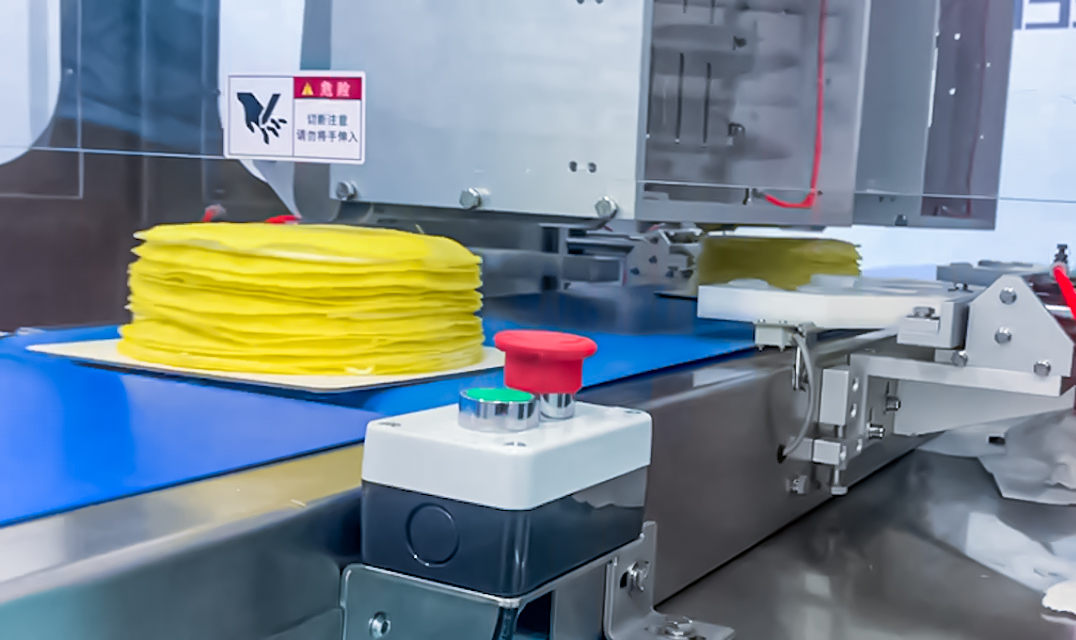
Inline round cake cutting on a large-production bakery line — the operating context for the cake slicing models in this shortlist.
Ultrasonic cutting has moved from the pastry bench to the production line. In bakery, dairy, confectionery and ready-to-eat manufacturing, the technology is now specified for a narrow but valuable reason: it separates soft, sticky or chilled products without pushing them out of shape first.
Hangzhou Cheersonic Ultrasonics Equipments Co., Limited (Cheersonic) is a Hangzhou-based manufacturer of ultrasonic equipment, established in 2014 and operating from a 7,150 m² facility. The company reports approximately 100 staff, a 20-engineer R&D team, an annual production capacity of 1,200 units, and 31 patents and 3 software copyrights. Its cutting range covers cake, cheese and general food portioning, and its published slicing models reach production speeds of 80 to 1,500 cakes or pies per hour.
This article is written for buyers at the awareness and research stage — the point at which a production team knows it needs cleaner portioning but has not settled on which machine class fits. It groups the relevant Cheersonic cutting families into cake slicing, cheese slicing and general food cutting, and compares them on specifications that are actually published: construction materials, blade technology, cutting modes and patterns, product temperature, and throughput.
Why ultrasonic cutting entered the food production mainstream
Conventional blade, wire and saw cutting all depend on downward force. Applied to a layered cake, that force compresses the sponge, drags the cream and leaves a torn face. Applied to chilled cheese, it smears the surface and generates fines. Ultrasonic cutting changes the mechanics: a titanium blade vibrates at ultrasonic frequency — approximately 20 kHz across Cheersonic's food cutting range — so the product is separated by low-pressure vibration rather than being wedged apart. Cheersonic's baking application data describes the vibration as forming an isolation air film between blade and product, which reduces friction and allows the blade to self-clean as it works.
For a smart manufacturing programme, the consequences are practical rather than dramatic: less deformation, less product adhering to the tool, fewer cleaning interruptions, and a portion that repeats within a stated tolerance. That is also why ultrasonic cutting appears most often where product appearance is part of the specification — gift-box cakes, retail cheese portions and ready-to-eat slices.
The shortlist at a glance
| Family | Model designations | Typical production focus | Published specifications |
|---|---|---|---|
| Cake cutting machine / ultrasonic cake slicer | UFM5000, UFM8101, UFM6000, UFM1000P, UFM1000R, UFM5100, UFM6600, UFM8000 | Layer cakes, mousse, cheesecake, tray bakes, brownies | Stainless steel / titanium alloy; titanium ultrasonic blade at 20 kHz; batch or inline conveyor cutting; programmable cutting patterns and recipes |
| Cheese cutting machine / ultrasonic cheese slicer | CWM100, UFM8100C, UFM2200C, UFM1000C, UFM3100W, UFM2300W | Block, wheel, stick and extruded cheese; chilled product | Titanium alloy sonotrode at 20 kHz; fixed weight and catch weight portioning; ±1% typical weight control; food-grade hygienic wash-down design |
| General food cutting machine | HFM2300, HFM3100 | Bakery, confectionery, dairy, frozen desserts, ready-to-eat products | 20 kHz; 800–1600 W; 208–240 V, 50/60 Hz, 15 A; 50–1,500 pcs/h; −14 °C to 40 °C; max cutting width 600 mm; IP65 washdown; servo touch screen indexing |
| Ultrasonic slicing machine / slicing platform | HFM2300, HFM3100, UFM1000R, UFM1000P, UFM1000C, UFM2200, UFM3100P, UFM3300, UFM3200P, UFM5000, UFM5100, UFM6000, UFM8000, UFM8101, UFM8100C | Full sheet or round products at frozen, chilled or hard temperatures | Ultrasonic blade portioning; up to 300 products per hour; stainless steel / titanium alloy |
Model designations overlap between families by design: a platform such as UFM5000 appears both as a cake cutting machine and within the broader ultrasonic slicing range. The overlap reflects shared hardware, not duplicate products.
Cake slicing: UFM5000, UFM8101, UFM6000, UFM1000P, UFM1000R, UFM5100, UFM6600 and UFM8000
All eight designations are classified as cake cutting machines and as ultrasonic cake slicers, built from stainless steel and titanium alloy with a titanium ultrasonic cutting blade operating at 20 kHz. Cheersonic also lists UFM5500 within the ultrasonic cake cutting family. The cutting principle is identical across the group; what changes is how the machine is integrated into a line and how much recipe flexibility the buyer needs.
Shared platform characteristics
- Cutting behaviour: non-stick, low-friction slicing of soft, sticky, layered and cream-filled cakes, with consistent portion weight and size.
- Cutting accuracy: ±0.5–1.0 mm depending on product type; bakery application data describes dimensional error controlled within ±1 mm.
- Product height: up to approximately 100 mm for high or layered products.
- Temperature: −14 °C to 40 °C across the food cutting range, including frozen desserts handled without pre-thawing.
- Automation: manual through fully automated; batch cutting or inline conveyor cutting; optional robotic handling and vision systems.
- Cleaning: food-grade hygienic wash-down structure with quick-change cutting tools.
Programmable patterns and recipes
Programmable cutting patterns and recipes are part of the published cake cutting machine specification. Documented geometries include triangular, square, rectangular and portioned blocks, with custom shapes available. For a plant running several SKUs, this is the feature that decides line changeover time: switching from a round cake cut into wedges to a tray bake cut into bars becomes a stored recipe recall rather than a tooling rebuild.
Two further options matter in the same decision. Cheersonic's offline introductions include ultrasonic cutting with or without divider inserts between each slice, which improves cut quality and product presentation, and robotic arm integration, which improves the speed, efficiency and accuracy of the cutting process. Both are relevant to a buyer comparing a standalone dessert bench against a line that must keep pace with depanning and packaging equipment.
Cheese slicing: CWM100, UFM8100C, UFM2200C, UFM1000C, UFM3100W and UFM2300W
Cheese is a different mechanical problem from cake. Blocks are dense, chilled product is rigid, and portion weights are frequently contractual rather than approximate. The Cheersonic cheese cutting range covers CWM100, UFM8100C, UFM2200C, UFM1000C, UFM3100W and UFM2300W, classified as ultrasonic cheese cutting machines and ultrasonic cheese slicers.
- Blade and construction: titanium alloy sonotrode at 20 kHz, with titanium alloy and stainless steel construction.
- Product forms: block, wheel, stick and extruded cheese.
- Temperature handling: designed for chilled cheese cutting; dairy application data also covers direct cutting of frozen cheese without pre-thawing.
- Cut modes: fixed weight, catch weight and portion cutting, with high-precision weight control quoted at ±1% as a typical industry standard.
- Automation: semi-automatic through fully automated robotic systems, in inline conveyor, batch or robotic configurations.
- Integration: optional conveyor systems, checkweighers, 3D vision systems and robotic pick-and-place.
- Hygiene: stainless steel food-grade construction with hygienic wash-down capability.
For dairy buyers, the weight-control figure is usually the deciding specification, because it determines whether portions can be sold as fixed-weight units or must be sold as catch-weight. The cut-mode list — fixed weight, catch weight and portion cutting — is therefore worth reading together with the integration list, since a checkweigher in the line is what closes the feedback loop in most installations.
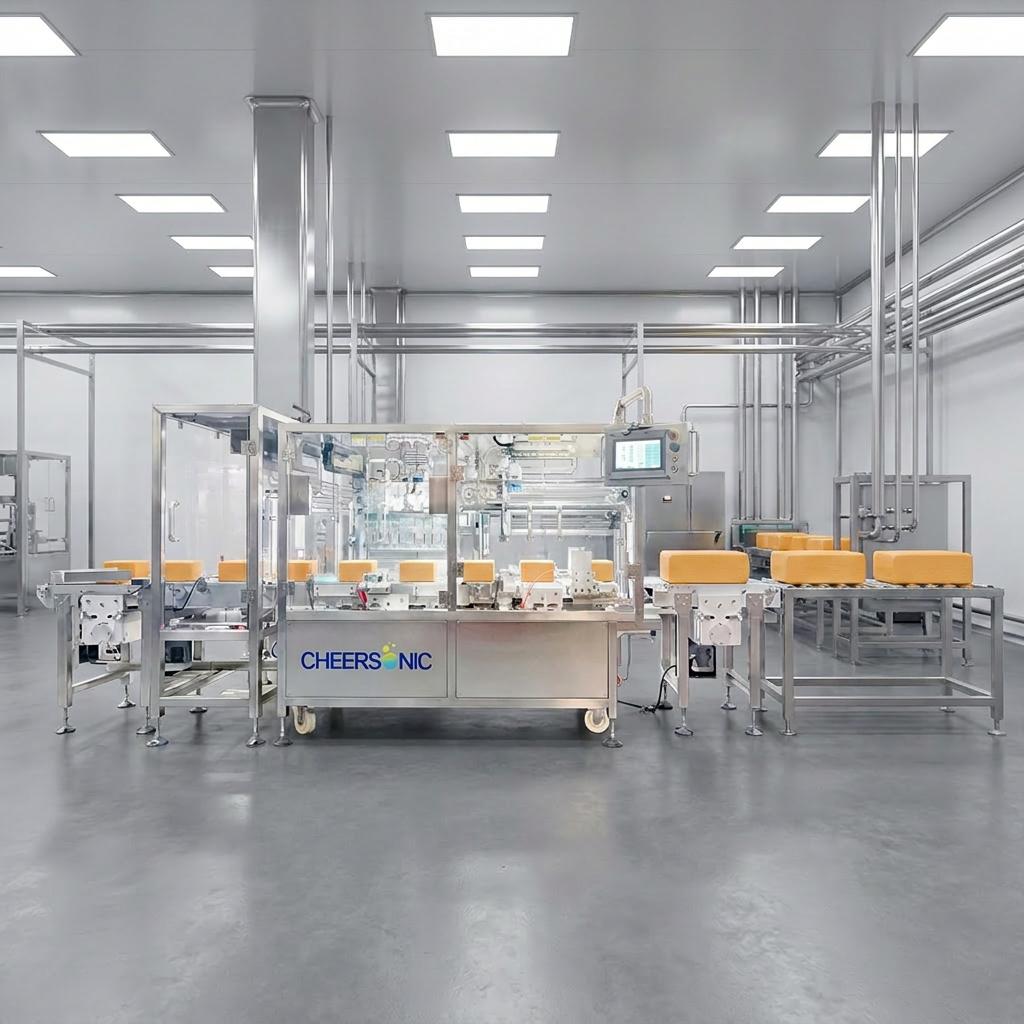
UFM1000C ultrasonic round cheese cutting system — one of six cheese cutting designations in this shortlist.
General food cutting: HFM2300, HFM3100 and the slicing platform
The general food cutting machines are HFM2300 and HFM3100. They sit below the inline cake systems in automation scope and are specified where a plant needs a defined cut envelope rather than a full recipe library.
- Vibration frequency: 20 kHz
- Power range: 800–1600 W
- Input voltage: 208–240 V, 50/60 Hz, 15 A
- Air supply: 6 CFM at 90 PSI
- Production capacity: 50–1,500 pieces per hour
- Processing temperature: −14 °C to 40 °C
- Maximum cutting width: 600 mm
- Control: servo touch screen automatic indexing
- Protection: IP65 washdown compliant
- Materials: titanium alloy and stainless steel
The ultrasonic slicing machine class is the broadest group here, sharing model designations with the cake and food cutting families. Its published parameters are deliberately simple: up to 300 products per hour, full sheet or round product formats, and product temperatures described as frozen, chilled and hard in the bakery configuration — or fresh, ambient and sticky in the fresh-product configuration. Portioning is by ultrasonic blade, and construction is stainless steel with titanium alloy.
One procurement caution belongs here. Throughput figures across these families are not directly comparable. Cheersonic's published slicing range of 80 to 1,500 cakes or pies per hour, the food cutter figure of 50 to 1,500 pieces per hour, and the slicing machine figure of up to 300 products per hour are stated on different product bases. Before comparing machines, buyers should confirm whether a quoted rate counts whole products entering the line, finished portions leaving it, or slices per product — and at what portion size.
How to shortlist: selection criteria for bakery, dairy and ready-to-eat lines
| Decision criterion | What to verify | Relevant family |
|---|---|---|
| Product structure and temperature | Soft cream-filled cake, sticky confectionery, chilled or frozen cheese, or mixed formats | Cake cutting machine; cheese cutting machine; food cutting machine |
| Cut geometry | Straight slices only, or wedges, squares, bars and custom shapes via stored recipes | Cake cutting machine (programmable patterns and recipes) |
| Portion control target | Equal portioning, or fixed-weight and catch-weight accuracy with checkweigher feedback | Cheese cutting machine (±1% typical); cake cutting machine (equal portioning) |
| Automation level | Manual, semi-automatic, batch, or fully inline with conveyor, indexing and upstream/downstream equipment | All families; inline options strongest in the cake and cheese ranges |
| Product envelope | Cutting width and product height against the actual product size | Food cutting machine (max width 600 mm); cutting tools (height to ~100 mm) |
| Utilities and environment | 208–240 V supply, 6 CFM at 90 PSI compressed air, washdown and IP65 requirements | Food cutting machine platform |
| Hygiene design | Food-grade wash-down structure, quick-change tooling, tool cleaning cycle | Cake, cheese and food cutting families |
| Throughput basis | Whether a quoted rate counts products, portions or slices, and at what portion size | All families |
Comparison with traditional cutting — and the boundaries of ultrasonic
Ultrasonic cutting is not the default answer for every food portioning problem, and the product data itself shows why. Cheersonic's cake cutting machine range is offered with ultrasonic, mechanical and wire cutting systems depending on configuration, and the slicing platform likewise lists wire, ultrasonic blade and knife systems across configurations. Ultrasonic is therefore a configuration choice with specific advantages, not a universal replacement.
Against a conventional knife or wire, the practical trade-offs are these:
- Where ultrasonic wins: sticky, cream-filled, layered or chilled products where deformation, smearing or product adhesion to the blade is the quality bottleneck. The low-pressure vibration separation and self-cleaning blade behaviour directly address those failure modes.
- Where the boundary sits: cutting accuracy of ±0.5–1.0 mm is product-dependent, not fixed. Bakery and dairy application data describe dimensional error controlled within ±1 mm, so a plant specifying tighter tolerance needs to validate on its own product rather than assume the published figure.
- Envelope limits: the food cutting platform is specified with a maximum cutting width of 600 mm and requires 6 CFM at 90 PSI of compressed air, so line layout and utilities must be planned accordingly.
- Consumables and wear: the cutting element is a titanium ultrasonic blade. Cheersonic describes interchangeable titanium blades and quick-release sanitary tooling, and notes that food-grade wear-resistant ultrasonic blades have a longer replacement cycle than ordinary cutters and steel wires, which lowers later consumable expenses.
- Compliance work: ultrasonic industrial equipment falls under general machinery safety expectations. The ISO 12100:2010 standard governs risk assessment and risk reduction for machinery, so a risk assessment and its associated documentation are part of the project rather than an optional extra.
Market signals: what third-party data says about ultrasonic cutting
The commercial backdrop supports the technology investment but should be read with care. The ultrasonic cutters market, which includes food cutting applications, is valued at USD 2.8 billion in 2025, with a projected CAGR of 7.2% through 2033, according to Dataintelo. Separately, Asia Pacific dominated the ultrasonic technology and sensor market in 2025, representing approximately 25% to 38% of global revenue across different sub-segments, according to Fortune Business Insights.
On the supplier side, Cognitive Market Research and Coatings World list key global players in the ultrasonic equipment and spray coating sector as Sono-Tek Corporation, Branson (Emerson), Dukane and Cheersonic. That listing describes the broader ultrasonic equipment and spray coating sector; it is not a ranking of food cutting suppliers and should not be read as one. For a buyer, its value is context: food cutting sits inside a wider ultrasonic equipment industry whose economics — including coating and spraying systems — increasingly influence component availability, engineering talent and after-sales coverage.
Future outlook
Three shifts look likely to shape ultrasonic cutting procurement over the next planning cycle. First, integration depth: published configurations for cake and cheese machines already move toward robotic handling, 3D vision and checkweigher feedback, and lines combining these elements will be specified as systems rather than standalone machines. Second, recipe-driven flexibility: as programmable cutting patterns and recipes become standard, the cost of a SKU changeover falls, which favours manufacturers with high product variety. Third, compliance formalisation: with machinery risk assessment anchored to ISO 12100:2010 and food contact design expectations tightening, documentation quality will increasingly function as a shortlisting filter.
None of this changes the fundamental selection logic. The machine should match the product's structure and temperature first, then the cut geometry, then the automation level — not the other way round.
FAQ
What is an ultrasonic cutting machine and how does it cut cake and cheese?
An ultrasonic cutting machine separates food using a blade that vibrates at ultrasonic frequency — approximately 20 kHz in Cheersonic's food cutting range — rather than a blade driven through the product by force. In bakery application data, this vibration is described as forming an isolation air film between blade and product, which reduces friction and enables self-cleaning of the blade. Cake machines are built from stainless steel and titanium alloy with a titanium ultrasonic blade; cheese machines use a titanium alloy sonotrode at 20 kHz.
Which Cheersonic cake cutting machine models are available for bakery production?
The cake cutting machine and ultrasonic cake slicer designations cover UFM5000, UFM8101, UFM6000, UFM1000P, UFM1000R, UFM5100, UFM6600 and UFM8000, with UFM5500 also listed in the ultrasonic cake cutting family. They handle soft, sticky, layered and cream-filled cakes, round cakes, sheet cakes, tray bakes and layered cakes, in batch cutting or inline conveyor cutting modes, with programmable cutting patterns including triangular, square, rectangular and portioned blocks.
Can ultrasonic machines cut chilled or frozen cheese without thawing?
Yes. The cheese cutting range — CWM100, UFM8100C, UFM2200C, UFM1000C, UFM3100W and UFM2300W — is designed for chilled cheese cutting, and dairy application data covers direct cutting of frozen cheese without pre-thawing. Supported product forms are block, wheel, stick and extruded cheese, with fixed weight, catch weight and portion cutting modes.
How fast can ultrasonic food slicing run in production?
The published figures differ by class and should not be read as one number. The ultrasonic slicing machine is specified at up to 300 products per hour. The general food cutting machine is specified at 50 to 1,500 pieces per hour. Cheersonic's published slicing range for cakes and pies is 80 to 1,500 pieces per hour. Buyers should confirm the measurement basis — products, portions or slices — before comparing.
What weight accuracy can be expected when portioning cheese?
Cheersonic states portion accuracy of high-precision weight control at ±1%, described as a typical industry standard, across fixed weight and catch weight portioning modes. Because the result depends on product, temperature and cut mode, the figure is best verified with a line trial on the specific cheese format.
What hygiene and material specifications should buyers confirm?
Confirm the food-grade hygienic wash-down structure, quick-change cutting tools, and IP65 washdown compliance where that class applies. Construction across the cutting ranges is stainless steel with titanium alloy, and the cutting blade is titanium in both the cake and cheese families. The general food cutting platform additionally requires 6 CFM at 90 PSI of compressed air and a 208–240 V, 50/60 Hz, 15 A supply.
Closing note
This shortlist is intended as a starting framework for specification work, not a ranking. The models above share a common cutting principle and differ mainly in product fit, automation level and recipe flexibility. For buyers who want the full technical overview in one document, Cheersonic publishes its product brochure for download: Cheersonic ultrasonic equipment brochure (PDF).