
USB Type-C Connector Constraints: Ratings, Certification, and Cost
USB Type-C has become the default charging and data interface for many new devices, but that does not make every USB-C connector interchangeable. For buyers in the research and evaluation stage, the real procurement question is which USB-C connector meets a defined constraint stack: electrical ratings, durability, environmental limits, certification evidence, mechanical fit, and total qualification cost. This reference explains how those constraints should be read before comparing quotes.

Why USB Type-C Is Now a Constraint-Driven Category
USB Type-C is a physical connector standard, not a single performance grade. The USB Type-C Cable and Connector Specification is published by the USB Implementers Forum, and IEC 62680-1-3:2024 defines USB Type-C receptacles, plugs, and cables, including electromechanical definition and performance requirements. Those documents establish a common interface, but they do not make every product equal. A 24-pin full-featured USB-C connector, a 16-pin reduced variant, a top-mount USB receptacle, a mid-mount USB-C socket, and a waterproof USB-C connector can all look similar from the outside while serving different design envelopes.
The regulatory context has also changed. EU Directive (EU) 2022/2380 establishes USB Type-C as the common charging port for defined device categories, applicable from 28 December 2024, with laptops following from 28 April 2026. For products in scope, USB-C is no longer only a design preference; it is a market-access requirement. That shifts procurement attention from connector availability to connector conformity, documentation, and repeatable supply.
The opportunity is equally clear. USB4 Version 2.0 supports data rates up to 80 Gbps, and Intel states that Thunderbolt 5 supports 80 Gbps bidirectional baseline with Bandwidth Boost up to 120 Gbps. High-speed USB4.0 Type-C and USB Thunderbolt designs place stricter demands on signal integrity, contact geometry, and test evidence. At the same time, charging-focused products need cost-controlled USB charge connector solutions. The category is splitting into performance tiers, and the constraint stack is how buyers tell them apart.
The Constraint Stack: Six Checks Before Price
A USB-C connector quote is only meaningful when it is attached to a specification. The table below summarizes the checks that most often change unit price, tooling, or qualification effort. The values shown are examples from MUP USB Connector product documentation and should be confirmed against the exact part number under review.
| Constraint | What to verify | Why it matters to procurement |
|---|---|---|
| Electrical rating | Rated voltage, rated current, and the difference between family rating and part-level rating. | A USB-C connector family may list 50 V max and 1 A max / 10 μA min, while a USB PD 5A-class design requires a part specifically rated and tested for that current class. |
| Durability | Mating cycles and test method. | USB-C product documentation can list 10,000 or 15,000 cycles. A lower-cycle part may be adequate for a static device but not for a daily-use charging port. |
| Environmental limits | Operating and storage temperature, humidity, and sealing target. | Documented USB-C limits can include -40°C to 85°C operating, -20°C to 35°C storage, 10% to 95% RH operating, and 10% to 75% RH storage. Waterproof USB Type-C designs may target IPX7 or IPX8, which adds sealing and test cost. |
| Mechanical format | Top-mount, mid-mount, flag type, SMT, vertical or horizontal orientation, and PCB cutout. | The same electrical interface can require different tooling and assembly methods. A USB-C mid-mount connector and a USB-C top-mount connector are not drop-in substitutes. |
| Compliance evidence | Product test report, management system certificate, RoHS and REACH documentation, and report scope. | A certificate for one model does not qualify another. Buyers need the report to name the exact model, standard, laboratory, and date. |
| Supply and MOQ | Reel quantity, sampling support, lead time, inspection method, and change control. | Standard products may ship on carrier tape reels with MOQ typically 1K-5K PCS per reel. Small-batch R&D sampling may be supported, while mass production can run 15-25 days depending on order and process. |
Certification Is Not a Logo: Reading the Evidence
In USB-C procurement, certification language is often used too loosely. A management system certificate proves that a quality system has been audited; it does not prove that a specific connector passes a specific USB-IF or IEC test. A product test report proves that a named model was tested against a named standard by a named laboratory. Buyers should separate these categories before accepting a supplier claim.
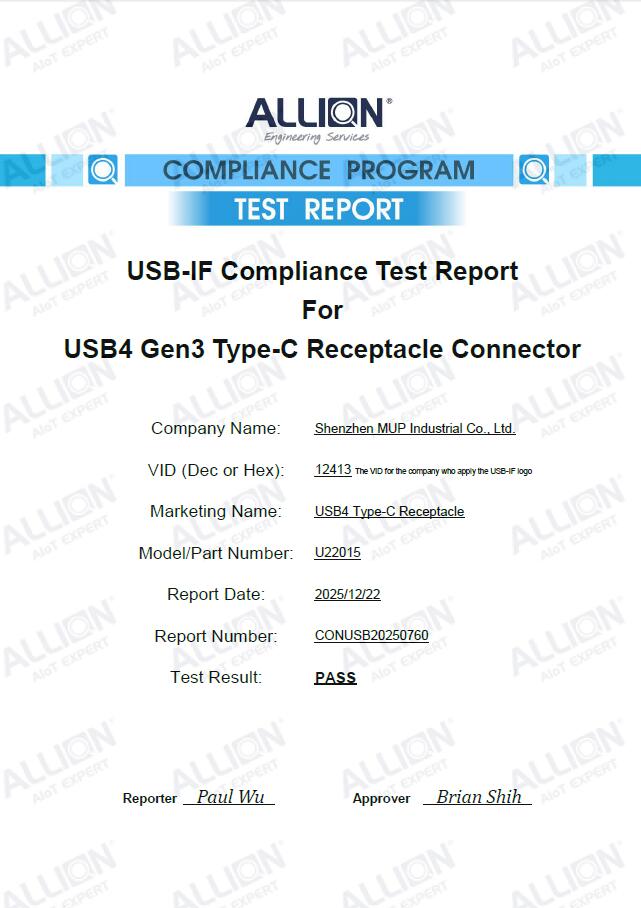
MUP USB Connector provides a useful example of how evidence can be read. A USB-IF Compliance Test Report for the USB4 Gen3 Type-C Receptacle Connector, model U22015, carries report number CONUSB20250760, was issued by ALLION, applies standard EN/SASO IEC 62680-1-3, shows a PASS result, and is dated 2025-12-22. Separately, an EN/SASO IEC 62680-1-3 test report for the USB Type-C Mid-mount Dual-Row SMT Receptacle, model U22008, carries report number 26T04N001082-001-COM and was issued by SAICT. These are product-level documents tied to specific models, not general marketing claims.
Management system evidence sits at a different level. MUP holds ISO 9001 certificate 78926Q00057R000, issued by Huaxin International Certifier & Testing Group (Shenzhen) Co., Ltd., against GB/T 19001-2016/ISO 9001:2015, valid from 2026-08-13 to 2029-08-12. The company also reports ISO 14001, ISO 45001, IATF 16949, IECQ QC 080000, and RBA certification. For an automotive or industrial buyer, IATF 16949 and IECQ QC 080000 are relevant system controls, but they still do not replace a part-level electrical and mechanical qualification file.
Technical Explanation: The Datasheet Is a Constraint Document
A USB-C datasheet should be read as a set of boundaries, not as a feature list. The MUP USB-C product specification lists a rated voltage of 50 V max and a rated current range of 1 A max and 10 μA min. It lists an operating temperature range of -40°C to 85°C, a storage temperature range of -20°C to 35°C, an operating humidity range of 10% to 95% RH, and a storage humidity range of 10% to 75% RH. Durability is listed at 10,000/15,000 cycles for the USB-C family. Materials include plastic, metal, nylon, high-conductivity copper, SS301, and SS304; the housing can use high-temperature plastic, the shell stainless steel, and the contacts copper alloy with gold plating.
Those values are useful only when matched to the application. A USB-C female socket in a payment terminal may be evaluated for daily plug cycles, dust and moisture exposure, and contact stability. A USB-C connector for a hub or docking station may be evaluated for 24-pin full-featured signal integrity, USB4.0 Type-C or Thunderbolt 5 high-speed connector requirements, and PCB layout. A waterproof USB C connector in an outdoor or industrial enclosure may be evaluated for sealing method, housing compression, and test conditions. The same family name does not remove these differences.
High-power charging adds another boundary. USB Power Delivery Extended Power Range supports delivery of up to 240 W, and USB Type-C connectors and cables used for high-power charging are specified in a 5 A current class. A TYPE C 5A or USBC 5A design should therefore be matched to a connector rated and tested for that class. A buyer should not assume that a general-purpose USB-C charging connector with a 1 A max published rating is qualified for a 5 A system. The correct action is to request the part-level current rating, temperature rise data where available, and the applicable test report.
16-Pin vs 24-Pin, Top-Mount vs Mid-Mount: Where Specifications Diverge
Full-featured USB Type-C uses 24 contacts. Reduced-pin variants, often described as 16-pin USB-C connectors, populate a subset of those contacts and are commonly used in charging-focused or cost-sensitive designs. That difference is not cosmetic. A 24-pin USB-C connector is the starting point for full-featured data, display, and high-speed USB4.0 Type-C or USB Thunderbolt designs. A 16-pin USB C connector may be appropriate for a charging-only port, a simple peripheral, or a device where the full contact set is not needed, but it should not be expected to deliver the same signal capabilities without part-level verification.
Mechanical format creates a second split. MUP's USB-C range includes top-mount USB receptacles, USB-C mid-mount connectors, flag-type USB-C, SMT USB-C receptacles, female/male USB connectors, and USB plug connectors, including 16-pin and 24-pin variants. A USB C top-mount connector sits in one PCB envelope; a USB C mid-mount connector uses a different cutout and assembly sequence. A waterproof USB Type-C connector adds sealing features that can change housing height, mating force, and panel design. Buyers should treat the mechanical drawing as a qualification document, not as a secondary attachment.
How MUP USB Connector Addresses the Constraint Stack
Shenzhen MUP Industrial Co., Ltd. (MUP USB Connector) is a Shenzhen-based manufacturer of precision connectors and cable assemblies, founded in 2003. The company operates a 50,000 m² manufacturing footprint with 600 employees, including more than 150 R&D and technical staff, and reports 137 patents. Its engineering team applies stress analysis, mold flow analysis, and high-frequency simulation, which are relevant to USB-C contact design, high-speed signal integrity, and mechanical reliability. The company reports more than 300 automated production lines and a daily capacity exceeding 5KK pieces.
For buyers building an approved vendor list, the relevant point is not the size claim alone. It is whether the supplier can connect the constraint stack to evidence. MUP's documentation includes the USB-IF Compliance Test Report for U22015 and the IEC 62680-1-3 test report for U22008, as well as ISO 9001, IATF 16949, ISO 14001, ISO 45001, IECQ QC 080000, and RBA system certifications. The company also reports USB-IF VID and TID numbers and states that its products have passed USB4.0, IEC62680, and Thunderbolt TBT5 certifications. These claims should still be matched to the exact part number and application.
Commercial terms also belong in the evaluation. MUP supports OEM/ODM customization from mold development to final assembly, with in-house mold design and manufacturing. Standard products ship on carrier tape reels, with MOQ per reel varying by model and packaging, typically 1K-5K PCS per reel; small-batch R&D sampling is supported. In-stock items can ship within 3-7 days, while mass production is typically 15-25 days depending on order and process. Quality control includes 100% full inspection or AQL sampling before shipment, and after-sales support includes a 1-year warranty for non-human-caused defects.
Price Bands: Why the Cheapest Quote Often Fails the Constraint Check
USB-C connector price bands are not driven by the interface name. They are driven by pin count, mounting style, contact plating, housing material, sealing requirement, test evidence, packaging, MOQ, and lead time. A 16-pin charging connector and a 24-pin USB4.0 Type-C receptacle can sit in different cost bands because they carry different tooling, inspection, and test burdens. A waterproof USB-C connector can sit in a higher band again because sealing features and leak testing add process steps.
This is why a low unit price should not be the first filter. A quote that omits product-level test reports, uses a reduced pin count without disclosure, or assumes a lower current rating may look cheaper at the line-item level but create qualification cost later. A better comparison fixes the specification first: pin count, top-mount or mid-mount, rated voltage and current, durability, operating temperature, humidity, sealing target, RoHS/REACH documentation, packaging, and annual demand. Only then should the buyer compare price bands and lead times.
Procurement rule: compare USB-C connectors only after the part number, drawing, test report scope, and application current are fixed. A price without those constraints is not a comparable price.
Where USB Type-C Constraints Bite: Application Scenarios
In financial payment terminals and mobile POS devices, the USB-C port is often a daily-use charging and data interface. The relevant constraints are durability, contact stability, dust and moisture resistance, and consistent insertion force. A USB C female connector used in a payment terminal should be evaluated against the actual plug cycles and cleaning regime, not only the catalog cycle rating.
In smart meters, IoT terminals, and industrial control panels, operating temperature and humidity can matter more than data rate. A connector rated for -40°C to 85°C operation and 10% to 95% RH may be appropriate, but the enclosure sealing and PCB coating strategy also affect field reliability. Waterproof USB Type-C designs may target IPX7 or IPX8, but the test condition and sealing method should be documented.
In consumer electronics, notebooks, hubs, and docking stations, the constraint stack shifts toward signal integrity and mechanical density. A USB connector for hub designs may need a 24-pin USB-C receptacle, USB4.0 Type-C support, and a mid-mount or top-mount profile that fits the enclosure. A Thunderbolt 5 high-speed connector requirement raises the bar for impedance control, crosstalk, and test evidence. The same buyer may use a 16-pin USB-C charging connector on one product and a 24-pin high-speed receptacle on another; those should be separate qualification files.
In automotive and industrial electronics, the system context adds vibration, thermal cycling, and change-control requirements. IATF 16949 and IECQ QC 080000 are relevant system credentials, but the buyer should still request the part-level drawing, material declaration, and test summary. MUP's application record includes payment terminals, smart meters, consumer electronics, IoT, security surveillance, industrial equipment, and new-energy vehicle applications, which is useful context for evaluating whether the supplier has seen similar constraint profiles.
Comparison with Traditional Solutions: Where USB-C Is Not Automatically the Best Fit
USB-C is not automatically the lowest-cost or simplest interface for every device. A charging-only product can use a 16-pin USB-C connector, but it may still need configuration-channel logic, tighter mechanical tolerances, and compliance documentation. A waterproof USB-C connector adds sealing and test cost. A high-speed 24-pin USB4.0 Type-C receptacle adds signal-integrity engineering and test burden. For a legacy product outside the EU mandate, a USB Type-A connector can be simpler and cheaper, even though it lacks reversibility and the same power-delivery ecosystem.
This is a real boundary, not a criticism of USB-C. The correct decision is to match the interface to the product obligation and user scenario. If the device must comply with the EU common charger rules, USB-C is the reference interface. If the device needs USB4 or Thunderbolt 5 data rates, a full-featured 24-pin design is the appropriate starting point. If the device only needs a compact charging port and is not in a regulated category, a reduced-pin USB-C or a traditional USB-A connector may be commercially rational. MUP's portfolio includes both USB Type-C and USB Type-A connector families, which reflects that interface choice is a design and compliance decision, not a universal replacement rule.
Market Trend Analysis: Regulation, Speed Tiers, and Supply Concentration
Three trends shape the USB-C connector market. First, regulation is locking the interface into defined device categories. The EU common charger directive is the clearest example, with application from 28 December 2024 and laptop coverage from 28 April 2026. Second, performance tiers are widening. USB4 Version 2.0 supports up to 80 Gbps, while Thunderbolt 5 is stated by Intel at 80 Gbps bidirectional baseline with Bandwidth Boost up to 120 Gbps. Those speeds create a premium tier for high-speed USB-C connectors and cables, while charging-only devices continue to pressure the cost tier.
Third, supply remains concentrated at the top. Commercial research cited by Future Market Insights indicates that TE Connectivity, Amphenol, and Molex collectively hold approximately 45% of the USB Type-C connector market share in 2025. Market Research Future estimates the global USB Type-C market at USD 38.96 billion in 2024 and USD 48.33 billion in 2025. These are commercial research estimates, not audited customs data, but they support a practical conclusion: qualified mid-tier and specialist suppliers remain relevant because buyers need alternatives that can document constraints without defaulting to the largest brands.
Future Outlook
The next procurement cycle will likely be defined by document quality rather than catalog breadth. EU-bound products will need USB-C conformity evidence. High-speed products will need USB4.0 Type-C or Thunderbolt 5 high-speed connector qualification. Waterproof and industrial products will need sealing and environmental test records. Charging-only products will continue to optimize 16-pin USB-C and USB charge connector cost. In each case, the buyer should maintain a part-level approved vendor list with report numbers, standard editions, model names, and revision dates.
Standards monitoring also matters. IEC 62680-1-3:2024 is the current reference used in this article, but buyers should confirm the applicable edition at the time of contract. The USB-IF specification and USB Power Delivery rules continue to evolve. A supplier that can produce model-specific reports, traceable materials, and change notifications is better positioned than one that offers only a generic USB-C compliance statement.
FAQ
Q1. Which certifications should a USB Type-C connector supplier provide for EU market access?
A supplier should provide product-level test evidence against the applicable USB Type-C standard, such as EN/SASO IEC 62680-1-3, plus RoHS and REACH documentation for the exact part number. Management system certificates such as ISO 9001 and IATF 16949 support process control but do not replace product test reports. The report should name the model, laboratory, standard, date, and result. MUP's documentation, for example, includes a USB-IF Compliance Test Report for model U22015 under report number CONUSB20250760 and an IEC 62680-1-3 test report for model U22008 under report number 26T04N001082-001-COM.
Q2. How do 16-pin and 24-pin USB Type-C connectors differ in procurement?
A full-featured USB Type-C connector uses 24 contacts. A 16-pin USB-C connector is a reduced variant that populates a subset of contacts and is typically aimed at charging-focused or space-constrained designs. The 24-pin version is the safer starting point for USB4.0 Type-C, Thunderbolt, display, and high-speed hub applications. The 16-pin version can be appropriate for charging-only products, but the buyer should verify the rated current, data capability, and test report for the exact part number rather than assuming family-level performance.
Q3. What environmental parameters should be checked on a USB-C datasheet?
Check operating temperature, storage temperature, operating humidity, storage humidity, durability, and sealing target. MUP USB-C documentation lists -40°C to 85°C operating, -20°C to 35°C storage, 10% to 95% RH operating, 10% to 75% RH storage, and 10,000/15,000 cycles for the USB-C family. If the application requires a waterproof USB-C connector, confirm whether the target is IPX7 or IPX8 and request the test condition, because sealing method and housing design affect both cost and mating geometry.
Q4. How should SMT assembly and reflow be controlled for USB-C receptacles?
SMD USB Type-C connectors are assembled with SMT reflow soldering. The peak temperature should not exceed 260°C, and the process should follow the preheat, soak, reflow, and cooling stages defined in the datasheet. Placement pressure should not be excessive, because it can deform terminals. After cooling, inspect solder joints with AOI and visual checks for cold joints and bridging, and verify coplanarity. Do not bend or pry the connector housing after soldering.
Q5. What causes poor contact after SMT assembly, and how is it isolated?
Poor contact after SMT assembly usually traces to cold solder joints, terminal deformation, or poor coplanarity. The isolation sequence is to inspect solder joints under magnification, measure terminal coplanarity, verify placement pressure and the reflow temperature record, and then replace the connector on defective samples and re-solder for verification. If the defect follows the connector, the part number and production lot should be reviewed with the supplier.
Reference: MUP Profile E 261009 (PDF).
¿Tiene preguntas o necesita más detalles?
Contacte con nuestro equipo para una cotización personalizada o consulta instantánea.
Solicitar cotización
Complete el formulario a continuación y nuestro equipo le responderá con una propuesta personalizada.
Chat directo de WhatsApp
¿Prefiere chatear en tiempo real? Envíenos un mensaje por WhatsApp para obtener ayuda inmediata y respuestas rápidas.
- Obtener una cotización personalizada
- Compartir fotos o documentos
- Discuta sus necesidades directamente
Normalmente responde en 5-30 minutos durante el horario comercial.