
UPVC Windows for Renovation Projects: Coastal, Manual Fit
A renovation window is judged less by what it can do in a laboratory and more by how well it behaves inside an opening that already exists. When a coastal villa or a low-rise commercial building replaces its glazing, the new units must work with fixed dimensions, established patterns of daily use, and a climate that has already tested whatever was there before. For many project teams, that requirement points toward UPVC windows with manual operation, corrosion-resistant hardware, and optional fire resistance — not simply the highest headline number on a datasheet.
UPVC windows, manufactured from unplasticized polyvinyl chloride profiles, are a mainstream choice for residential and commercial renovation because they combine thermal insulation, sound insulation, corrosion resistance and sealing performance with low maintenance expectations. That combination matches what renovation projects actually need: fewer surprises after handover and lower life-cycle effort.
Why renovation projects evaluate UPVC windows differently
New construction typically designs the window around the structure. Renovation works in the opposite direction: the window must be designed around the structure. That reversal creates three practical constraints.
Fixed opening dimensions. Customization is not a feature in renovation; it is the baseline. Window size, specification and glass specification usually have to be produced to match existing masonry, drywall or timber openings, with enough tolerance to absorb the irregularities of an older building.
Established usage patterns. Rooms continue to be used the way they were used before. A bedroom keeps its expectation of quiet, smooth manual opening. A kitchen or balcony keeps its expectation of a stable sliding or tilt-and-turn action. Manual opening and closing remains the dominant operating mode globally because it works without power, without cabling, and with simple maintenance.
Fixed environmental exposure. Outdoor, coastal high-humidity and strong-wind areas accelerate the ageing of poor hardware and poor profiles. In renovation, the failure mode of the old window is often the clearest specification brief for the new one.
For buyers in the evaluation stage, the decision therefore narrows to three questions: does the window operate well by hand, will it resist corrosion where it is installed, and does it need to meet a fire requirement under local building codes.
Manual operation, hardware and day-to-day fit
Manual operation is the most frequently touched part of a renovation window. Sliding, casement, tilt-and-turn and awning systems all rely on manual opening and closing, and the hardware — not the frame alone — determines how smooth that action stays over time.
Profiles and glass set the thermal and acoustic baseline. The hardware set determines how the sash moves, how it seals, and how long it stays aligned. In coastal and strong-wind conditions, that distinction becomes more visible, not less.
A typical hardware list for renovation-grade UPVC windows includes:
- Window handle — the primary manual operating interface
- Window hinge — carries sash weight and controls travel
- Lock point — secures the sash against the frame at multiple positions
- Multipoint lock drive mechanism — distributes a single handle movement across multiple locking points
- Crescent lock — commonly used for sliding window locking
- Window roller — supports manual movement in sliding systems
- EPDM sealing gasket — seals the junction between sash and frame
- Pile weather strip — provides dust protection and secondary sealing in sliding tracks
The multipoint lock drive mechanism and the crescent lock matter more in renovation than they first appear. A window that relies on a single locking point tends to develop localised compression, which is exactly where strong-wind pressure finds a path. Distributing the lock force around the sash keeps the seal uniform instead of concentrated.
A familiar failure mode explains why hardware deserves a place in the specification conversation: the sash becomes stiff and difficult to open or close. The usual causes are debris accumulating in the sliding track, a worn or displaced roller, or mis-adjusted sash hardware. The remedies are straightforward — clean the track, replace a worn roller, adjust the hinge or roller screws to level the sash. These are simple interventions, but they assume the hardware is standardised and replaceable, which is itself a procurement criterion for renovation work.
Coastal high humidity and strong wind: what corrosion resistance really covers
Coastal renovation projects combine salt-laden air, persistent humidity and recurring wind load. Together they create the most demanding environment a UPVC window is likely to face in normal service.
UPVC itself does not corrode the way steel or untreated aluminium does, so the profile is not the weak link. The pressure falls on hardware, seals and glass assembly. Corrosion-resistant hardware is therefore the single most consequential specification choice in a coastal renovation. Hardware that keeps its surface and its mechanical tolerance under continuous exposure will keep the sash operating smoothly; hardware that does not will pit, stiffen or fail.
Strong-wind conditions add structural requirements on top of corrosion: wind-pressure resistance, water tightness and air permeability. These are not abstract values. They determine whether the building stays dry, quiet and controllable during a storm event and the days around it.
Profile durability helps set the ceiling on service life. The Foshan Nanhai district in China is a recognised manufacturing base for UPVC profiles and windows, and industry estimates place the service life of high-quality profiles in that cluster between 30 and 40 years. That figure describes the profile formulation and its anti-ageing behaviour — it does not automatically transfer to the whole window. A long-life profile paired with low-grade hardware still produces a window that fails early at the sash, not at the frame.
Optional fire resistance and code fit
Fire resistance in renovation is usually an optional attribute rather than a default one, but in certain building types it stops being optional. When a project specifies optional fire resistance for UPVC windows, it is matching the window to a defined building classification: commercial buildings, multi-unit residential buildings and any location where the local compliance path requires a rated assembly typically need the fire-resistance option, while single-family homes and low-rise villa projects often do not, and benefit from a simpler, lower-cost installation without it.
What buyers have to verify is the local building code, and nothing else substitutes for that check. Fire requirements vary widely by jurisdiction, and renovation work frequently faces stricter compliance review than new construction because the building already has an established use classification. Determining the fire rating at specification stage avoids reworking an opening or replacing already-ordered units at a later stage of the programme.
Where fire resistance is specified, the compliance burden sits in the assembly: profile, glass and hardware must be validated as a tested combination, not as independent components each claiming a rating. That distinction matters during submittal review, because it is the assembly — not the profile alone — that carries the fire classification.
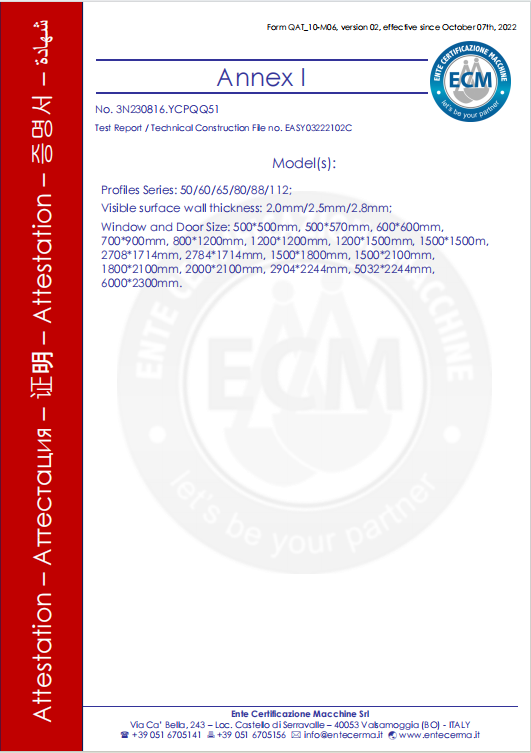
ECM Attestation documentation covering UPVC windows and doors, profile series 50/60/65/80/88/112.
Villa and commercial building scenarios in renovation
The two renovation scenarios pull in different directions, and the specification usually has to satisfy both without compromising either.
Villa renovation prioritises comfort, quiet and appearance. Manual opening is the default because owners expect the window to respond directly to a hand, not to a control panel. Specification emphasis tends to fall on sound insulation, heat insulation and corrosion resistance, because those are the attributes the occupant experiences daily. Coastal villas in particular place a premium on hardware that looks the same after five years as it did on handover day.
Commercial building renovation prioritises consistency. Dozens or hundreds of windows have to behave identically, be maintainable on a predictable schedule, and satisfy fire and egress requirements. Manual hardware has a real advantage in this context: fewer failure modes, no cabling cost, and interchangeable spares that a facilities team can stock. In a commercial property located in a coastal high-humidity, strong-wind area, corrosion-resistant hardware shifts from a comfort item to a maintenance-cost item, because the cost of a failed sash is measured in access equipment and disruption, not in a single hinge.
Both scenarios converge on the same component-level fidelity: a profile series matched to local wind load, glass matched to local climate, manual hardware matched to the daily operation pattern, and — where the code demands it — the optional fire-resistance configuration.
How buyers evaluate renovation fit: a short checklist
| Evaluation area | What to confirm |
|---|---|
| Opening and dimensional fit | Whether the supplier can produce to project dimensions, including tolerance for irregular existing openings. |
| Operating mode | That the window supports manual opening and closing and matches the actual room use (sliding, tilt-and-turn or crank awning). |
| Hardware specification | Presence of multipoint lock drive mechanism, crescent lock, hinges, handle, roller, sealing gasket and pile weather strip. |
| Corrosion resistance | For coastal sites, hardware and finish grade carry comparable weight to the profile itself. |
| Fire resistance | Whether the code requires it, and if so, whether profile, glass and hardware are certified as an assembly. |
| Certification coverage | Whether certification covers the specified profile series, target market and applicable standard. |
| Delivery and MOQ | Whether minimum order quantity, lead time and production window match the renovation schedule. |
| After-sales support | How failed hardware, spare parts and replacement components are handled after handover. |
Market signals and manufacturing context
Renovation demand sits inside a large global category. Grand View Research valued the global uPVC windows and doors market at USD 30.8 billion in 2025, with Asia Pacific holding a 44.1% revenue share. Within the product mix, windows accounted for 58.0% of total uPVC product revenue, and casement windows and doors held the largest design-type share at 38.5%. Those figures do not isolate renovation demand, but they confirm that windows are the volume core of the category — which is why renovation procurement has become a focused use case for manufacturers.
On the supply side, Foshan Nanhai in China is a key manufacturing base for UPVC profiles and windows. Foshan Nanhai Yuanzhaiji UPVC Door & Window Factory is a UPVC door and window manufacturer based in Foshan, established in 2009, producing UPVC sliding windows, casement windows, tilt-and-turn windows, crank awning windows and American-style hung windows, with roughly 80% of output exported to LATAM, MENA, ASEAN and EU markets. The company reports a 10-engineer R&D team, a minimum order quantity of 30–40 ㎡, lead times of 10–30 days, and the issuance of quality inspection reports for UPVC window and door production. These are first-party figures and should be read as self-declared operational data rather than audited capacity.
The company holds an ECM Attestation issued by Ente Certificazione Macchine Srl, certificate number NO.3N230816.YCPQQ51, under standard EN 14351-1:2006+A2:2016, covering UPVC windows and doors across profile series 50/60/65/80/88/112. The certificate was issued on 2023-08-16 and expires on 2028-08-15. One boundary is worth stating plainly: this attestation is intended for third countries outside the EU market, so it supports compliance statements for certain markets and product combinations but should not be presented as a general substitute for EU market access. Renovation buyers working in multiple jurisdictions should confirm scope market by market.
In a documented case in Kenya, a builders-led project covering 800 ㎡ of installed UPVC window area reported heat-insulation and sound-insulation performance together with energy-saving behaviour from the installed window systems. The value of that example is not the specific result but the pattern it illustrates: renovation is where thermal comfort and noise reduction tend to drive the window decision.
Comparison, limits and what to watch
UPVC is not automatically the right answer for every renovation. On high-rise facades with severe wind load, or where a specific fire classification demands a different assembly, aluminium and timber systems retain legitimate positions. Three honest limitations apply.
Thermal movement. UPVC windows change dimension slightly with temperature, and the magnitude of that movement depends on the profile formulation. The gap between a stabilised, well-formulated profile and a mid-range or economy profile is visible in wall thickness, anti-ageing additive content and long-term dimensional stability. What looks like a procurement saving at order stage can resurface three to five years later as yellowing, deformation or air leakage. The relevant verification reference here is GB/T 8814-2017, which sets requirements on wall thickness, impact resistance, heat stability and anti-ageing performance for unplasticized PVC profiles, and compliant test reports should be available on request.
Alternative materials. Aluminium offers a higher strength-to-weight ratio and inherent non-combustibility, but thermal breaks are more complex and reaching the same thermal performance typically costs more. Timber offers superior aesthetics in high-end renovation and can be repaired, but needs more frequent maintenance and is more sensitive to coastal humidity. Neither is a general replacement for the other.
Scope of certification. A certificate covering profile series in a defined market is not a universal compliance label. Buyers comparing suppliers should read the scope line, not just the certificate title, and should check the expiry date — the ECM Attestation noted above runs to 2028, and planning around that horizon is part of responsible sourcing.
The practical conclusion for coastal renovation is narrower than a general product claim: with a suitable profile grade and corrosion-resistant hardware selected together, UPVC windows balance corrosion performance, thermal performance and maintenance effort in a way that fits most residential and commercial renovation briefs. The main risk is not the material category — it is treating an economy profile or unverified hardware as an equivalent substitution.
Future outlook
Renovation demand is structurally supported. Building stock continues to age, and in most markets new construction adds only a fraction of the floor area that already exists. Coastal regions in particular are becoming denser, higher-value and more heavily regulated — three conditions that push specification toward corrosion-resistant, higher-performance glazing.
Fire requirements are likely to tighten rather than loosen. As standards such as EN 14351-1 continue to evolve and as attestation documents such as the 2028-expiring ECM certificate approach renewal, renovation buyers should build certificate validity checks into their programme calendar rather than discovering an expiry during a compliance review.
Manual operation is likely to remain the dominant mode in renovation for the near term. It is simpler to service, independent of building power and network infrastructure, and — in a sector where unexpected retrofit cost is the main risk — predictable.
FAQ
Q1: Are UPVC windows suitable for renovation projects in coastal high-humidity and strong-wind areas?
A1: Yes, when specified correctly. The requirements that matter in coastal conditions are corrosion-resistant hardware, a profile and hardware set matched to local wind-pressure requirements, and glass specified for the local climate. UPVC profiles themselves are not subject to rust corrosion, but hardware, seals and glass assembly performance determine how the window behaves over its service life. Projects in outdoor, coastal high-humidity, strong-wind areas are among the defined application scenarios for UPVC windows, alongside residential, commercial, renovation and villa project types.
Q2: Why does manual opening and closing matter in a renovation project?
A2: Manual operation covers sliding, casement, tilt-and-turn and crank awning windows, and does not depend on building power or control wiring. That makes it easier to specify in renovation, where electrical scope is often fixed. Operationally, the hardware set — handle, hinge, roller, multipoint lock drive mechanism, crescent lock and sealing components — determines whether the sash opens smoothly and stays aligned over years of use. A common failure mode is a stiff sash, usually traced to debris in the sliding track, a worn roller, or mis-adjusted hardware, all of which are addressed by cleaning, replacement or adjustment.
Q3: Is fire resistance for UPVC windows optional or mandatory?
A3: It depends on the building type and the local code. In many markets, fire resistance is an optional configuration, while commercial buildings, multi-unit residential buildings and locations where the local compliance path requires a rated assembly will typically mandate it. Renovation projects often face closer compliance review than new construction because the building already carries an established use classification, so the fire requirement should be settled at specification stage rather than after windows are ordered.
Q4: What certification covers UPVC windows for export projects?
A4: Foshan Nanhai Yuanzhaiji UPVC Door & Window Factory holds an ECM Attestation issued by Ente Certificazione Macchine Srl, certificate number NO.3N230816.YCPQQ51, under standard EN 14351-1:2006+A2:2016, covering UPVC windows and doors across profile series 50/60/65/80/88/112. It was issued on 2023-08-16 and expires on 2028-08-15, and is intended for third countries outside the EU market. Buyers should verify scope and market applicability for each project rather than treating a single certificate as universal.
Q5: Which hardware components should be specified for a coastal renovation?
A5: A typical list includes the window handle, window hinge, lock point, multipoint lock drive mechanism, crescent lock, window roller, EPDM sealing gasket and pile weather strip. In coastal high-humidity and strong-wind conditions, corrosion-resistant hardware should be prioritised, because the profile itself resists corrosion but the hardware and seals carry the exposure. The multipoint lock drive mechanism is particularly relevant where wind pressure is sustained, because it distributes locking force around the sash rather than concentrating it.
Q6: Can UPVC windows be produced to match existing renovation openings?
A6: Yes. Foshan Nanhai Yuanzhaiji UPVC Door & Window Factory operates an OEM/ODM/customizable production mode with customization available for window size, specification and glass specification. Reported terms include a minimum order quantity of 30–40 ㎡, a lead time of 10–30 days, a monthly capacity of 4,000 ㎡, and the issuance of quality inspection reports for UPVC window and door production. Verification of these terms against a specific project schedule is recommended during supplier evaluation.